Reach
How to Get YouTube Videos Cited in AI Search (2026 Data)
To get your YouTube videos cited in AI search, make one video per buyer question, title it with that question, answer it in the first minute and name your brand in the title and description. Views and subscribers don't matter: the typical top-cited video has 1,790 views.

YouTube is now one of the biggest sources in Google's AI answers. In November 2026, 4 in 10 Google AI Overviews cited a YouTube video, up from 3 in 10 in September. ChatGPT, by contrast, cites a video in 1% to 2% of its answers, so this is a Google AI play.
The gap is wide open. Brands' own channels account for 1.4% of the citations to top videos on their own category's prompts, while independent creators take most of the rest. A brand that publishes the comparison video for its own category is competing with small reviewers, not with its rivals.
I've spent the last three months testing this at Reach AI: analyzing 1.6 million AI answers and 508,648 YouTube citations, and running six YouTube channels of our own, where 57 videos have been cited 513 times so far. This guide is the playbook that came out of it, with the numbers behind each step.
Key Takeaways
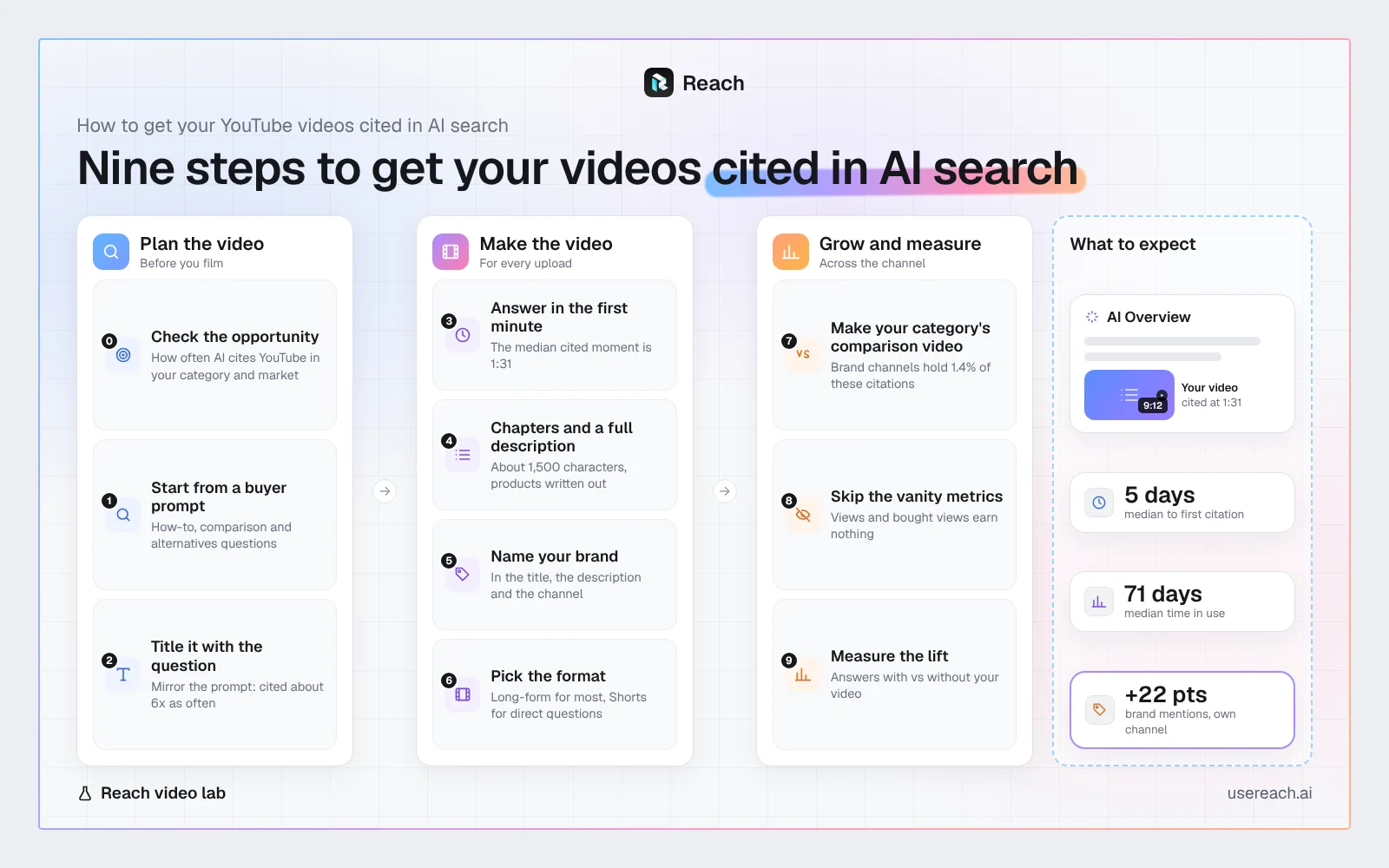
- Where it works: Google AI Overviews (about 40% of answers cite YouTube) and AI Mode (about a third at its normal level). ChatGPT almost never cites a video.
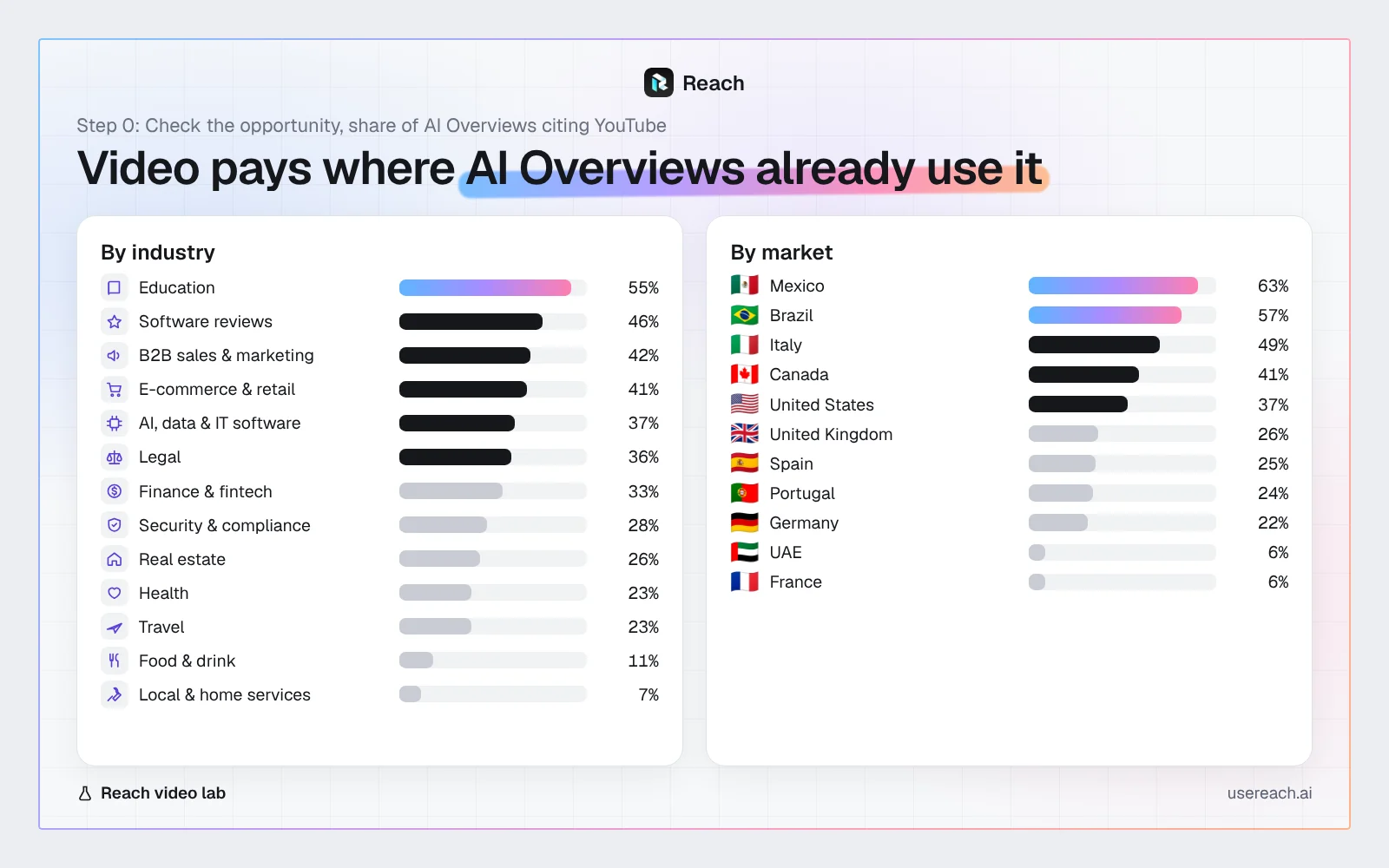
- Check before you invest: YouTube is in 55% of AI Overviews in education and 42% in B2B sales and marketing software, but 7% in local services. Mexico and Brazil are at about 6 in 10, France at 6%.
- Which questions to target: how-to (53% of AI Overviews cite a video) and comparisons (40%). Every video needs a real buyer prompt behind it: videos with no matching question were never cited.
- How to title it: a title carrying two thirds of the prompt's keywords is cited about six times as consistently as one that shares none.
- Where to put the answer: in the first minute. Half of Google's YouTube citations link to a moment, and the median cited moment is 1:31.
- How to make it move the answer: brands in a cited video's title are mentioned 12.9 points more often, brands in the description 10.5 points, and a brand's own channel 22 points.
- Format: long-form of 6 to 13 minutes for most questions, and Shorts for single direct questions, where their share of citations has grown fast. Live streams and promotional Shorts almost never get cited.
- What to expect: a median of 5 days from upload to first citation, then about 71 days of use.
- What doesn't matter: views, likes and subscribers. Paid views didn't produce citations either.
How to Get YouTube Videos Cited in AI Search at a Glance
| Step | What to do | What the data shows |
|---|---|---|
| 0. Check the opportunity | Measure how often AI answers in your category and market cite YouTube | 7% to 55% of AI Overviews, depending on the industry |
| 1. Pick the prompts | Choose how-to, comparison and alternatives questions your buyers ask | 53% of how-to and 40% of comparison AI Overviews cite a video |
| 2. Title it with the question | Mirror the prompt's words: "Best X in 2026", "X vs Y", "How to" | About 6x more consistent citations |
| 3. Answer in the first minute | Put the direct answer up front | 41% of timestamped citations point to the first minute |
| 4. Add chapters and a full description | About 1,500 characters, timestamps, product names written out | Brands in the description gain 10.5 points |
| 5. Name your brand | In the title, the description and on your own channel | +12.9 points in the title, +22 on your own channel |
| 6. Pick the format | Long-form for most questions, Shorts for direct ones | Shorts went from 8.5% to 13.3% of AI Overviews' YouTube citations |
| 7. Make your category's comparison video | Cover "best X" and "X vs Y" for your own category | Brands' own channels take 1.4% of those citations |
| 8. Skip the vanity metrics | Don't chase views or buy them | Views correlate with citations at 0.02 |
| 9. Measure the lift | Compare answers with and without your video | Brands named in 59% of answers with our videos vs 35% without |
Why YouTube Matters in AI Search Now
Google's AI answers lean on YouTube more every month. Across 1.6 million answers between September 1 and November 24, 2026, the share of AI Overviews citing at least one video went from about 3 in 10 to 4 in 10, and YouTube's share of all AI Overview citations rose from 7% to 10% to between 10% and 12%.
| Week of | AI Overviews | AI Mode | ChatGPT |
|---|---|---|---|
| August 31 | 32.3% | 33.7% | 1.6% |
| September 28 | 24.2% | 11.7% | 1.0% |
| October 19 | 35.1% | 12.0% | 1.2% |
| November 2 | 41.4% | 7.0% | 0.5% |
| November 16 | 39.5% | 25.3% | 1.9% |
Two things to keep in mind when you read that table:
- AI Mode's dip isn't real. From mid-September, Google's AI Mode reported far fewer citations across every source, then jumped back from November 16. That's a reporting change on Google's side. About a third of answers citing YouTube is the normal AI Mode level.
- ChatGPT barely uses YouTube. It cites a video in 1% to 2% of answers, and half of its YouTube links now point to channel pages rather than videos. If ChatGPT is where your buyers research, written pages, listicles and Reddit are the levers there.
The practical consequence: a YouTube strategy is a Google AI strategy. Plan it around AI Overviews and AI Mode, and measure it there.
Step 0: Check If YouTube Is Worth It in Your Category
Before you make a single video, check how often AI answers in your category, market and question types cite YouTube. The same tactic is worth about five times more in one industry than in another.
By industry
YouTube is a core source in education, software and e-commerce, where it appears in 4 to 5 of every 10 AI Overviews. In food and local services, written sources and directories decide the answer.
| Industry | AI Overviews citing YouTube | AI Mode |
|---|---|---|
| Education (language learning, edtech) | 55% | 28% |
| Software reviews | 46% | 32% |
| B2B sales and marketing software | 42% | 21% |
| E-commerce and retail | 41% | 21% |
| AI, data and IT software | 37% | 18% |
| Legal | 36% | 18% |
| Finance and fintech | 33% | 12% |
| Security and compliance | 28% | 9% |
| Real estate | 26% | 9% |
| Health | 23% | 6% |
| Travel | 23% | 7% |
| Food and drink | 11% | 4% |
| Local and home services | 7% | 4% |
By market
Latin America is YouTube-first: about 6 in 10 AI Overviews in Mexico and Brazil cite a video. Europe sits below the US, and France and the Gulf are close to zero.
| Market | AI Overviews citing YouTube | AI Mode |
|---|---|---|
| Mexico | 63% | 40% |
| Brazil | 57% | 37% |
| Italy | 49% | 12% |
| Canada | 41% | 24% |
| United States | 37% | 17% |
| United Kingdom | 26% | 12% |
| Spain | 25% | 10% |
| Portugal | 24% | 7% |
| Germany | 22% | 6% |
| UAE | 6% | 1% |
| France | 6% | 3% |
Mexico, Brazil, Italy and the smaller markets rest on one to three accounts each, so treat them as directional.
By question type
One in two how-to answers in AI Overviews cites a video, and comparisons come next. "Best X" lists and pricing questions lean on written pages.
| Question type | AI Overviews | AI Mode |
|---|---|---|
| How-to ("how do I", "set up", "tutorial") | 53% | 22% |
| Comparison / alternatives ("X vs Y", "alternatives to X") | 40% | 20% |
| Review / is it worth it | 37% | 17% |
| What / why | 29% | 11% |
| Best / recommend ("best X for Y") | 29% | 15% |
| Pricing | 26% | 11% |
In Reach AI, we measure YouTube coverage for every prompt an account tracks. If your category sits above 30%, video is one of the cheapest ways into Google's AI answers right now. If it's under 10%, put the effort into written pages first.
How AI Picks Which YouTube Video to Cite
AI engines pick the video that answers the question, not the most popular one. That's the single most important thing to understand before you plan a channel, and every dataset we looked at agrees on it.
Views, likes and subscribers don't predict citations
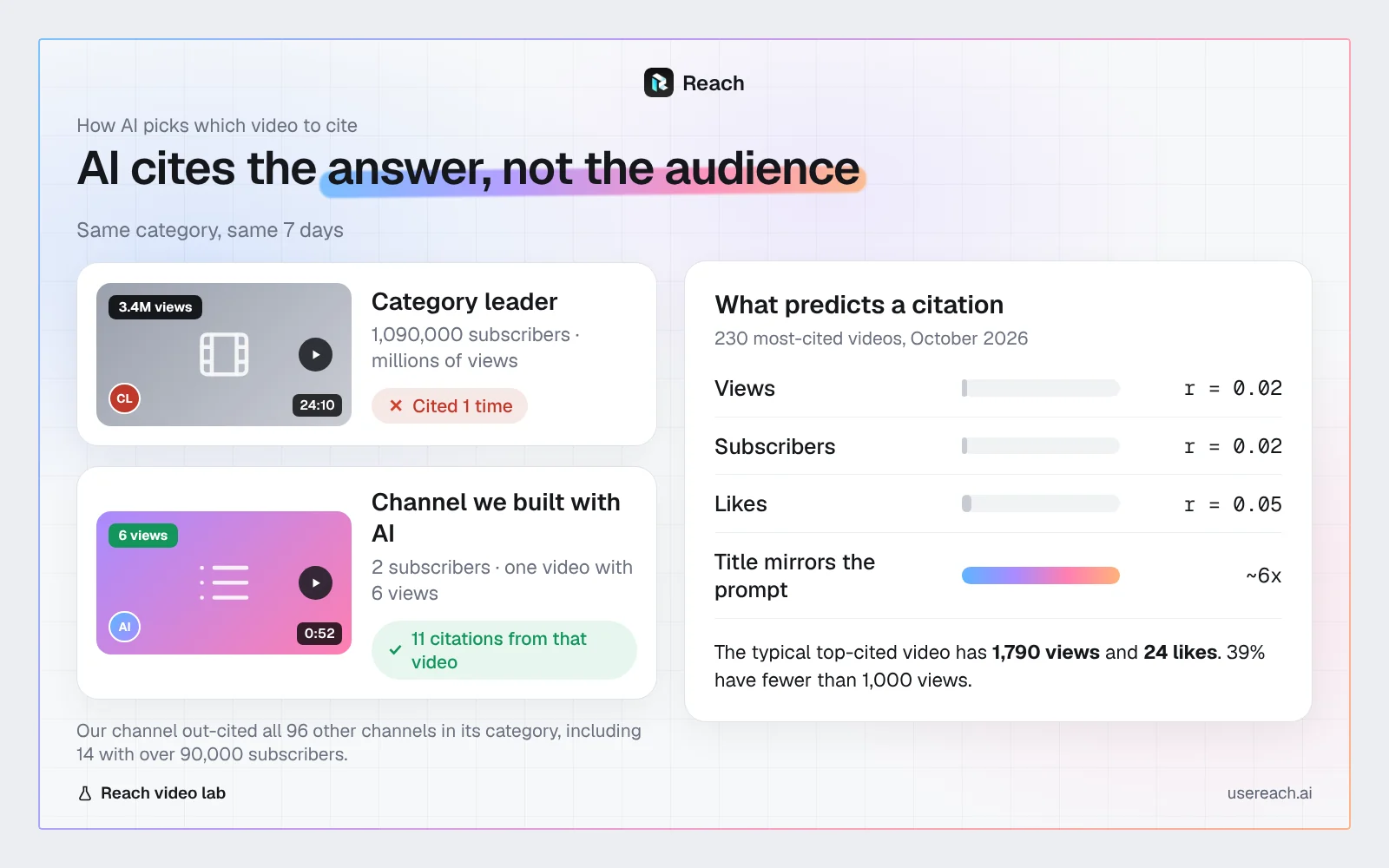
In our October study of the 230 most-cited videos, the rank correlation between how often a video is cited and its views was 0.02. With subscribers it was also 0.02, and with likes 0.05. In practical terms, there's no relationship.
| The typical top-cited video | Median | Middle half: from | Middle half: to |
|---|---|---|---|
| Views | 1,790 | 520 | 7,100 |
| Likes | 24 | 6 | 100 |
| Channel subscribers | 15,300 | 3,100 | 58,200 |
| Length (minutes) | 9 | 6 | 13 |
| Age when cited (months) | 8 | 5 | 15 |
39% of the top-cited videos had fewer than 1,000 views, and only 12 of 230 had more than 100,000. One channel we built with AI in about a month, with 2 subscribers and 1,534 lifetime views, was cited 55 times in a week. That was more than any of the other 96 channels in its category, including 14 with over 90,000 subscribers, and one video with 6 views produced 11 citations.
The title has to match the question
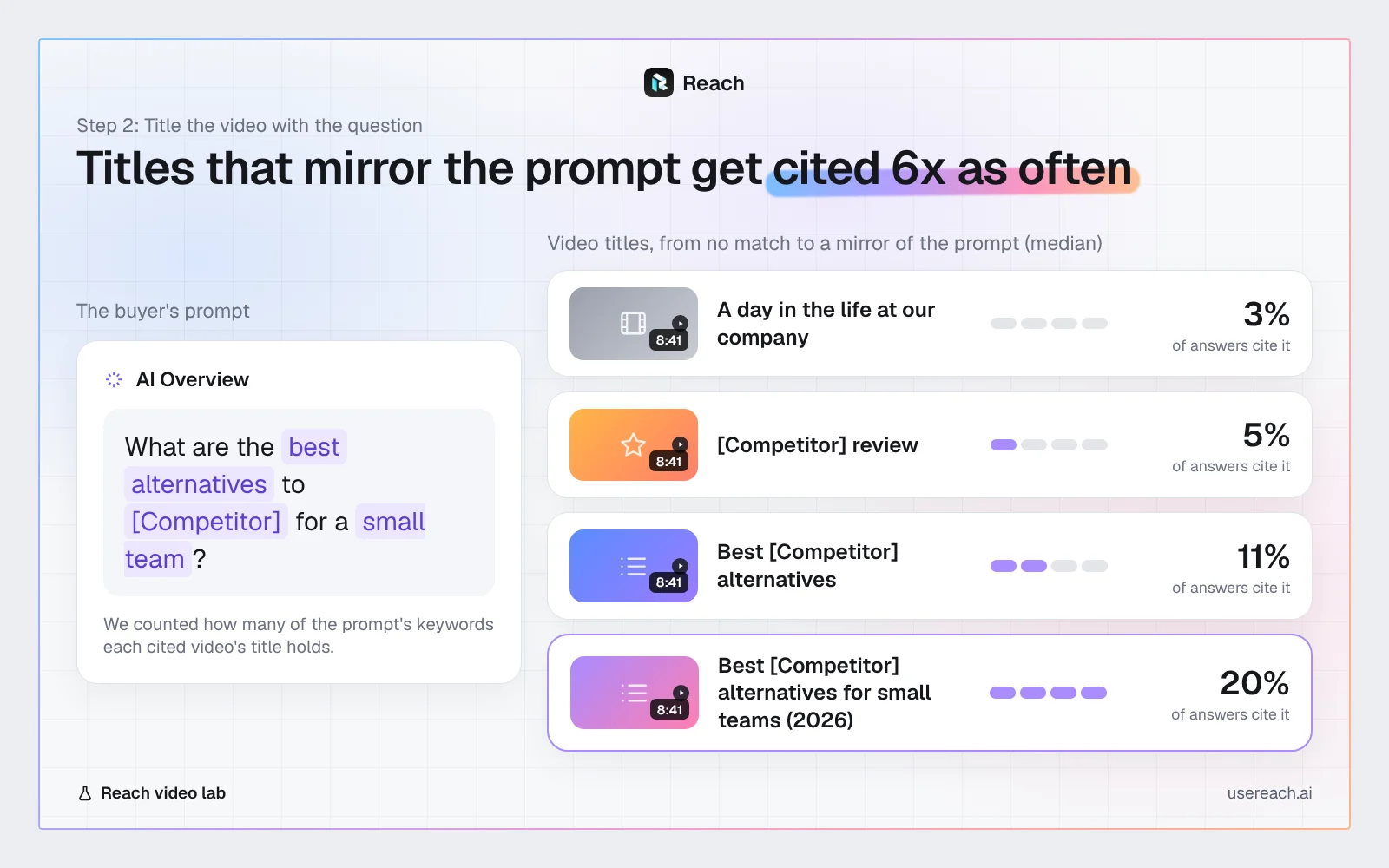
For each video and each prompt it was cited on, we measured how many of the prompt's keywords appear in the video's title, then how often that prompt's answers cite the video.
| Prompt keywords found in the video title | Share of the prompt's answers citing the video (median) |
|---|---|
| None | 3% |
| Under a third | 5% |
| A third to two thirds | 11% |
| Two thirds or more | 20% |
A title that mirrors the prompt is cited about six times as consistently as one that shares no keywords. The title isn't everything: the median title holds 20% of the prompt's keywords, while title, description and tags together hold 50%. The engines read the description, and likely the transcript, too.
Each question has its own few videos
There's no YouTube top 10 to beat. 56,216 different videos were cited between September and November, 43% of them only once, and the 100 most-cited videos take only 11% of citations. An answer that cites YouTube uses about two videos on average.
That makes the question, not the channel, the unit to plan around. One video built for one buyer question can win that question's citations with no audience at all.
The video changes what the answer says
A cited video does more than add a link. It shapes which brands the answer names. We compared answers to the same prompt on the same engine, with the video cited and without it, and checked how often each brand was mentioned.
| Where the brand appears in the video | Named when the video is cited | When it isn't | Lift (points) |
|---|---|---|---|
| The video is on the brand's own channel | 41.7% | 22.0% | +22.0 |
| In the video title | 75.7% | 61.3% | +12.9 |
| Only in the description or tags | 44.2% | 33.1% | +10.5 |
| Not in the video at all (control) | 17.3% | 15.7% | +1.0 |
The lift follows what the video says. Brands the video names gain 10 to 22 points, while brands it doesn't name barely move. This is a comparison of answers, not a controlled experiment, but the control row rules out a general "YouTube answers name more brands" effect.
In one account's sentence-by-sentence source mapping, YouTube was behind 8.8% of the brand-recommendation sentences in AI Overviews. 54% of the sentences sourced from YouTube were recommendations naming a brand, and 40% explained what a product does, who it's for and what it costs.
Free organic growth review
See your own AI search visibility, free
Where your buyers search, who's winning today, where you're missing out and what we'd do first, from our SEO and AEO experts.
Prefer to talk first? Book a call with Alex
Free · We tell you if search isn't a real channel for you
How to Get Your YouTube Videos Cited in AI Search: The 9-Step Playbook
This is the process we follow at Reach AI for every channel we run, built from the data above and from what happened to our own videos. Steps 1 to 5 shape each video, and steps 6 to 9 shape the channel and how you measure it.
1. Start From a Buyer Prompt, Not a Video Idea
Every video needs a real question behind it. On the channels we run, videos built for a tracked buyer prompt were cited within days, while recipe and lifestyle videos with no matching prompt were never cited once, whatever their quality.
Pick the questions where video already shows up in the answer: how-to (53% of AI Overviews cite YouTube), comparisons and alternatives (40%) and "is it worth it" reviews (37%). If you don't have a prompt list yet, start with our prompt research guide, then check which of those prompts already cite YouTube.
2. Title the Video With the Question
Titles that carry two thirds of the prompt's keywords are cited about six times as consistently as titles that share none. So write the title the way the buyer asks the question, and keep it specific.
The shapes that win citations in our data:
- "Best [category] for [use case] in 2026"
- "[Competitor] alternatives in 2026"
- "[X] vs [Y] vs [Z]: which one should you pick?"
- "How to [task] with [category]"
Among the top-cited videos, 51% of titles say "best" or "top", 49% include the year and 22% are "X vs Y". Only 10% are framed as "how to", even though how-to questions pull YouTube in most, which makes how-to titles the least contested slot. On our own channels, every one of the most-cited videos is a head-to-head or an alternatives title.
3. Answer the Question in the First Minute
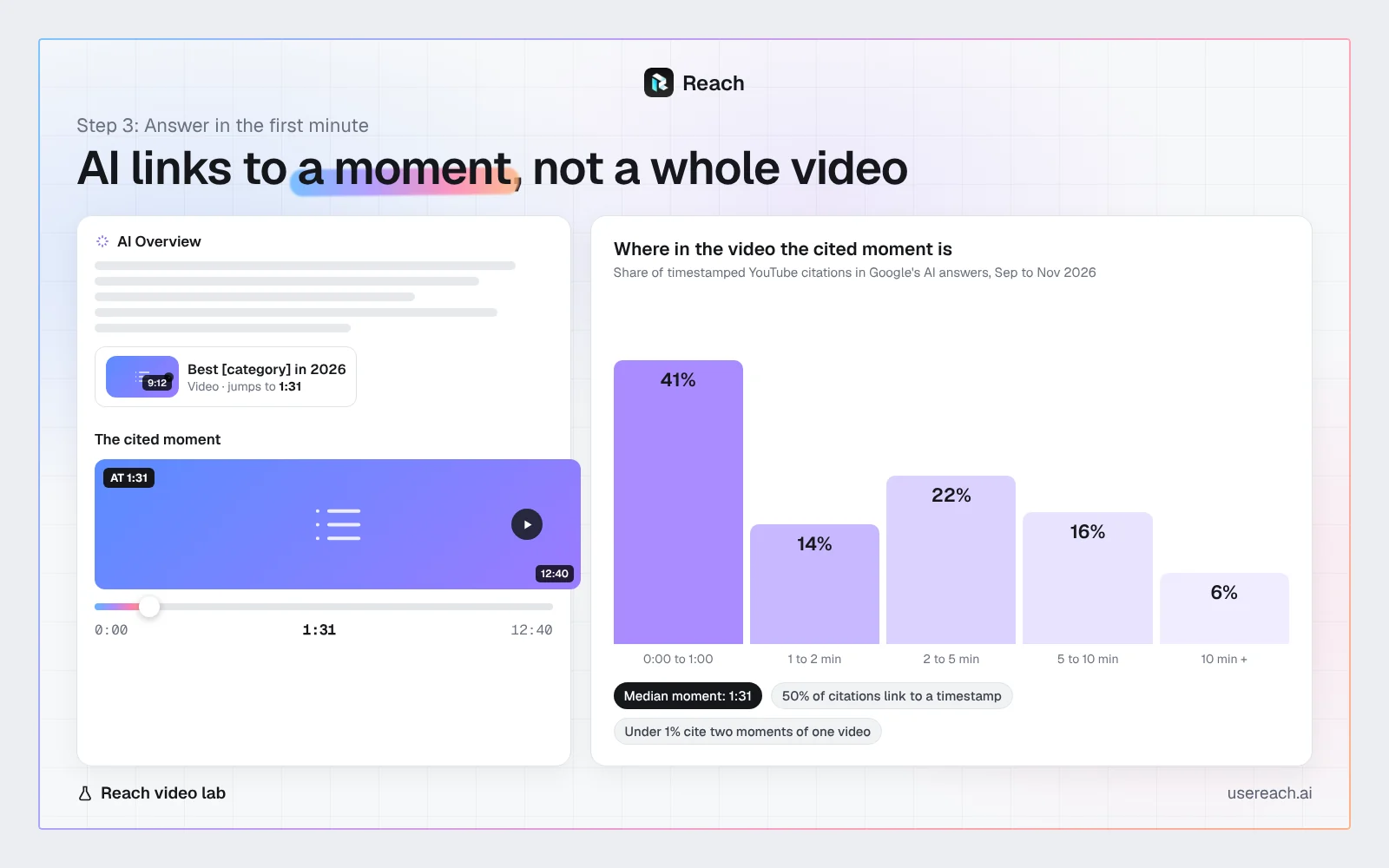
AI engines link to a moment, not only a video. Half of Google's YouTube citations (50%) point to a specific second with a timestamp link, and the median cited moment is 1 minute 31 seconds in.
| Where the cited moment is | Share of timestamped citations |
|---|---|
| First minute | 41% |
| 1 to 2 minutes | 14% |
| 2 to 5 minutes | 22% |
| 5 to 10 minutes | 16% |
| After 10 minutes | 6% |
AI takes one moment per video: fewer than 1% of answers cite two moments of the same video. Open with the direct answer (the pick, the verdict or the first step), then explain. The later minutes of a 20-minute video are rarely used.
4. Add Chapters and Write a Full Description
Chapters give the engine a clean link to each part of the answer, and the description gives it the words to match. 75% of the top-cited videos have chapters, the median description runs about 1,600 characters, 62% list timestamps and 87% include links.
A good description for AI search has:
- A first paragraph that answers the question in one or two sentences
- Timestamps for each chapter, named with the sub-question it answers
- Every product and brand written out, including yours, since brands named only in the description still gain 10.5 points in mentions
- Links to the page that goes deeper on your site
One company formation brand we analyzed had long descriptions on every video but no chapters, and its most cited videos were the ones whose titles matched a prompt. Chapters were the cheapest fix on the list.
5. Name Your Brand in the Video, the Title and the Description
A citation only turns into a mention when the video names the brand. Brands in a cited video's title are mentioned 12.9 points more often, and a video on the brand's own channel lifts its mention rate from 22% to 42%.
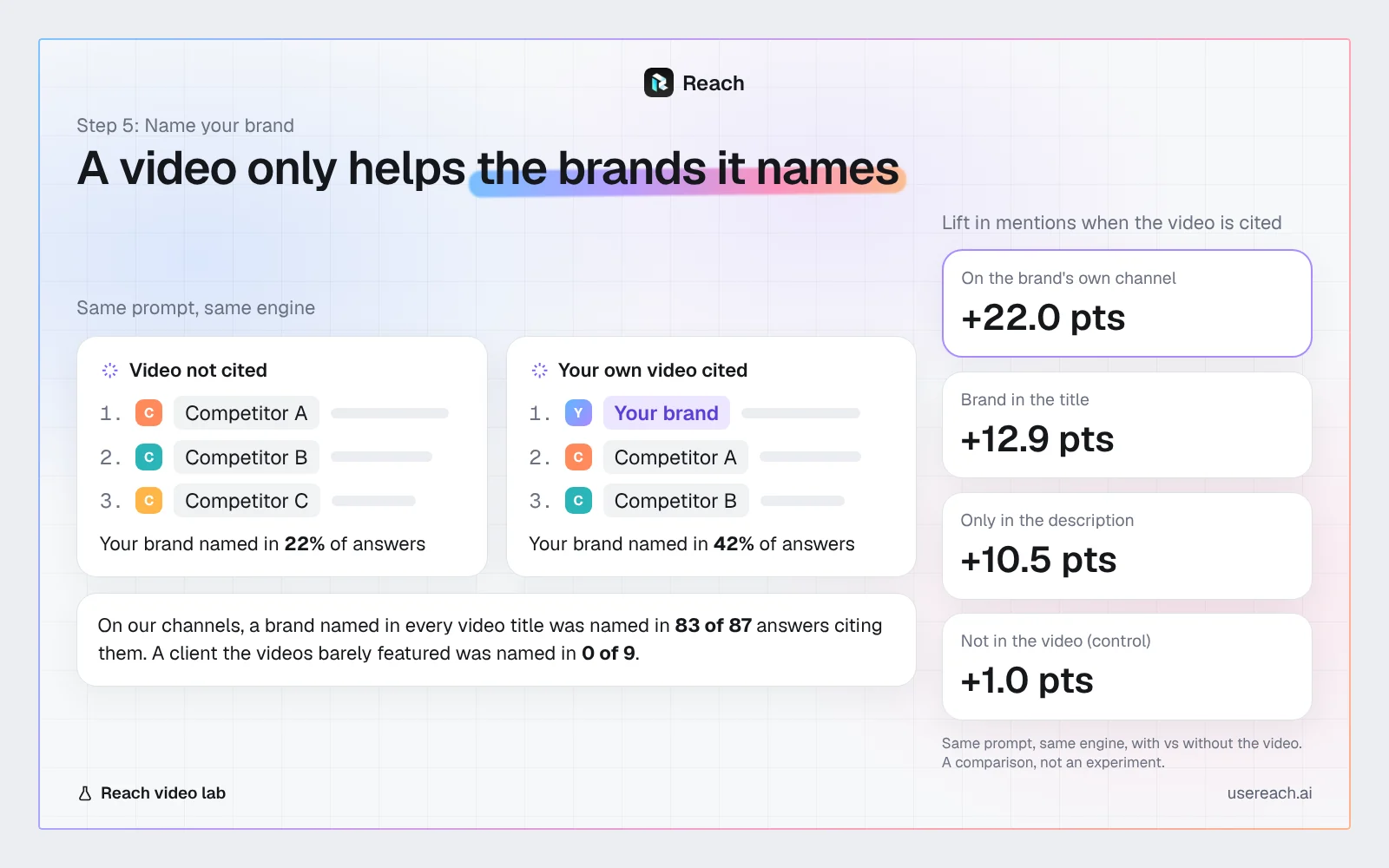
We saw both sides of this on our own channels. For a DTC smoothie brand, the brand was in the title of every video we made for it, and it was named in 83 of the 87 AI answers that cited them (95%). For a B2B software client, our videos were cited on its prompts nine times, but they didn't feature the brand prominently, and the answers never named it.
If the video is on your channel, also make sure the channel name is your brand name. That's how the engines connect the video to you even when the title doesn't.
6. Pick the Right Format: Long-Form, Shorts or Neither
Long-form landscape video of 6 to 13 minutes is still the default. It's what most cited videos look like, and it gives you room for chapters that each answer a sub-question.
Shorts are rising fast, though. Their share of Google's YouTube citations tripled in AI Mode and grew by half in AI Overviews in three months, and that count only includes links using the /shorts/ address, so the real share is higher.
| Month | Shorts share of AI Overviews' YouTube citations | AI Mode |
|---|---|---|
| September | 8.5% | 3.9% |
| October | 10.4% | 7.2% |
| November | 13.3% | 12.7% |
On the channels we run, 19 of our 57 cited videos are Shorts, all uploaded from October onward. The Shorts that get cited answer one direct question. In the company formation brand's channel, Shorts like "Do US LLCs pay taxes?" were cited, while promotional Shorts (event invites, Black Friday offers) never were.
Live streams are the format to skip for AI search. Only 1 of that brand's 25 live streams, each 40 to 75 minutes long, was ever cited.
7. Make the Comparison Video for Your Own Category
Independent creators own YouTube citations in AI answers. Among the 60 channels with the most citations, reviewers, educators and consultants take 62%, company channels 24% and review sites 12%.
| Who made the top-cited videos on a brand's own prompts | Share of citations |
|---|---|
| The brand's own channel | 1.4% |
| A creator's video that names the brand in its title | 6.5% |
| Another tracked brand's channel | 2.3% |
| Someone else, not naming the brand | 90% |
The company channels that do win are mostly software vendors publishing comparison videos about their own category, and they collect citations on their competitors' prompts. So make the "best [category]" and "[you] vs [competitor]" videos yourself, with fair comparisons, before a reviewer makes them without you.
Language matters less for comparisons than you'd think. One English "X vs Y" creator video was cited on Brazilian, Mexican and US prompts alike, so a strong English comparison can work across markets, while how-to guides do better in the buyer's language.
8. Don't Chase Views, and Don't Buy Them
Views don't earn citations. Across one brand's 245 videos, citations correlated with views at 0.12 and with likes at 0.03.
Paid views didn't help either. That brand's four biggest videos had like rates of 0.001% to 0.012%, against 2.9% for its typical video, which is consistent with views bought through ads. Only one of the four was cited heavily, and it was the one whose title matched a buyer question.
9. Measure Whether the Video Changes the Answer
A new video usually gets cited within a week. On the channels we run, the median video was first cited 5 days after upload.
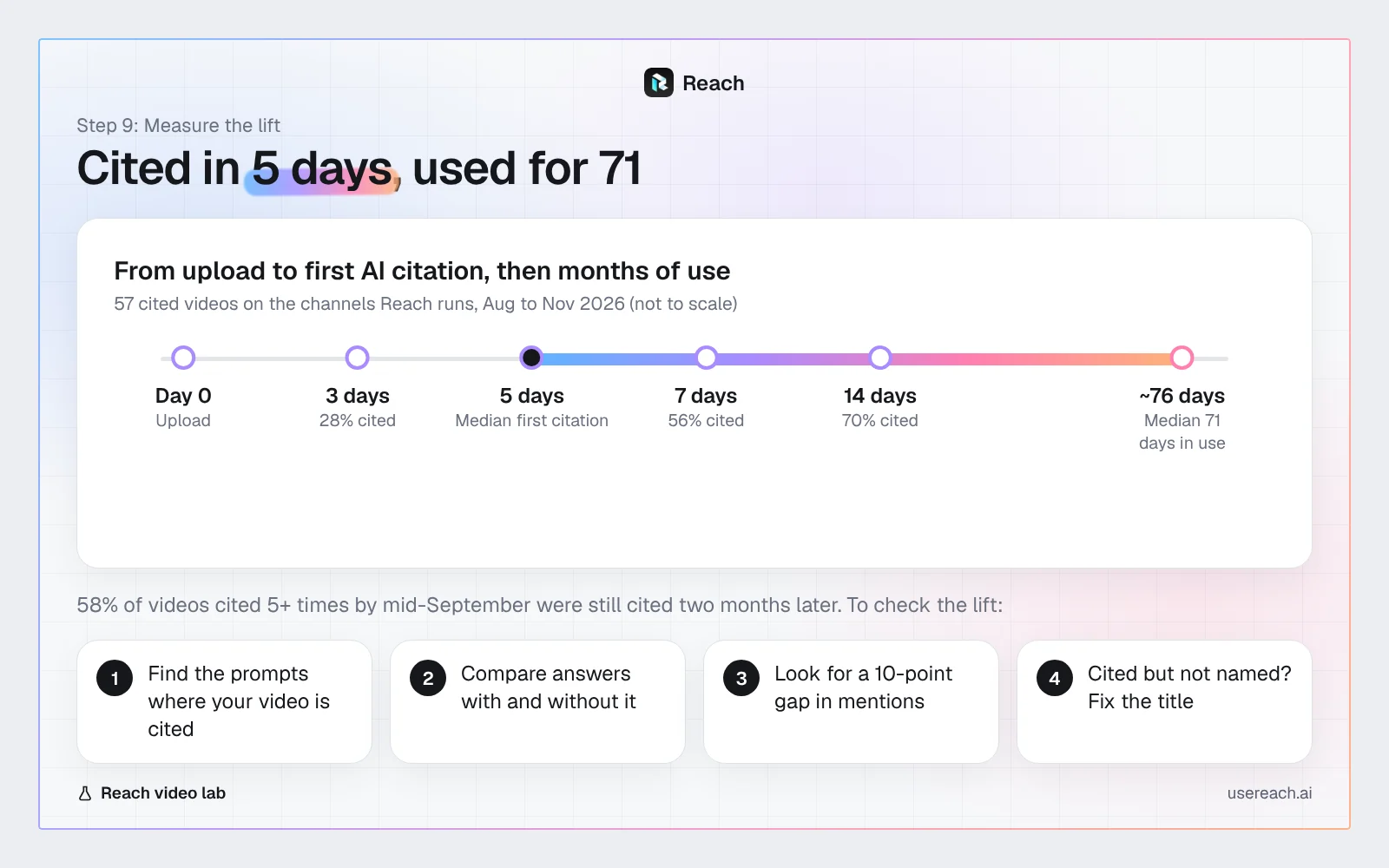
| Days from upload to first AI citation | Videos | Share of cited videos |
|---|---|---|
| 3 days or fewer | 16 | 28% |
| 7 days or fewer | 32 | 56% |
| 14 days or fewer | 40 | 70% |
Once cited, videos keep working: 58% of the videos cited at least five times by mid-September were still cited two months later, and the median video stayed in use for 71 days.
To check whether a video is moving your recommendations, run the same comparison we use:
- Find where it's cited. List the tracked prompts on AI Overviews and AI Mode where your video appears as a source. In Reach AI, the Sources view shows this per prompt and engine.
- Compare answers with and without it. For the same prompt and engine, check how often your brand is named and recommended when the video is cited and when it isn't.
- Look for a gap of 10 points or more, with no gap for brands the video doesn't name.
- If it's cited but you're not named, the video doesn't feature you clearly enough. Fix the title and description first.
Across our channels, client brands were named in 59% of the answers that cited our videos, against 35% for the same prompts and engines without them.
What Happened When We Ran This on Our Own Channels
We run six YouTube channels at Reach AI to test this playbook for customers. Between August 25 and November 25, 2026, 57 of their 272 videos were cited 513 times, in 453 AI answers to 80 prompts across 11 accounts. 98% of those citations came from Google's engines: 57% from AI Overviews, 41% from AI Mode and 2% from ChatGPT.
Here's what that looked like in practice, the wins and the misses.
A 1-view video moved a smoothie brand to first place
For a DTC smoothie brand, we published 12 short videos between October 12 and 21, each under about a minute, with 1 to 148 views. The titles matched the brand's tracked prompts: a "best [competitor] alternatives" video, two "[competitor] vs [competitor] vs [brand]" comparisons and a how-it-works explainer.
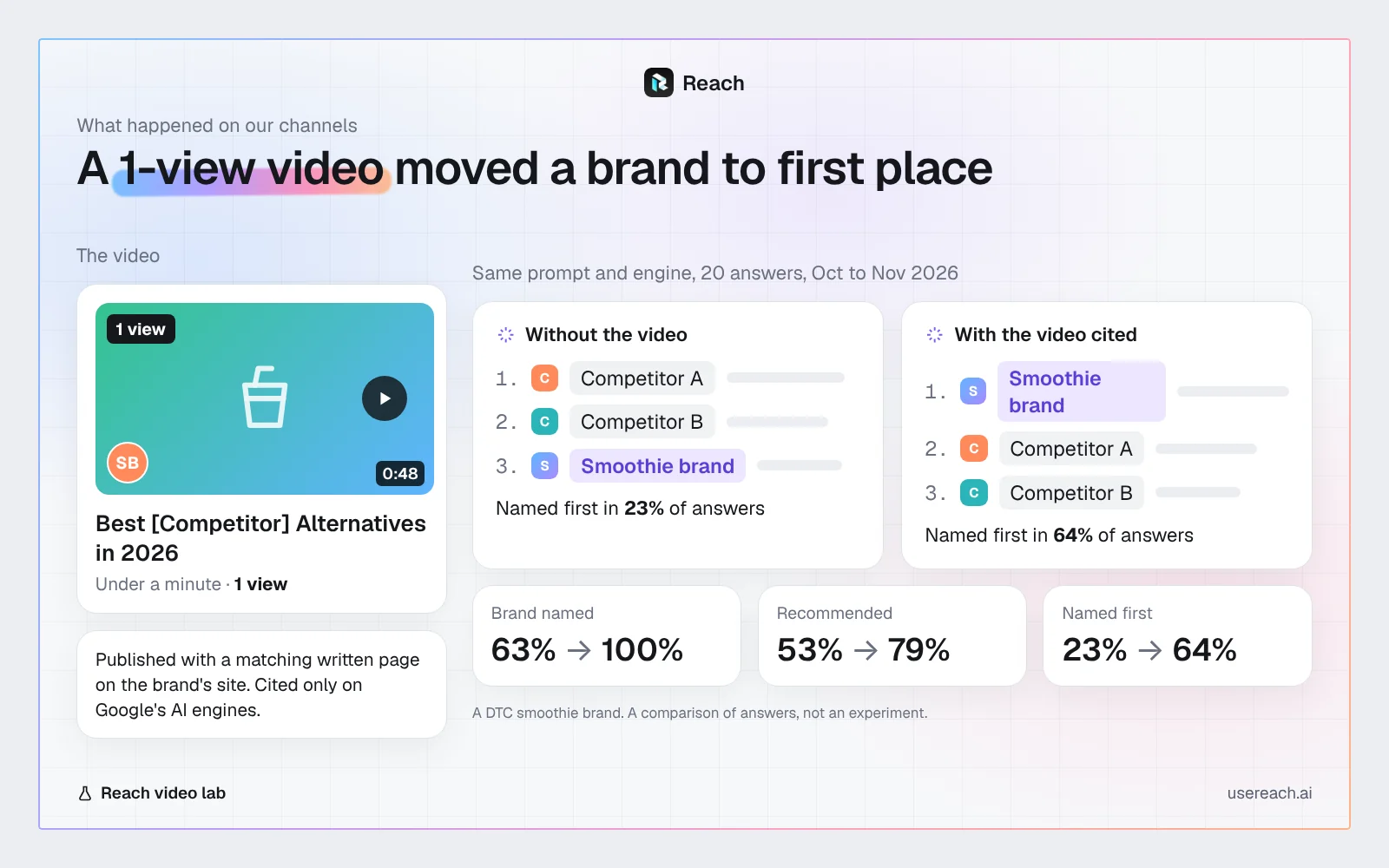
| Same prompt and engine | Without the video | With the video |
|---|---|---|
| Brand named | 63% | 100% |
| Brand recommended | 53% | 79% |
| Brand named first | 23% | 64% |
That was the alternatives video, with one view, across 20 answers. By November 25, six of the channel's videos had been cited in 87 answers on the brand's prompts, and the brand was named in 83 of them. We published matching written pages on the brand's site at the same time, so the videos weren't working alone, and the recipe videos with no matching prompt were never cited.
A company formation brand won Brazil with Portuguese guides
A company formation service selling to founders in Latin America had YouTube in 54% of its AI Overviews answers. Its own channel was the most cited on its prompts, with 8.1% of video citations, and AI Overviews answers citing one of its videos named the brand 46% of the time, against 13% for the rest.
The win was concentrated in one market. Its Portuguese long-form guides were cited in 16% of answers on Brazilian prompts, against 2.6% on Mexican prompts and 0.2% on US prompts, where creators' English comparison videos took the citations instead.
Where it didn't work
Not every cited video moves the answer. For a B2B inventory software client, our videos were cited 29 times on its prompts, and the brand was named in 39% of answers both with and without them. For another software client, our videos were cited nine times, and the brand was never named, because the videos didn't feature it clearly.
Both point back to step 5. A citation that doesn't carry your brand helps whoever the video names.
How to Make These Videos at Scale
You probably don't need a new content program to do this. If you already publish articles for your buyer prompts, you already have the scripts: a "best X" listicle or an "X vs Y" page turns into a video with the same structure, the same title and the same answer up front.
The channel I mentioned earlier, built in about a month with 2 subscribers, was made entirely with AI. The workflow:
- Create the channel's visual identity with Claude, following your brand guidelines.
- Build each video with Claude's animation features, starting from the article's structure and its key numbers.
- Add a voice-over with ElevenLabs, using one consistent voice for the channel.
- Upload with the question as the title, chapters taken from the article's subheadings and a full description.
Eight videos went up in twelve days, and those eight out-cited channels with more than a million subscribers in the same category. The quality bar is a clear answer to a real question, not production value.
YouTube SEO for AI Search: Mistakes to Avoid
Most of these come from treating AI citations like YouTube growth. The audience you're building for is the engine, and it reads titles, descriptions and the first minute.
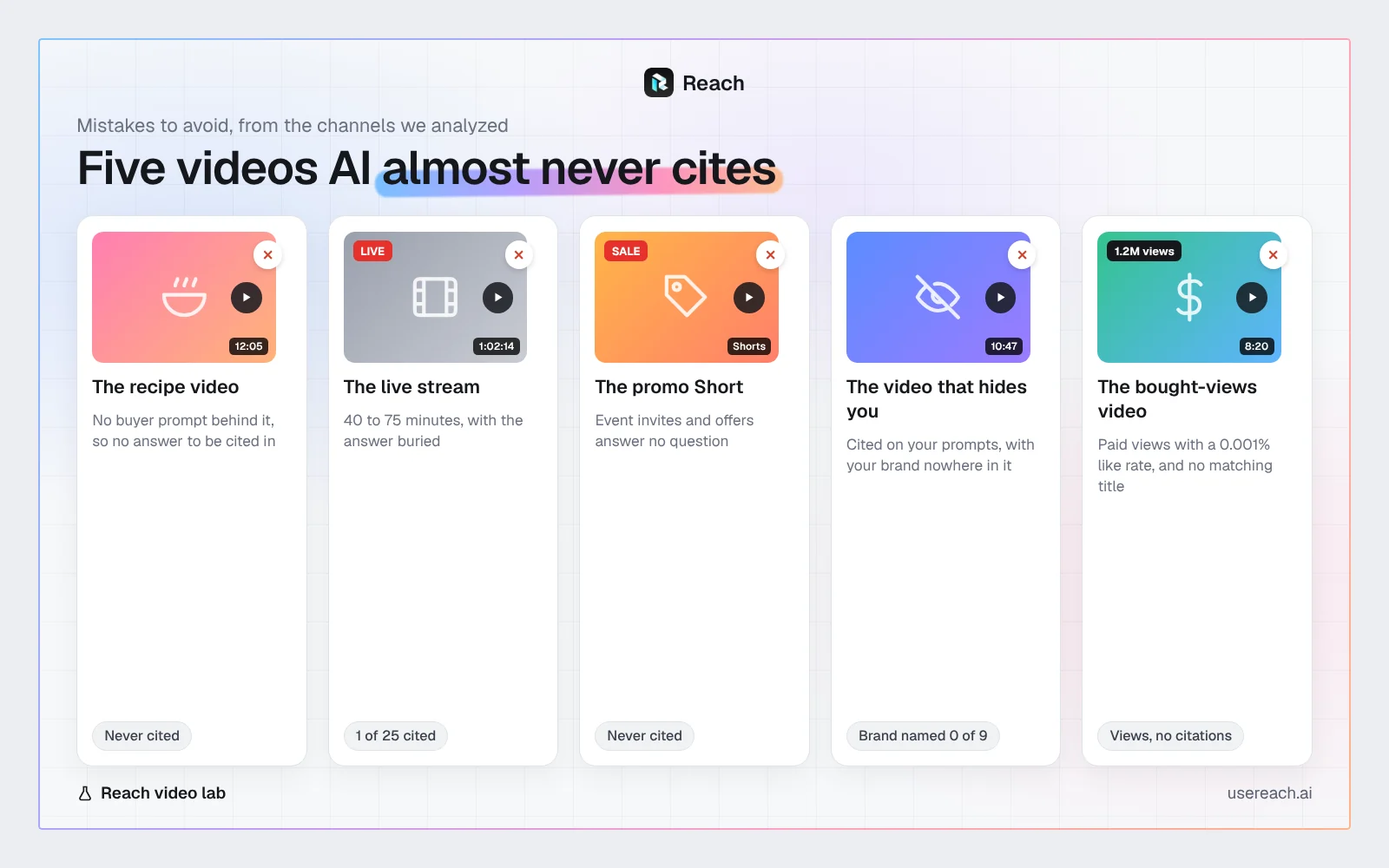
Making Videos With No Prompt Behind Them
Recipe, lifestyle and brand-story videos can be good YouTube content and still never get cited, because no buyer question matches them. Start from the prompt list, and make the video for one question.
Hiding the Brand
A video that's cited but doesn't name you helps the brands it does name. Put your brand in the title or description, and publish on a channel that carries your brand name.
Burying the Answer
Intros, channel trailers and "before we start" segments push the answer past the first minute, where 41% of timestamped citations land. Lead with the verdict and explain after.
Measuring Success in Views
Views, likes and subscribers don't predict citations, and bought views don't produce them. Track citations, mentions and the lift on the prompts the video targets.
Investing in Live Streams and Promotional Shorts
One brand's 25 live streams produced a single citation, and its event and offer Shorts produced none. Keep those formats for your audience, and make answer videos for AI search.
Expecting Video to Move ChatGPT
ChatGPT cites a video in 1% to 2% of answers. If it's your buyers' main engine, put the effort into written pages, listicles and Reddit instead.
Does YouTube Take Citations Away From Your Website?
No. We compared answers to the same prompt on the same engine, with and without a YouTube citation, and checked how often the brand's own website was cited.
| Engine | Brand's site cited with YouTube | Without YouTube |
|---|---|---|
| AI Overviews | 14.2% | 11.3% |
| AI Mode | 13.7% | 11.2% |
| ChatGPT | 25.5% | 23.8% |
Answers that cite a video cite more sources overall, so they cite your site slightly more often too. A video is an extra way into the answer, not a trade-off against your pages.
Everything You Need to Know About YouTube Videos Cited in AI Search
| Topic | What to know |
|---|---|
| Where it works | Google AI Overviews (about 40% of answers cite YouTube) and AI Mode (about a third); ChatGPT 1% to 2% |
| Best categories | Education 55%, B2B sales and marketing software 42%, e-commerce 41% |
| Best markets | Mexico 63%, Brazil 57%, US 37%; France and the Gulf about 6% |
| Best questions | How-to 53%, comparisons 40%, reviews 37% |
| What gets a video cited | A title that mirrors a real buyer prompt, a full description and the answer up front |
| What doesn't | Views, likes, subscribers or paid views |
| Title match | Two thirds of the prompt's keywords: cited about 6x as consistently |
| Where AI links | One moment per video; median 1:31, 41% in the first minute |
| Format | Long-form 6 to 13 minutes; Shorts for direct questions (13.3% of AI Overviews' YouTube citations) |
| Brand effect | +12.9 points in the title, +10.5 in the description, +22 on your own channel |
| Competition | Creators take 62% of top channels' citations; brands' own channels 1.4% on their prompts |
| Speed and lifespan | Median 5 days to first citation, 71 days in use |
| Effect on your website | None negative; your site is cited slightly more often |
Get Your Videos Into Google's AI Answers
At Reach AI, YouTube is part of the system we run for customers, next to the pages, mentions and community work. We find the prompts where your category's AI answers cite video, turn your best articles into videos titled with those questions, and track whether each video changes how often you're named and recommended.
It works best for companies in categories and markets where AI Overviews already lean on YouTube, such as software, education, e-commerce and Latin America, including teams that publish content and haven't touched video yet. We run the whole process, from the first prompt to the pipeline it brings in, measured on leads and revenue rather than views.
The results behind the rest of our work are public, step by step: Carro's listicle became the #1 cited URL in its industry, and Fraudio became the #2 most cited domain in fraud prevention. There are no 12-month contracts. Get a free organic growth review to see how often your category's AI answers cite YouTube, or book a call and we'll look at your market live.
Free 30-minute call
Book a call with Reach AI
In 30 minutes Alex looks up you and your closest competitors on Google and in ChatGPT, Claude and Gemini, live, and shows you what we'd do first.
Not ready for a call? Get a free organic growth review
Free 30-minute call · You keep the notes
 Google
 ChatGPT
 Claude
 Gemini
FAQs About Getting YouTube Videos Cited in AI Search
How do I get my YouTube videos cited in AI search?
To get your YouTube videos cited in AI search, make one video per buyer question, title it with the words of that question and answer it in the first minute. Add chapters and a full description of about 1,500 characters that names every product, including yours. Titles carrying two thirds of the prompt's keywords are cited about six times as consistently, and the median video on our channels was first cited 5 days after upload.
Does Google AI Overviews use YouTube videos?
Google AI Overviews use YouTube videos in about 4 of every 10 answers, up from 3 in 10 in September 2026. YouTube's share of all AI Overview citations rose to between 10% and 12% in November. The share is highest on how-to questions (53%), in education (55%) and in Mexico and Brazil (about 60%).
Does ChatGPT cite YouTube videos?
ChatGPT cites YouTube videos in only 1% to 2% of its answers, against about 40% for Google AI Overviews. Half of its YouTube links in November pointed to channel pages rather than videos. On the channels we run, 2% of our video citations came from ChatGPT, so video is a Google AI strategy.
Do views or subscribers matter for AI citations?
Views and subscribers don't matter for AI citations: the rank correlation between citations and views was 0.02 among the most-cited videos. The typical top-cited video has 1,790 views and 24 likes, and 39% have fewer than 1,000 views. A channel we built with 2 subscribers out-cited 96 channels in its category, including 14 with over 90,000 subscribers.
How long does it take for a YouTube video to get cited by AI?
A YouTube video takes a median of 5 days to get its first AI citation on the channels we run. 56% of our cited videos were cited within a week and 70% within two weeks. Once cited, the median video stayed in use for 71 days.
Do YouTube Shorts get cited in AI search?
YouTube Shorts get cited in AI search more each month, rising from 8.5% of AI Overviews' YouTube citations in September to 13.3% in November. In AI Mode, the share went from 3.9% to 12.7%. The Shorts that get cited answer one direct question, while promotional Shorts are rarely or never cited.
What should a YouTube title look like for AI search?
A YouTube title for AI search should mirror the buyer's question, such as "Best [category] for [use case] in 2026", "[X] vs [Y]" or "How to [task]". Among the top-cited videos, 51% of titles say "best" or "top", 49% include the year and 22% are "X vs Y". Only 10% are framed as "how to", which leaves how-to questions the least contested.
Which part of a YouTube video does AI cite?
AI usually cites the start of a YouTube video: half of Google's YouTube citations link to a specific moment, and the median cited moment is 1 minute 31 seconds in. 41% of timestamped citations point to the first minute and three quarters to the first 4.5 minutes. Fewer than 1% of answers cite two moments of the same video.
Does a YouTube video change which brands AI recommends?
A YouTube video changes which brands AI recommends when it names them: brands in a cited video's title are mentioned 12.9 points more often in answers to the same prompt. Brands named only in the description gain 10.5 points, and a video on the brand's own channel adds 22 points. Brands the video doesn't name gain 1 point, which is no real change.
Should my brand make its own YouTube videos or work with creators?
Your brand should make its own YouTube videos for its category's key questions, because brands' own channels take only 1.4% of top-video citations on their own prompts and the slot is open. A video on your own channel gave the largest lift in our data, at +22 points in mentions. Creator videos still help when they name you in the title, so earning those mentions is the next step.
Read next
Guides
Prompt Research for AI SEO in 2026: Find the Questions AI Is Answering
Prompt research has no keyword planner. See how we turn Google data, sales calls and Reddit threads into the prompts that bring pipeline.
Research
How to rank in AI search: what I wish I knew earlier
What 551,849 AI answers about 1,037 companies show: Google rankings were the strongest signal, the engines disagree, answers change daily, and pipeline is the number to judge.
Opinions
Why AI Search Uses Your Content but Never Names Your Brand
Ghost citations happen when an AI answer links to your website but never says your brand name. We measured 71,275 of them, and one change stood out.
Agencies charge $3k+ for this
Apply for an in-depth audit of your organic growth potential
Our proprietary platform makes it possible for us to do this audit quickly.
Prefer to talk first? Book a call with Alex
All audit numbers are estimated