Reach
How to rank in AI search: what I wish I knew earlier
How to rank in AI search, from Reach AI's study of 551,849 AI answers about 1,037 companies: ranking on Google for more of your buyers' searches was the strongest signal we found. ChatGPT, AI Overviews and AI Mode name different companies, the answers change daily, and you should judge it all by pipeline, not AI traffic.

| Strongest signal we found | Ranking on Google's first page for more of your category's buying searches |
|---|---|
| Named in AI answers | 18.3% for the top quarter of companies by Google rankings, 1.9% for the bottom quarter |
| ChatGPT on buying questions | Searched the web before answering 96% of the time |
| Same question, same day | 30% of the companies ChatGPT names also show up in Google AI Overviews |
| Next day | 54% chance ChatGPT names the same company again |
| AI's share of website visits | Under 2.5% at each of 9 Reach AI customers, Aug to Oct 2026 |
| Data | 551,849 answers from ChatGPT, Google AI Overviews and AI Mode, 14 Oct to 12 Nov 2026 |
AI is already huge. The top six AI assistants (ChatGPT, Gemini, Claude, Grok, Perplexity and DeepSeek) get 76 billion visits a month worldwide, up 37% in a year, according to Similarweb data shared by Ethan Smith of Graphite in November 2026.
But your analytics make it look tiny. At 9 of our customers, AI assistants sent less than 2.5% of website visits from August to October 2026. At the typical one, it was about half a percent (0.53%).
It shows up somewhere else: in people searching for your name on Google. At Fraudio, the people who Googled "Fraudio" and clicked went from 55 to 589 in August to October, against the same months a year before. That's 10.7x in a year. We can't prove AI caused it, and it starts from a small number. But it's what you'd expect if buyers hear your name in an AI answer and then look you up.
For context: we run Google and AI search for 20+ companies, some of them up against Harvey, Duolingo and Feedzai. From 14 October to 12 November 2026 we tracked 551,849 AI answers about 1,037 companies. And we judge all of it by pipeline, not by mentions on prompts no buyer types.
These are the things I wish I'd known earlier about how to rank in AI search. Each one comes with the data, and the method is at the end.
1. What gets you recommended by AI
Ranking on Google for more of your buyers' searches. It was the strongest signal we found.
Inside each category (a customer and the competitors it tracks), we counted how many of the category's buying searches each company ranks for on Google's first page. Then we split the companies into four groups. The top quarter got named in 18.3% of AI answers. The bottom quarter: 1.9%.
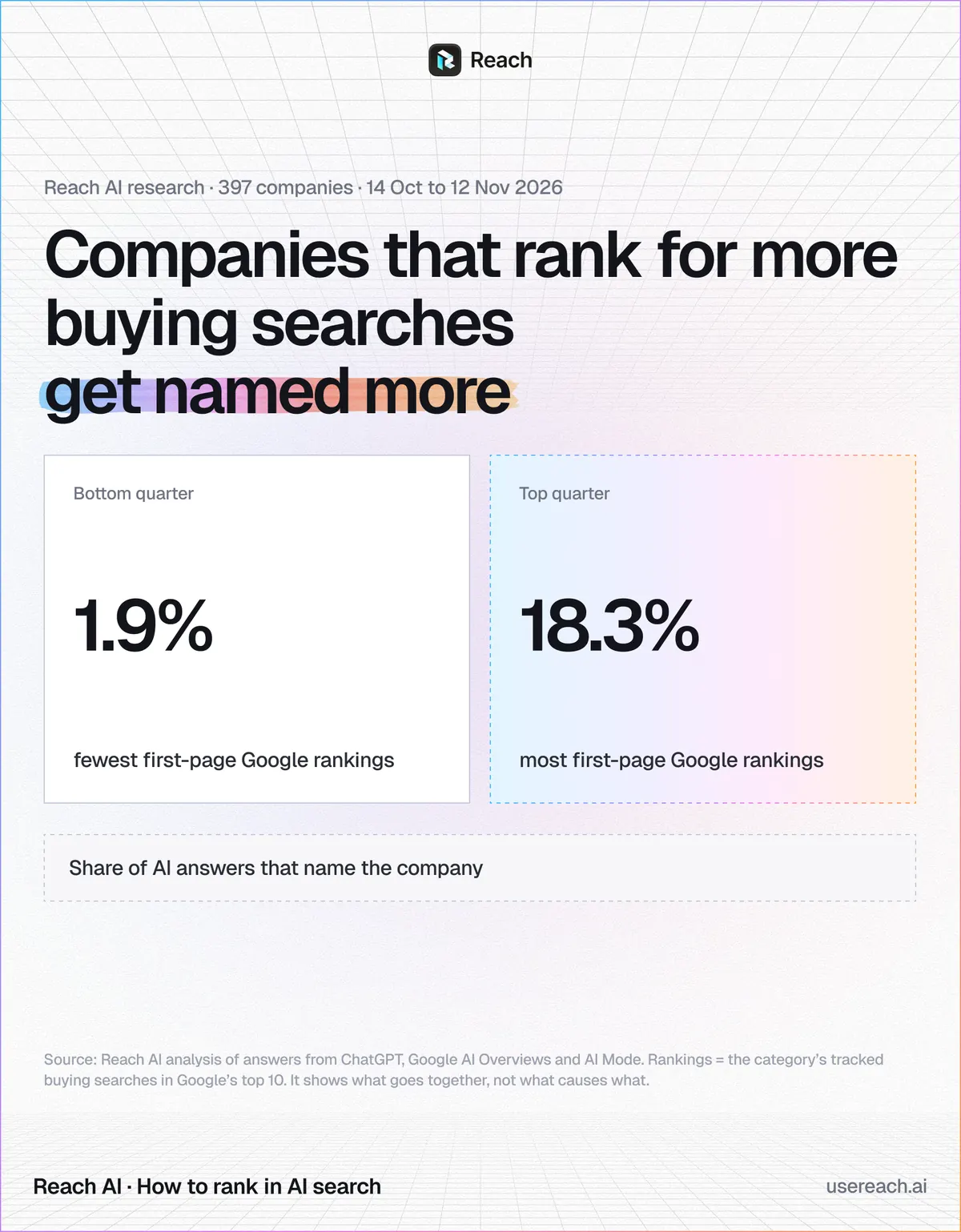
If you're looking for AI search ranking factors, this is the one that stood out.
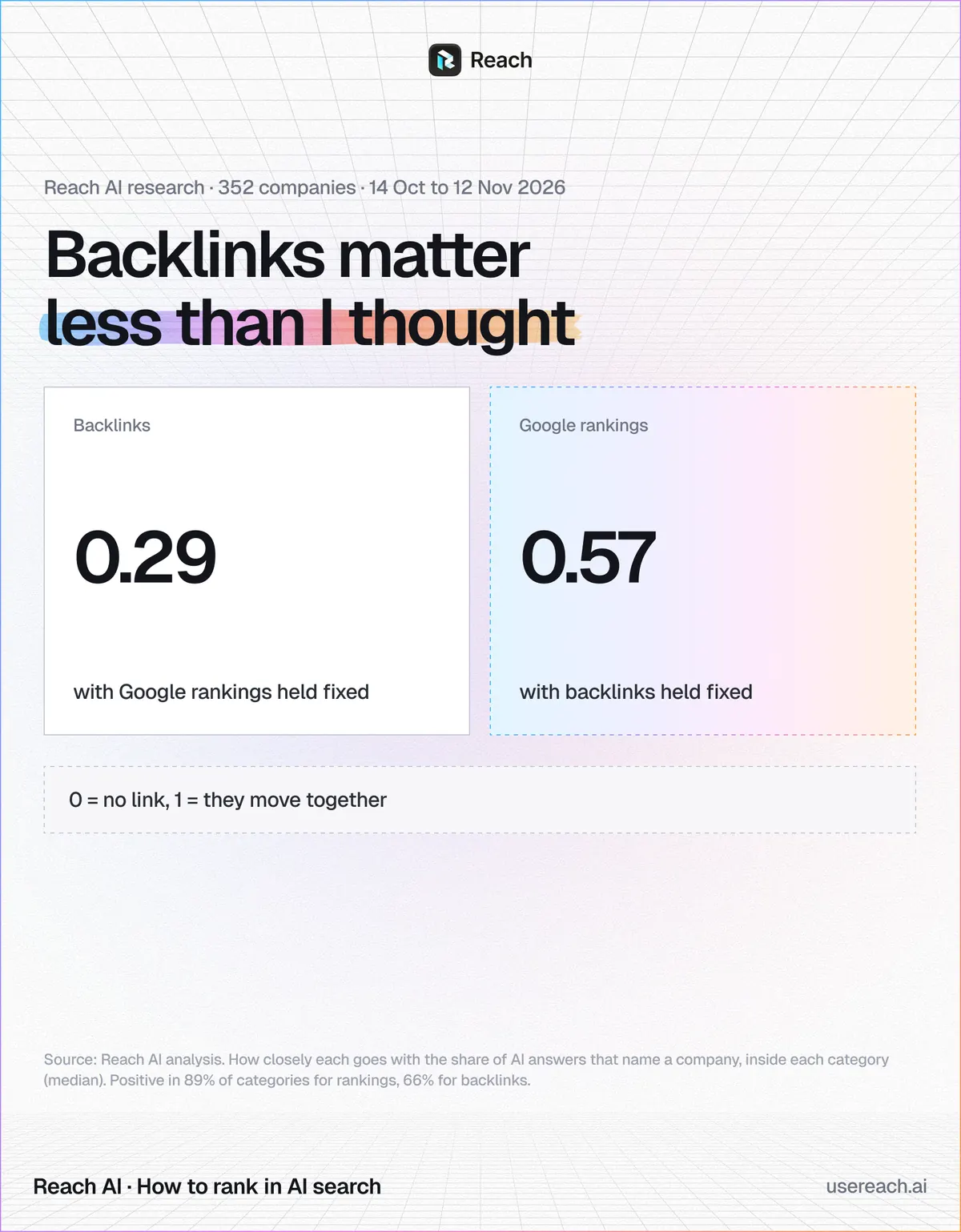
Backlinks matter less than I thought. Take companies with the same backlinks: the ones that rank for more buying searches get named a lot more. Take companies with the same rankings: more backlinks make a much smaller difference.
On a scale from 0 (no link) to 1 (they move together), Google rankings scored 0.57 with backlinks held fixed. Backlinks scored 0.29 with rankings held fixed. The rankings link was positive in 89% of categories. The backlinks one in 66%, which could be chance.
No first-page ranking, almost no AI mentions. Of the 119 companies that weren't on Google's first page for any of their category's tracked buying searches, only 4.2% were named in at least 1 in 20 answers. Of the 278 with at least one first-page ranking, 56.1% were.
Rankings get you in the running, not to #1. In about 2 of 3 categories, the company with the most first-page rankings wasn't the one AI named most. Rankings put you on the list. They don't decide who comes first.
The AI searches before it answers. On buying questions, ChatGPT searched the web before answering 96% of the time (91% on mid-funnel questions, 81% on early research questions). It cited at least one source in 98% of its answers to buying questions. My best guess at the link with Google: when the AI searches, the pages that rank are the pages it reads. That's a guess, not something we measured, and we didn't check which search index each engine uses.
Being cited and being named are not the same thing, by the way. We looked at that gap in our study of ghost citations.
Free organic growth review
See your own AI search visibility, free
Where your buyers search, who's winning today, where you're missing out and what we'd do first, from our SEO and AEO experts.
Prefer to talk first? Book a call with Alex
Free · We tell you if search isn't a real channel for you
2. ChatGPT and Google's AI don't agree
Same question, same day: only about 3 in 10 companies ChatGPT names also show up in Google's AI Overviews. The exact figure is 30%. For Google's AI Mode it's 32%.
Google's own two AI answers don't agree much either. AI Mode and AI Overviews share 37% of the companies they name, fewer than 4 in 10.
And only 1 in 10 of the companies named (10%) gets named by all three.
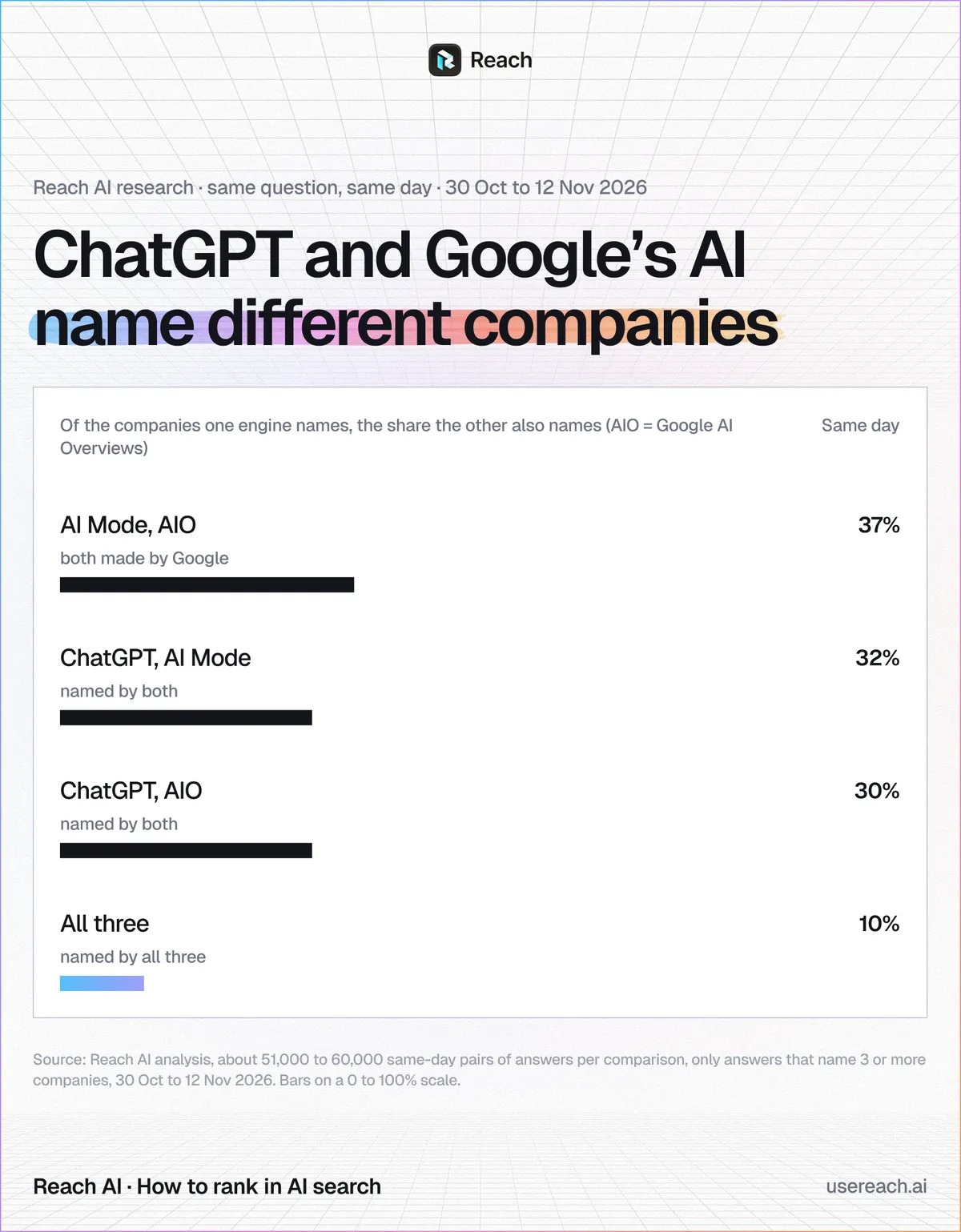
So a win on ChatGPT tells you little about Google's AI, and the other way round. The engines also move on their own: we saw it when ChatGPT cut its Reddit citations and Perplexity went the other way. Track each engine on its own, for the questions your buyers ask.
3. The answers change every day
Ask ChatGPT the same question two days in a row, and almost half the companies change. A company it names today has a 54% chance of being named again tomorrow. On AI Overviews it's 47%. On AI Mode, 48%.
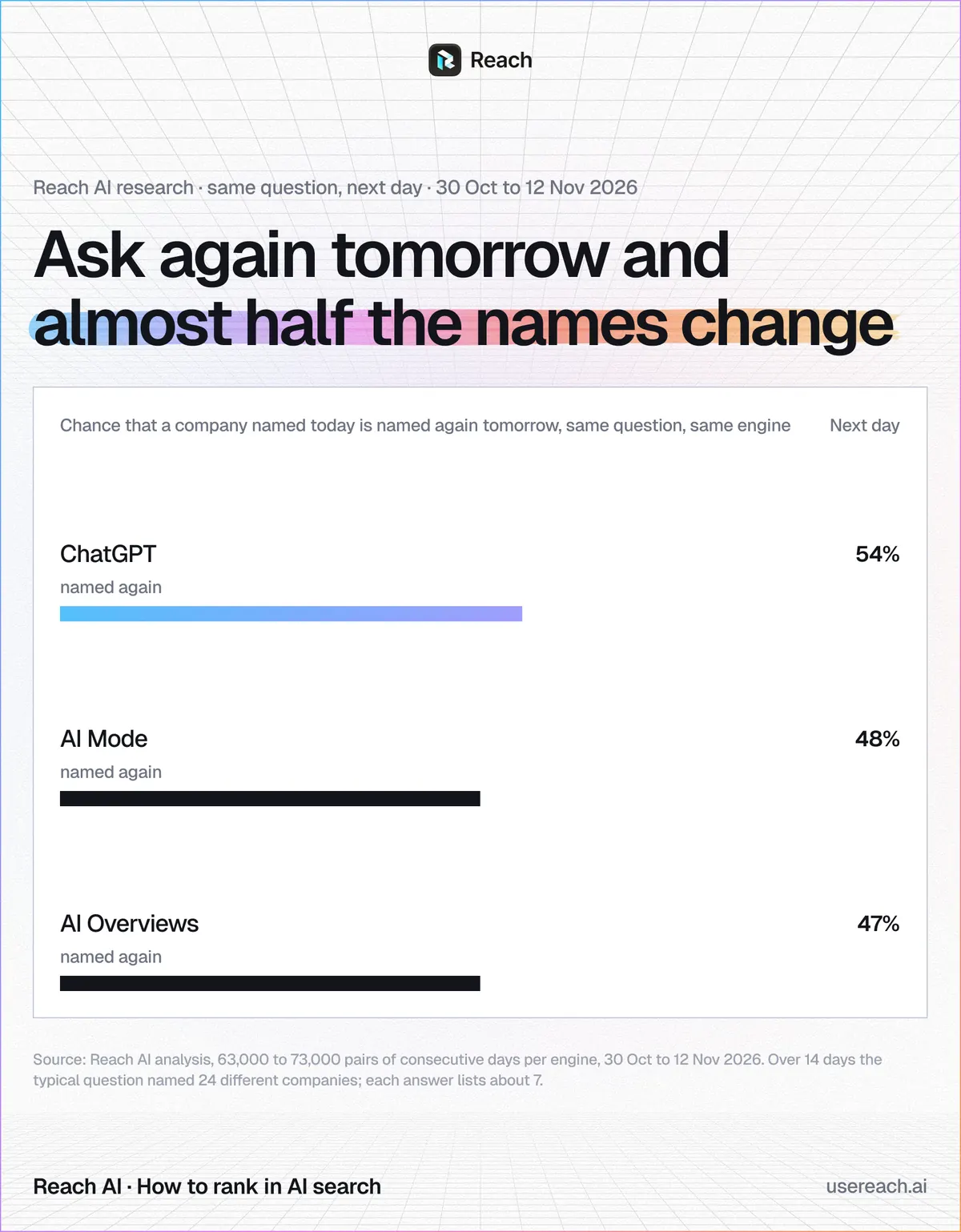
Over two weeks, the typical question named 24 different companies. Each single answer listed about 7.
One screenshot proves nothing. What counts is how often you're named across many days, on each engine. That's why we ask the same questions every day, on each engine, for every customer.
4. Measure pipeline, not traffic
Don't trust Direct traffic. One customer's Direct visits tripled in a year, comparing August to October. More than half of the increase came from two countries where almost nobody did anything on the site. Those were bots, not buyers.
Give it a couple of months. Fraudio had no deals from organic search from January to March 2026. We started working together in February, and the first deals came in April, about two months in. Eight months in, Fraudio had 10x the inbound pipeline from SEO and AI search, about $2M in inbound pipeline.
That's why we judge the work by pipeline. Mentions, rankings and traffic are steps on the way. The deals are the goal.
How our data compares with Ethan Smith's
Ethan Smith runs Graphite and shares a lot of AI search data on LinkedIn. Three of his recent posts touch the same questions as ours. Here is where we line up, and where we differ.
How often AI answers use sources. In his October 2026 post on how long AEO takes, Ethan wrote that 10% to 80% of answers have citations, depending on which prompts you focus on. On buying questions, we sit at the top of his range: ChatGPT searched the web in 96% of answers and cited a source in 98%. Pick the questions buyers type and almost every answer is built from what the AI finds on the web.
How long it takes. In the same post he wrote that changes to what a model already knows take at least 2 to 5 months to show, because of training cutoffs. Fraudio's first deals from organic search came about two months in, at the short end of his range. My read, which we haven't tested: answers that search the web can move faster than what a model learned in training.
Which engines to watch. In his November 2026 post on AI Mode, Ethan shared Similarweb data showing Google's AI Mode passed Gemini in the US: 491 million vs 360 million web visits in August 2026. AI Mode is now a big engine on its own. And since AI Mode and AI Overviews share fewer than 4 in 10 of the companies they name, one can't stand in for the other. Track them separately.
What to do: how to rank in AI search
It won't work the same for everyone. This is the order we work in.
First, the foundations.
- Say what you do the same way everywhere: your site, your profiles and the pages that write about you.
- Build pages for the searches your buyers make.
- Make sure Google and AI can read those pages.
From what we've seen, that gets you 20% to 40% of the way. That's my judgment from doing this for our customers, not a number we measured.
Then the loop, which is most of the work.
- Pick the questions that matter, with real prompt research: the questions your buyers ask, tied to the searches they make.
- For each one, look at what the AI searches for, what shows up, who gets named and what they have in common.
- Change your pages and your mentions to match. Then do it again, because the answers change every day.
This loop is also how to rank in ChatGPT, AI Overviews or AI Mode: you run it for each engine. From what we've seen, most of the work happens on your own site, with pages that answer your buyers' questions. Mentions on other sites help you make the shortlist.
At Reach AI, our software asks the questions and reads the answers every day, on each engine. Our experts turn that data into the roadmap of changes that wins those searches, then make them.
How we did this research
The data. Answers from ChatGPT, Google AI Overviews and Google AI Mode to the questions our customers track on the Reach AI platform, 14 October to 12 November 2026: 551,849 answers about 1,037 companies (each customer and the competitors it tracks). Only questions that don't name a company. We left out one review site's category, where being cited is the whole business. Perplexity and Claude had too few answers to report on their own, and Gemini had none in this window.
Named in AI answers. For each company, the share of its category's answers that name it. A company needs 50 or more answers to count.
Google rankings. For each category, the buying searches our customer tracks. A company ranks for a search when its site is in Google's top 10 in the latest results we have for that search. These are each customer's tracked searches, not every search in the category.
Backlinks. Referring domains (other sites that link to you), from DataForSEO. Every company in a category was checked within the same week.
How we compared them. Inside each category first, then the median across categories, so a big category can't drown out a small one. For backlinks against rankings we held one fixed and checked the other (a partial correlation, 352 companies). A pooled model gave the same answer: Google rankings 0.55, backlinks 0.15. The four groups in lesson 1 are made inside each category, then pooled (397 companies).
Engines and days (lessons 2 and 3). 30 October to 12 November 2026. Same question on the same day: about 51,000 to 60,000 pairs of answers per comparison, only answers that name 3 or more companies. Next day: 63,000 to 73,000 pairs of consecutive days per engine. The 24 companies is the median over 14 daily runs of a question.
ChatGPT searching the web. 7,526 ChatGPT answers to buying questions, 7,762 to mid-funnel questions and 2,085 to early research questions, 6 to 12 November 2026, collected from ChatGPT's own interface.
Traffic. Google Analytics 4 for 9 customers, August to October 2026. AI visits are sessions whose source is ChatGPT, OpenAI, Perplexity, Gemini, Copilot, Claude, Bard, DeepSeek or Grok. The totals include some bot traffic, so the real AI share is a bit higher, but still small.
We left out 4 sites where the number would mislead: an app that tags its own ChatGPT traffic, an app property, a flood of bot visits, and one site with no 2025 data.
Branded searches and deals. Branded searches come from Google Search Console: queries that contain the brand name, August to October 2026 against the same months of 2025. The base is small, and Search Console hides rare queries, which flatters the growth a little. Deals: the customer's HubSpot, pulled 7 October 2026.
What this shows, and what it doesn't. All of this is correlation. Bigger, older companies tend to rank more and get named more, and backlinks are a control for size, not proof. That's why we write "goes with", never "causes". These are our customers' categories, mostly challengers doing content work, not a random sample of companies.
Pulling company names out of answers isn't perfect, which adds a little noise to lessons 2 and 3.
What we didn't measure. Mentions on other sites (review sites, lists, forums) for each company. Perplexity, Claude or Gemini on their own. Controlled tests. And the 20% to 40% in the "What to do" section is my judgment, not a measurement.
Sources
- Reach AI research: 551,849 answers from ChatGPT, Google AI Overviews and Google AI Mode about 1,037 companies, 14 October to 12 November 2026 (method).
- Reach AI research: ChatGPT answers to buying, mid-funnel and early research questions, collected from ChatGPT's interface, 6 to 12 November 2026.
- Google Analytics 4 data from 9 Reach AI customers, August to October 2026.
- Google Search Console data for Fraudio, August to October 2025 and 2026.
- Fraudio's case study on Reach AI, with deals from Fraudio's HubSpot, pulled 7 October 2026.
- Ethan Smith (Graphite), "AI Is Growing // State of Generative AI 2026", LinkedIn, 9 November 2026, with Similarweb data. Linked in the introduction.
- Ethan Smith (Graphite), post on how long it takes to impact AEO, LinkedIn, 21 October 2026. Linked in the comparison above.
- Ethan Smith (Graphite), post on Google AI Mode passing Gemini, LinkedIn, 10 November 2026, with Similarweb data. Linked in the comparison above.
FAQ about ranking in AI search
How to rank in AI search: where should you start?
To rank in AI search, start by ranking on Google's first page for more of the searches your buyers make. In Reach AI's study of 551,849 answers, that was the strongest signal: the top quarter of companies by Google rankings was named in 18.3% of AI answers, the bottom quarter in 1.9%. Then pick the questions that matter, study who gets named and why, and change your pages and mentions to match.
Does SEO help you get recommended by ChatGPT?
SEO goes with getting recommended by ChatGPT in our data. On buying questions, ChatGPT searched the web before answering 96% of the time. Companies with no first-page Google ranking on their category's buying searches were almost never named: 4.2% of them were named in at least 1 in 20 answers, against 56.1% of companies with at least one.
Do backlinks help you rank in ChatGPT?
Backlinks help you rank in ChatGPT less than Google rankings do, in our data. With rankings held fixed, more backlinks made a much smaller difference to how often AI named a company: 0.29 on a 0 to 1 scale, against 0.57 for rankings with backlinks held fixed. The rankings link held in 89% of categories, the backlinks one in 66%.
Do ChatGPT and Google AI Overviews recommend the same companies?
ChatGPT and Google AI Overviews mostly recommend different companies. For the same question on the same day, only 30% of the companies ChatGPT named also showed up in AI Overviews. Only 10% were named by ChatGPT, AI Overviews and AI Mode together, so track each engine on its own.
How long does it take to show up in AI search?
Showing up in AI search can take a couple of months to turn into deals. Fraudio's first deals from organic search came in April 2026, about two months after we started working together. Ethan Smith of Graphite puts changes to what a model already knows at 2 to 5 months, because of training cutoffs.
How much website traffic comes from AI assistants?
Website traffic from AI assistants still looks small in analytics: at 9 Reach AI customers it was under 2.5% of visits from August to October 2026, about 0.53% at the typical one. That doesn't make AI small, since the top six AI assistants get 76 billion visits a month. Look for it in branded Google searches and in pipeline too.
Read next
Opinions
Why AI Search Uses Your Content but Never Names Your Brand
Ghost citations happen when an AI answer links to your website but never says your brand name. We measured 71,275 of them, and one change stood out.
Events
How to Turn AI Visibility Into Traffic & Pipeline
The full end-to-end system, built live: from finding the prompts your buyers search to turning the traffic AI sends you into pipeline.
Opinions
Does schema markup actually impact AI citations?
An honest analysis of the Ahrefs study and the three layers it didn't measure.
Agencies charge $3k+ for this
Apply for an in-depth audit of your organic growth potential
Our proprietary platform makes it possible for us to do this audit quickly.
Prefer to talk first? Book a call with Alex
All audit numbers are estimated