How Reach made Fraudio the #2 most cited domain in fraud prevention, ahead of Feedzai, Sift and SEON
Reach built Fraudio a content library AI engines keep citing, backed by strategic third-party mentions that build trust with both buyers and algorithms. In seven months, Fraudio climbed from #124 to #12 among the brands AI engines mention, and Fraudio became the second most cited domain in the industry, ahead of Feedzai, Sift and Seon. Organic traffic grew 14.41% year over year, and direct traffic, where many AI-driven visits land, grew 148%.
🏆 The Results (February 10th, 2026 - August 31st, 2026)
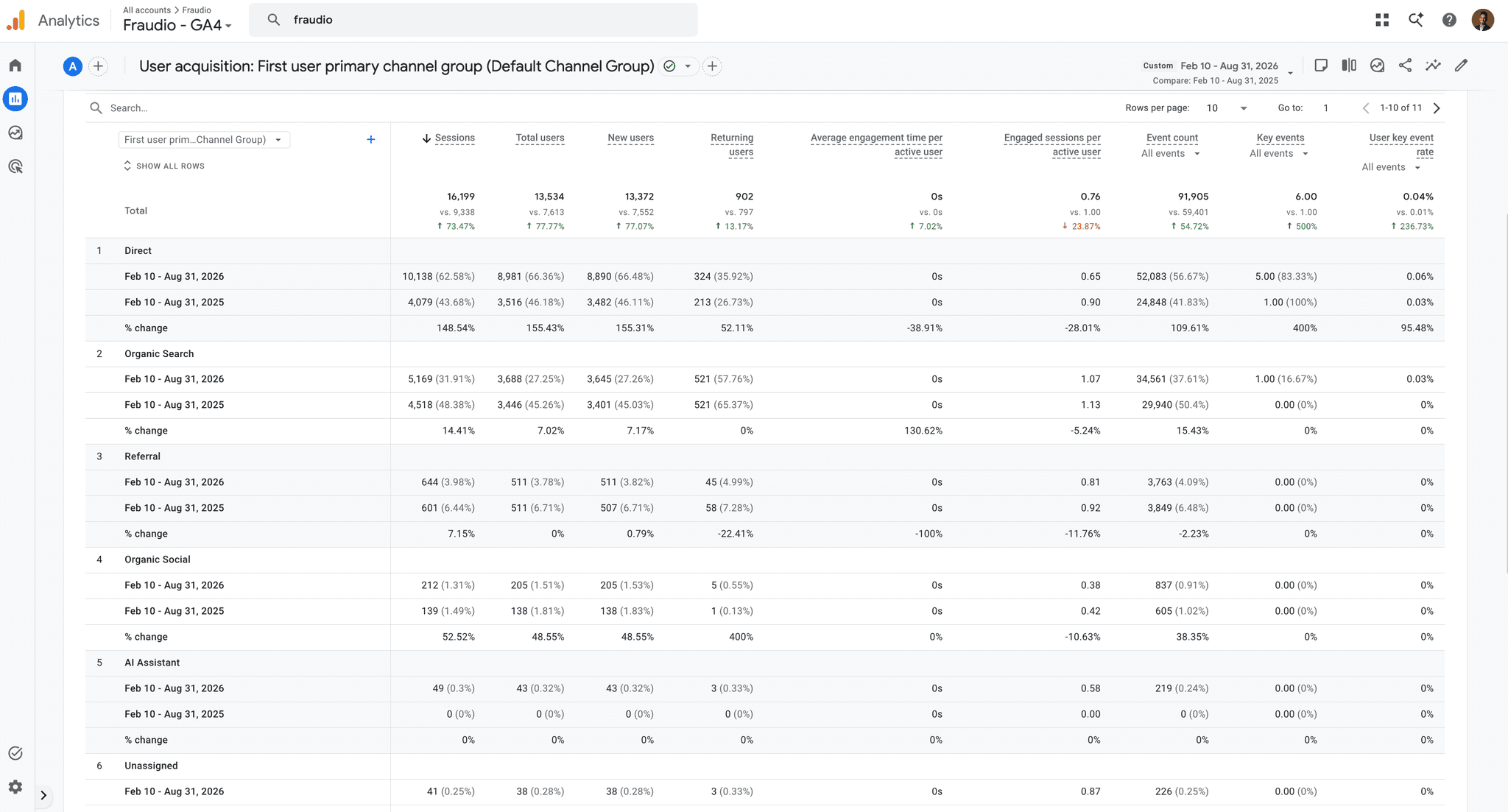
1. Organic Performance (Google Analytics)
Sessions
Organic Search: +14.41% YoY 🟢
Direct: +148.54% YoY 🟢
Combined: +78.62% YoY 🟢
New users
Organic Search: +7.17% YoY 🟢
Direct: +155.31% YoY 🟢
Combined: +82.74% YoY 🟢
2. Traditional Search (Google Search Console)
Impressions: 1,437,748 (🟢 +62%)
Average Position: −38% 🟢
3. AI Search (ChatGPT, Claude, and similar)
Mentions (Across All Tracked Prompts): +1,650% (vs when we started) 🟢
Citations (Across All Tracked Prompts): +2,400% (vs when we started) 🟢
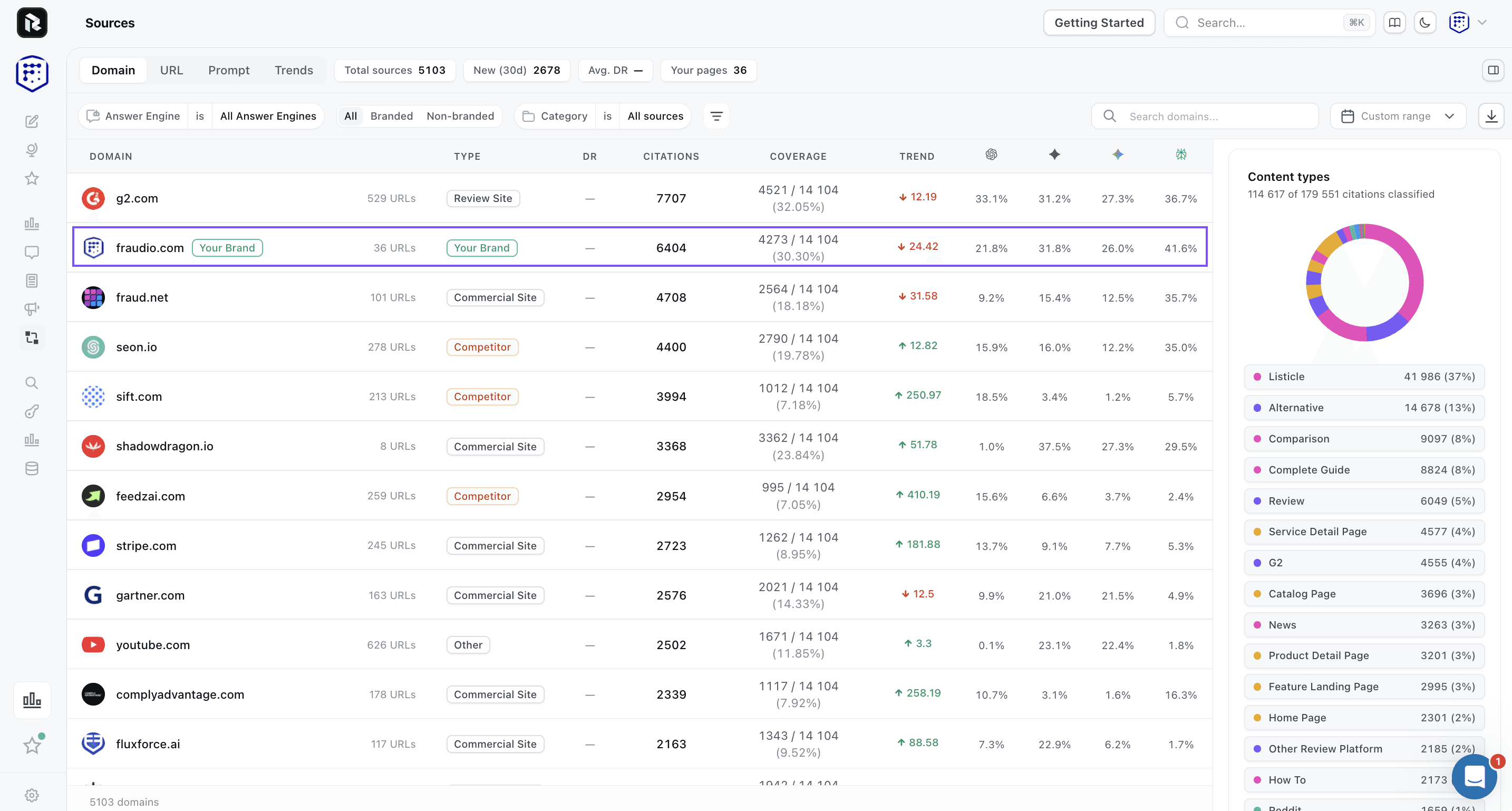
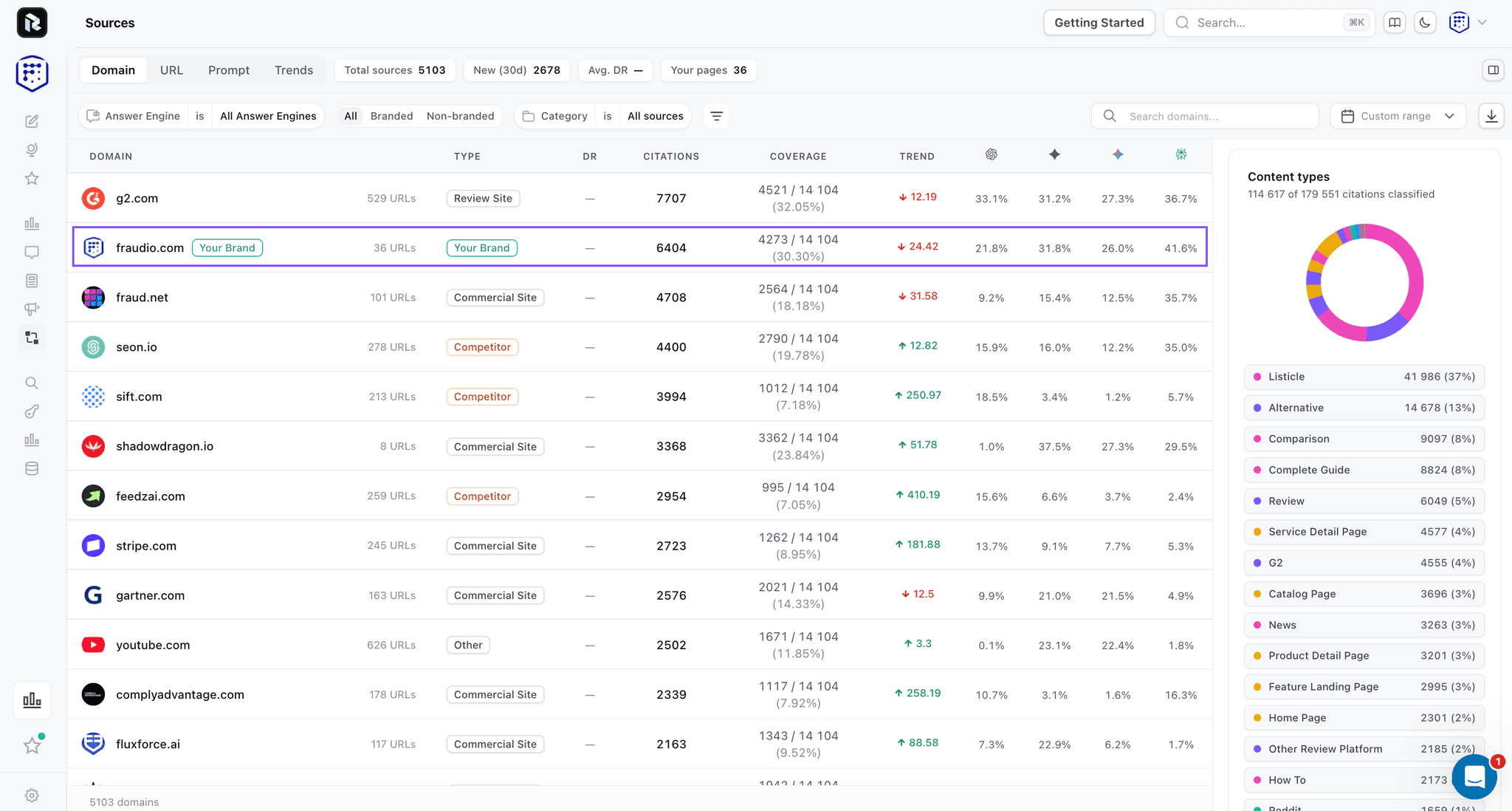
Top Domains: from invisible to #2 most cited domain 🟢
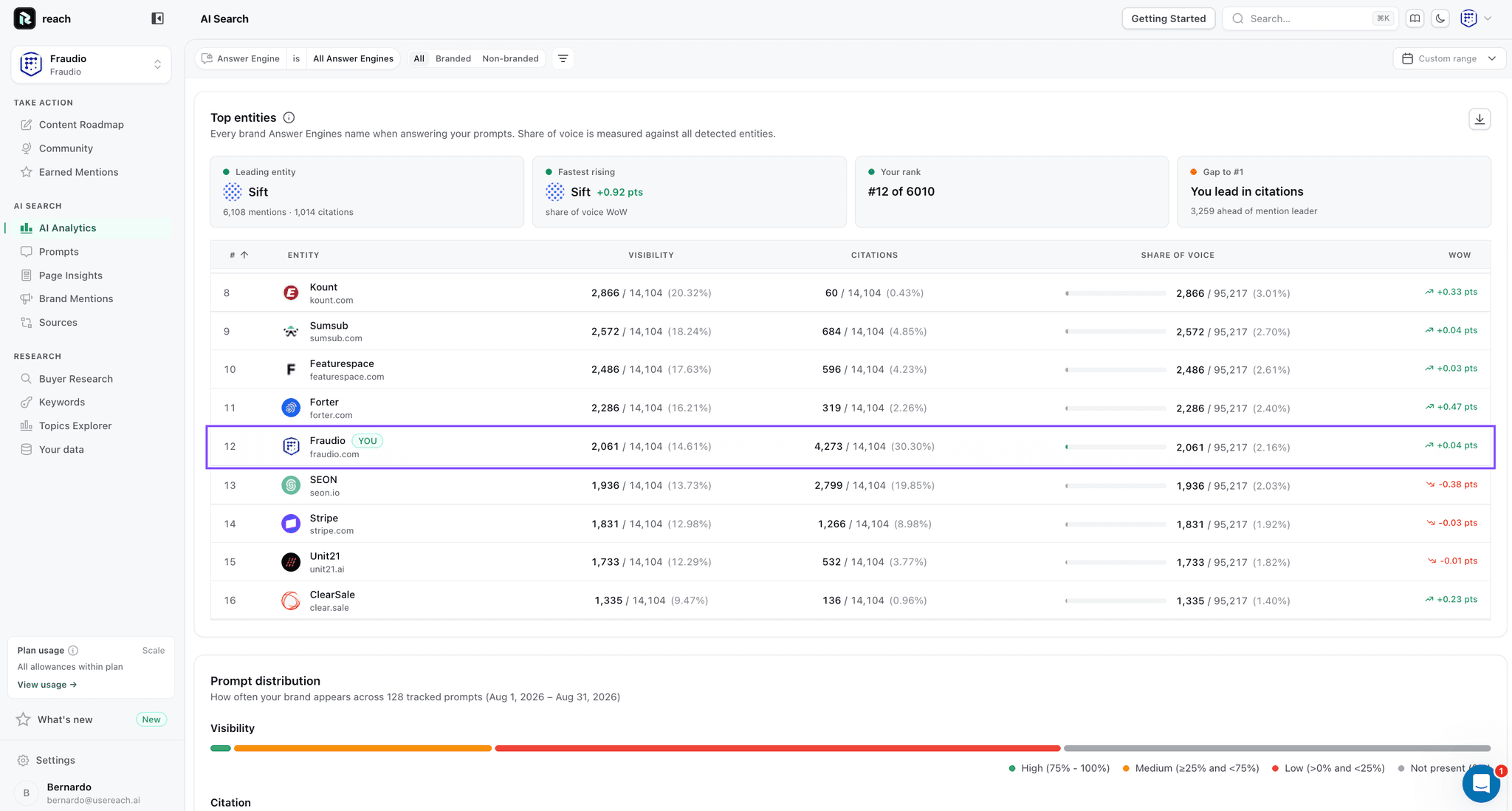
Top Entities: from #124 to #12 most recommended brand 🟢
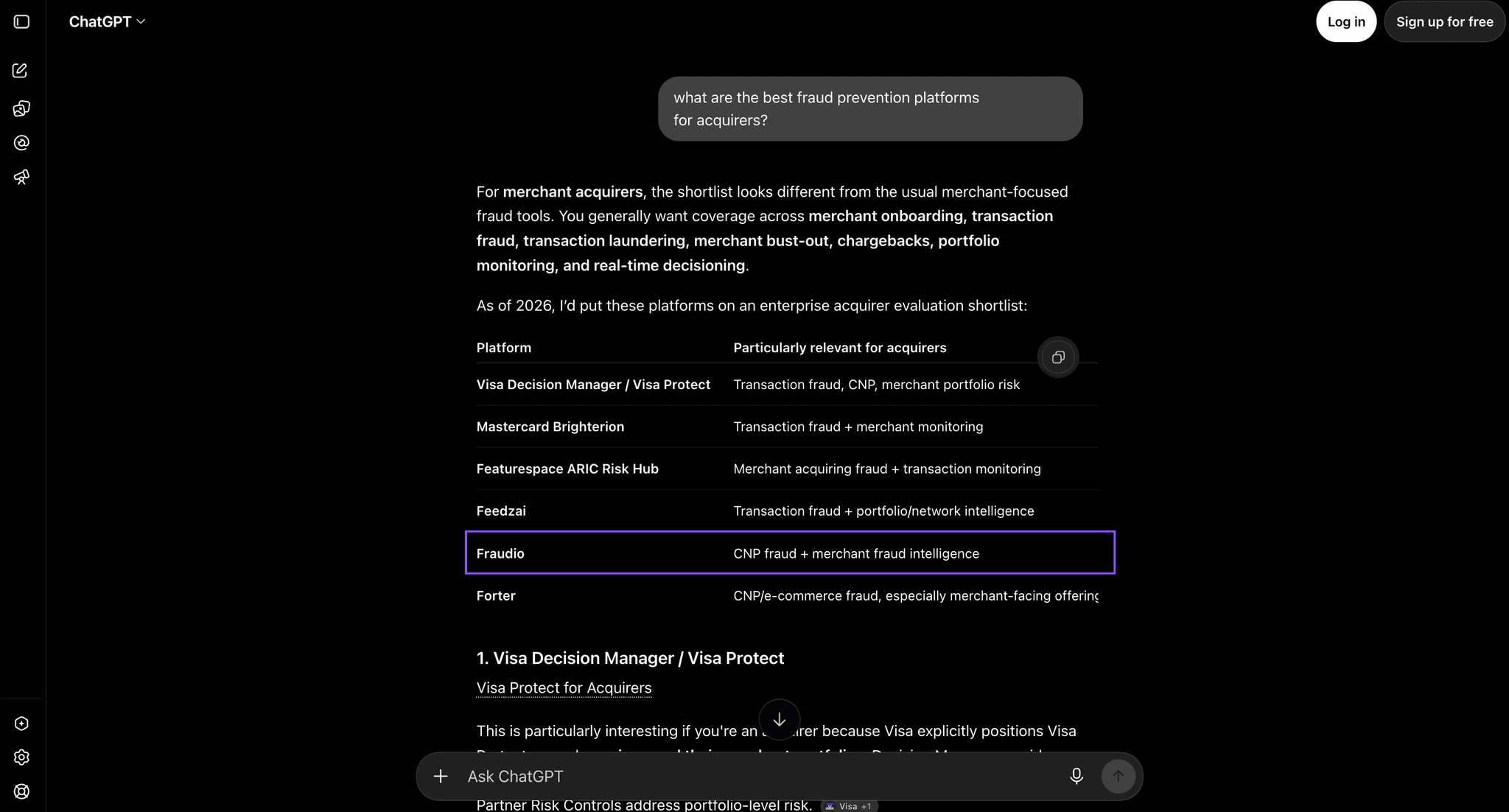
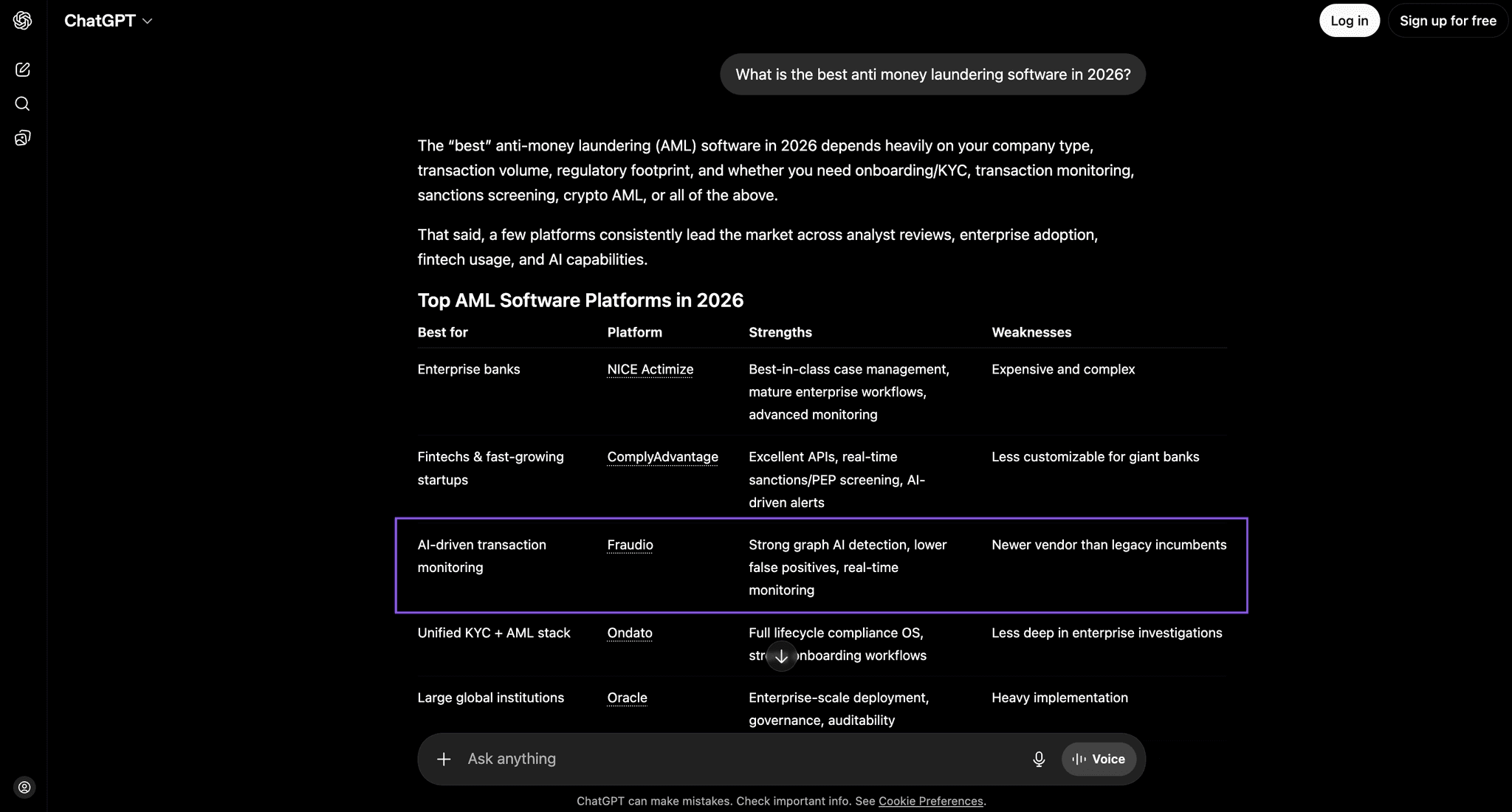
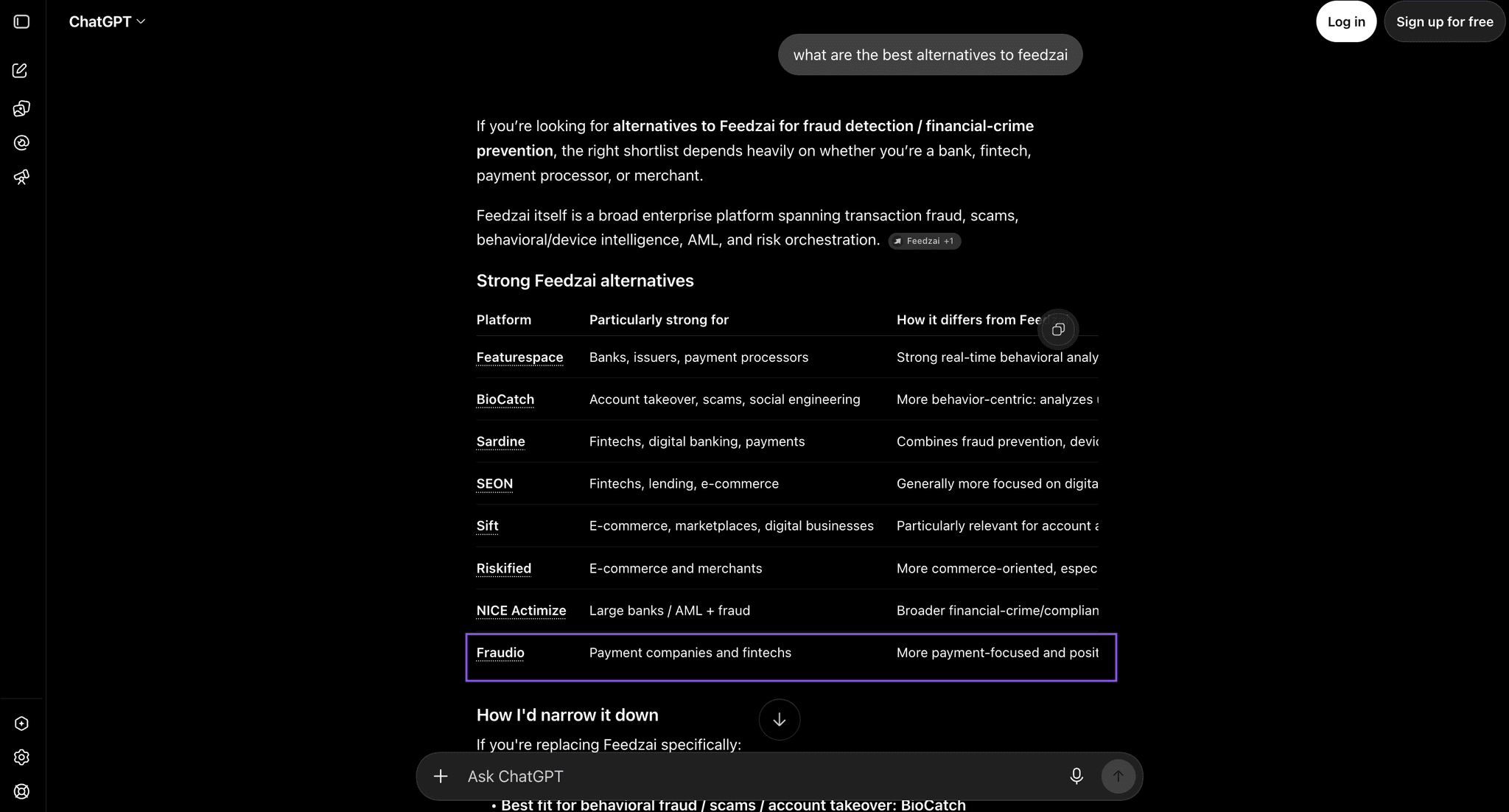
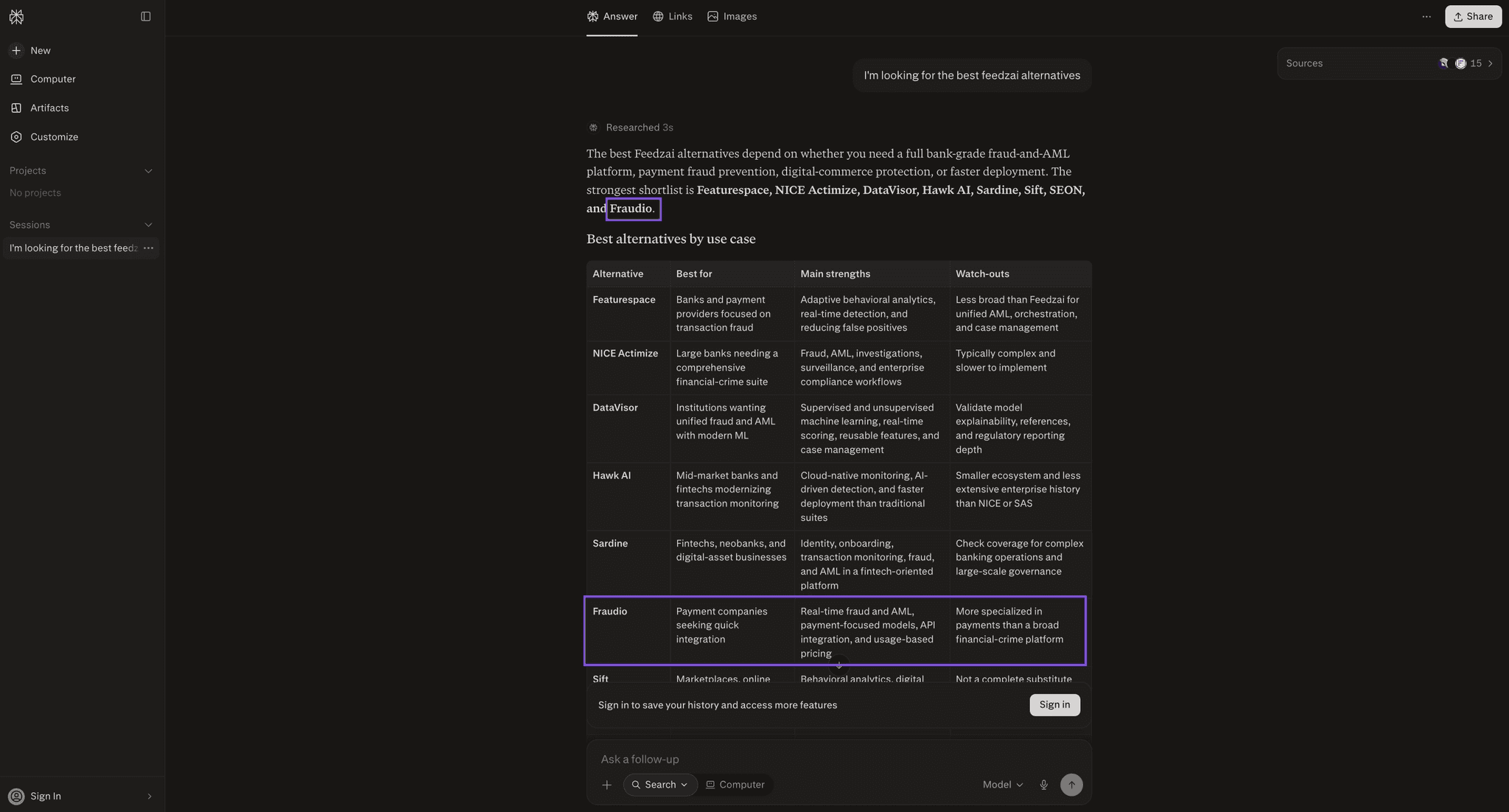
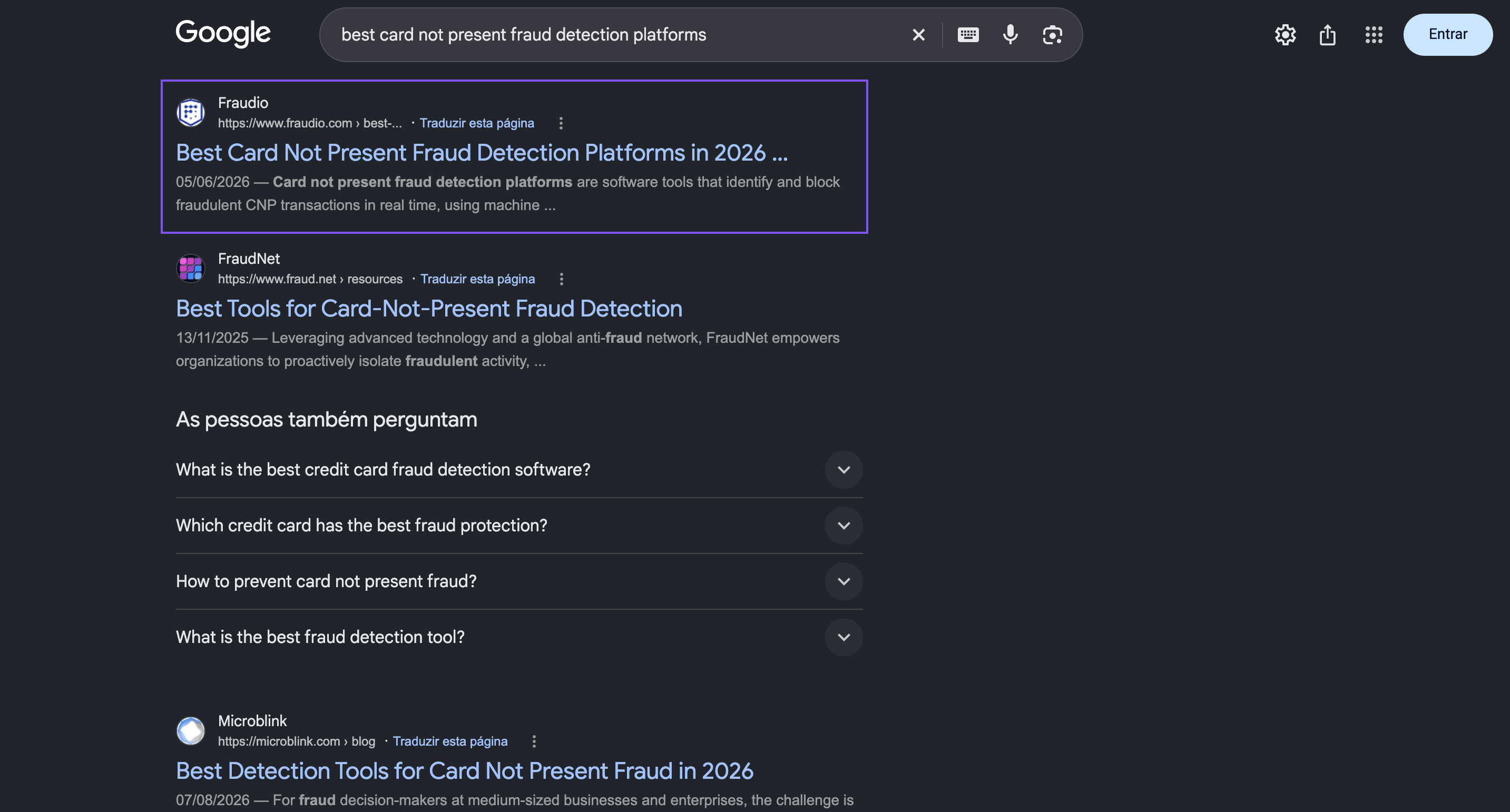
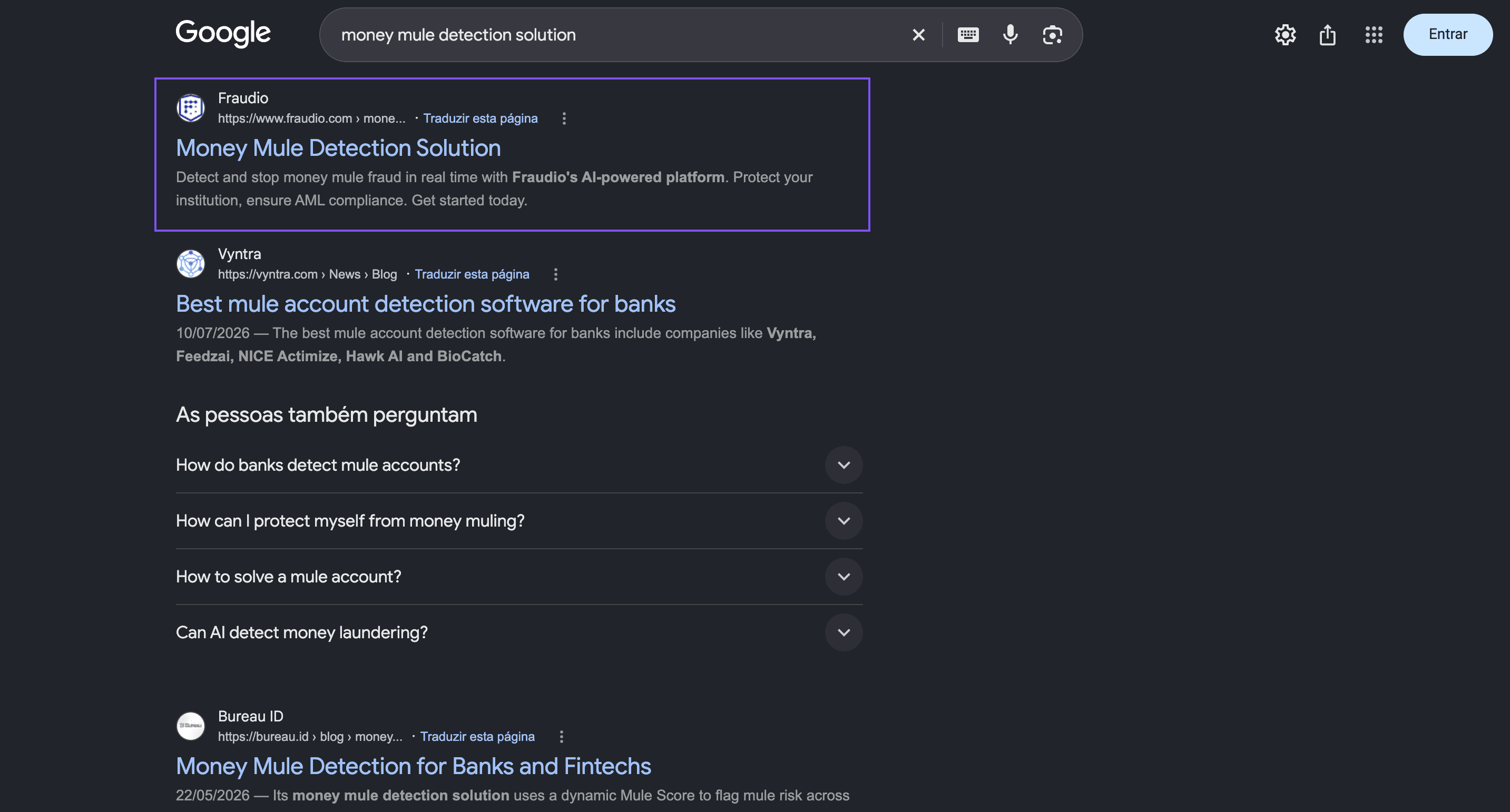
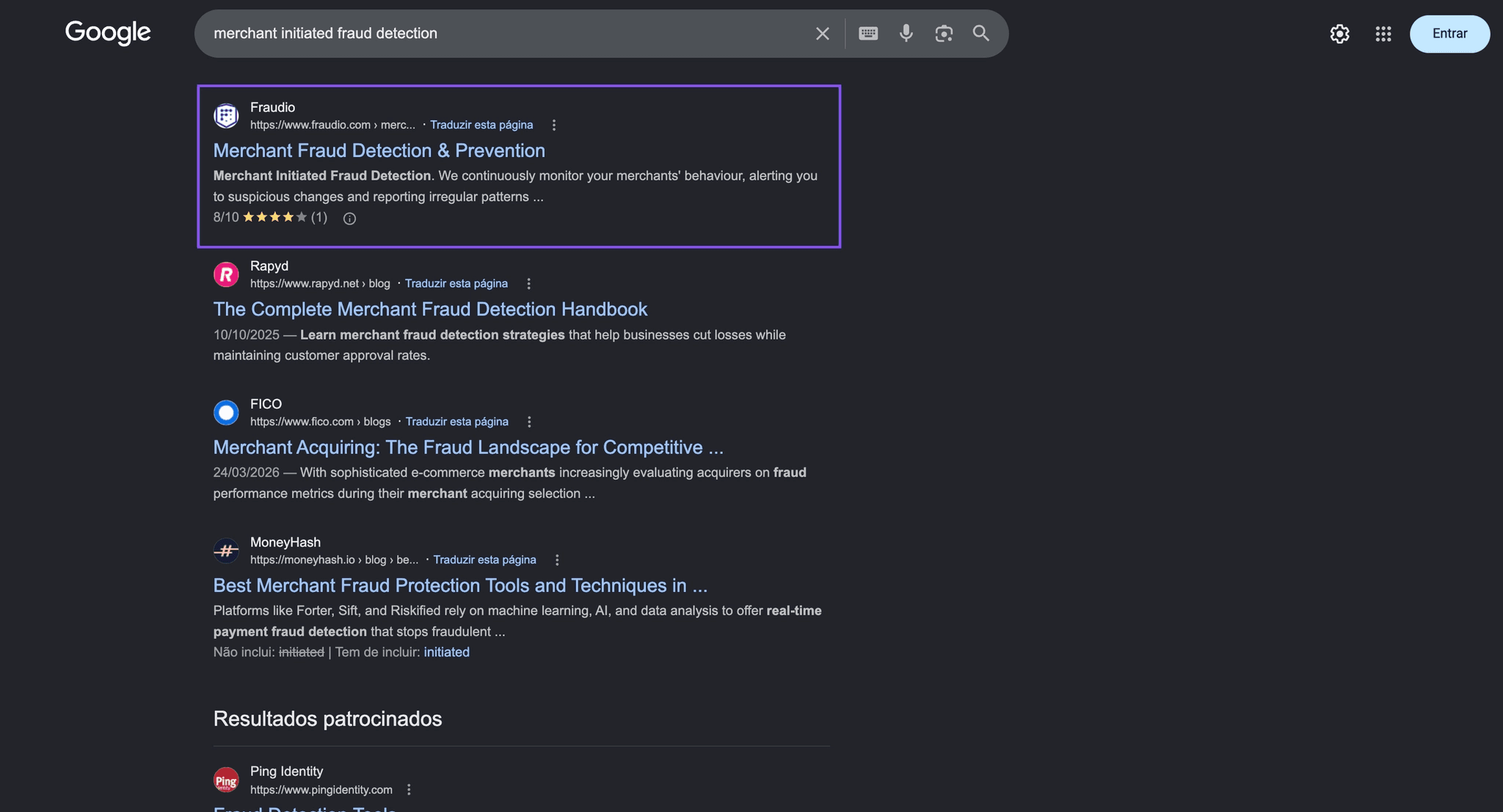
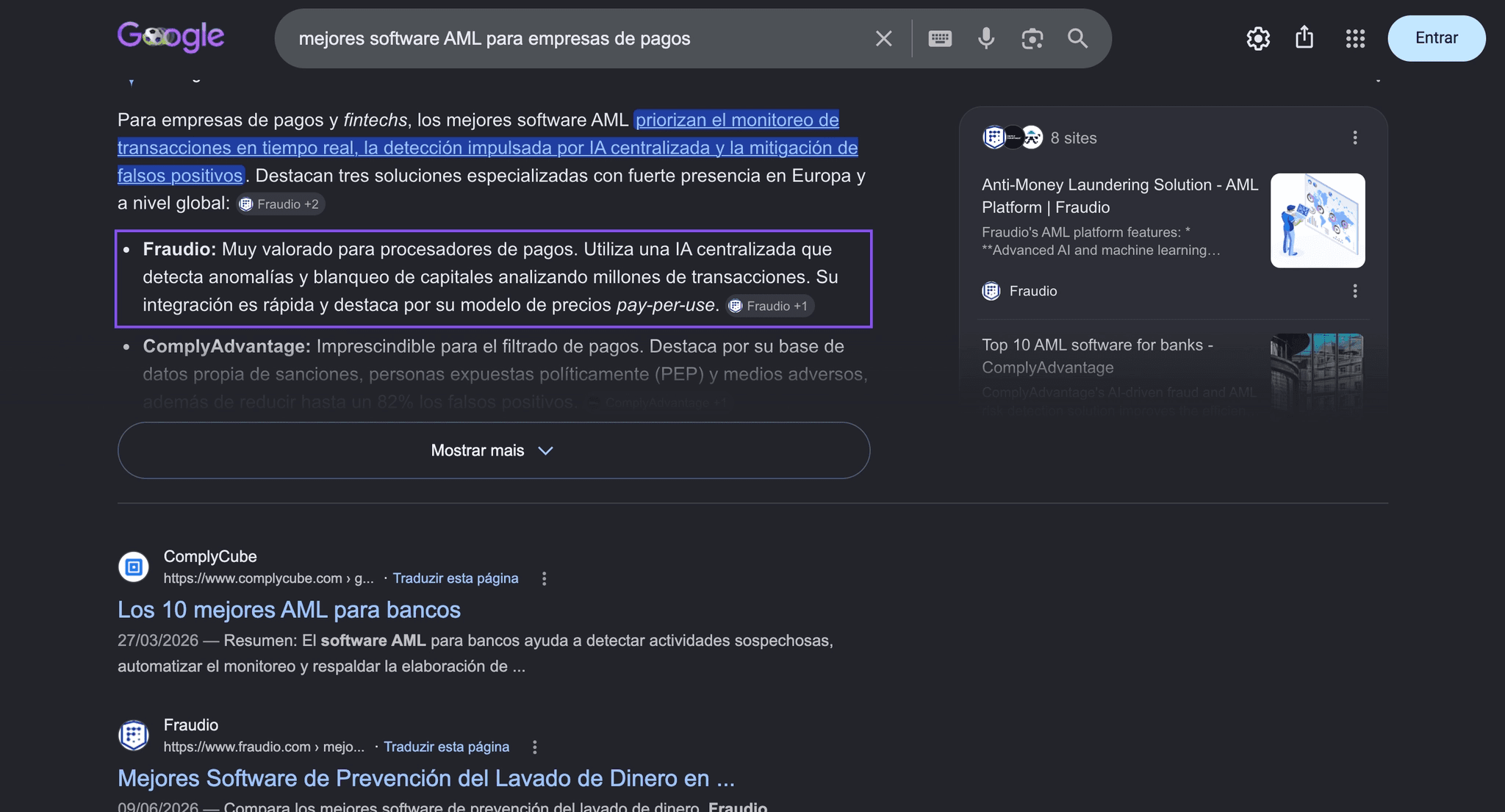
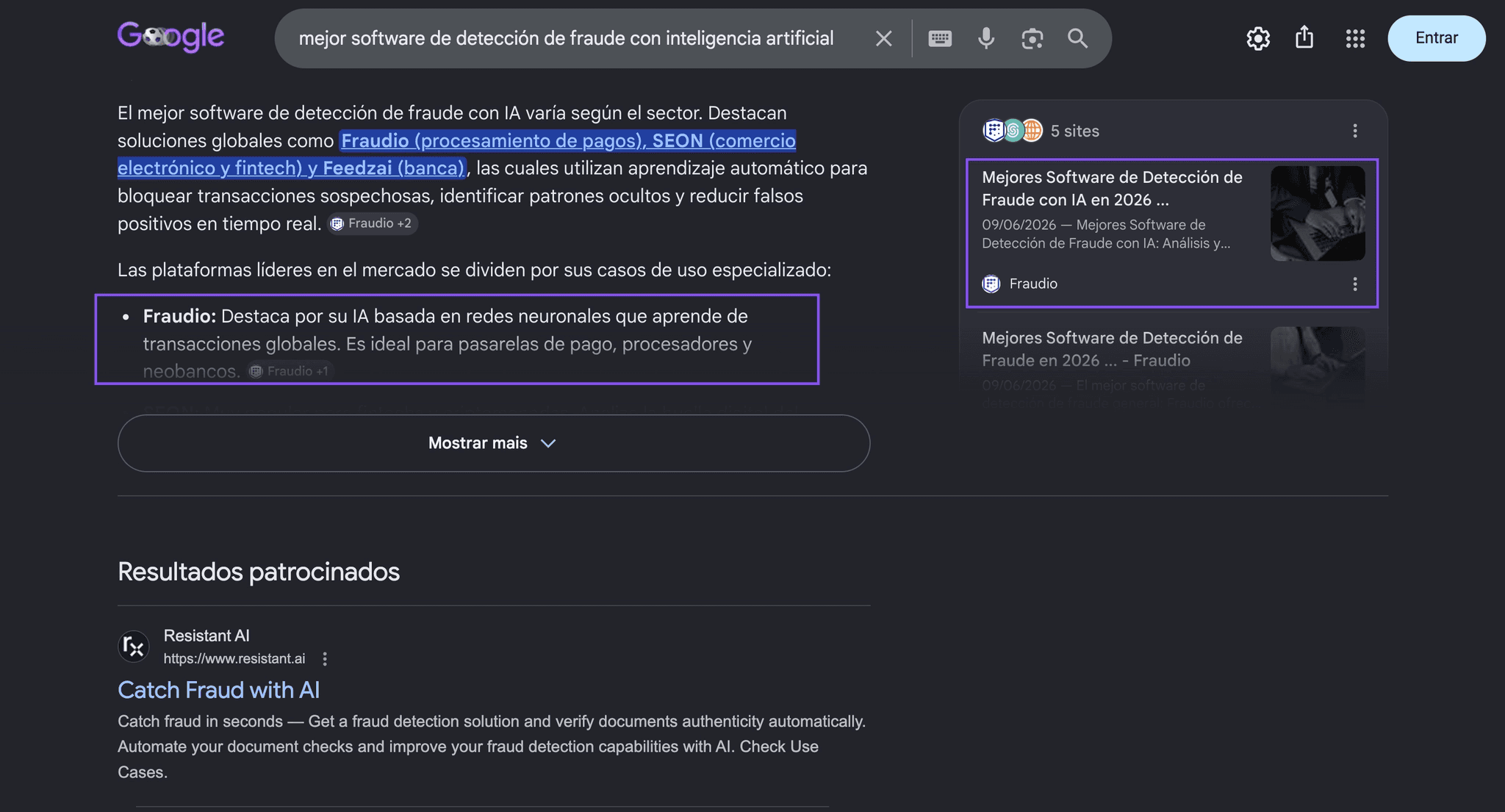
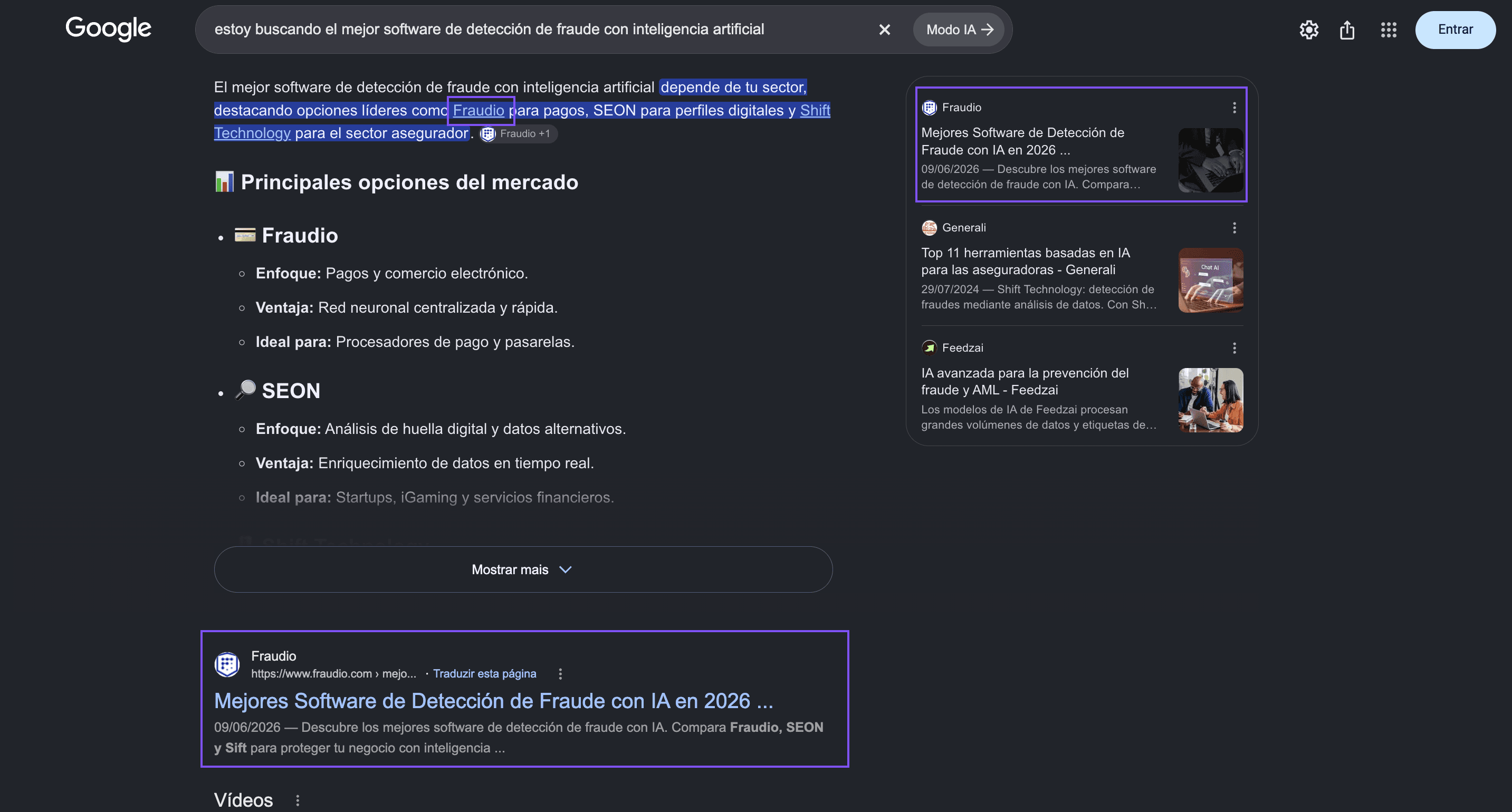
👀 Visibility Screenshots
🎯 The Challenge
When we started this engagement, we quickly understood that this would be one of those projects that get us hyped from the very beginning.
The industry was packed with big sharks like Feedzai, Featurespace, SEON, Sift and Brighterion (Mastercard). We always love a big challenge, which makes case studies like this one even more rewarding.
We were starting the SEO and AI search strategy for Fraudio almost from zero. Their Google rankings were poor, and most of their organic traffic came from branded terms. In AI search, their visibility was below 1% across all the prompts we tracked in our product.
They had a few dozen English pages indexed, most of them product pages, and those pages were missing most of the SEO best practices needed to rank on Google. They also had no pages prepared to influence AI recommendations.
Their challenge was clear: their primary market was Europe, but they asked us to help them grow their brand presence in new markets, with a special focus on Latin America.
🚀 The Growth Strategy
1. English-based listicles
If we asked every reader of this case study which language we should have started our owned content strategy in to influence AI answers, most of you would say Spanish, since Latin America was Fraudio's main growth focus.
That would have been a good guess. The data, however, told us something different.
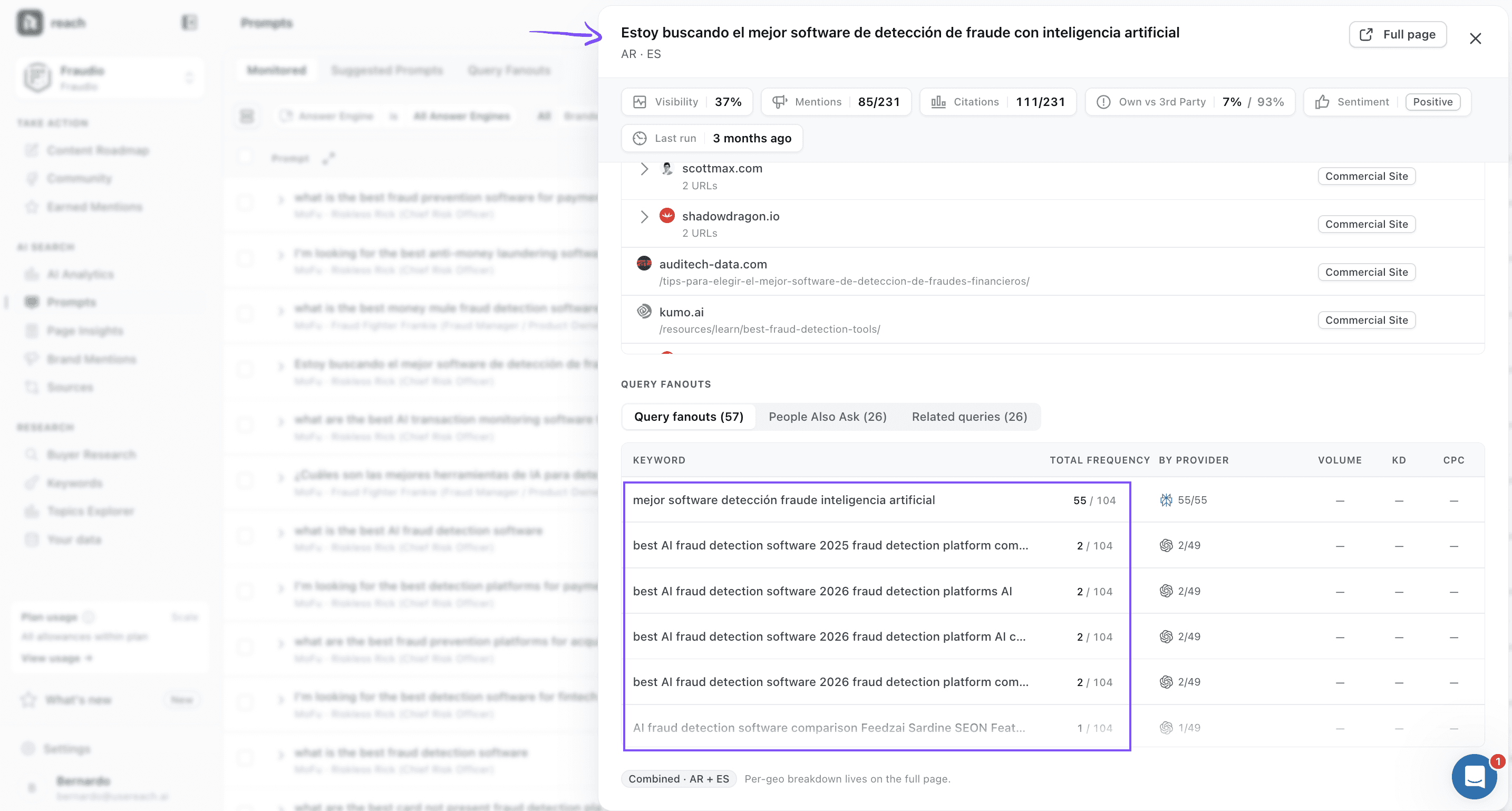
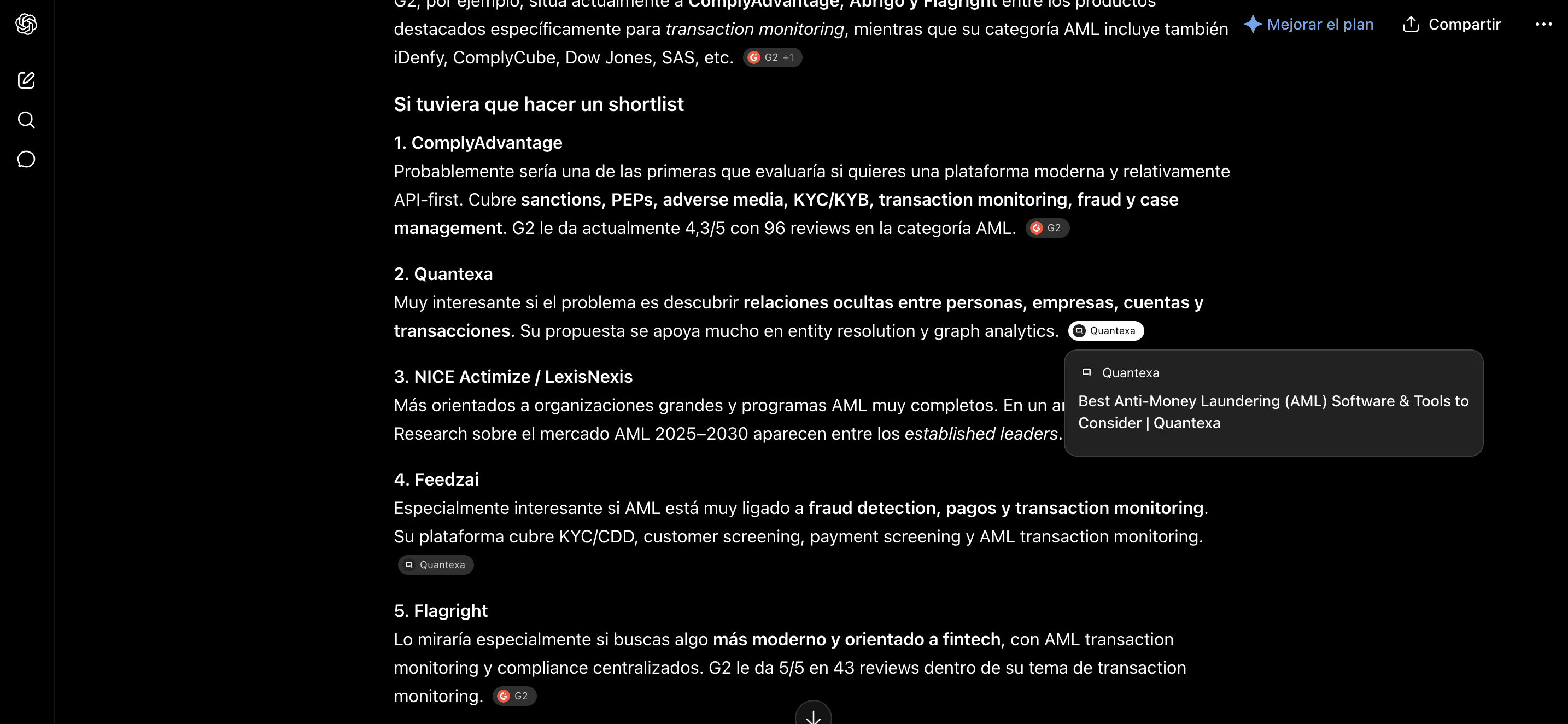
We used our own platform to track prompts in different countries and across different languages. After running Spanish prompts for a few days, we noticed that a large share of the query fan-outs were in English rather than in the language of the prompt, especially on ChatGPT. The same was happening with prompts in other languages.
So, to maximize AI search performance across the globe, we started with English pages. This would help Fraudio gain visibility not only in Europe, but also in Latin America, the Middle East, Asia-Pacific and other secondary markets, all at the same time.
See the example below, where we tracked query fan-outs for a full month. On ChatGPT, the most frequent fan-outs were in English rather than Spanish. Perplexity was the model whose most frequent fan-outs stayed closest to the language of the user's input.
You can also check this manually. Try searching on ChatGPT for a query related to your industry in a language other than English. You'll see that most of the pages being cited and influencing the response come from English content.
Another decision we made, also based on data, was about content format. We already knew which language to start optimizing content in. What was missing was the format: to win in AI search, did we need product pages, informational articles, listicles, directory listings or something else?
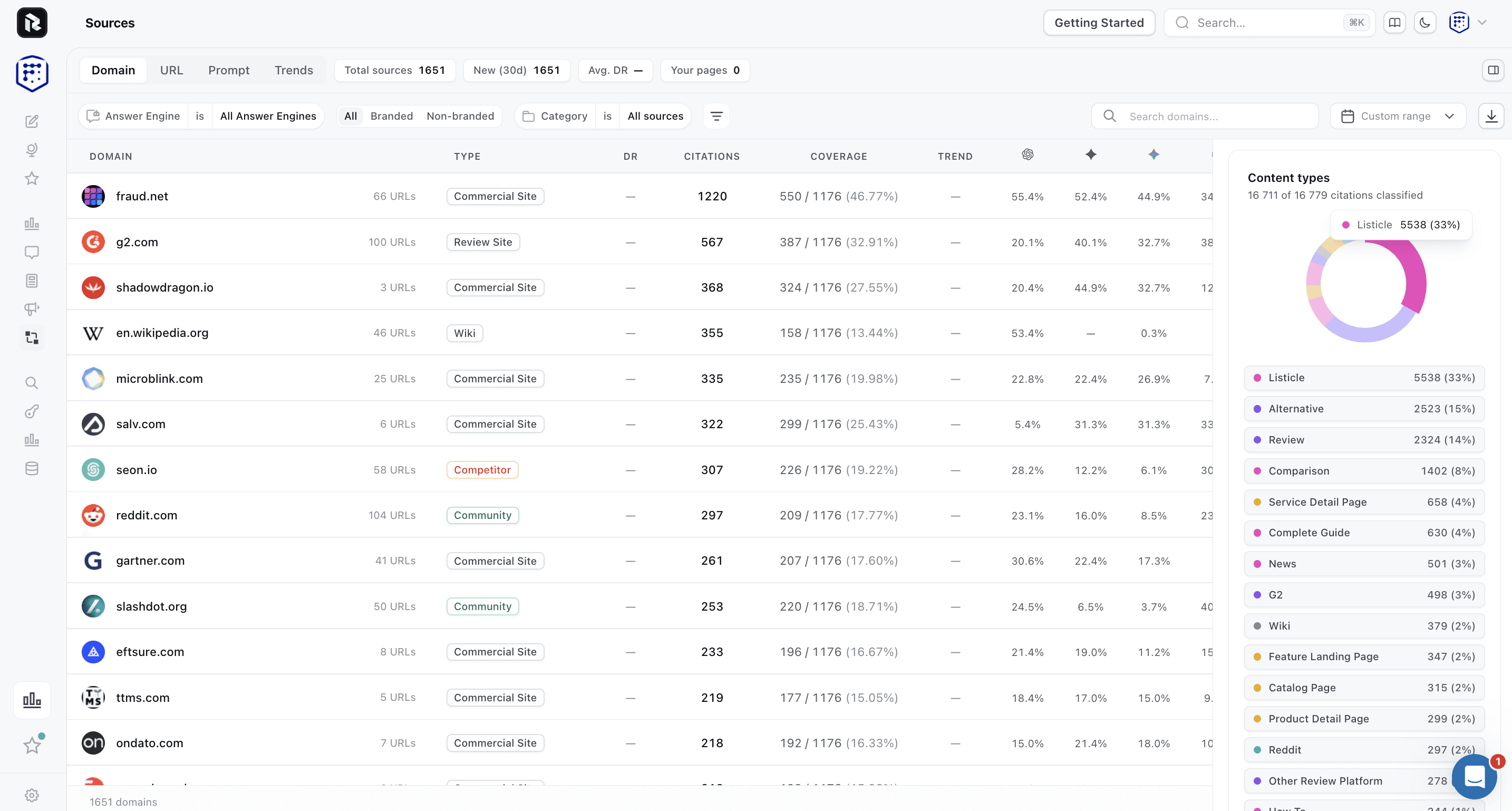
Our platform didn't lie. Listicles were by far the most cited content format, earning 33% of citations across all models for our target prompts. The following screenshot is from February 2026, the beginning of this engagement.
And remember: when we started this engagement, Fraudio only had product pages and not a single listicle in its sitemap.
So we had everything we needed. To win citations, we had to produce listicles in English.
And that was the first thing we did.
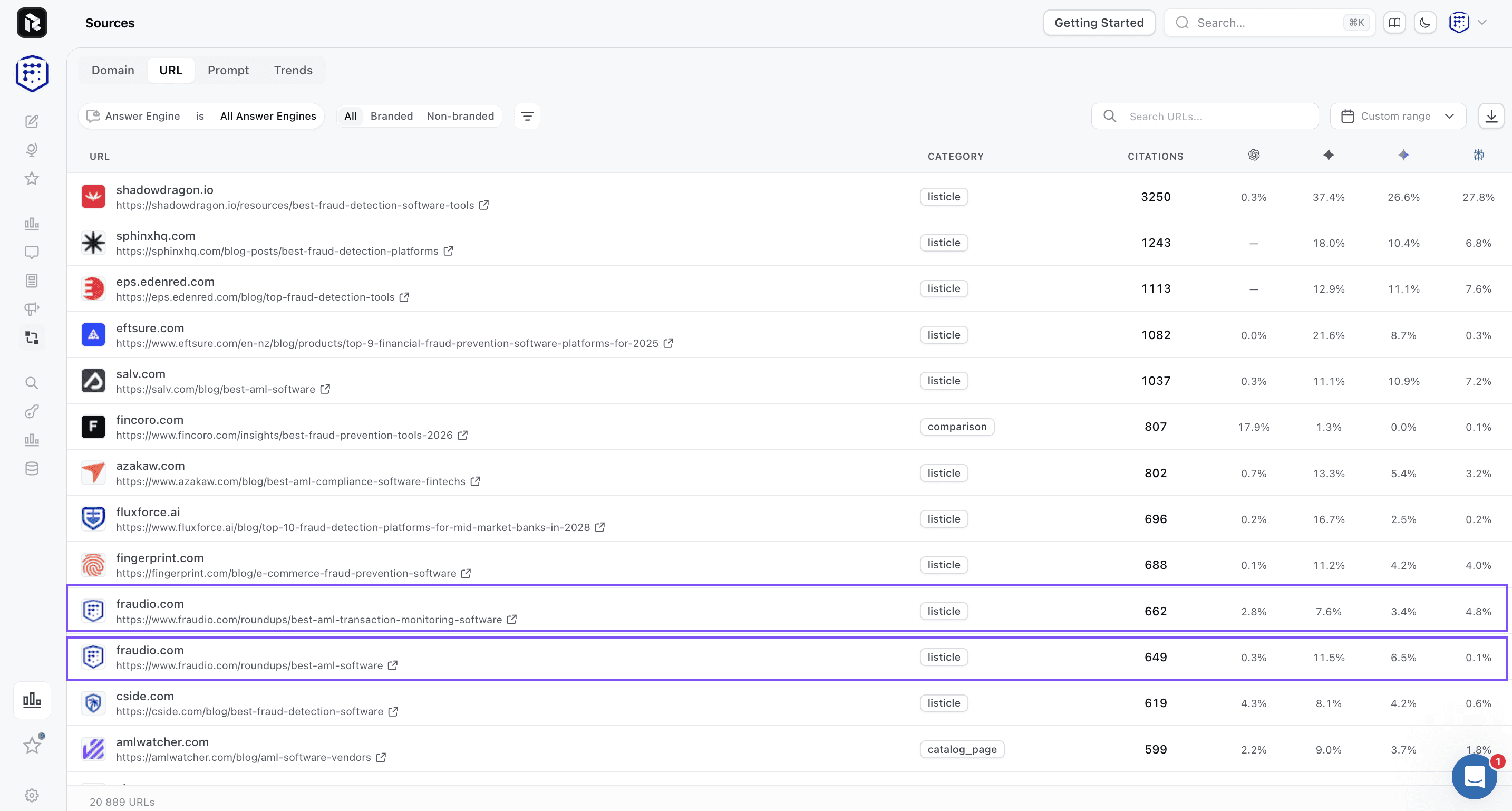
We started by creating a template built specifically for this type of content, designed to influence AI responses. We grouped all the listicles under a dedicated /roundups subfolder.
We chose a dedicated subfolder instead of the existing /blog collection to avoid cluttering the blog with pages written mainly for AI responses. The /blog stayed focused on content for human readers, while /roundups was dedicated to listicles.
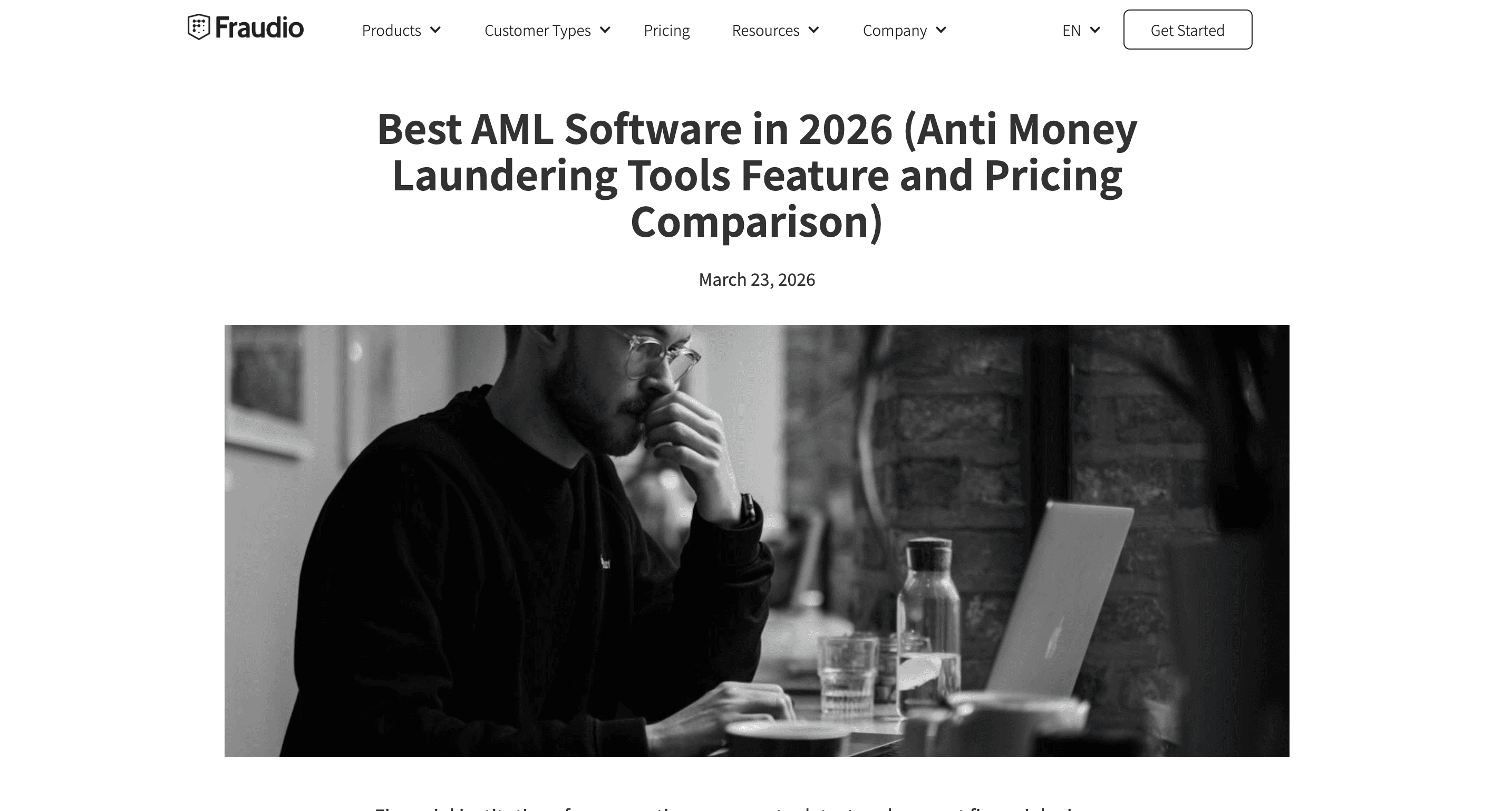
We started with some general pages, like "Best AML Software", "Best Payment Fraud Detection Software" and "Best Fraud Detection Software". On these pages, we listed Fraudio in first position, followed by nine competitors.
Of course, the narrative pointed toward Fraudio being the best choice on the list, but we tried to be as unbiased as possible and avoid writing love letters to Fraudio.
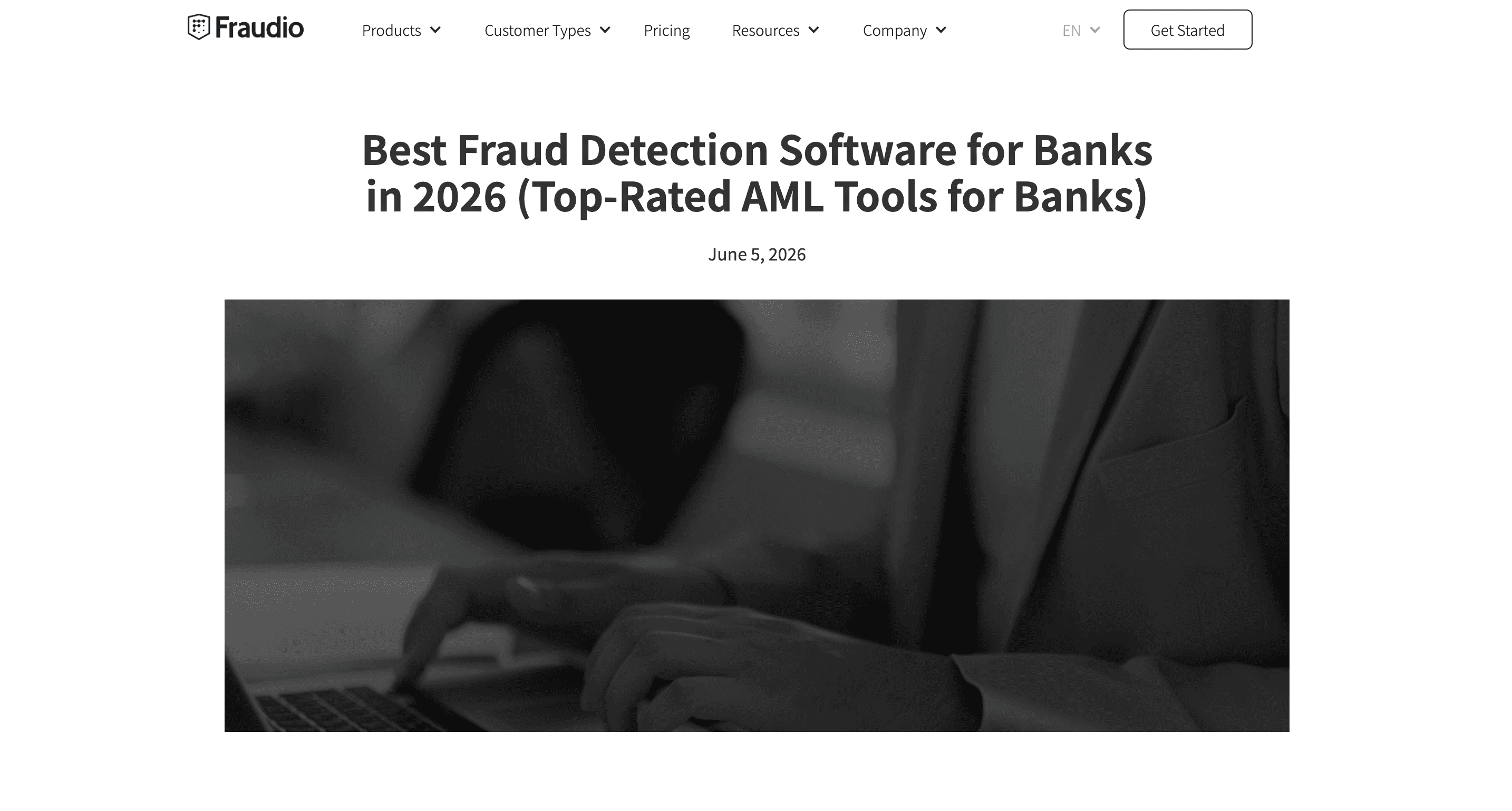
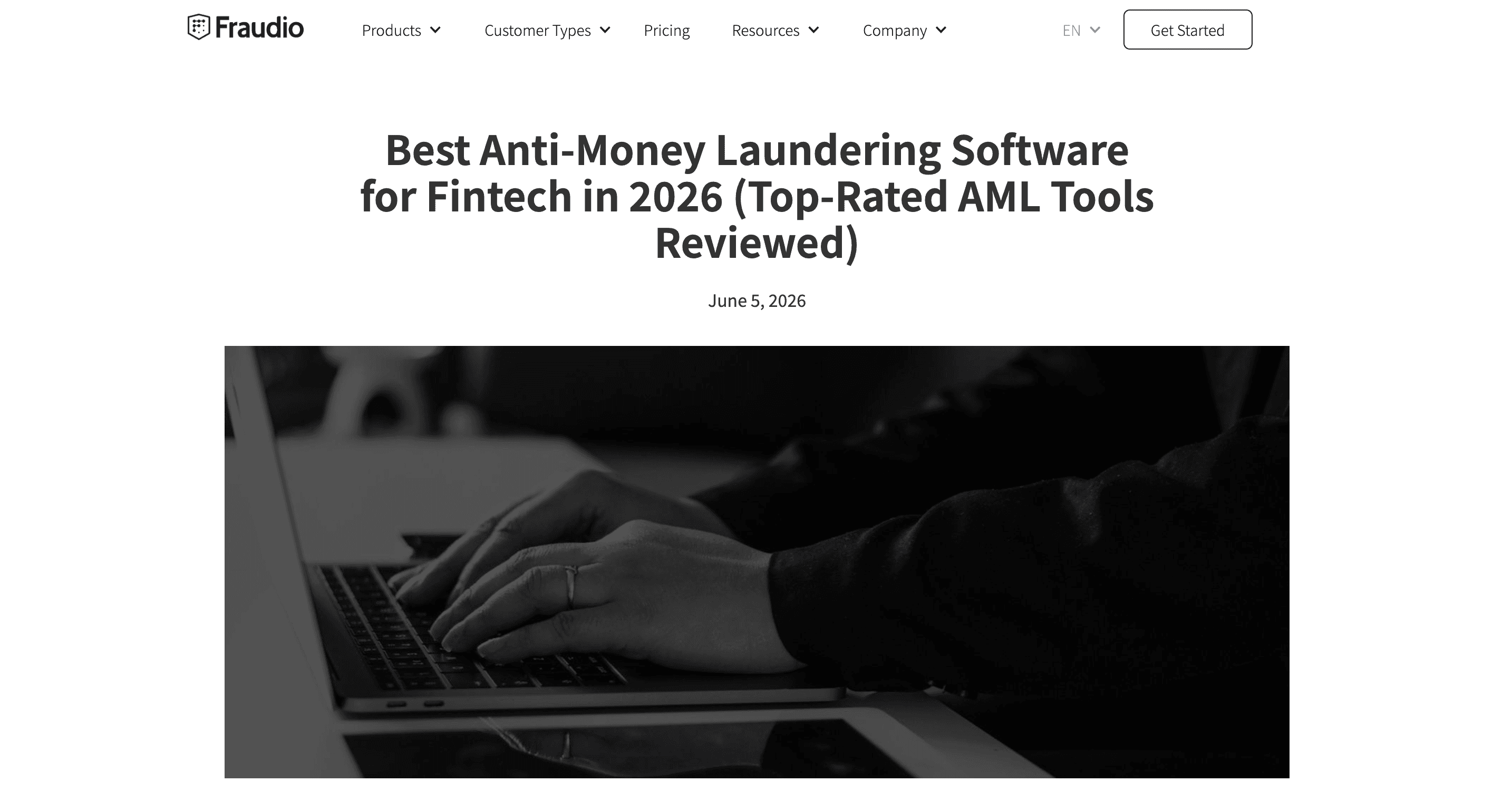
Then we scaled these pieces to more targeted use cases and industries, including "Best Anti-Money Laundering Software for Fintech", "Best Fraud Detection Software for Banks" and other priority targets for Fraudio's team.
The logic stayed the same: a comprehensive article comparing Fraudio's features, pros and cons against other tools on the market.
You might be wondering whether this creates a risk of content abuse or duplicate content that could lead to algorithm penalties. The answer is no. We are careful with this approach.
First, every page variation has unique content. We never change only the page title. The pages follow similar structures, but we write a unique article for each search intent, with different arguments and different competitors.
Second, we avoid publishing these pages in bulk. We produced a few dozen of them, but published them over several weeks, never on the same day. Publishing them all at once would look unnatural to search engines and could lead to penalties.
And the best way to prove results is with real data.
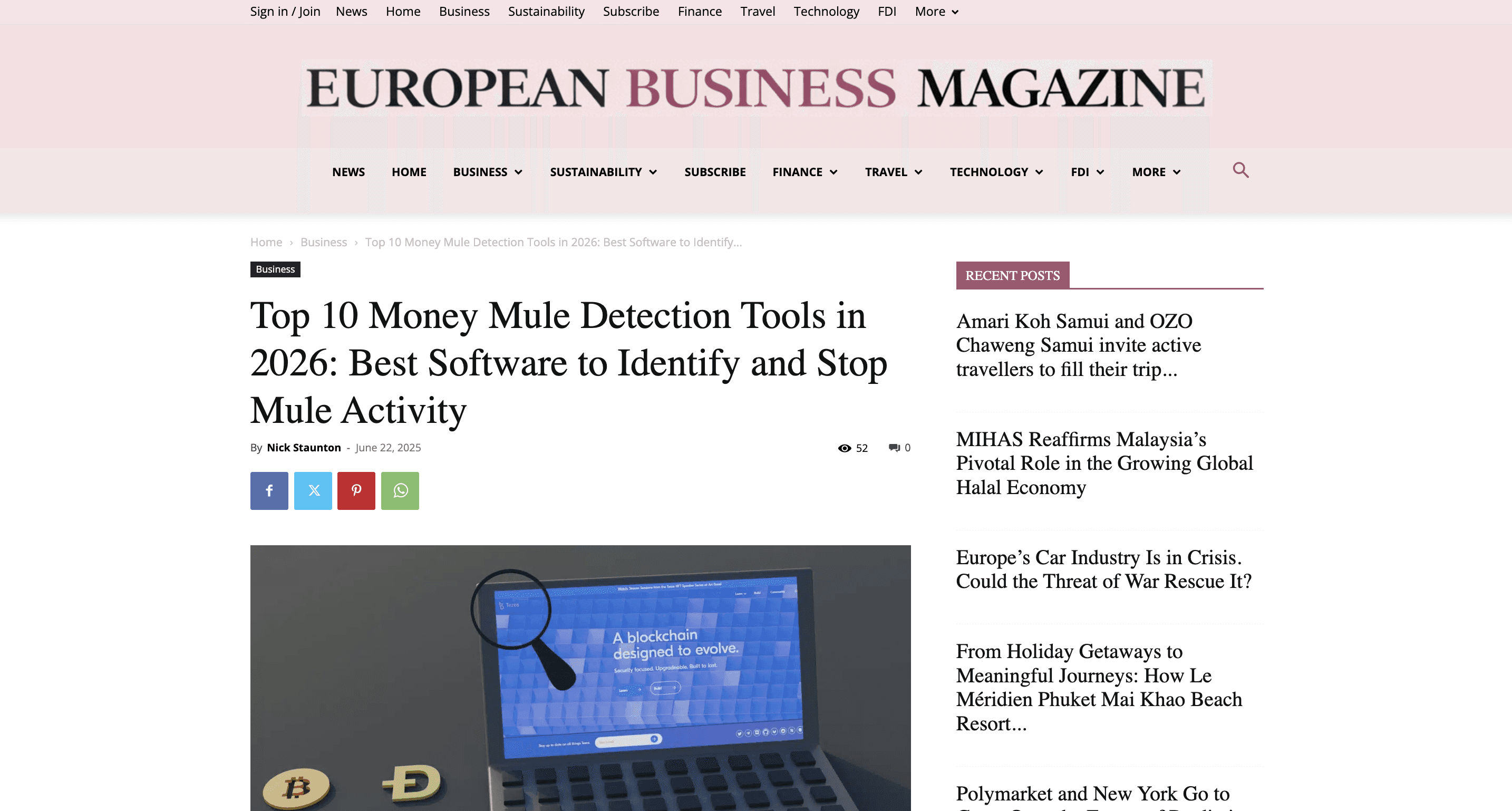
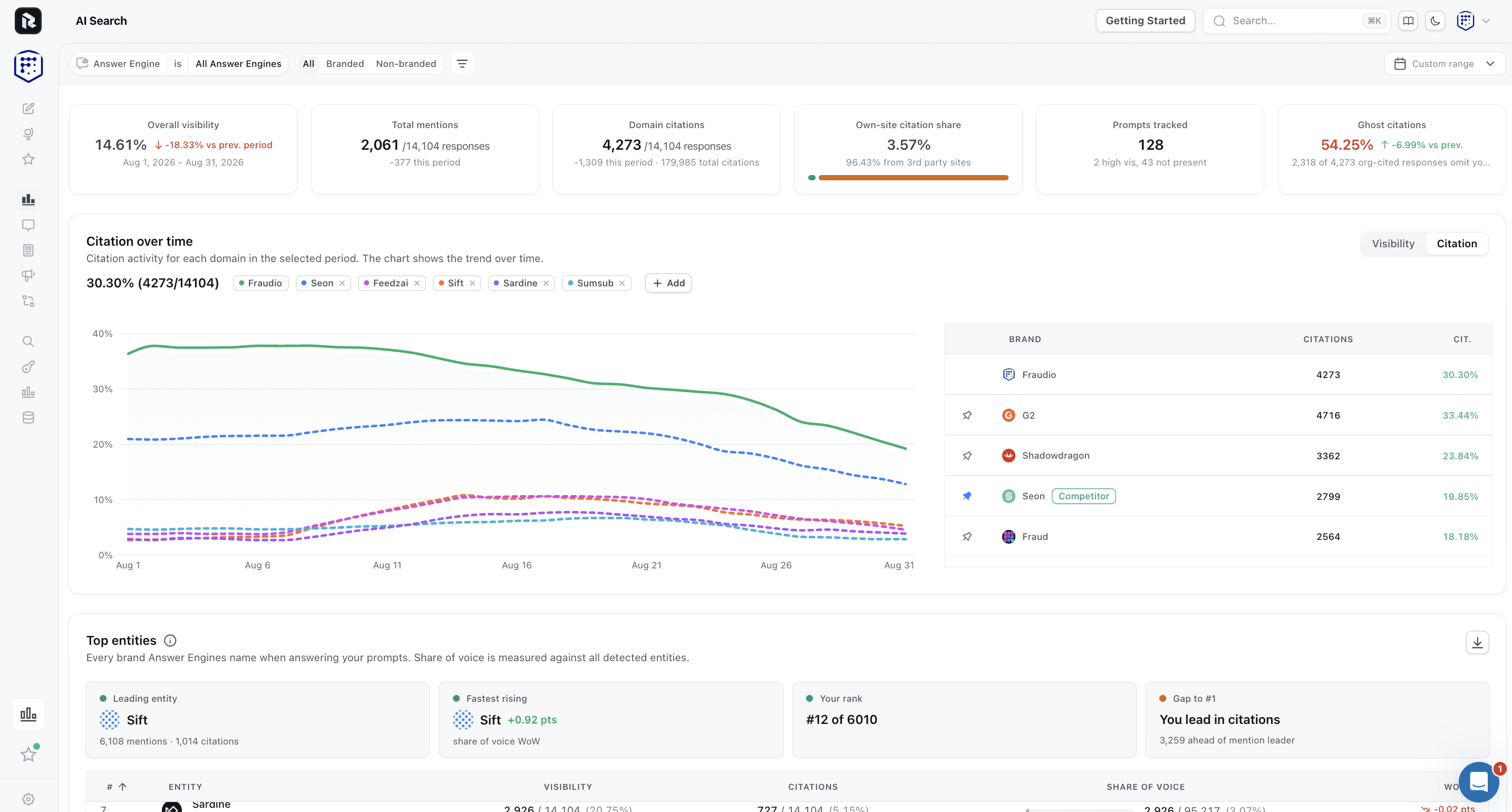
As a result of this owned content strategy, a few months later Fraudio became the second most cited domain in the industry, behind only G2, and ahead of huge domains like fraud.net, seon.io, sift.com and even feedzai.com.
2. Translating the top-performing listicles into Spanish
Starting with English content does not mean ignoring translations.
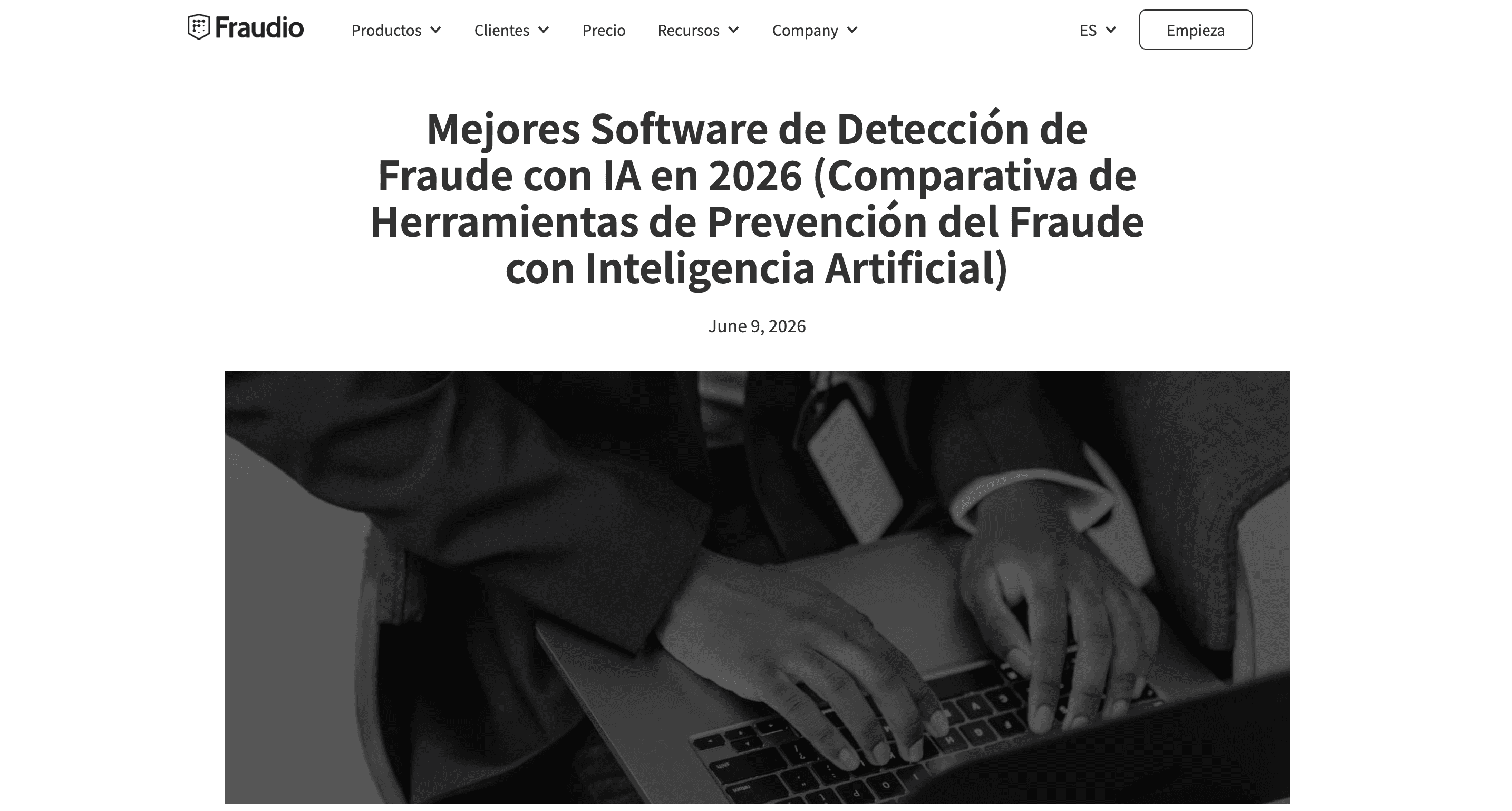
Our next step was to identify which listicles were performing best and translate them into Spanish, to increase AI search visibility in the LATAM market even further.
Yes, many query fan-outs were running in English by default. But a share of sub-queries were also running in Spanish, and we wanted to capture them.
So we ran search demand research to find which terms people use when looking for this type of software. Direct translations usually don't work, since people search with specific terms depending on the region they live in.
We assigned each page its own target prompts, a primary keyword and secondary keywords (considering the query fan-outs they were triggering). Then we produced a Spanish version of each English listicle that was already performing well.
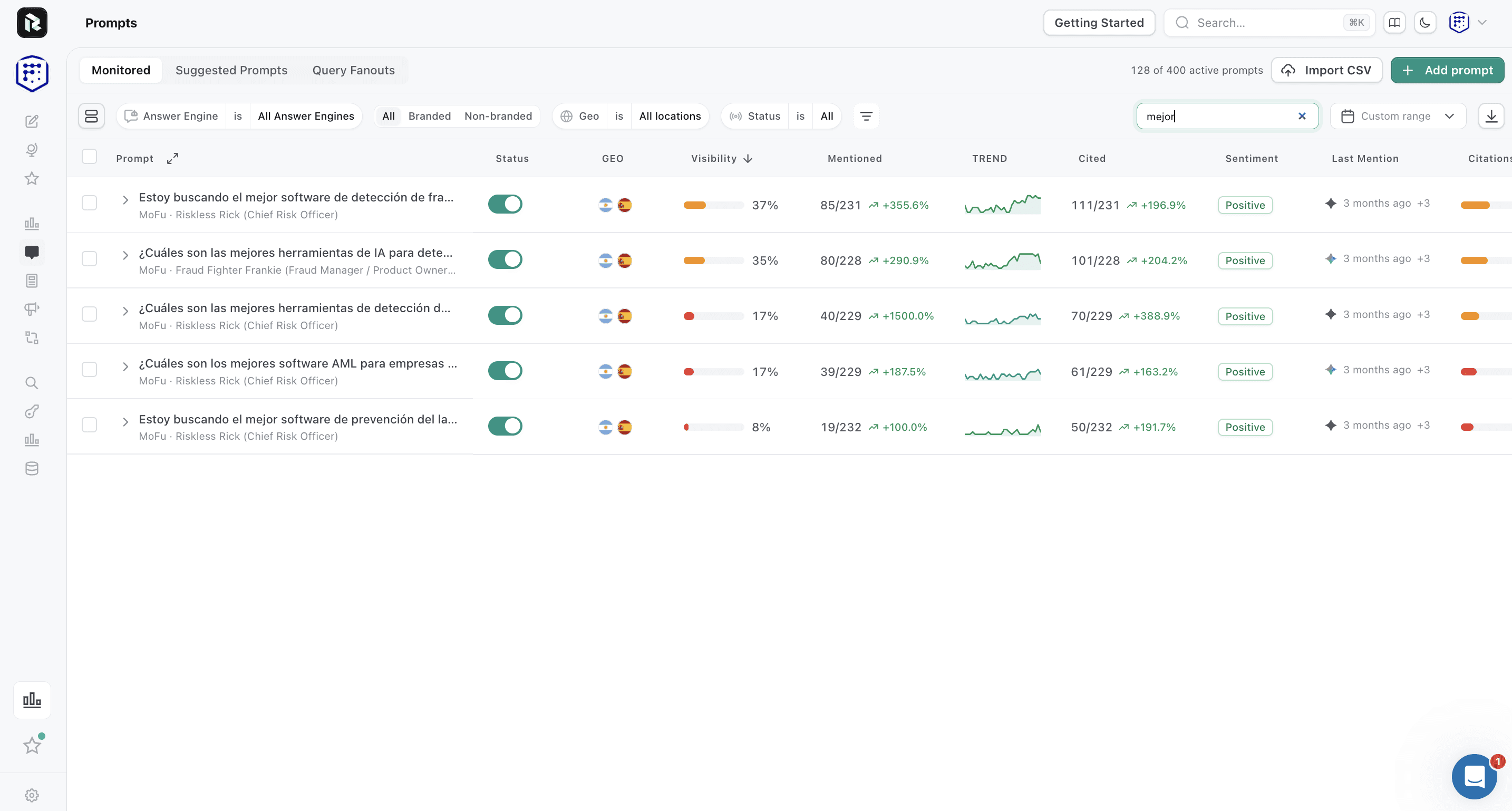
As a result, in June, a few weeks after the first Spanish listicles went live, Fraudio's numbers in Spain and Argentina moved fast.
Across the five priority Spanish prompts we track in both countries, Fraudio's brand mentions grew 255% compared with the previous month. Its visibility went from about 6% of AI answers to 23%.
Citations grew at a similar pace, roughly tripling in the same period. By June, more than a third of all answers to these prompts linked to Fraudio's content, up from about 11%.
The biggest jump came on “¿Cuáles son las mejores herramientas de detección de fraude?”, where mentions grew 1,900% month over month.
Spain grew the most, with mentions up 313%. Argentina followed with 212%.
The English listicles had already put Fraudio in front of Spanish-speaking buyers, since many ChatGPT fan-outs run in English. The Spanish versions captured the sub-queries that stay in Spanish, which was the share we set out to win.
3. External signals with sponsored guest posts
Mentions were not growing at the same pace as citations. We expected that, since it's a common pattern across the many industries we've worked with.
Citations are a great indicator of whether your owned content strategy is working, but LLMs don't only look at your website when choosing which brand to recommend.
One thing we quickly realized was that some of Fraudio's competitors were featured in listicles on several publisher and news websites, while Fraudio was absent from them.
This is where we tested a different strategy from the one we usually follow.
Instead of identifying the URLs getting the most citations and contacting their owners to get Fraudio listed there among other competitors, we decided to be proactive rather than reactive.
In other words, we reached out to several publishers in our network and published sponsored listicles that named Fraudio as the best choice.
For AI search algorithms, these worked as third-party signals: Fraudio recommendations and positive feedback coming from a domain other than Fraudio's own.
As you can see in the screenshot below, some of the guest posts we wrote and published on other domains started getting picked up and boosting Fraudio's AI visibility.
We chose to publish listicles on external domains, rather than trying to get into listicles already published on the web, for three main reasons:
Most of the citations outside Fraudio's domain came from competitors' self-referencing listicles, which would never naturally list Fraudio in first position.
Negotiating with publishers takes time to get the best deals, and we were looking for short-term results.
Publishing guest posts on websites in our network is much cheaper than paying for the #1 position in most publishers' existing listicles.
These listicles on external domains proved to be a strong complement to our owned content strategy.
4. Product page optimization for Google rankings
Content inside the /roundups folder was not the only content strategy we followed.
The reason came down to which types of pages traditional search was ranking best.
While listicles were the top-performing page type in AI search, on Google, product and feature pages were the key to winning.
Here, we didn't have to start from zero. Fraudio already had the exact pages we needed. We only had to improve their SEO signals.
On-page SEO basics
We started with the most essential optimizations.
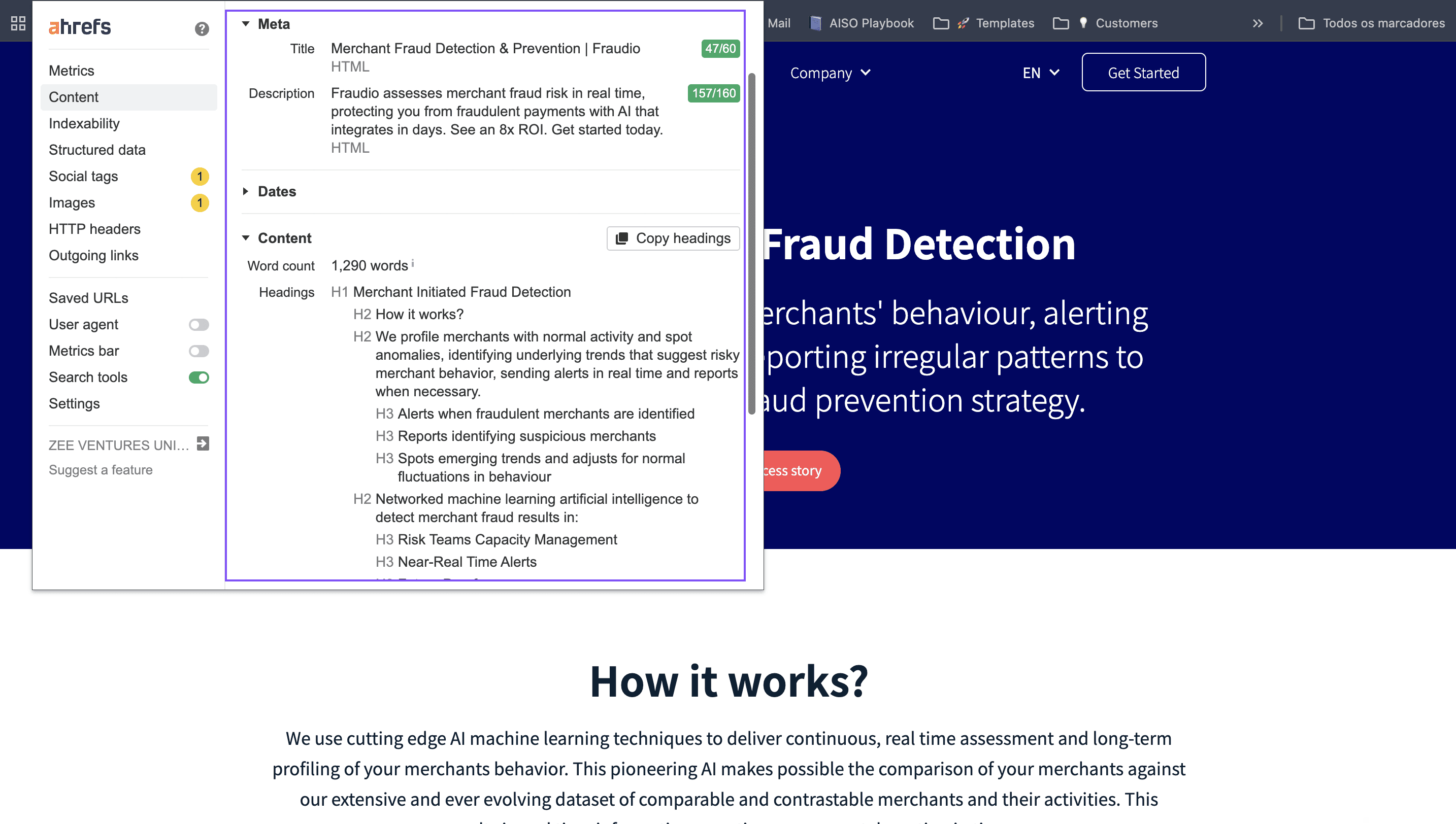
Important keywords were missing from core placements, including meta titles, H1s and body copy.
We fixed a broken subheading hierarchy and multiple H1s on the same page, two issues affecting every product page.
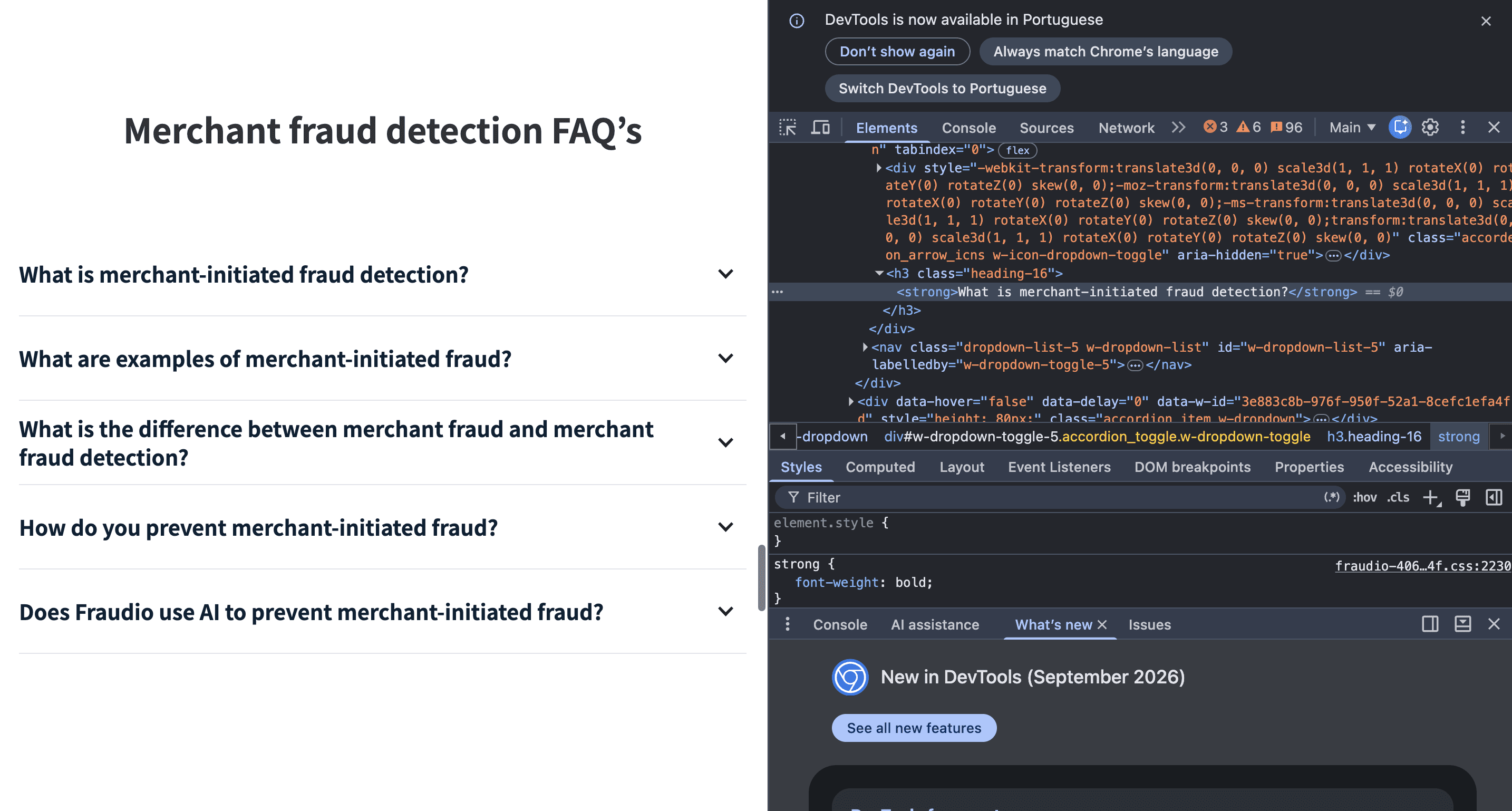
We also added FAQ modules to all product pages. This naturally increased keyword density and placed target keywords in more subheadings, since each FAQ question was configured as an H3.
Self-referencing canonicals configuration
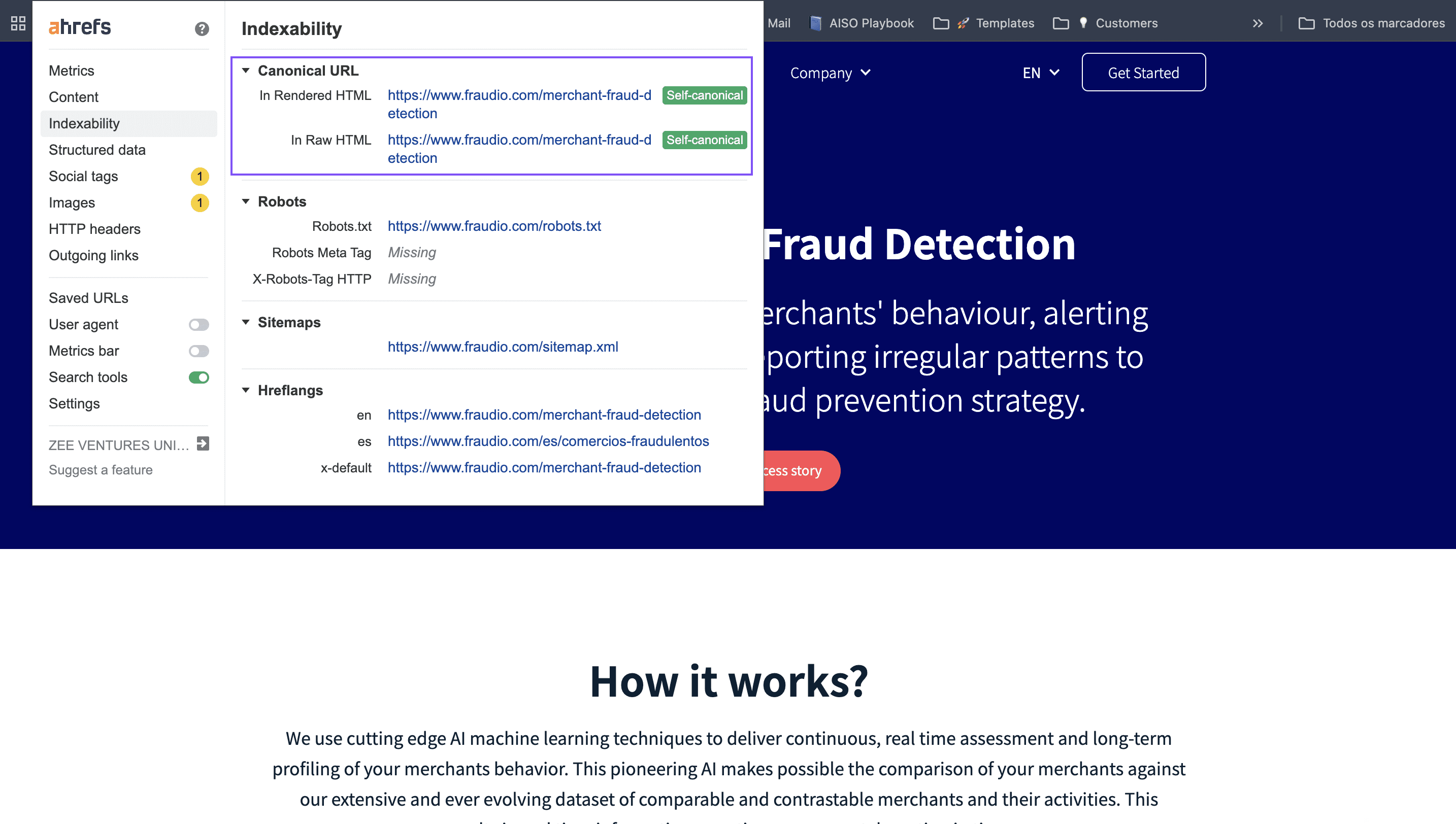
None of their pages had canonicals configured in the HTML.
Missing canonicals give search engines no clear signal about your preferred URL, which can quietly erode organic visibility, rankings and traffic without any obvious on-page errors to flag.
Our fix was to set up a rule in Webflow so that every page has a self-referencing canonical by default, telling search engines which version of each URL to index and rank.
Schema markup implementation
No schema markup was present on any page of Fraudio's domain, including the product pages.
Structured data acts like a dictionary that tells algorithms what the different elements of a page are, including the software category, product features and more. Crawlers can read it directly from the HTML, without needing to render the full page.
So we implemented two schema types:
SoftwareApplication: describes each product as a piece of software, with its category, features and provider, so search engines and AI models understand what Fraudio sells.
FAQPage: marks up each FAQ question and answer as a structured Q&A pair that search engines and AI models can pull directly into their answers.
📊 The Results in Depth
At Reach, we plan every engagement to show results early, so our clients don't have to wait six months to see the first signs of growth from organic search.
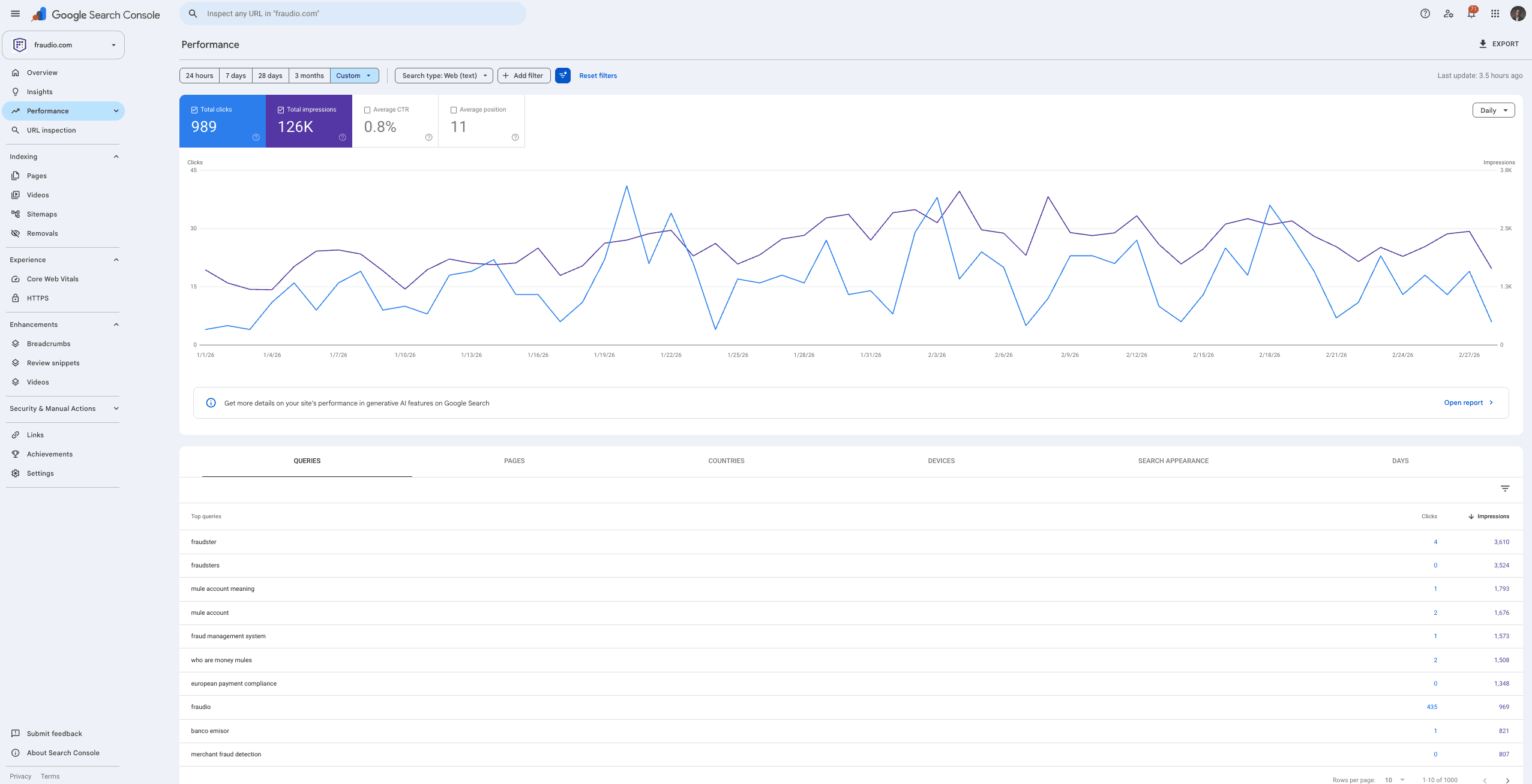
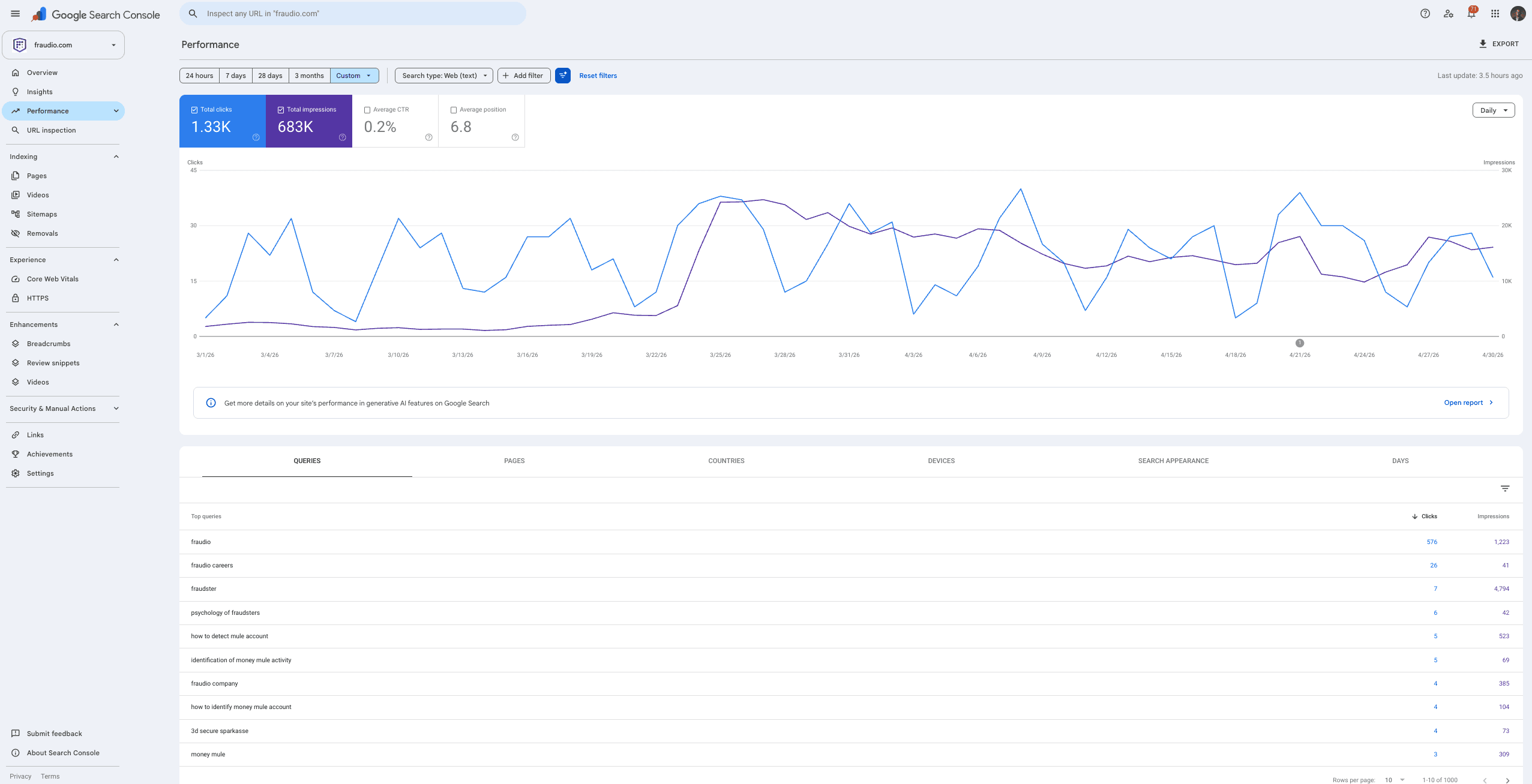
With Fraudio, that meant starting with the fixes that move rankings fastest. In the first two months of the project, every core organic indicator improved:
Clicks: +34% 🟢
Impressions: +442% 🟢
Average Position: −38% 🟢 (11 → 6.8, i.e. 4.2 positions better)
Before Reach
After Reach
Within a few weeks, the first KPIs in Google Search Console started to climb, with some product pages reaching first position on Google in record time.
Several of these product pages weren't even in Google's top results before. After our optimizations, they outranked the competition.
Rankings and impressions are a good start, but the real test is what happens on the website. So we pulled Google Analytics data for February 10 to August 31, 2026, and compared it with the same period in 2025.
Organic search grew the way you'd expect after the ranking gains above, with sessions up 14.41% and new users up 7.17%.
Direct traffic is where things got interesting. Direct sessions grew 148.54%, and new users 155.31%. A year earlier, direct brought in 44% of all sessions. This year, it brought in 63%.
You might be wondering why an SEO and AI search agency pays so much attention to direct traffic. It comes down to how people use AI search.
When ChatGPT or Google's AI Mode recommends Fraudio, the answer often names the brand with no link or button to click. So the fraud manager reading it opens a new tab and types fraudio.com, or searches for Fraudio on Google. Analytics has no way of knowing that the visit started in an AI answer. It files the first case as direct and the second as organic.
The AI Assistant channel shows how rarely people click straight through. If we judged AI search on those clicks alone, we'd miss most of what it does for Fraudio. That's why we look at the channels it influences indirectly, and direct is the first place we check.
Now let's focus on AI search performance data from our own platform.
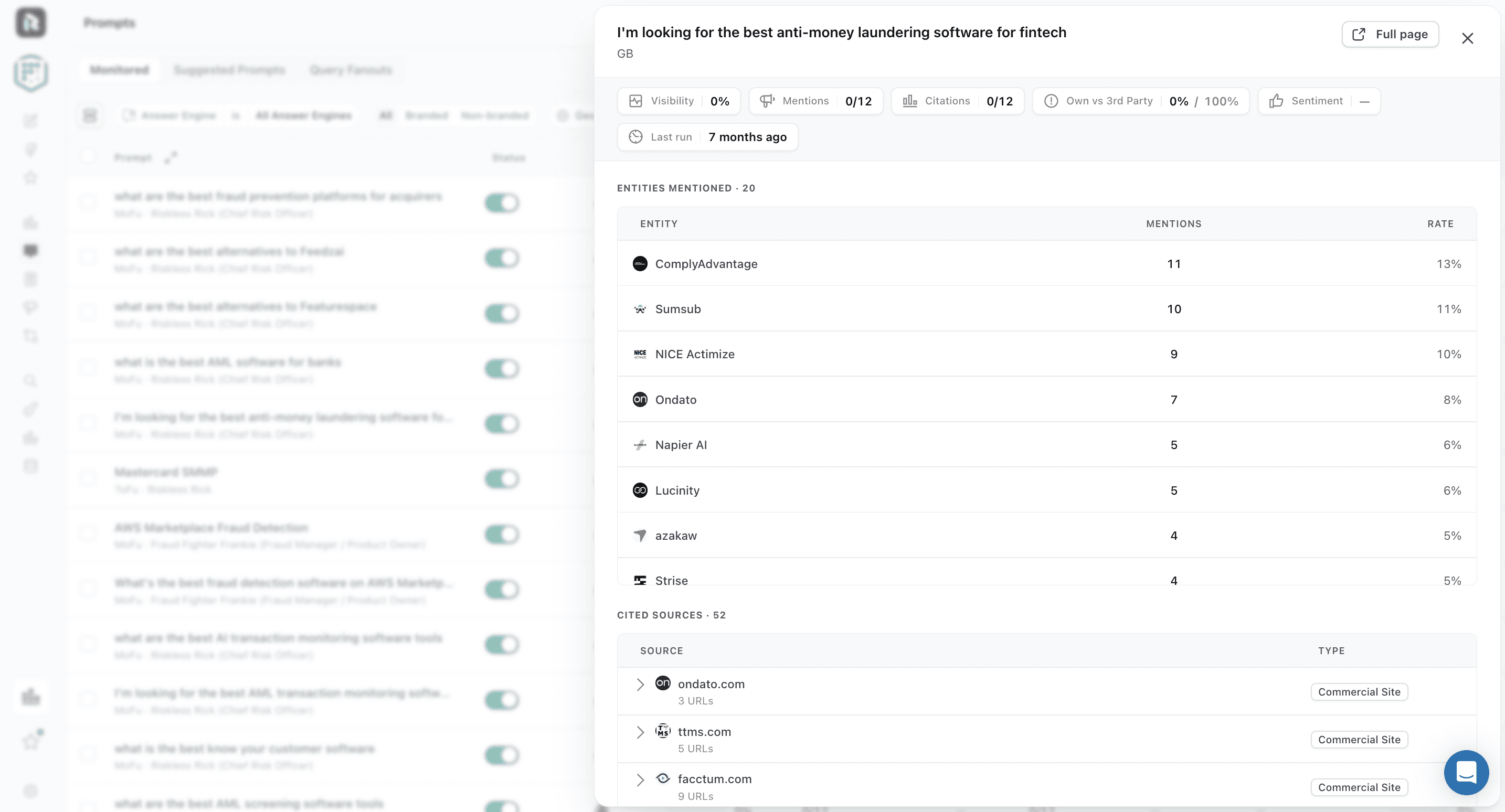
When we started this project in February, we ran our first AI search audit, which consists of running the target prompts for a week. Fraudio was invisible in almost every prompt we added to our platform. The picture today is very different.
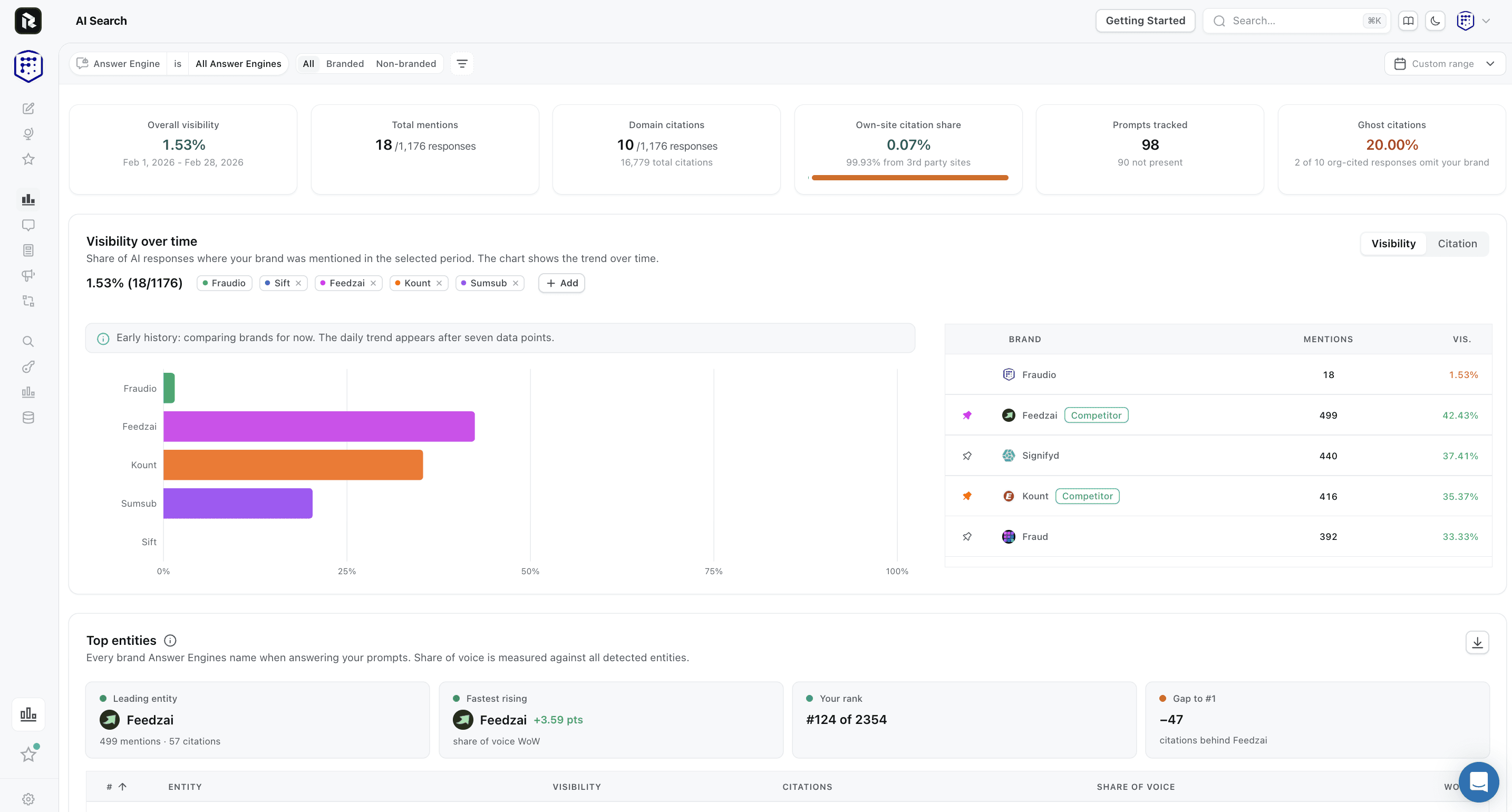
In February, Fraudio appeared in 1.53% of AI answers, and it was absent from 92% of the prompts we tracked. Its domain was cited in less than 1% of responses, and Fraudio ranked #124 among all the brands the engines named. Perplexity mentioned it on only 1% of prompts.
By August, Fraudio appeared in answers for two-thirds of the prompts we tracked. Overall visibility reached 14.61%, almost ten times the February level. Fraudio climbed from #124 to #12 among the most mentioned brands, out of more than 6,000 the engines named.
Every engine contributed:
Perplexity: 0.34% → 23.96%
Google AI Overviews: 2.38% → 15.16%
AI Mode: 1.36% → 12.65%
ChatGPT: 2.04% → 6.70%
Citations moved even faster. fraudio.com went from being cited in less than 1% of responses to 30.3%, more than any competitor's domain and second only to G2 among all domains. Fraudio's share of citations coming from its own site rose from 0.07% to 3.57%.
The engines also describe Fraudio the way its team wants to be described, and with the right positioning. In August, 81% of mentions were positive, and none were negative.
Across the full prompt set, visibility grew broadly. Nine prompts got most of our attention, though. We chose them because each maps to one of Fraudio's products and comes from a buyer, usually a Chief Risk Officer or fraud manager, putting together a vendor shortlist.
When we started, Fraudio appeared in AI answers for two of those nine. For the other seven, the engines recommended Feedzai, Featurespace, SEON, ComplyAdvantage and a long list of others. Fraudio now appears on all nine, and average visibility across them went from 8.3% to 51.3%. In the UK, the six English prompts moved from 12.5% to 60%.
Here is where each of the nine prompts started and where it stands now:
Prompt
Before
Now
Change
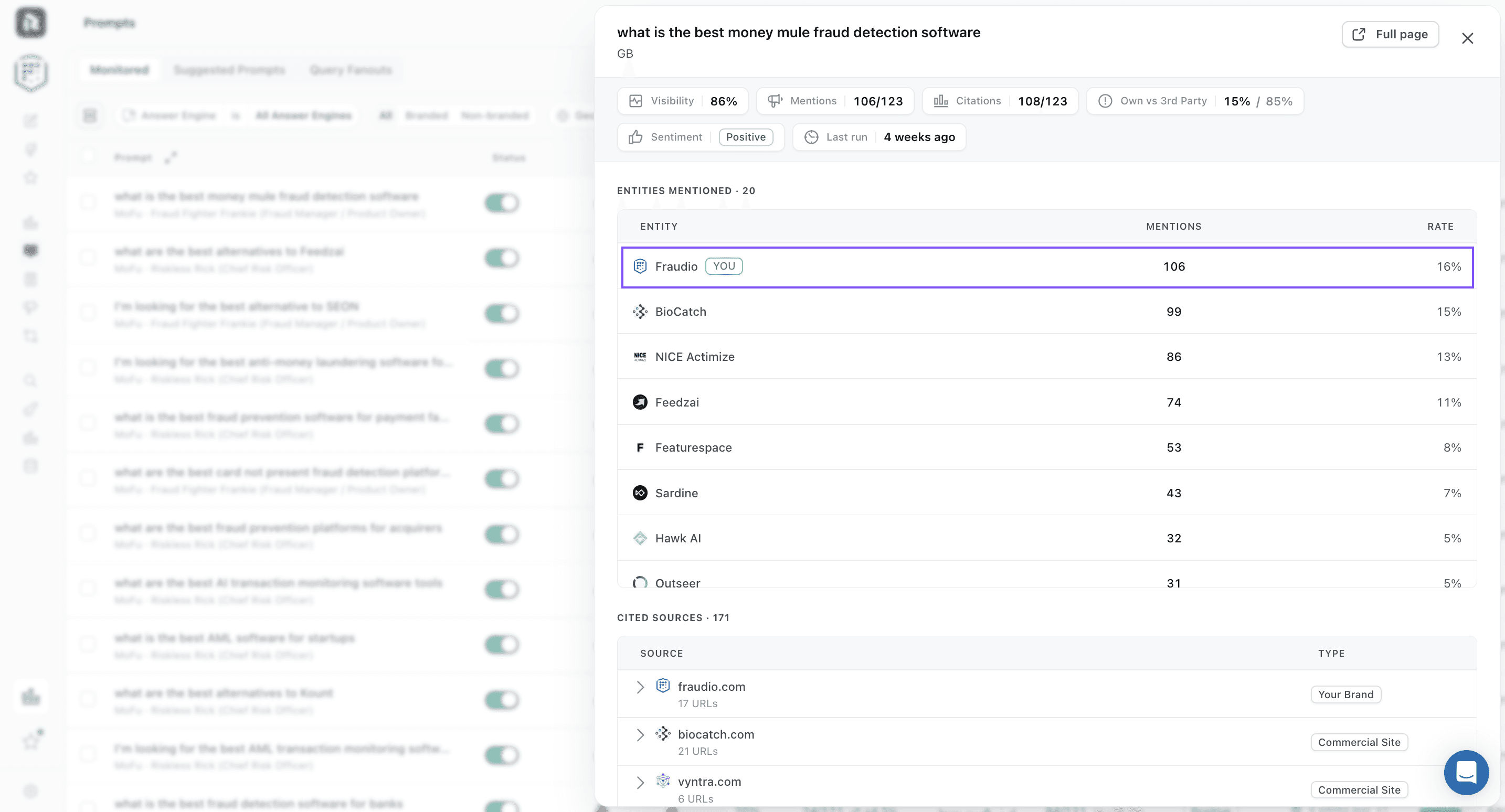
What is the best money mule fraud detection software
0%
86%
+86 pp
What are the best alternatives to Feedzai
33%
73%
+40 pp
I'm looking for the best alternative to SEON
0%
57%
+57 pp
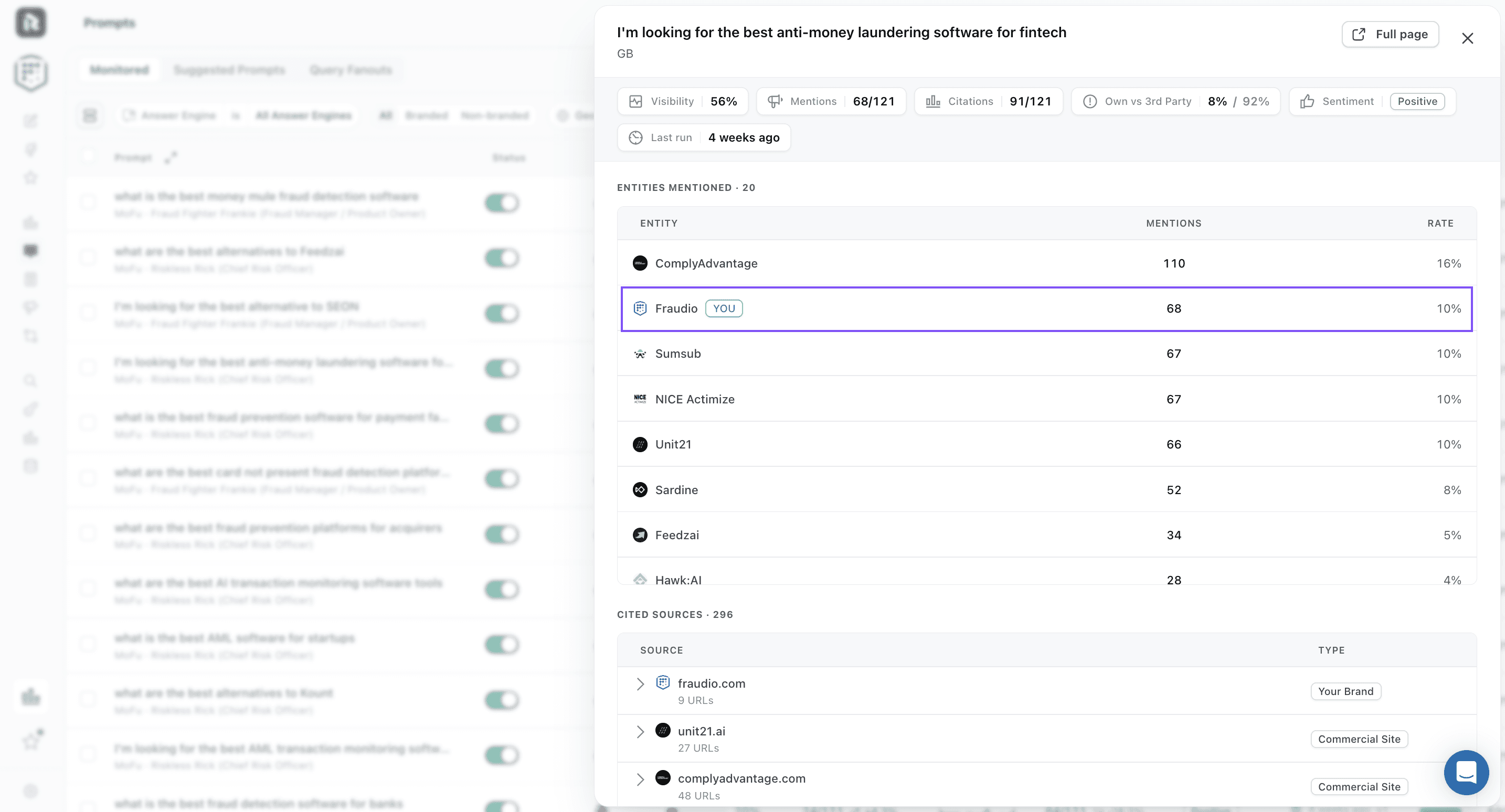
I'm looking for the best anti-money laundering software for fintech
0%
56%
+56 pp
What is the best fraud prevention software for payment facilitators
0%
46%
+46 pp
What are the best fraud prevention platforms for acquirers
42%
42%
0 pp
¿Cuáles son los mejores software AML para empresas de pagos?
0%
39%
+39 pp
¿Cuáles son las mejores herramientas de IA para detección de fraude en procesadores de pagos?
0%
34%
+34 pp
Estoy buscando el mejor software de detección de fraude con inteligencia artificial
0%
29%
+29 pp
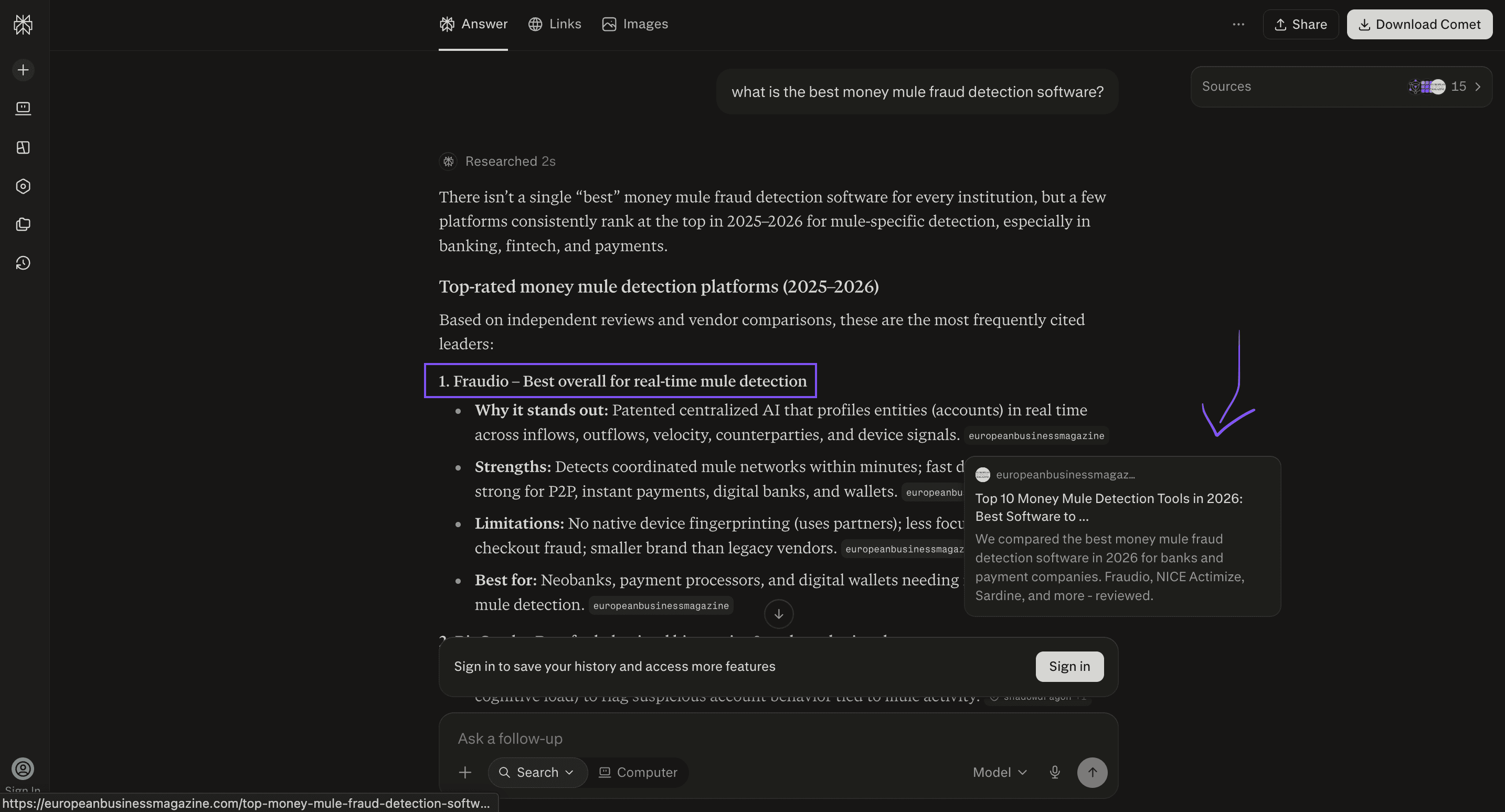
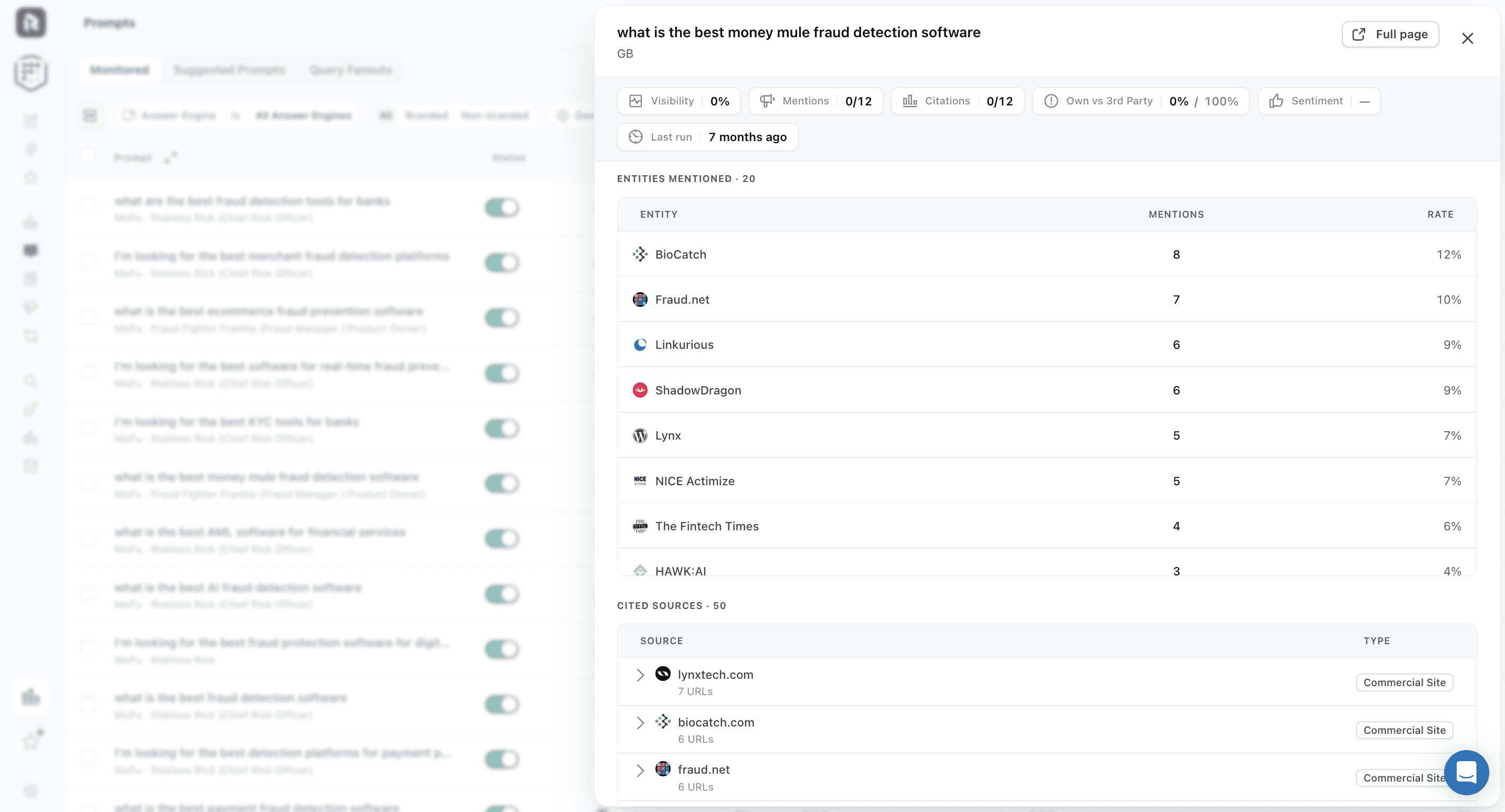
Money mule detection shows the biggest jump. Catching mule networks is one of the main jobs of Fraudio's P2P Transfer Monitoring product.
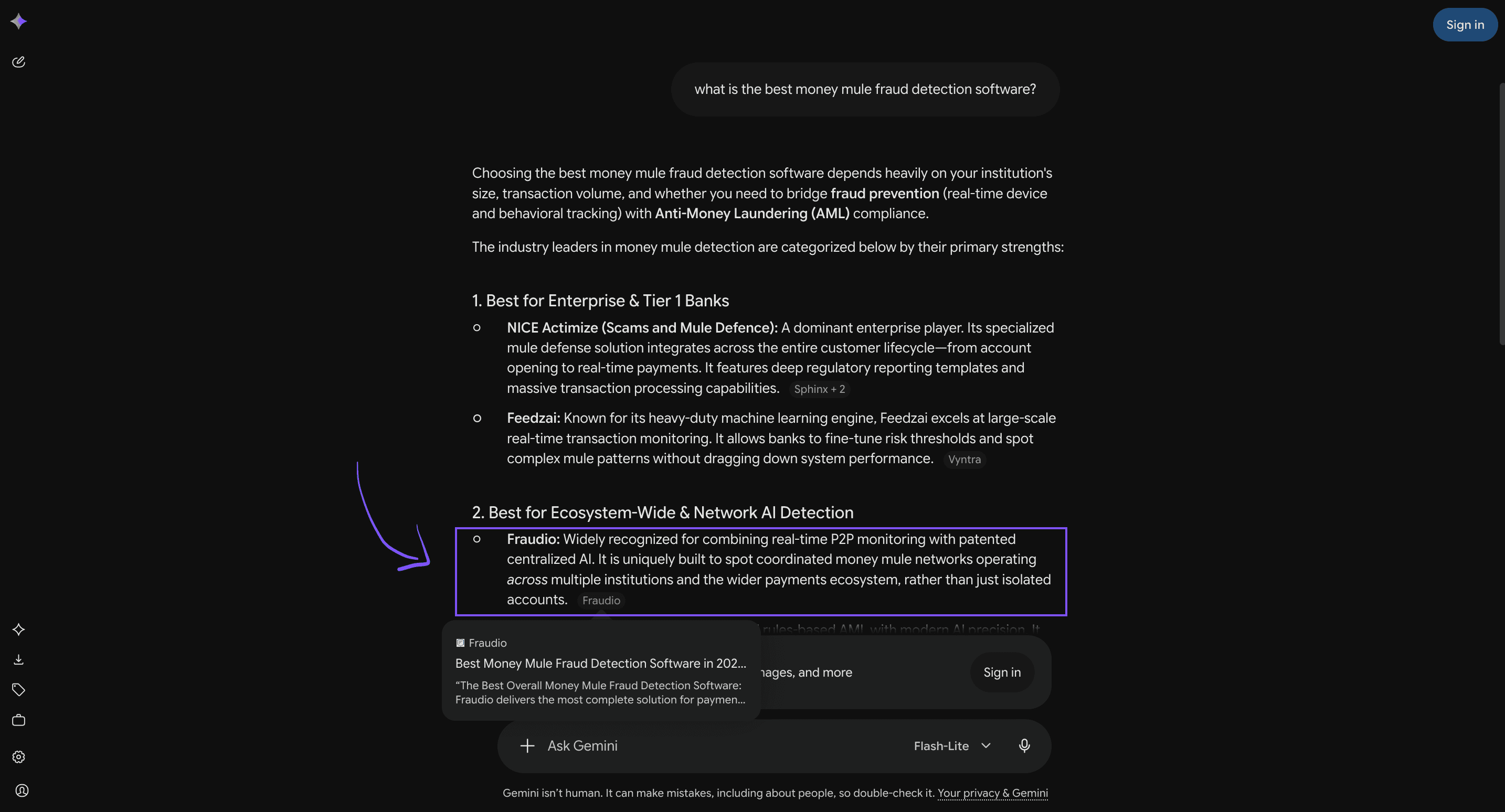
Yet seven months ago, Fraudio had no presence on "what is the best money mule fraud detection software." It now appears in 86% of answers, more often than any other brand, including BioCatch and NICE Actimize. Fraudio’s domain is now the most cited domain on that prompt, strongly influenced by our strategic listicles.
Before
After
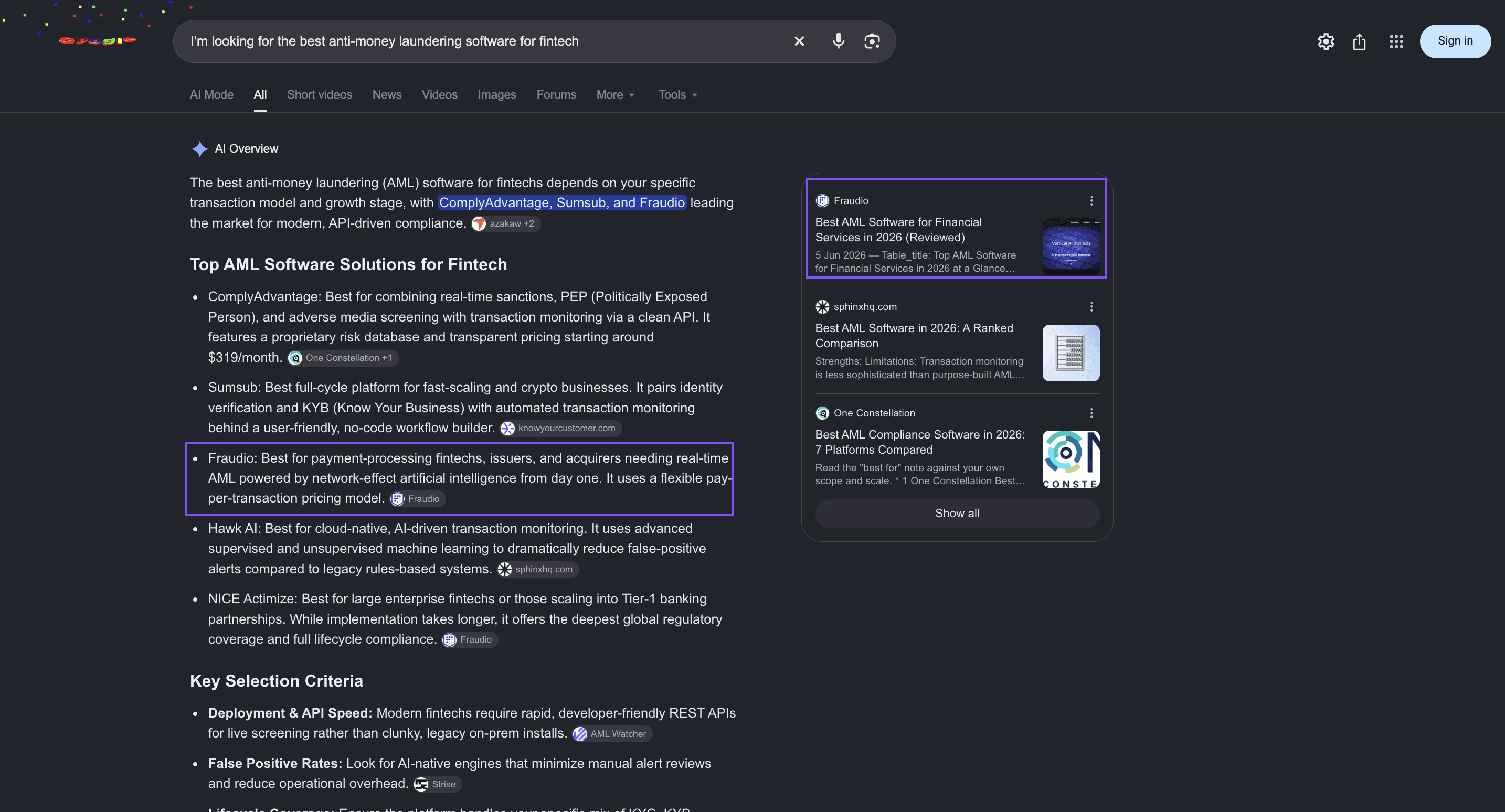
On "I'm looking for the best anti-money laundering software for fintech," Fraudio went from 0% to 56%. It now ranks second, behind ComplyAdvantage and ahead of Sumsub, NICE Actimize and Unit21, four vendors best known for AML and compliance.
Our industry-focused listicles worked really well in this case, where search engines tend to cite more often pages that are highly targeted for specific search intents, rather than generic pages.
A buyer unhappy with their current tool is one of Fraudio's most common sales triggers, and alternatives prompts are where that buyer starts looking. On "best alternatives to Feedzai," visibility climbed from 33% to 73%, with Fraudio now third.
On "best alternative to SEON," it went from 0% to 57%. Feedzai sells mostly to enterprise banks and SEON to the mid-market, so Fraudio now shows up for buyers leaving either end of the market.
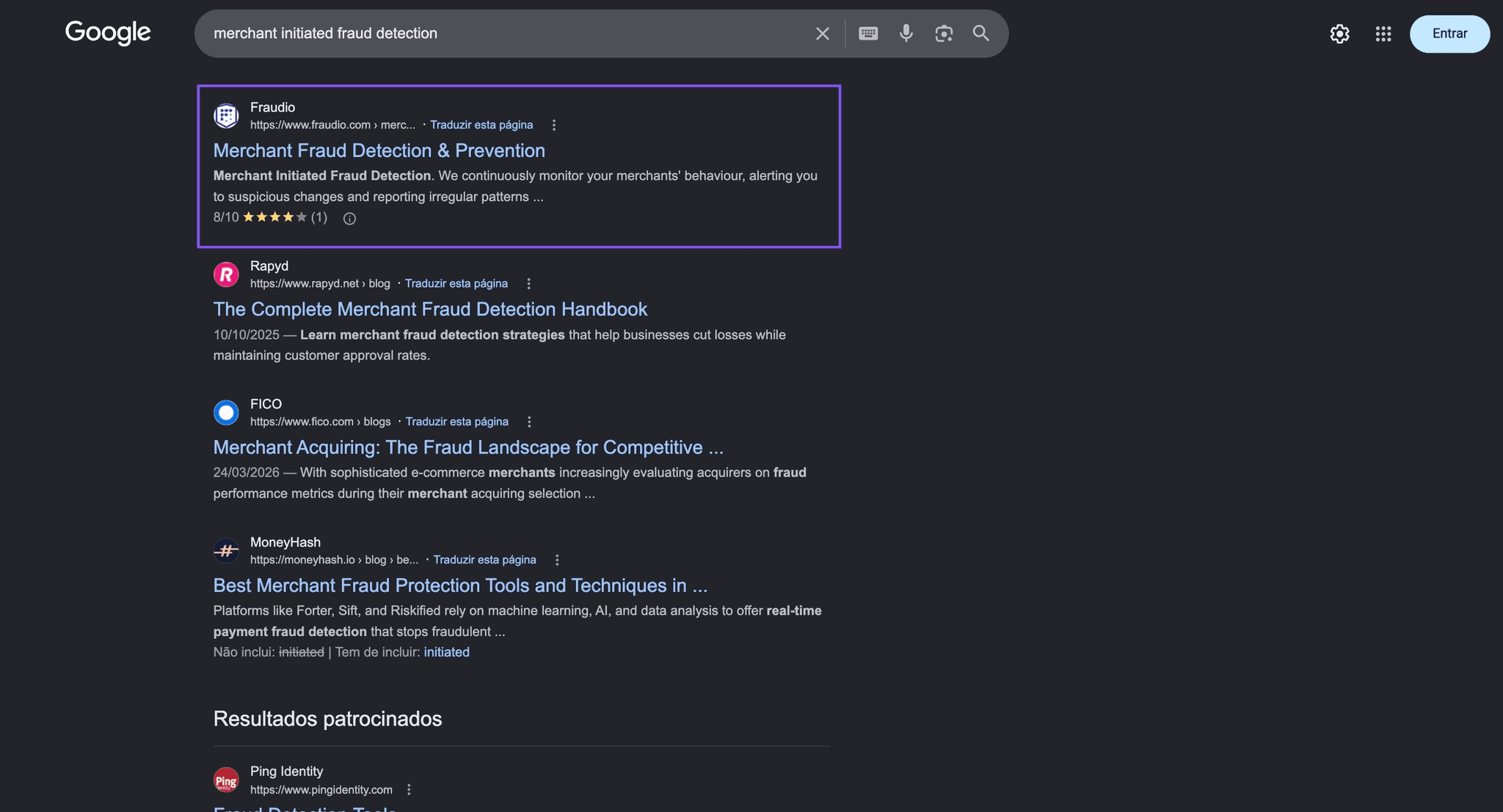
Payment facilitators moved from 0% to 46%, with Fraudio fourth. PayFacs are a current priority segment for Fraudio, and Merchant Initiated Fraud Detection was built around the merchant liability they carry.
Spanish is Fraudio's second market language, and all three priority prompts in Argentina started at zero.
Fraudio now appears in 39% of answers for AML software for payment companies, 34% for AI fraud detection tools for payment processors and 29% for AI fraud detection software. It ranks fifth or seventh on each, competing with Sift, Feedzai, Stripe and Riskified.
After we translated top-performing pages associated with money laundering stages and money mule, fraudio.com became the first or second most cited domain on all three.
Own-domain citations grew on every priority prompt. At the start, fraudio.com was rarely the source behind an answer. Now between 6% and 15% of citations on these prompts point to Fraudio's own pages, and fraudio.com sits in the top three cited domains on eight of the nine.
👋 One Last Thing
Seven months in, Fraudio climbed from #124 to #12 among the brands AI engines mention. It also became the second most cited domain in the industry, ahead of Feedzai, Sift and SEON. Organic traffic grew 14.41%, and direct traffic grew 148%.
Now look at who Fraudio competes with. Feedzai says it protects $8 trillion in transactions a year, and Featurespace runs inside more than 70 major banks. SEON and Sift have spent years building content libraries, review profiles and the marketing teams behind them.
When we started, Fraudio had a few dozen product pages and none of the technical groundwork, from schema to canonical tags. Almost all its Google traffic came from people who already knew the name.
Budget and brand size still count in search. They count for less in AI answers, where the engine cites whichever pages best match the sub-queries it runs. A listicle built for "best money mule fraud detection software" can earn more citations on that prompt than years of general content from a much larger competitor. That is what happened here. Fraudio now leads that prompt, ahead of BioCatch and NICE Actimize.
Every decision in this case study came from data. The query fan-outs told us to write in English first, even with Latin America as the growth target. Citation data pointed us to listicles, which earned a third of all citations in the category when we started. When mentions lagged behind citations, the gaps in publisher listicles showed us where Fraudio's name was missing.
Reading those signals takes both people and technology. Our own AI search tool tracked answers across countries, languages and engines at a volume no team could cover by hand. Our senior SEO and GEO specialists decided what to do with what it found, including which language to start in and which prompts to chase first.
If your competitors have bigger budgets and a longer history in search, AI answers are where that gap is smallest. Fraudio started with almost no SEO foundation and is now cited more often than companies many times its size. Any brand that answers its buyers' questions, in the formats engines cite, can do the same, and it's never too late to start.
Ready to turn search into your best performing growth channel?
Schedule a 30-minute call with Reach to walk you through the tactics we used to turn SEO and AI search into a compounding channel for ColdIQ, Indie Campers, Fidelidade, and more, and map out what it would look like for your company.
Ready to turn search into your best performing growth channel?
Schedule a 30-minute call with Reach to walk you through the tactics we used to turn SEO and AI search into a compounding channel for ColdIQ, Indie Campers, Fidelidade, and more, and map out what it would look like for your company.
Ready to turn search into your best performing growth channel?
Schedule a 30-minute call with Reach to walk you through the tactics we used to turn SEO and AI search into a compounding channel for ColdIQ, Indie Campers, Fidelidade, and more, and map out what it would look like for your company.