How Reach 14x'ed Indie Campers' revenue from AI search through a full website migration
This case study breaks down the exact process and the tactics that helped Indie Campers protect organic traffic through a full website migration, and still compound growth across Google and AI search.
We have a large, experienced team internally, but what made me decide to go work with Reach was their unique approach.
They pull real questions and intent signals from the places our buyers actually learn and make decisions, and use that to focus on the keywords and prompts that really matter. Then they continuously monitor how different AI models respond to those prompts, reverse engineer what patterns win, and adapt the strategy as the models and results evolve.
That’s what turns SEO and AEO into a predictable science, and lets them execute with a level of precision and speed that even the best in-house teams would struggle to match.
They’re now our go-to team for critical decisions about website architecture, content strategy, and international expansion.
Google
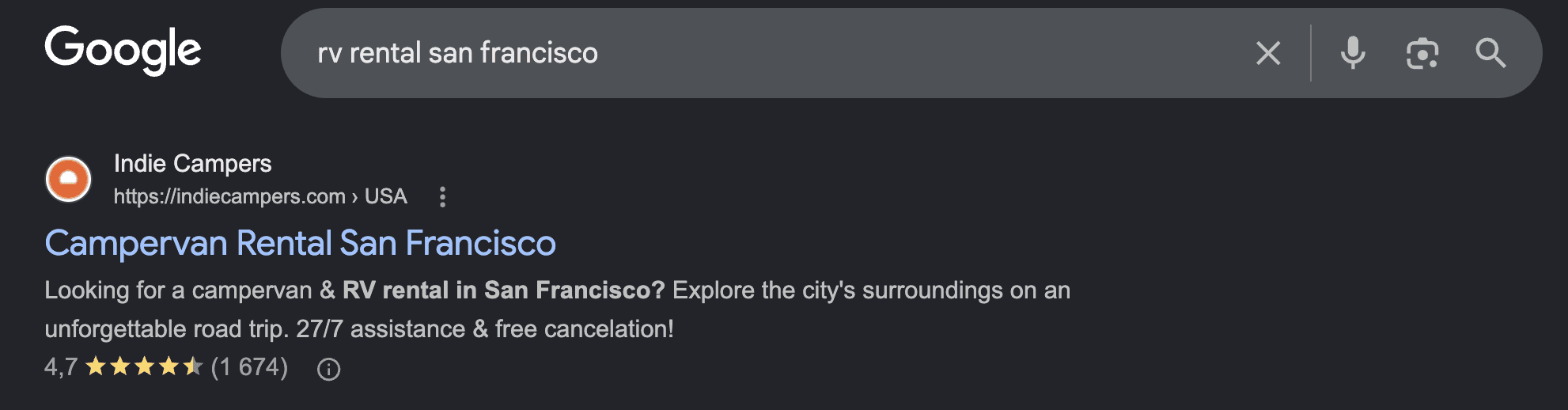
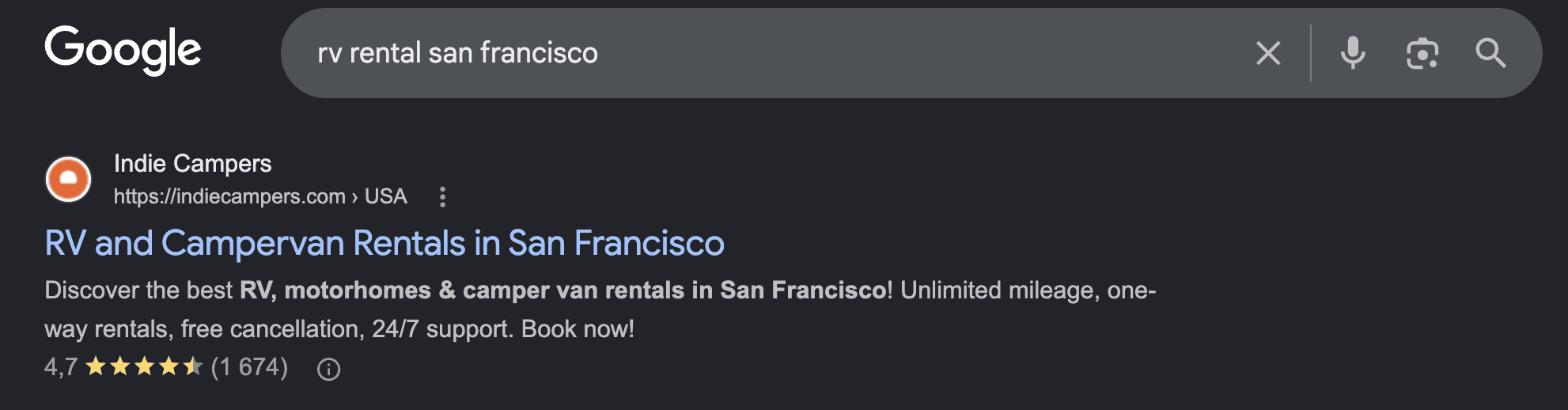
Indie Campers owns the #1 organic spot for this high-intent query.
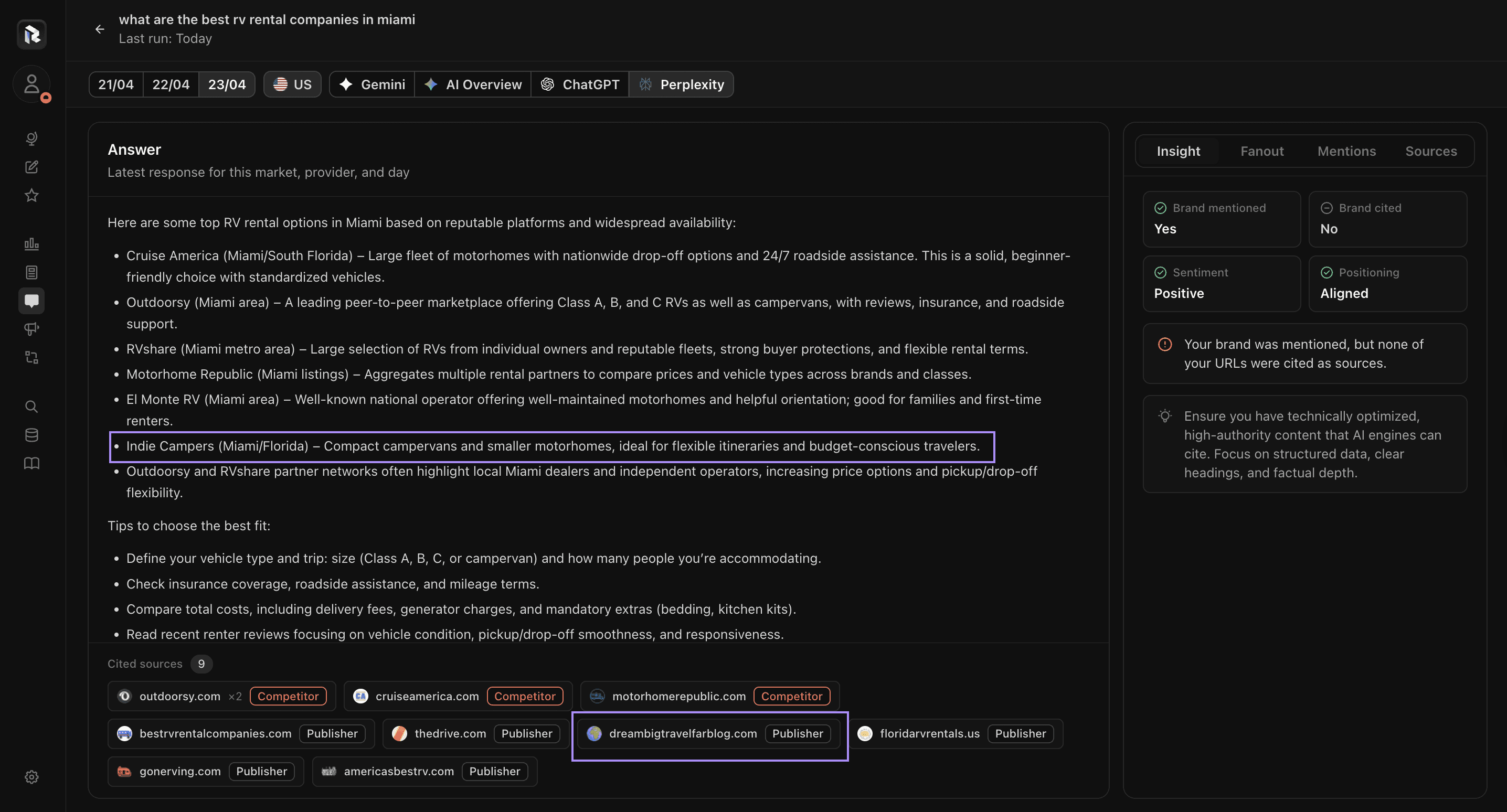
Perplexity
One of the world's largest campervan and motorhome rental marketplaces. 7,000+ vehicles serving hundreds of thousands of travelers each year.
All of this was delivered during a full website migration, the kind of project that typically flatlines organic performance for quarters.
Context
Indie Campers is one of the world's largest campervan and motorhome rental marketplaces, operating 7,000+ vehicles across Europe, North America, Oceania and other regions. Their buyer journey is long: travelers research destinations, compare itineraries, read guides, check licensing requirements, and only then shortlist a rental provider.
That journey used to start and end on Google. It now splits across Google, ChatGPT, Perplexity, Gemini, and Google AI Overviews. Meanwhile, their paid acquisition costs were rising faster than the margin a rental generates.
The challenge
When this engagement started, Indie Campers had three problems running in parallel:
A growth ceiling on paid search. CPCs were climbing. Each incremental euro of ad spend was generating less incremental booking revenue.
A blind spot in AI search. Their organic engine was already producing real results on Google, but it wasn't reaching the new surfaces. Indie Campers was missing from the buyer prompts hitting ChatGPT, Perplexity, Gemini and Google AI Overviews. And like most high-traffic sites, they were starting to lose Google clicks to AI-generated answers intercepting users before the click landed. The upside and the downside of search now lived in AI.
A full website migration in flight. They were moving to a new web infrastructure. Migrations routinely cause 30 to 70% drops in organic traffic when handled poorly: indexation errors, canonical drift, broken hreflang, dropped internal links.
They needed a partner who could simultaneously protect existing organic value through the migration, adapt the location-page layer for AI search, and build a presence inside LLM answer sets before their competitors did.
The outcome
By mid-April 2026, organic + AI search had become one of Indie Campers' top-performing demand channels, with measurable revenue attribution, accelerating traffic, and growing AI citation share. The migration shipped without the expected organic crater; the opposite happened.
The results we achieved
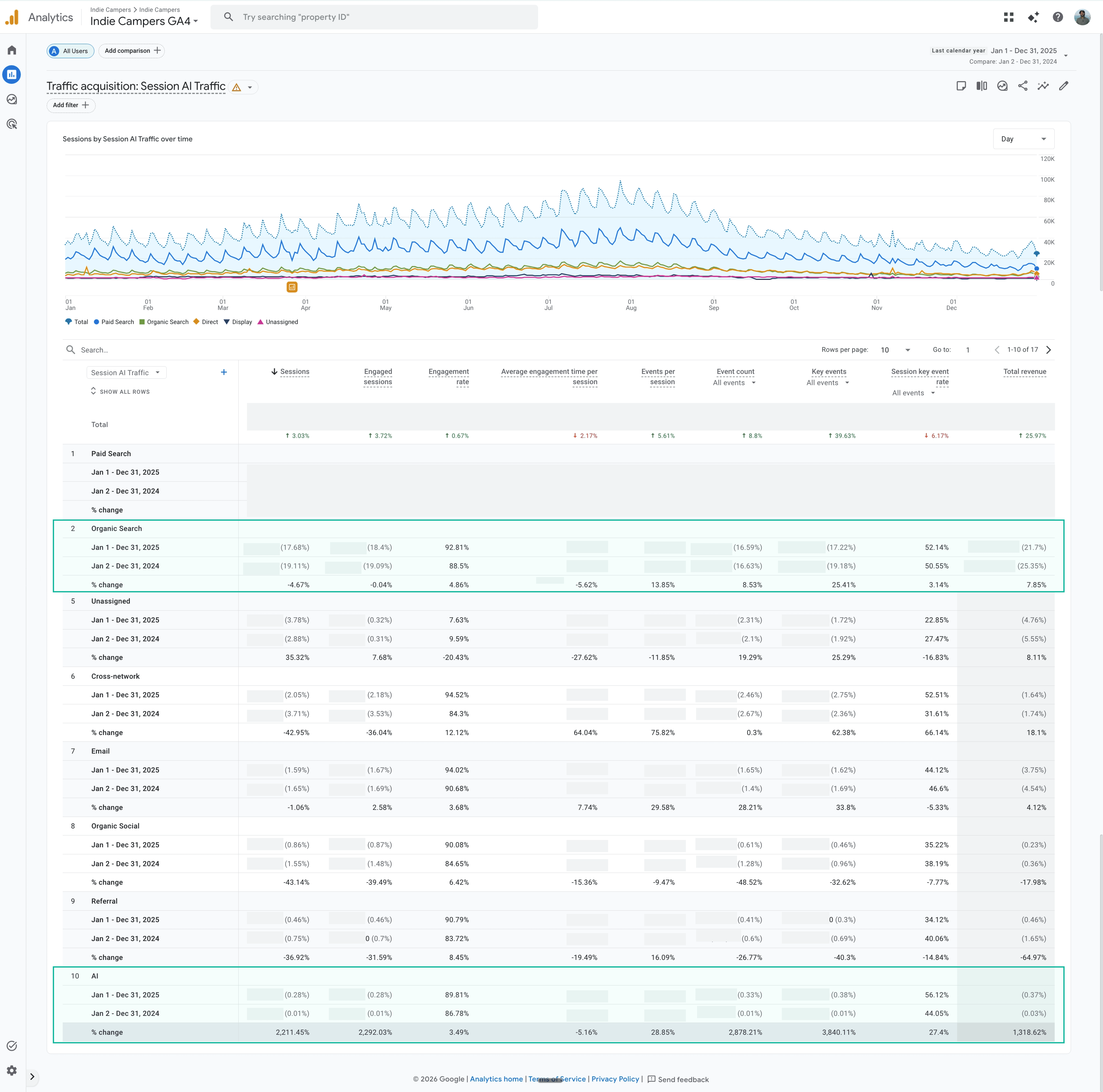
The headline is revenue. AI search went from a rounding error to a measurable, source-stamped channel during 2025. Organic kept compounding on top.
+1,318.62%
Increase in revenue attributed to AI search*
+7.85%
Increase in revenue attributed to organic search*
+1,318.62%
Increase in revenue attributed to AI search*
+7.85%
Increase in revenue attributed to organic search*
* Measured January 1 to December 31, 2025 vs the same period the year before.
How these revenue numbers are tracked. All revenue figures use Google Analytics event-level attribution against the advanced source/medium and UTM mapping that Indie Campers had already implemented before the engagement began. This setup separates sessions across organic search (Google, Bing), AI-source referrals (ChatGPT, Perplexity, Gemini, Claude), direct, and paid. We did not modify the attribution layer, we measured against it.
Google Analytics 4 traffic acquisition report. Full-year 2025 vs full-year 2024. Revenue figures in the rightmost column intentionally blurred. The two highlighted rows are the source of the headline numbers: Organic Search at +7.85% YoY revenue and AI at +1,318.62% YoY revenue (sessions on the AI row went from 2,270 to 52,470). AI search went from a rounding error in 2024 to a real channel in 2025.
Three checkpoints, same compounding curve
The full-year numbers above are the headline, but they include a long pre-engagement period. To make the impact concrete, here are three review checkpoints across the engagement, each one isolating a different window and showing the curve still bending up.
Snapshot 1 — Revenue impact
October 1 to December 31, 2025 vs prior year
First measurable revenue lift, AI search starts showing up as its own channel
+8.8% YoY
Organic revenue
+254.4% YoY
Revenue attributed to AI search
+8.8% YoY
Organic revenue
+254.4% YoY
Revenue attributed to AI search
Snapshot 2 — Traffic and AI visibility (Q1 peak)
January 1 to March 21, 2026 vs prior year
Migration fixes, blog program and location-page work compound at the same time
+26.2% YoY
Organic clicks
+38.8% YoY (+3.53MM)
Organic impressions
+26.2% YoY
Organic clicks
+38.8% YoY (+3.53MM)
Organic impressions
+154.8% YoY
Non-branded clicks
15% → 33% (+120%)
AI mentions across 77 prompts and 4 LLMs
+154.8% YoY
Non-branded clicks
15% → 33% (+120%)
AI mentions across 77 prompts and 4 LLMs
Snapshot 3 — Sustained baseline
January 1 to April 15, 2026 vs prior year
Growth holds as the prior-year comparison window catches up
+19.8% YoY
Organic clicks
+29.1% YoY (+3.7M)
Organic impressions
+19.8% YoY
Organic clicks
+29.1% YoY (+3.7M)
Organic impressions
6.05x
Blog clicks
+88% YoY
ChatGPT add-to-cart events
6.05x
Blog clicks
+88% YoY
ChatGPT add-to-cart events
Rui's words on the engagement, looking at the full 2025 vs 2024 picture:
Rui Costa
CTO at Indie Campers
Reach went far beyond the original scope to make sure we saw measurable impact early. They helped us increase organic revenue by 8.8% YoY, and revenue attributed to AI search by 254.41% in the first 5 months of working together. In a moment where search is changing and traffic is declining across many sites, they helped grow organic clicks by 26.1% and increase organic impressions by 4.7M. The pages they created are now some of our best performing pages in terms of visibility and driving qualified traffic. At our scale, these numbers have a real impact on the business. The ability to systematically monitor thousands of pages and identify the exact ones we need to improve to rank for the searches that drive revenue is a big differentiator.
Before & after results
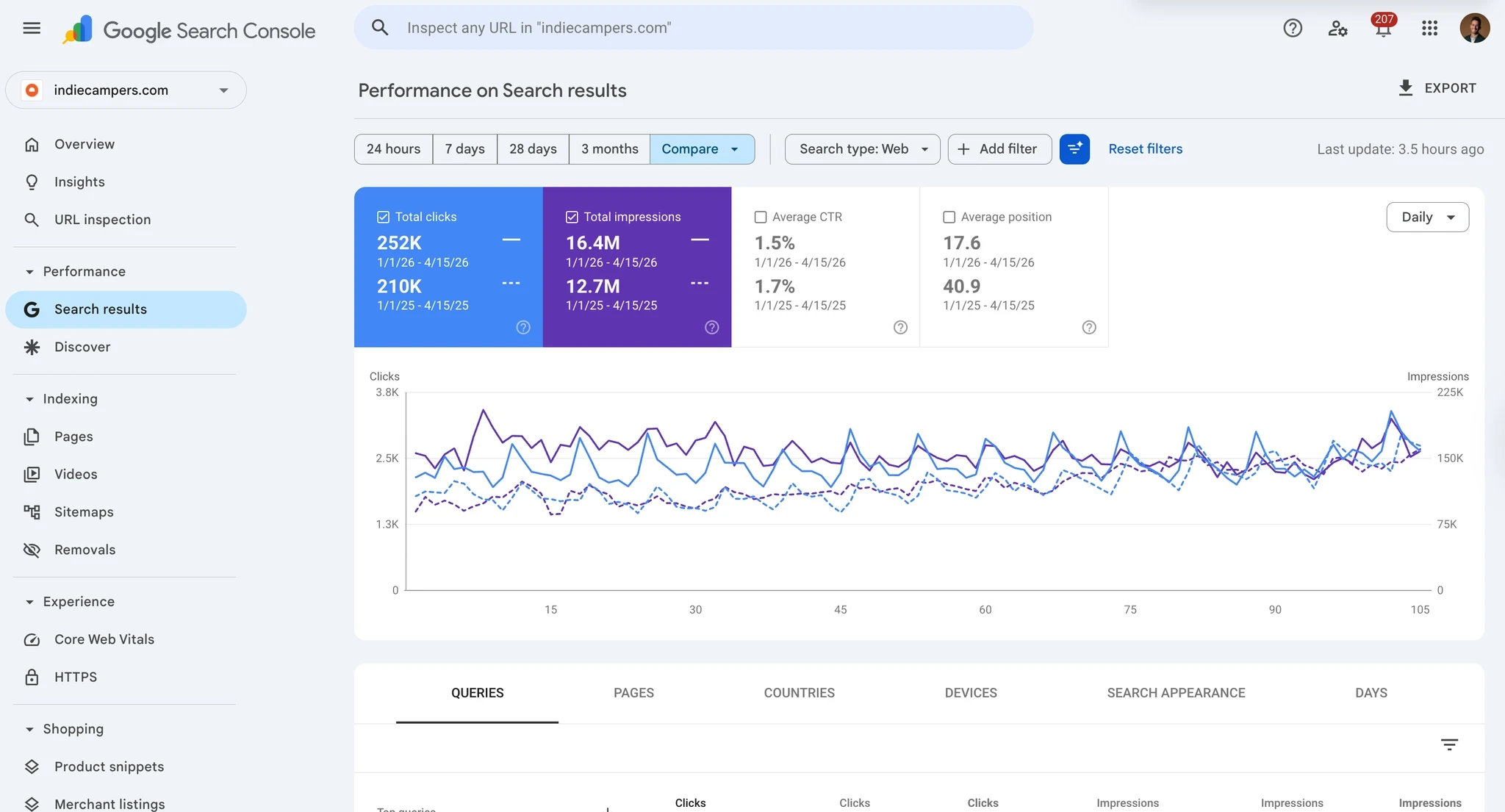
Two windows. Q1 (Jan 1 to Mar 21) shows the peak. The full window (Jan 1 to Apr 15) shows the sustained level after the comparison base grows.
Metric
Window
Before
After
Change
Organic clicks
Jan 1 – Mar 21
149,000
188,000
+26.2%
Organic clicks
Jan 1 – Apr 15
210,012
251,557
+19.8%
Organic impressions
Jan 1 – Mar 21
9.07M
12.6M
+38.8%
Organic impressions
Jan 1 – Apr 15
12.68M
16.37M
+29.1%
Average position
Jan 1 – Mar 21
40.6
18.9
+53.4%
Average position
Jan 1 – Apr 15
40.9
17.6
+57.0%
Non-branded clicks
Jan 1 – Mar 21
36,623
93,314
+154.8%
Non-branded clicks
Jan 1 – Apr 15
90,281
117,181
+29.8%
Blog clicks
Jan 1 – Apr 15
2,160
13,071
6.05x
Blog impressions
Jan 1 – Apr 15
312,569
1,633,198
5.22x
Blog average position
Jan 1 – Apr 15
35.2
6.7
+81.0%
AI visibility (77 prompts)
continuous
15%
33%
+120%
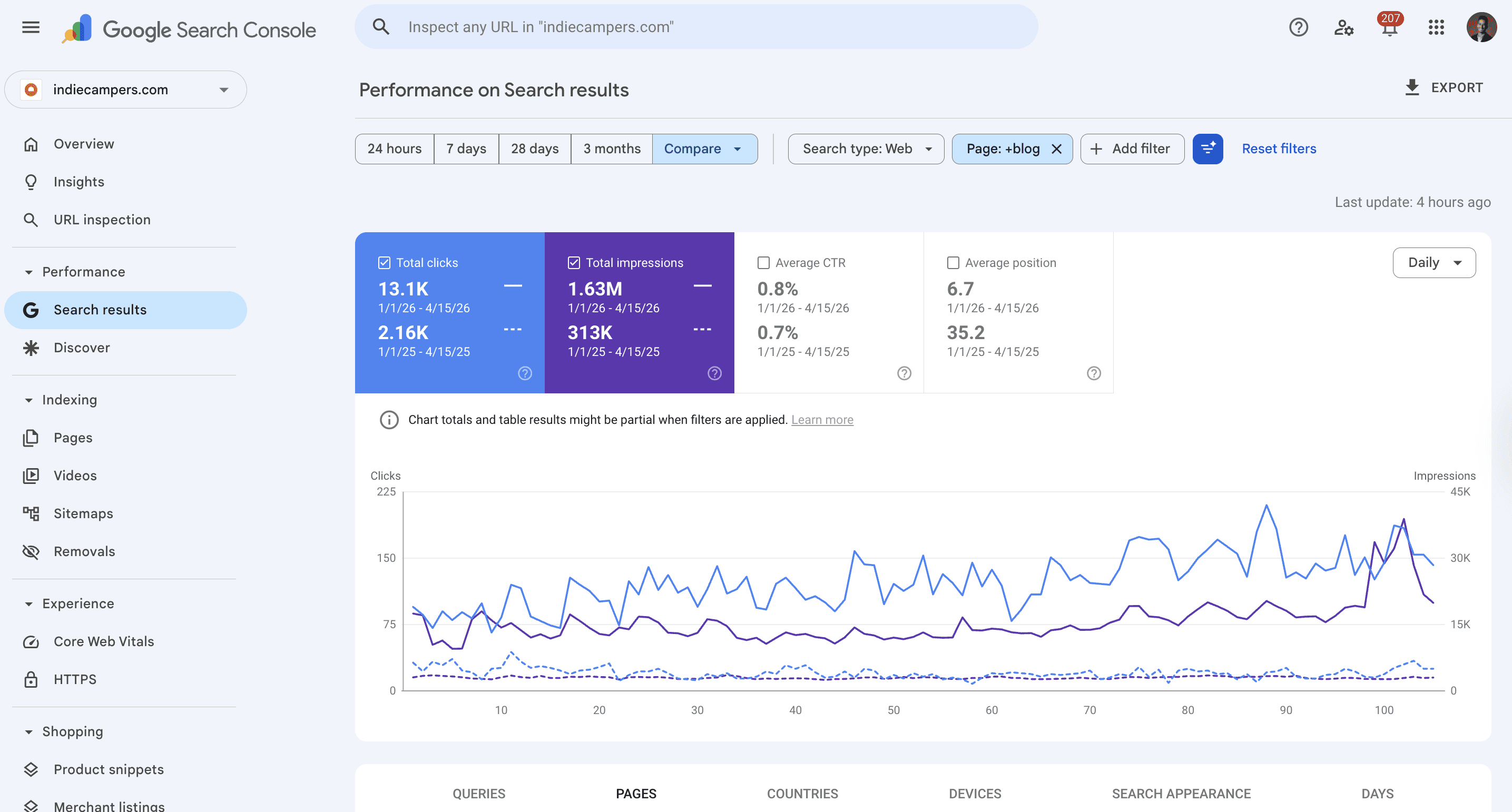
Blog section performance YoY in Google Search Console. Clicks 6.05x, impressions 5.22x, average position moved from page 4 to page 1.
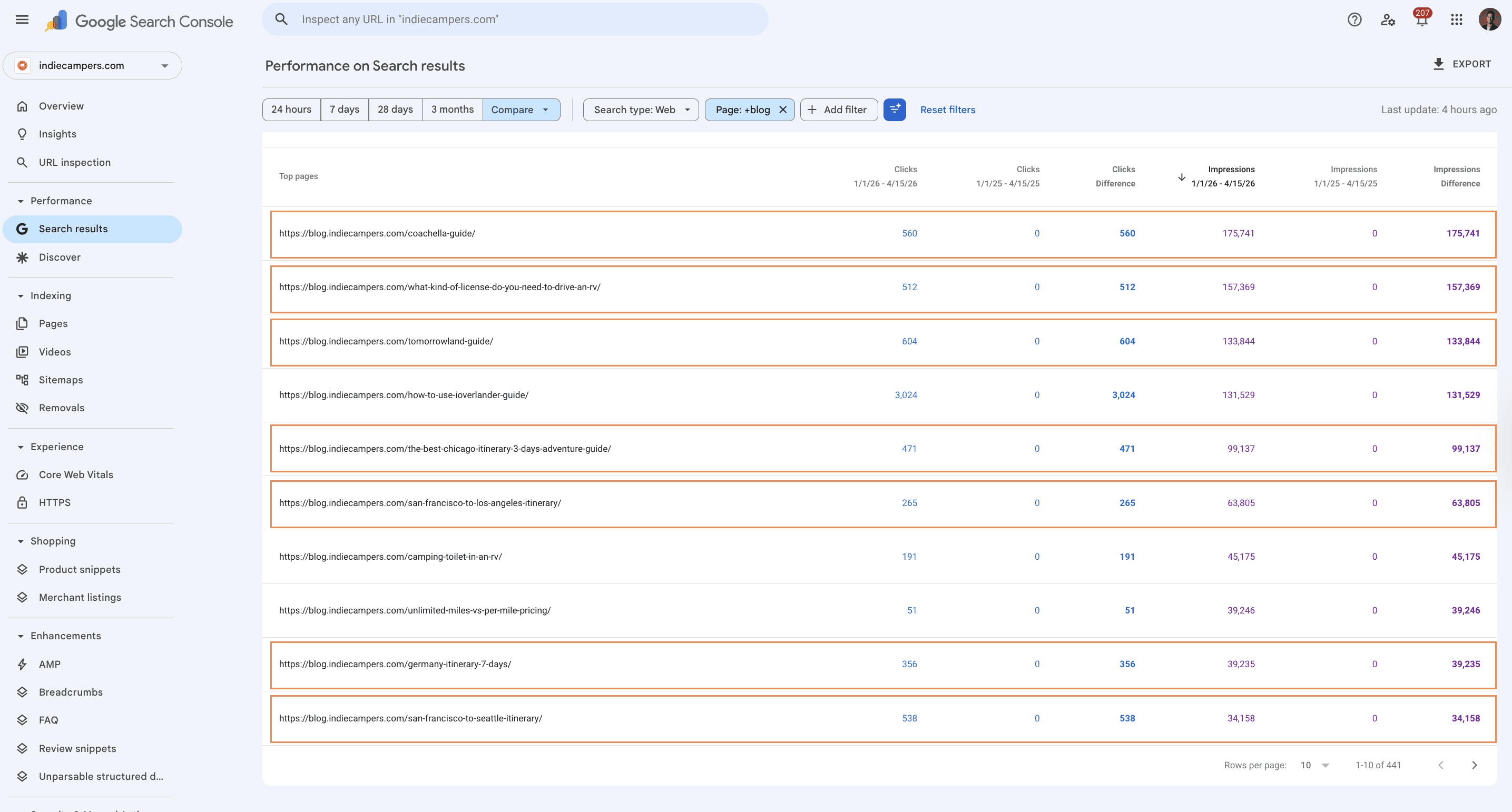
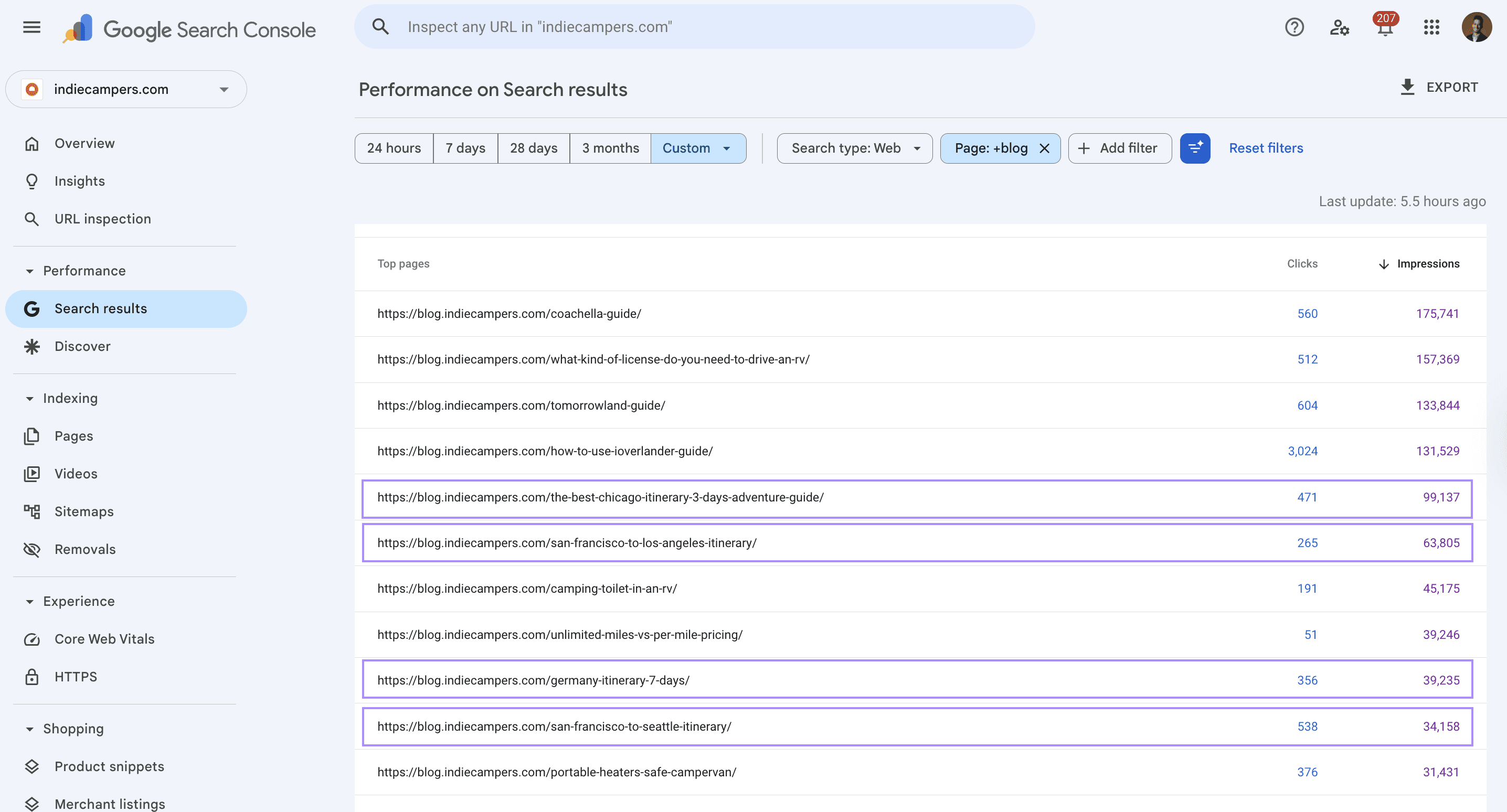
Top blog pages by impressions. The highlighted rows are articles Reach created from zero. 7 of the top 10 impression drivers on the blog have been produced by the Reach team.
Clicks, impressions and position all moving in the right direction, simultaneously. 3 of the top 5 pages driving this growth were pages created from zero by Reach.
Revenue extrapolation, organic + LLM combined
We ran a full keyword analysis on Indie Campers' addressable market: 626 keywords in the RV and campervan rental space, 80% commercial or transactional intent. At top-3 rankings across the set, the annual organic revenue potential is $297.6M.
The top 370 keywords (100+ monthly searches each) alone represent 94.7% of the opportunity. Today Indie Campers is capturing a small fraction of that. The 187-page location rebuild, the backlink program, and the LLM-visibility compounding are all built to close that gap.
Pipeline impact
In travel/marketplace businesses, the equivalent of "pipeline" is add-to-cart and booking intent. Filtered to organic and direct sources (Google, Bing, ChatGPT, Perplexity, Gemini, Reddit, direct), comparing Jan 1 to Apr 15 2026 vs same period 2025:
Organic + direct sessions: 1,503,197 (+3% YoY)
Organic + direct add-to-cart events: 167,979 (+24% YoY)
Direct traffic sessions: 885,834 (+40% YoY), driven in large part by the brand-lift effect of increased presence in AI answer sets
ChatGPT-driven sessions: 14,210 (+70% YoY)
Branded search volume for "indie campers" (exact match): 4,717 → 6,157 monthly searches (+31% YoY, Mar 2026 vs Mar 2025), the same brand-momentum signal showing up on the search side
Visitors and impressions (in a world where search is changing)
Most travel brands are seeing flat or declining organic traffic as Google surfaces more answers directly in the SERP and AI tools intercept the research phase. Indie Campers is compounding in the opposite direction: +3.7M additional impressions and +41K additional clicks over Jan 1 to Apr 15 vs the same period last year, while the domain climbs 23.3 positions.
Traffic share trend (organic + LLM share)
Organic + direct traffic share is growing as a percentage of total sessions, even as paid volumes stay elevated. Direct traffic (+40% YoY) is the clearest leading indicator of brand momentum driven by LLM visibility, where users see Indie Campers recommended and type the URL instead of clicking a link.
Traffic growth (LLM search)
ChatGPT-sourced traffic is now a measurable channel in its own right: 14,210 sessions over the period, +70% YoY, with +88% YoY add-to-cart events from ChatGPT visitors specifically. Indie Campers is one of the few travel brands with a trackable AI search channel at this scale.
Traffic growth (organic search)
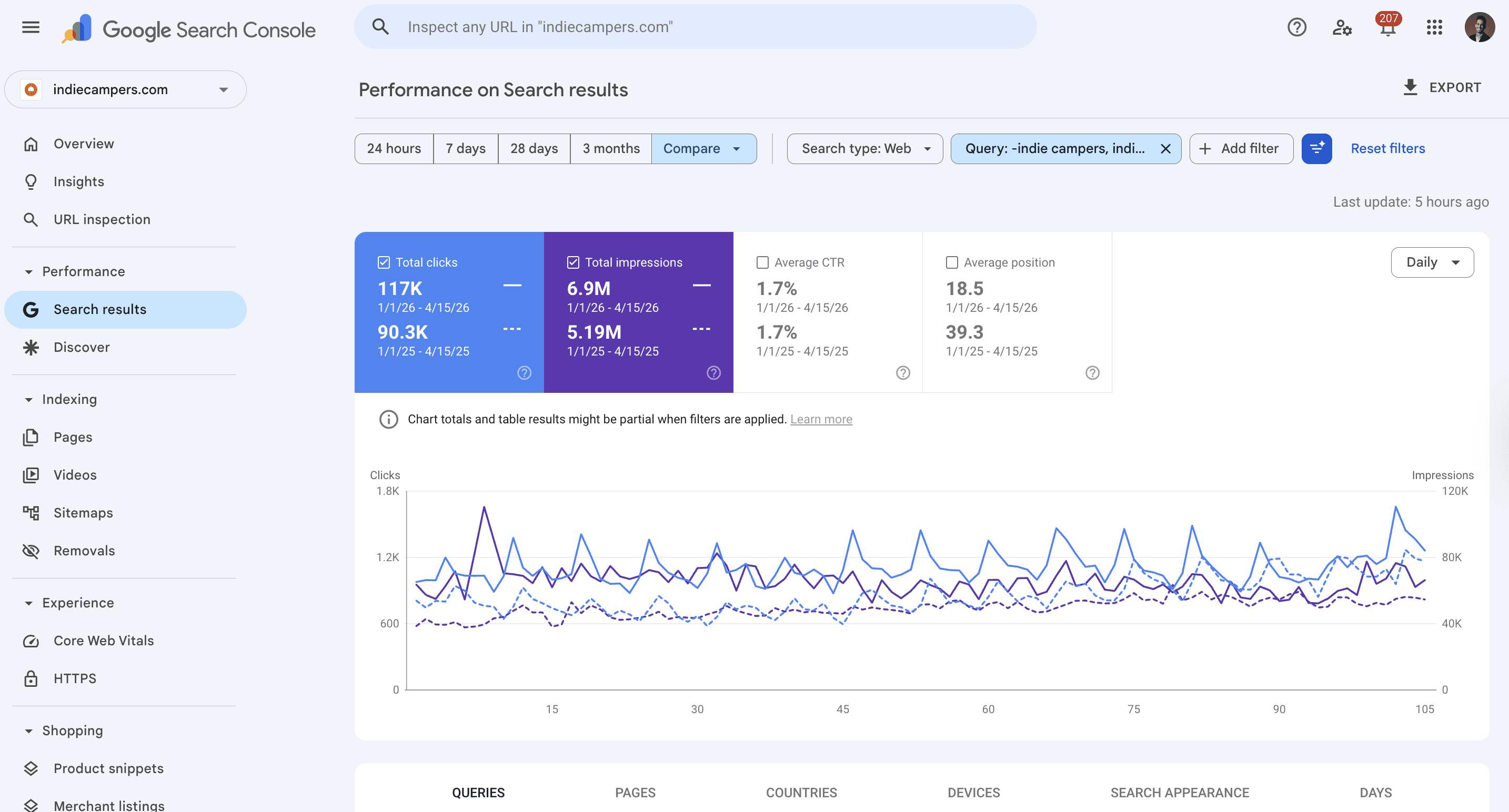
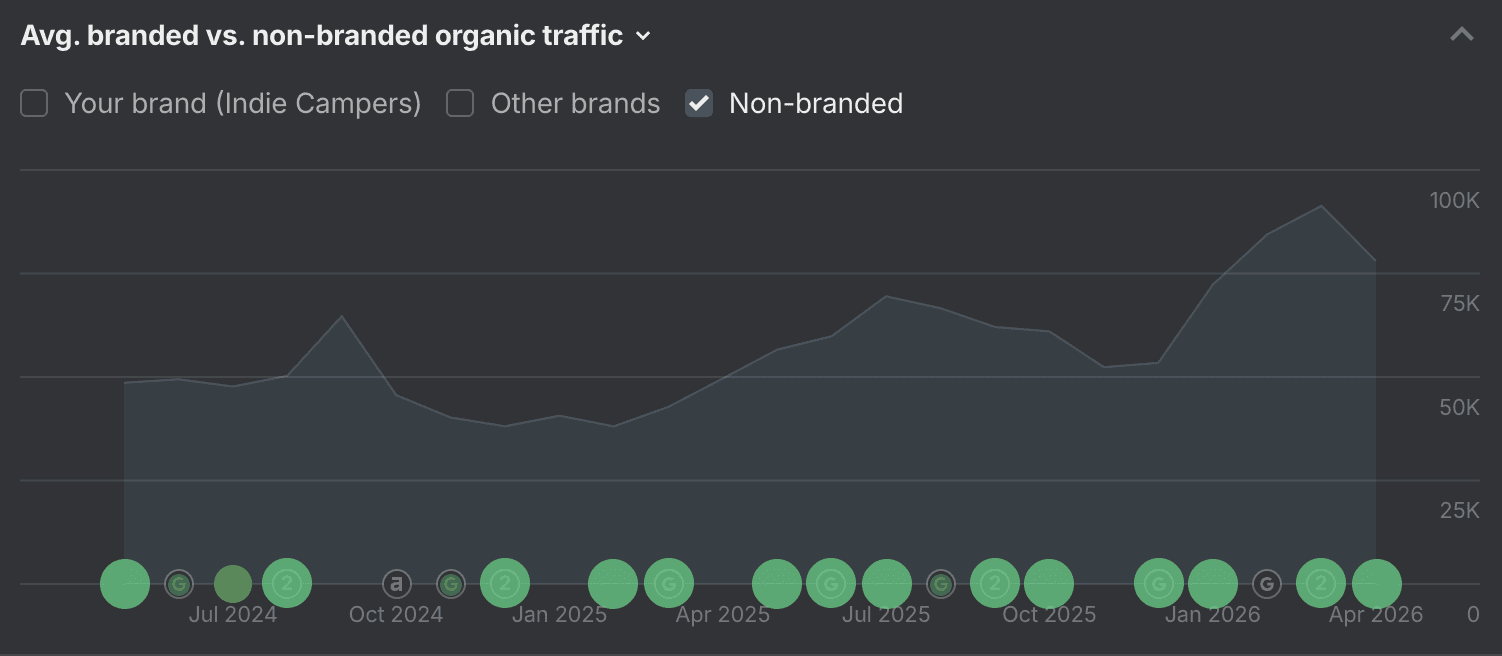
Inside the Ahrefs database, non-branded traffic shows a clean upward trend from the start of the engagement. Non-branded clicks from Google grew +29.8% YoY over Jan 1 to Apr 15 (90,281 to 117,181), with a Q1 peak of +154.8% YoY (36,623 to 93,314) over Jan 1 to Mar 21. The Q1 peak is when the migration fixes, the blog program, and the location-page rebuild plan compounded fastest. The Jan-Apr number is the new sustained baseline as the comparison period grows. Non-branded impressions are up +33.1% over Jan-Apr with average position improving from 39.3 to 18.5.
Non-branded performance YoY in Google Search Console. This is the clean signal: pure demand capture, not brand dependency.
Ahrefs non-branded trend for the same window. Consistent upward trajectory through the migration.
Impact on high intent keywords
Across the engagement we delivered 187 region-adapted location-page rebuilds, with the primary keyword swapped per market: "RV rental" for US, "motorhome rental" for UK, "campervan rental" for AU/NZ and most of Europe. Each page now speaks the local query language, not a translated US template. The high-intent ranking lift to date has come from the technical fixes during the migration and the blog program, with the location-page rebuilds queued for rollout as the next compounding layer. See the detailed before/after breakdown in the approach section below.
Impact on AI visibility (prompts & mentions)
We tracked 77 buyer prompts weekly across ChatGPT, Perplexity, Gemini and Google AI Overviews. Mention share moved from 15% to 33% (+120%), with the cleanest gains inside ChatGPT and Perplexity. The earned-mention partnership with DreamBigTravelFar (covered in the approach section below) was a major lever here.
Note on the migration
When we started, the conservative forecast was that organic would stay flat through the migration. The aggressive case was a modest lift in Q2. What actually happened: organic grew double digits during the migration window itself, and the technical debt that would have surfaced post-migration never materialized.
What actually worked: the four initiatives with the biggest impact
We experimented with a lot of different things during this engagement, across location pages, blog content, earned mentions, backlinks, and technical SEO. Every page and every campaign was tracked end to end inside Reach and Page Insights, so we could measure the attribution impact of each one on impressions, clicks, AI citations and revenue.
The four initiatives below are not the full list of work we shipped. They're the ones the data told us to double down on, because they were driving the clearest movement on the metrics that mattered. Each one was built on top of the previous, and executed in parallel with a full website migration.
Where we started
The first weeks of this engagement were focused on understanding the main target locations of Indie Campers, who operate more than 7,000 RVs, motorhomes, and campervans for rental across the world. We learned about their culture, their ICPs, and their business goals. Then we built our strategy on top of those learnings.
During this period, we also faced a very challenging moment, with Indie Campers migrating to a new website infrastructure. This is usually a nightmare for SEO, as these big changes often negatively impact organic performance, affecting crawling, page indexing, and rankings. The good news is that Reach and Indie Campers' team worked together to mitigate this risk, and at the same time, we were actually able to even boost their organic performance across Google and AI search engines.
INITIATIVE 01
Location pages optimizations
During our first weeks of research and reverse-engineering Google and AI search responses, we saw a pattern: these search engines were relying a lot on geographic pages to provide results. In practice, for low-funnel queries like "RV rentals" + a specific country or city, the landing pages that were performing the best on search were commercial pages specifically optimized for those regions.
We were in a good stage when we started, as Indie Campers already had pages created and indexed for each location. The problem was that they were not ranking well across multiple regions, heavily impacted by on-page SEO issues and low authority scores.
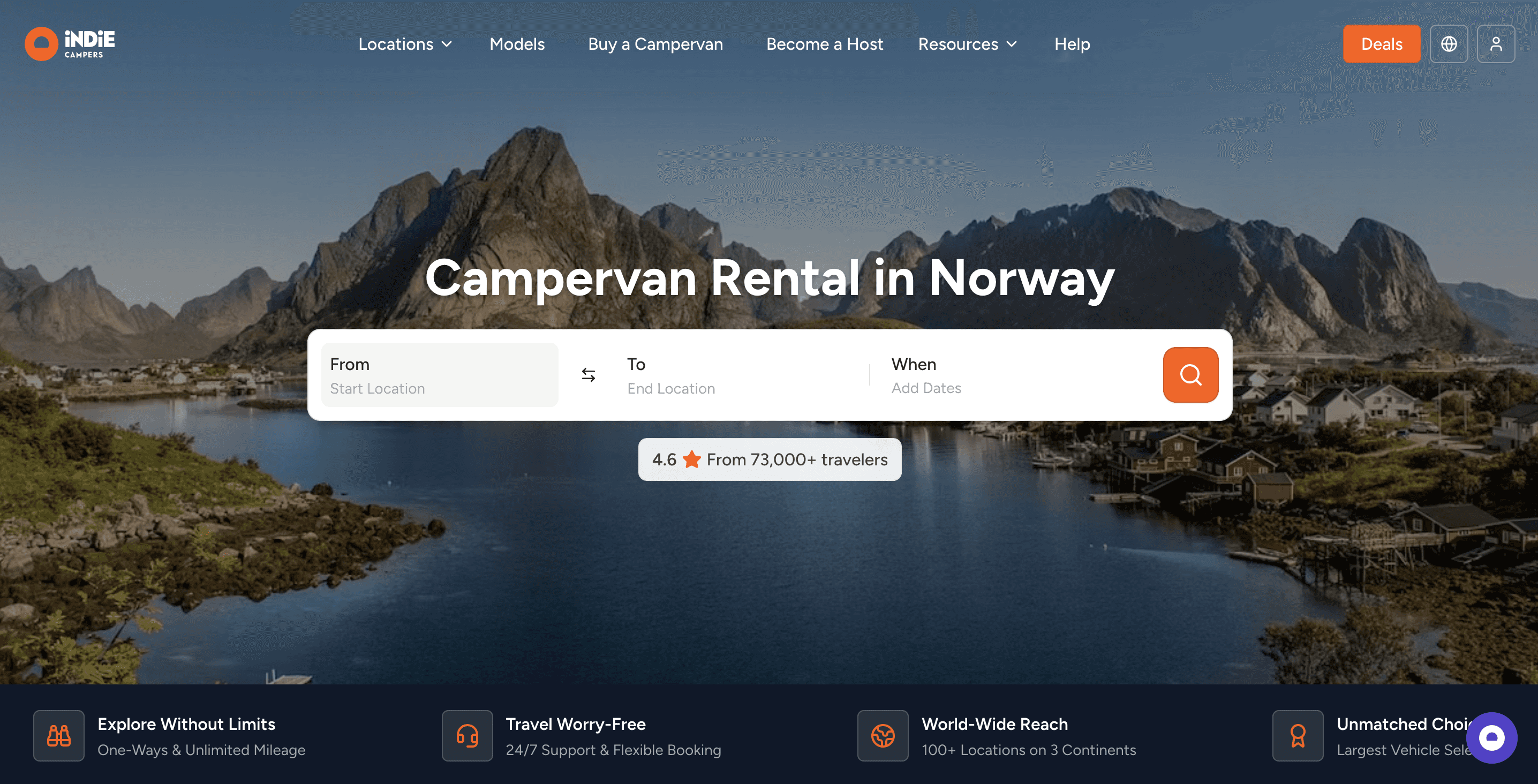
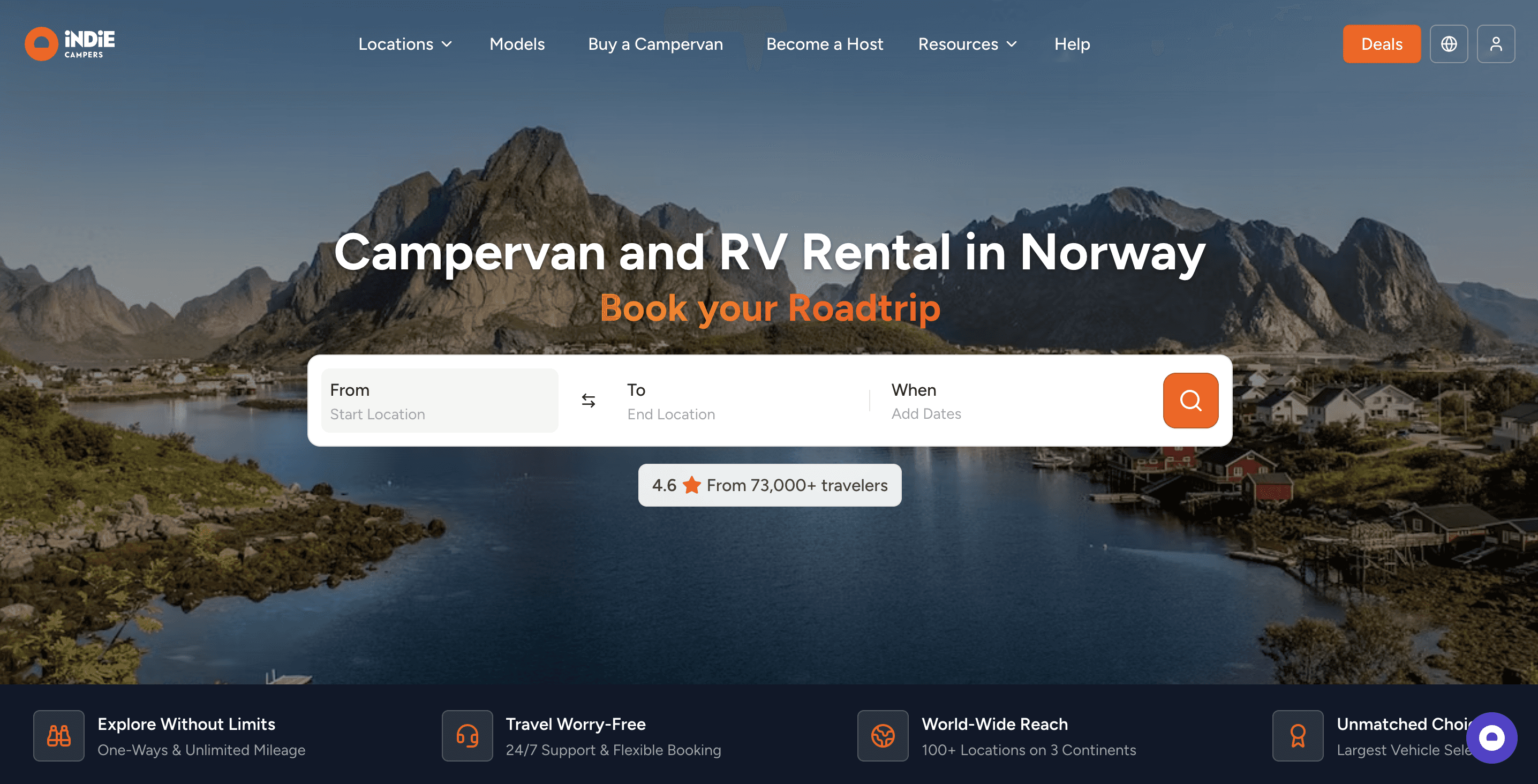
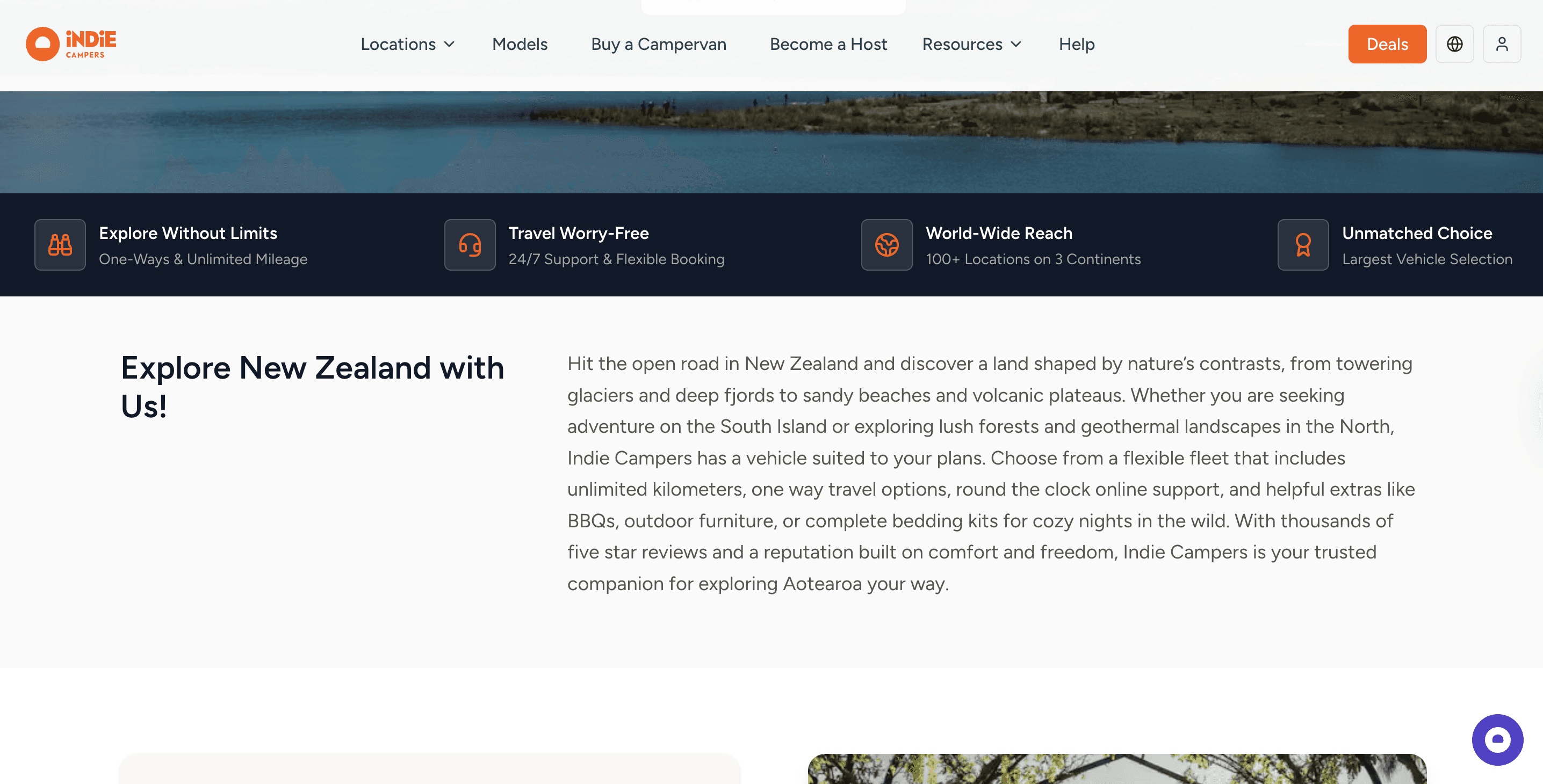
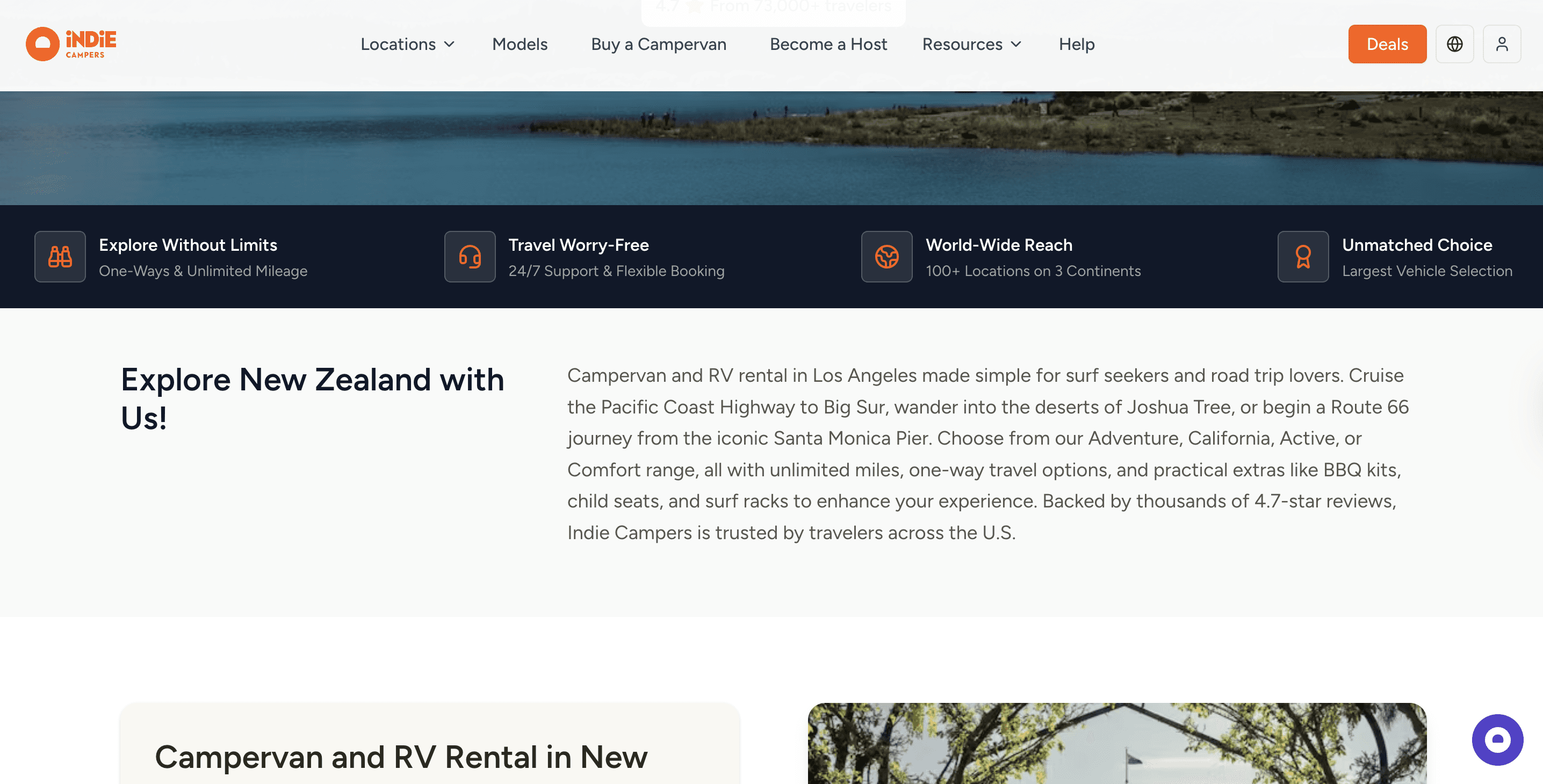
That's why we put a lot of effort into producing 187 location-page rebuilds, including adjustments to meta titles, H1s, subheadings, and body content. Part of this job was to actually adapt the primary target keywords of each region, as in some countries people use "RVs" more often and in other ones "motorhomes" or "campervans". These rebuilds have been delivered to Indie Campers' team and are queued for rollout, with each page already adapted to the local way people search and to the way the AI models phrase their answers.
Here's an example:
Before
After
Before
After
Before
After
INITIATIVE 02
Strategic earned mentions & backlinks
In AI search, it's not only what you say about your offer, but also what other domains are saying about your brand in that space. That's why we used our product and AI agents to crawl thousands of times the results of target prompt searches across multiple LLMs (ChatGPT, Perplexity, Google AI Overviews and Gemini) to identify the most-cited external domains we could collaborate with.
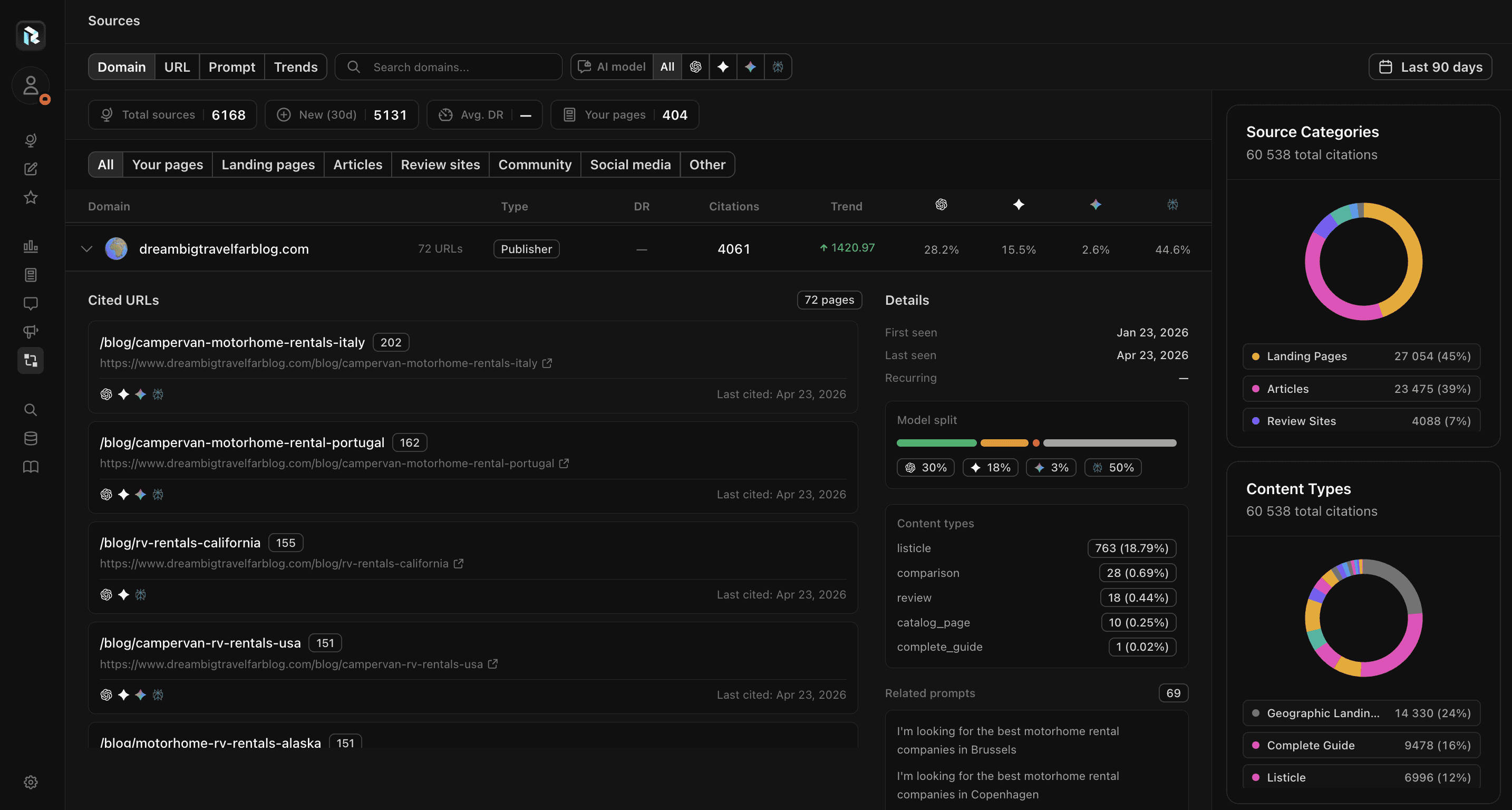
The idea was to identify potential partners, from niche-specific publishers to travel blogs. During this research, our data showed us that one of the most cited sources in this space was DreamBigTravelFar, a global adventure travel blog. They have plenty of pages providing travel tips, guides, and RV rental company reviews. It was our biggest opportunity to attract mentions from.
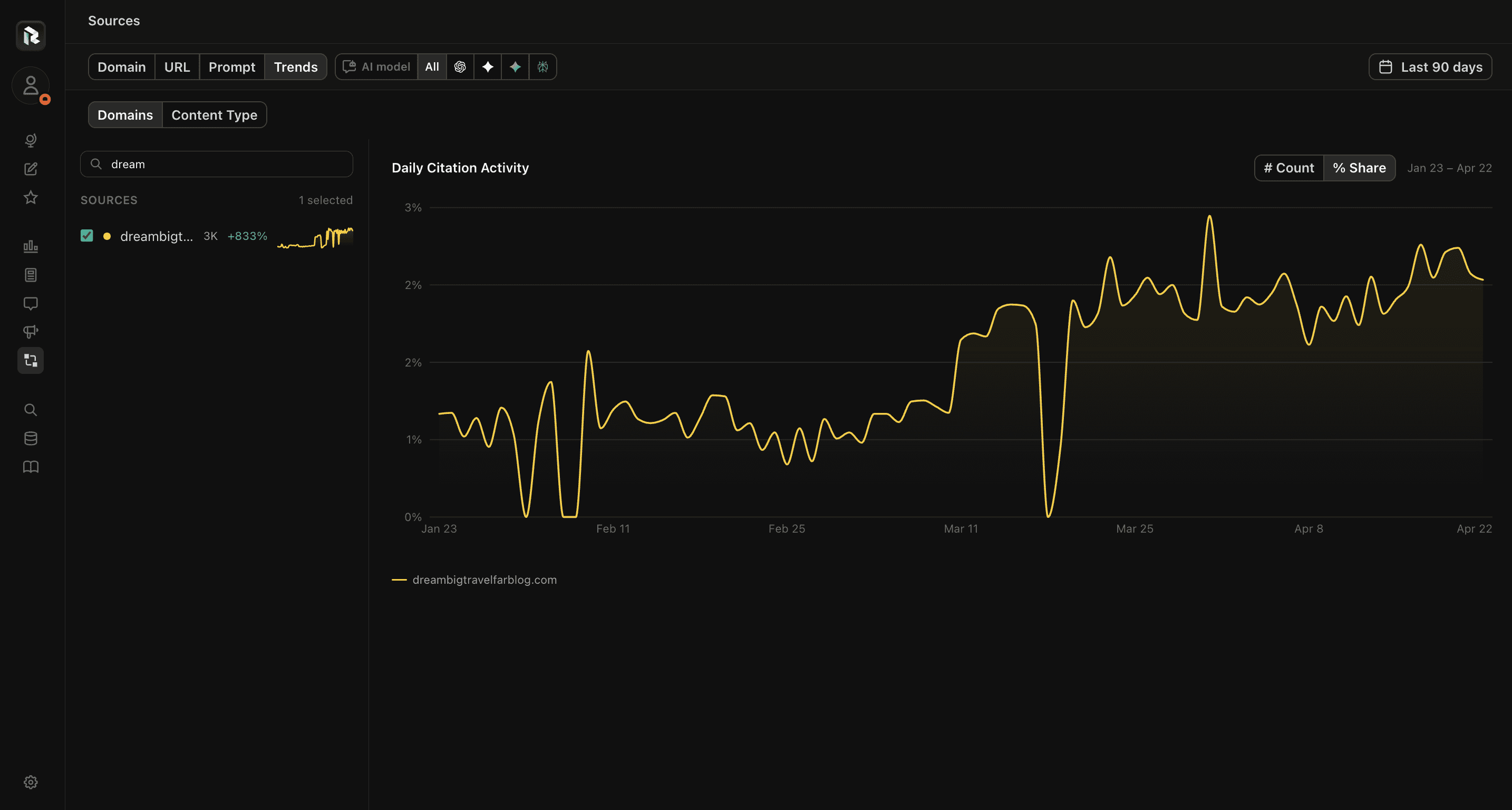
DreamBigTravelFar's citation profile inside Reach: 4,061 citations across ChatGPT, Perplexity, Gemini and Google AI Overviews over 90 days.
Cited URL breakdown and model split: particularly strong in ChatGPT (28.2%) and Perplexity (44.6%).
They were leading citations in the space, with particular impact on ChatGPT and Perplexity responses. One reason we keep running those queries for several weeks before closing these earned-mention partnerships is that these models are probabilistic. The pages surfaced today may not be the ones picked tomorrow. So we look for patterns across multiple days, tracking the citation trend over time. That trend was strongly positive for DreamBigTravelFar.
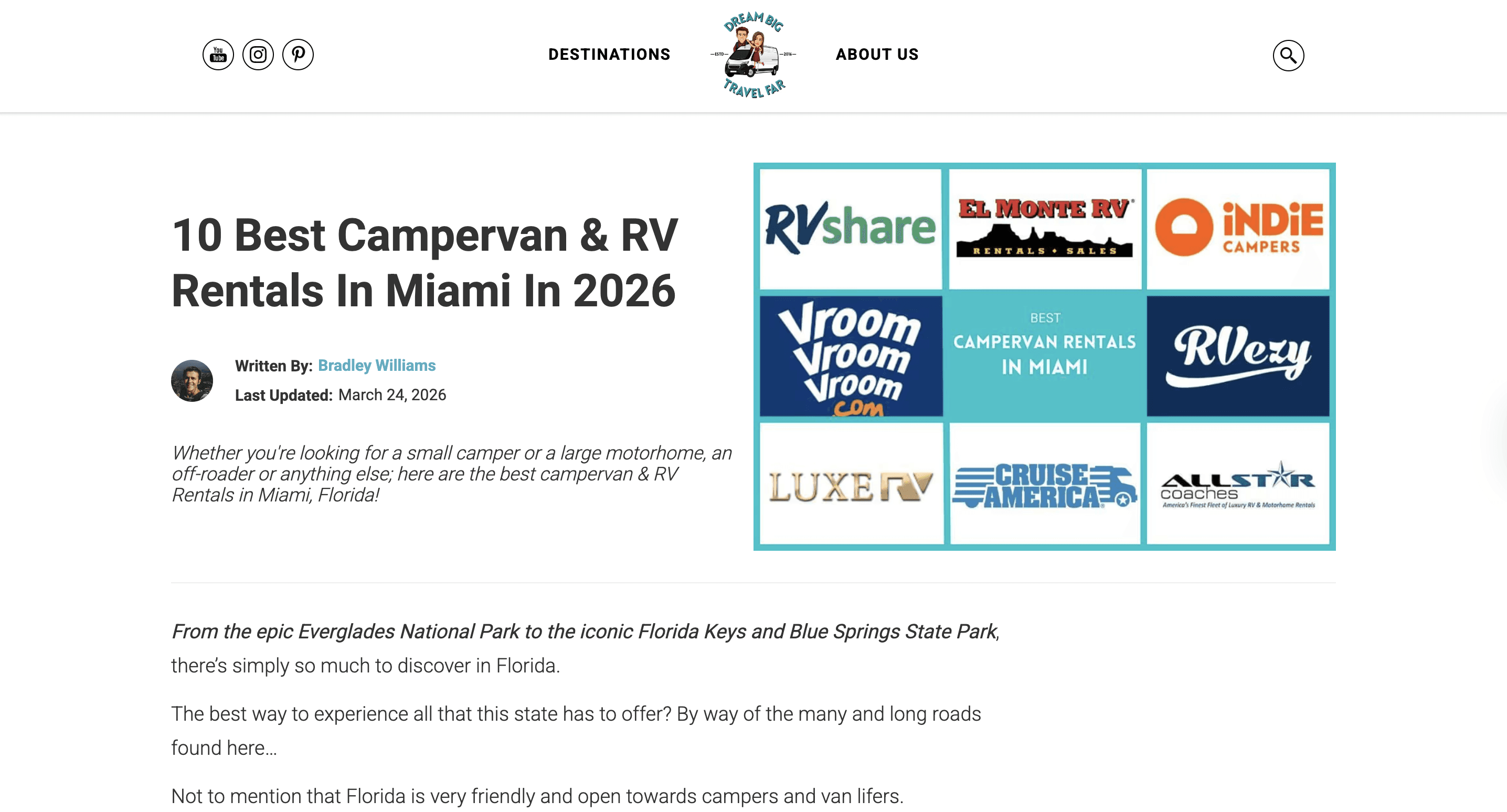
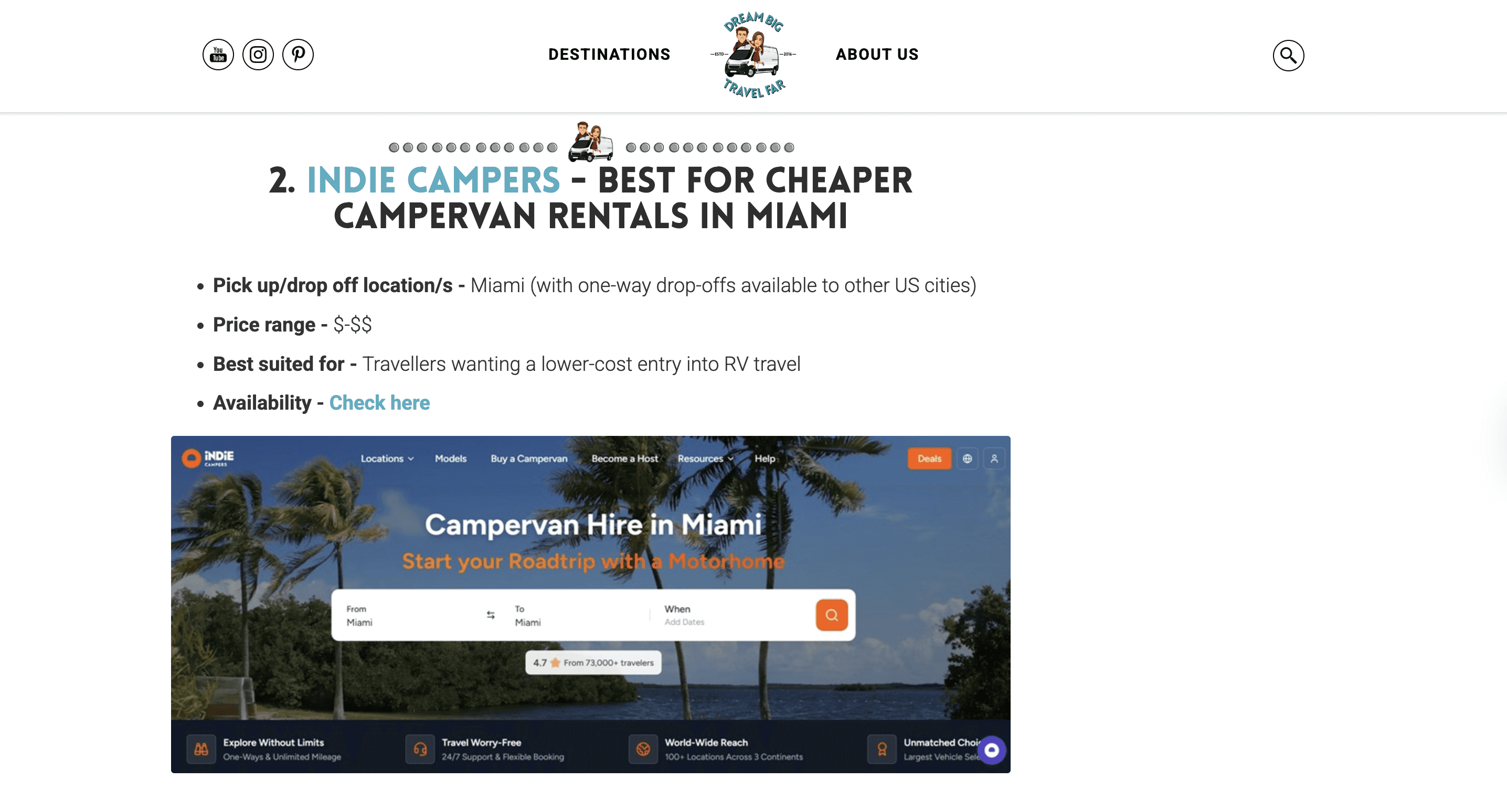
We identified the prompts with lower AI visibility rates and closed partnerships with this travel publisher to boost Indie Campers mentions for those regions.
As the screenshots above show, Indie Campers is now being mentioned in several prompt runs (in Perplexity and ChatGPT), influenced by the DreamBigTravelFar collaboration.
We also took advantage of their good authority score to attract some dofollow backlinks pointing to strategic Indie Campers landing pages. In practice, we killed two birds with one stone: captured mentions to influence AI responses, and generated backlinks to improve Google rankings.
INITIATIVE 03
Scale TOFU/MOFU content for event and itinerary queries
We learned from the research about Indie Campers' target personas that the buying journey starts well before people realize they need an RV. Sure, there are plenty of warm audiences that already enjoy the RVing world. But a big part of travelers aren't aware of this type of travel experience, one that gives you freedom and helps you save money on accommodation to spend on experiences instead.
During our keyword research and prompt mining process, we realized that a lot of people were searching for accommodation solutions for music events and festivals. Usually, the most well-known festivals like Tomorrowland, Coachella, and EDC Las Vegas sell their tickets really fast, and people need to look for accommodation solutions beyond their sold-out camping packages.
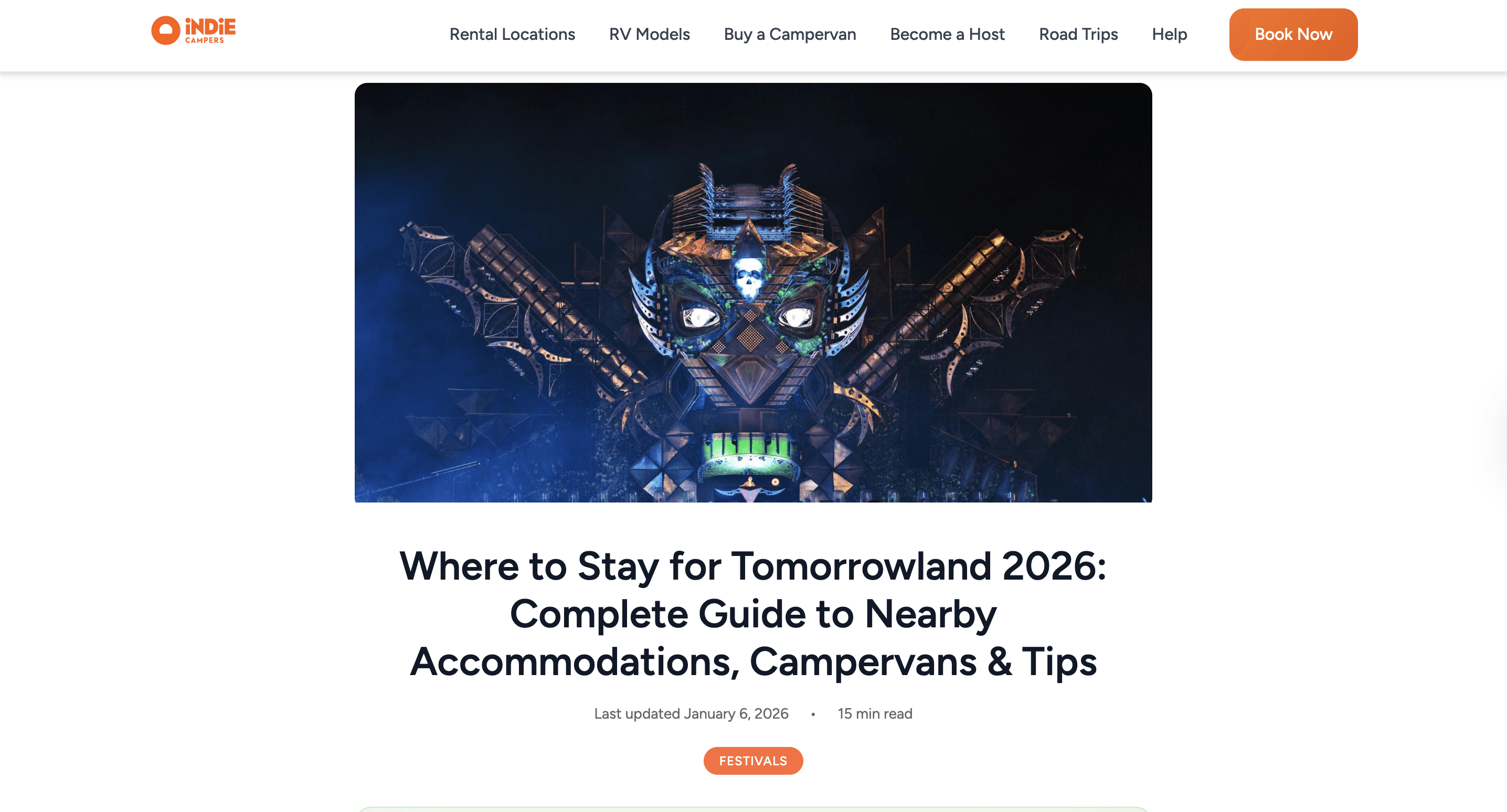
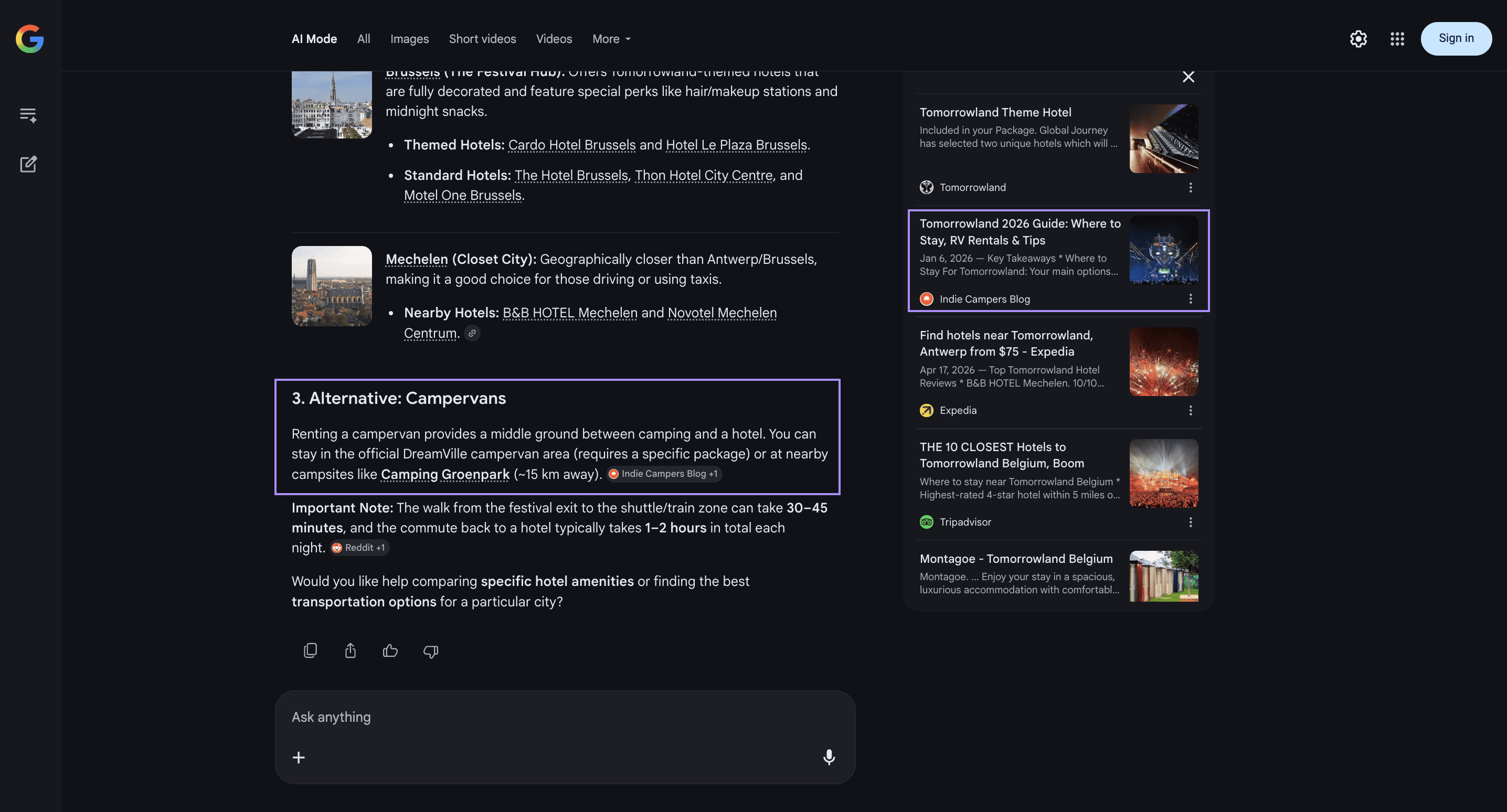
That's the reason why we implemented festival-based content on Indie Campers' blog, which quickly became some of the best-performing content pieces. Within a few weeks, these articles were already influencing AI responses and ranking on Google's top 10 results.
For most of these queries, our goal wasn't to generate brand mentions directly, but to influence recommendations around places to stay, because those same people go on to search for campervan rentals. The example above shows exactly that. A MOFU search for Tomorrowland accommodations was returning campervans as an alternative to expensive hotels and sold-out Airbnbs.
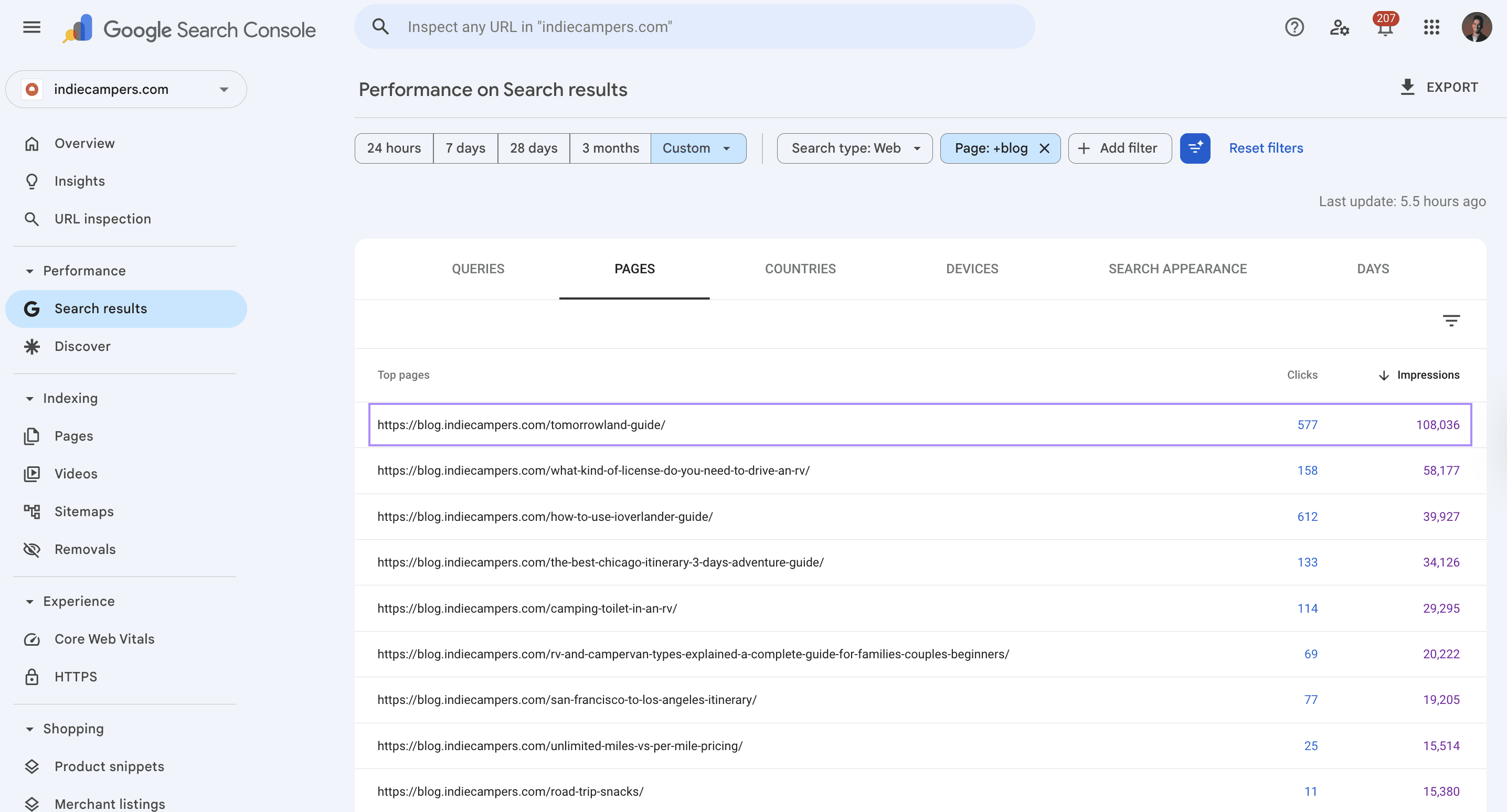
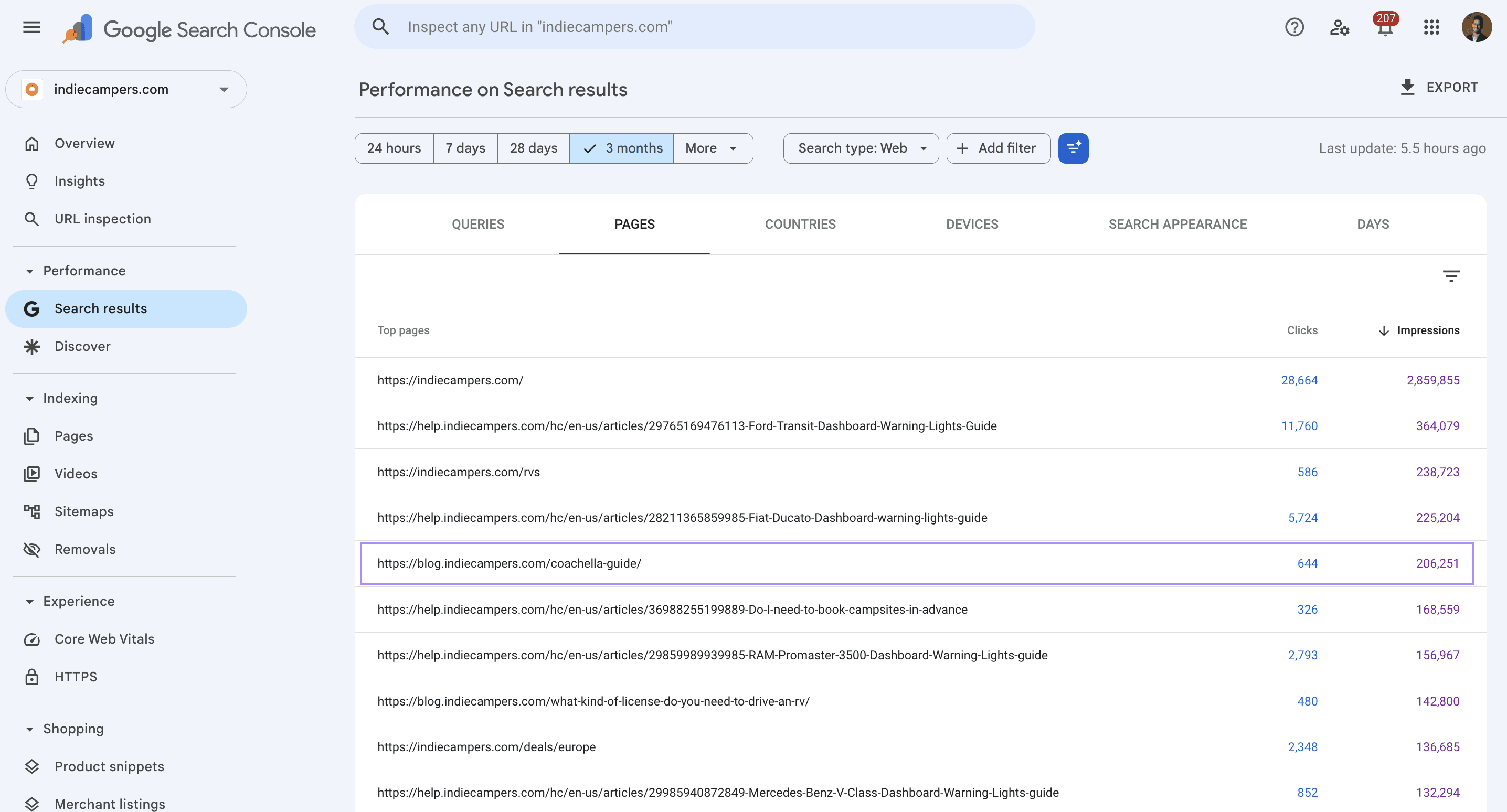
Between December 2025 and January 2026, this Tomorrowland guide became our #1 post by impressions and #2 by clicks. That window is typically when people buy their festival tickets and start looking for accommodation nearby.
Tomorrowland guide performance during the festival ticket-buying window.
Something similar happened with Coachella, but with even larger impact. Our accommodation guide reached the top 5 pages by Google impressions across the entire website, beating a big part of pages with years of indexing history.
Coachella accommodation guide breaking into the top 5 pages sitewide by impressions.
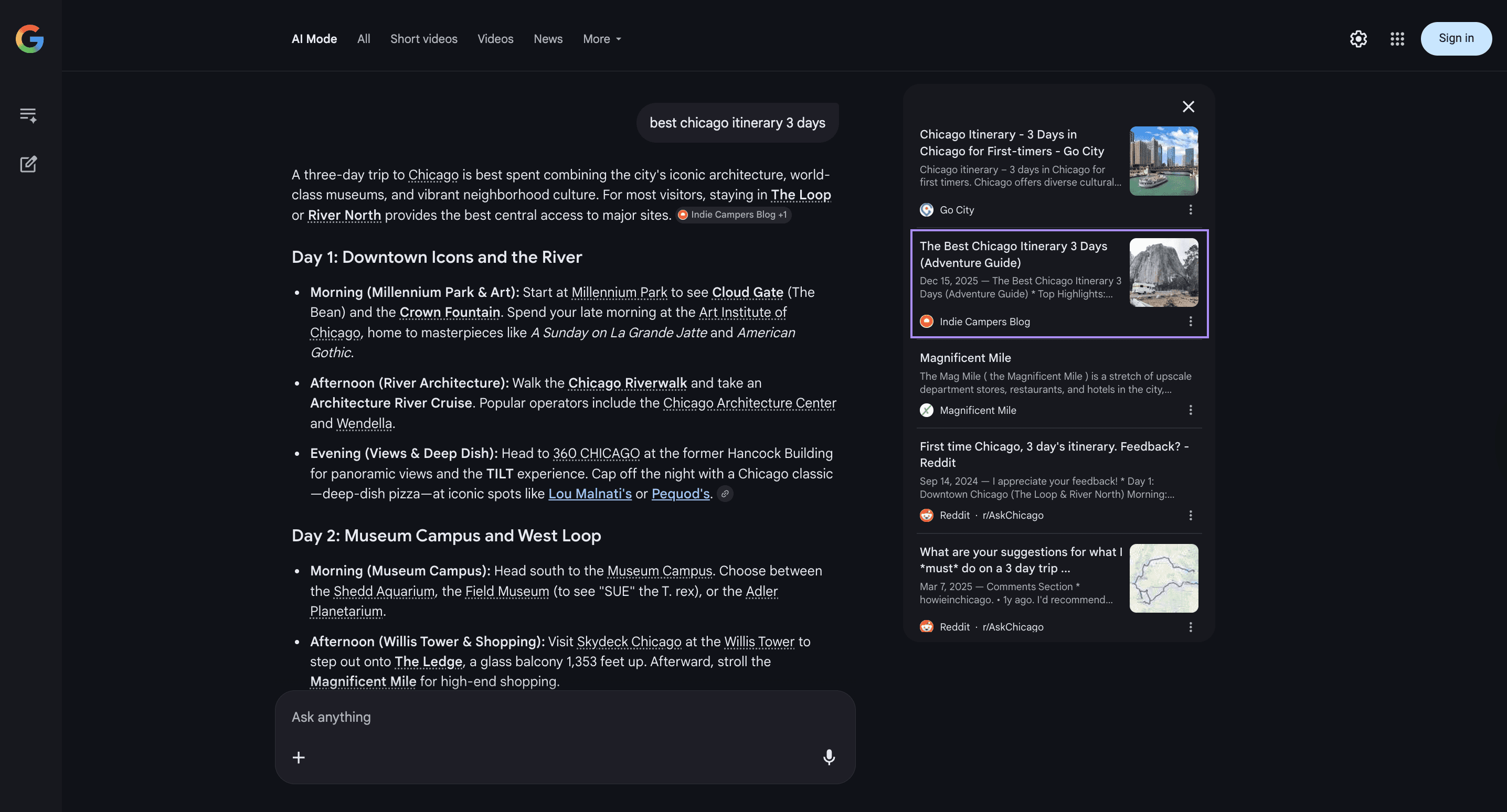
Apart from festivals, there's a large cold audience searching for itineraries before they actually book a place to stay. For this type of query, we focused on Google traditional search, Perplexity, AI Overviews and AI Mode. Models like ChatGPT and Gemini weren't triggering RAG on these queries, so we prioritized the surfaces where our content could actually appear.
INITIATIVE 04
Technical challenges along the way
Now the boring part for non-SEO folks. This engagement has been happening during a troubled period due to Indie Campers' infrastructure migration. And even without a migration, when you do SEO for a company at this scale, you need to stay alert every day, because you're not the only team working on the website. These were some of the main problems we solved along the way:
1) Hreflang issues
Hreflang tags tell search engines which language and regional version of a page to serve depending on where the user is searching from. For a brand operating across dozens of countries and languages, getting this right is what makes sure a UK user lands on the English-UK page, an Italian user on the Italian one, and so on.
We found two overlapping problems:
Generic `en` instead of `en-us`. The site used a generic hreflang="en" instead of hreflang="en-us", which conflicted with the existence of regional English variants (en-gb, en-ie) and left Google unsure which English version was the default.
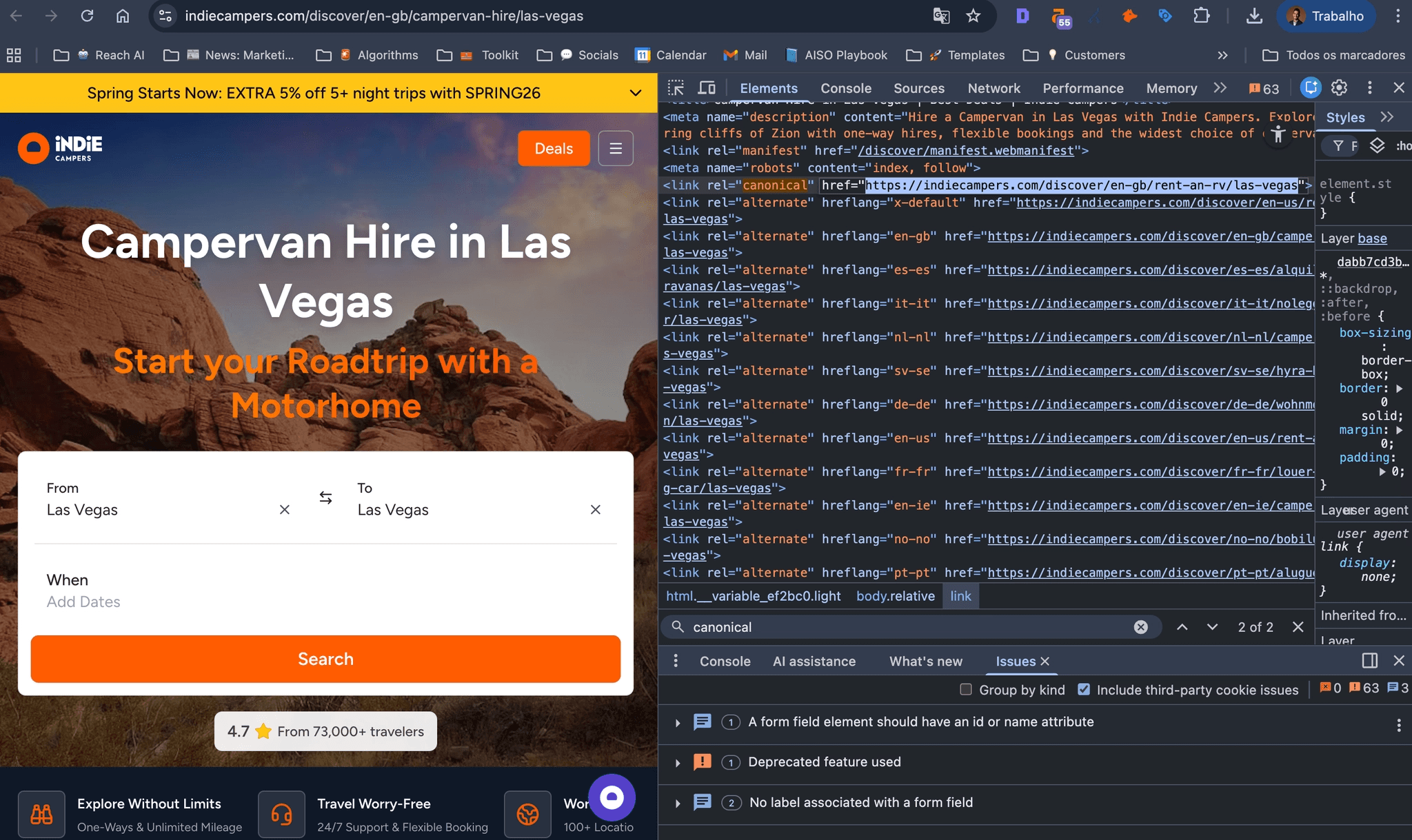
Hreflang pointing to non-canonical URLs. More critically, the hreflang tags on every location page were pointing to URLs whose canonical tags referenced a different (older) URL. In practice, this told Google "the UK version of this page is X" while X itself said "no, the real version is Y", a circular signal that quietly undermined indexing across every regional version.
The canonical/hreflang misalignment pattern we found across the site.
Our fix had two parts: (1) replacing the generic en with properly formatted en-us hreflang tags and setting en-us as the x-default, and (2) updating canonical tags across all location pages so each page self-references its own live URL rather than pointing to an old redirecting one. With canonicals and hreflangs finally aligned, Google can confidently map each regional version to the correct audience.
2) Unwanted indexed URLs
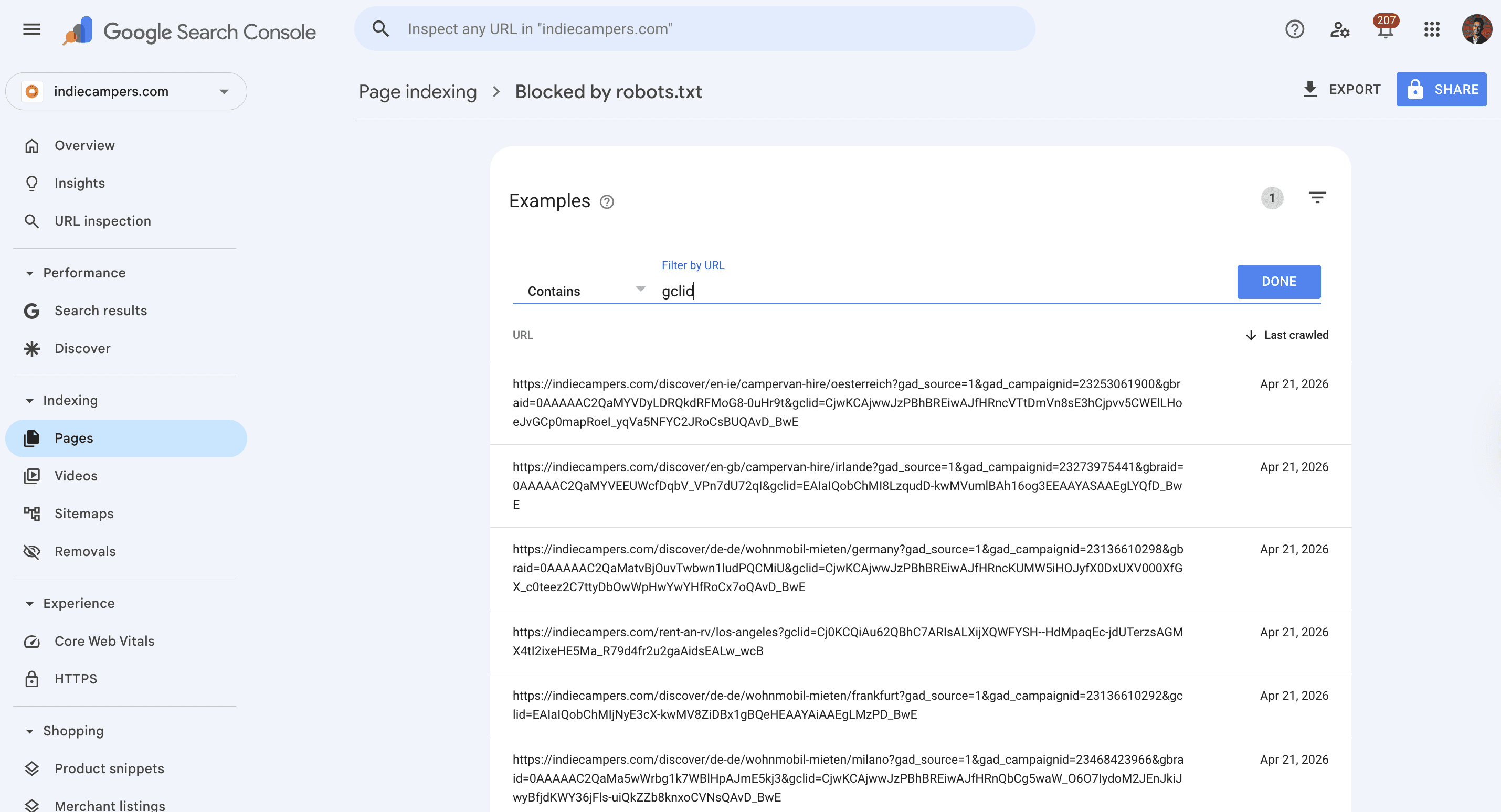
Every tracked marketing link, currency selector, and email campaign was generating a new URL with parameters like ?apcid=, ?currency=, ?utm_source=, and so on. The underlying content was identical, but from a crawler's perspective each parameter combination looked like a distinct URL worth revisiting.
This created two compounding problems. Crawlers were burning budget, revisiting the same pages under endless parameter variations, and PageRank was getting diluted across dozens of duplicate URLs. Worse, some of those URLs with parameters started to index, directly competing with the canonical URL of that page.
We updated the robots.txt to block the parameter patterns generating duplicate content: apcid, ai-src, currency, amp, sa, and the major ad-tracking IDs like gclid, msclkid, gbraid.
Updated robots.txt blocking the parameter patterns that were spawning duplicate indexed URLs.
3) Page rendering issues
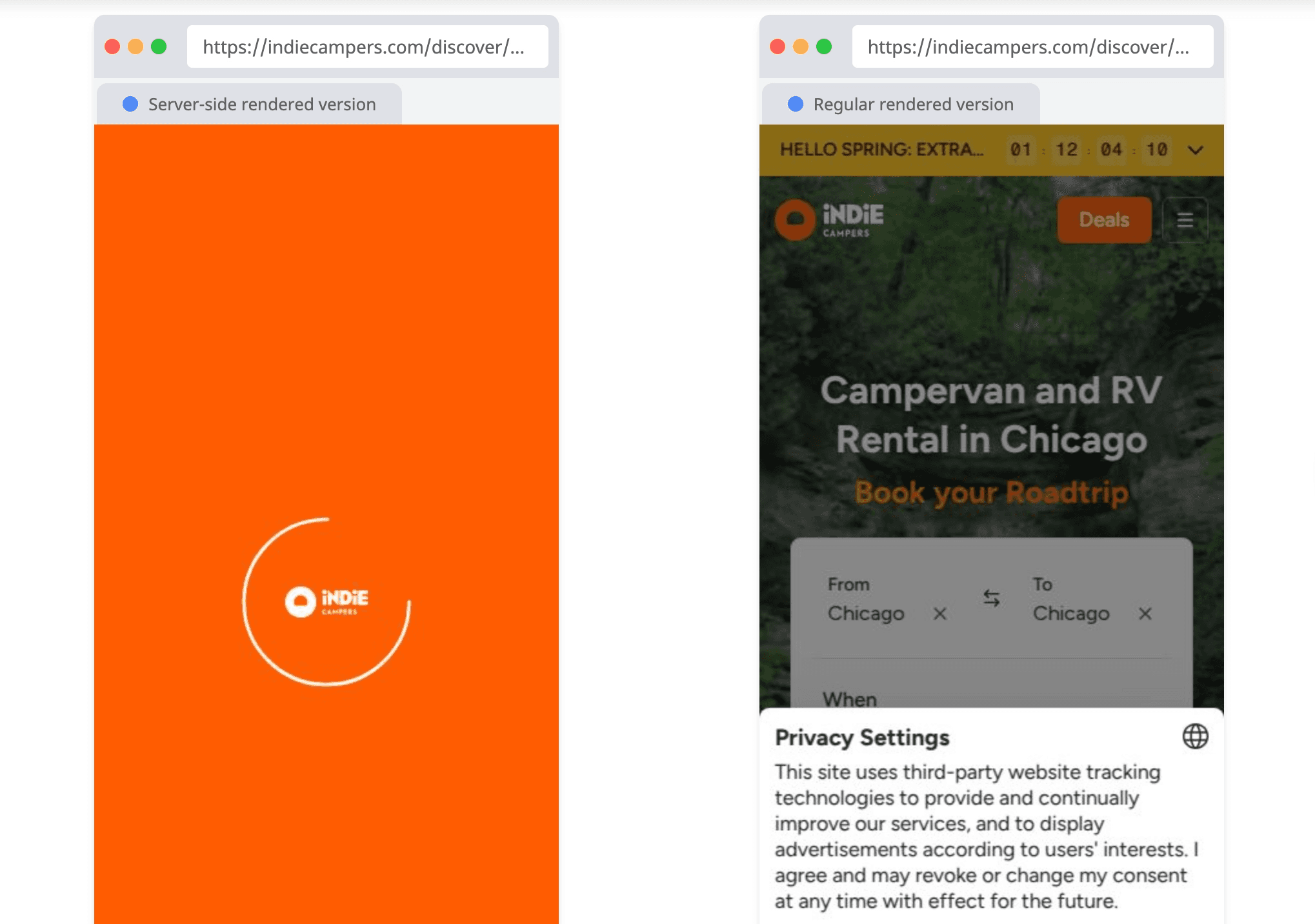
Following the React-based migration, the raw HTML served by the server contained only a loading spinner. All the actual content (headings, body copy, FAQs, internal links) was built in the browser after JavaScript executed. Google, which runs a two-stage indexing process that includes a JavaScript rendering step, could eventually see the full page. But most other crawlers can't.
Raw HTML served to bots: loading spinner, no content. Every location page was partially hidden to GPTBot, ClaudeBot, PerplexityBot.
This turned out to be the most severe issue we identified, mainly because of its impact on AI search visibility. Bots like GPTBot, ClaudeBot, PerplexityBot, and the fetch agents powering Google AI Overviews and Gemini grounding do not execute JavaScript. They fetch the raw HTML and move on. For them, every location page on Indie Campers was partially hidden. Even for traditional Google search, the rendering dependency was causing delayed indexing, crawl budget waste, poor Core Web Vitals, and fragile visibility tied to whether the second-stage render succeeded.
We recommended moving to true Server-Side Rendering, so HTML is produced on the server for every request rather than being built client-side after JS execution. As a transitional step while SSR is being implemented, we proposed a properly configured prerendering layer that serves prerendered HTML to all bots (not just Googlebot), waits for the content to fully render before snapshotting, and explicitly includes GPTBot, ClaudeBot, PerplexityBot, DeepseekBot and CCBot in the allowlist. This closes the AI visibility gap while the longer SSR work is prioritized.
4) Sitemap not updated
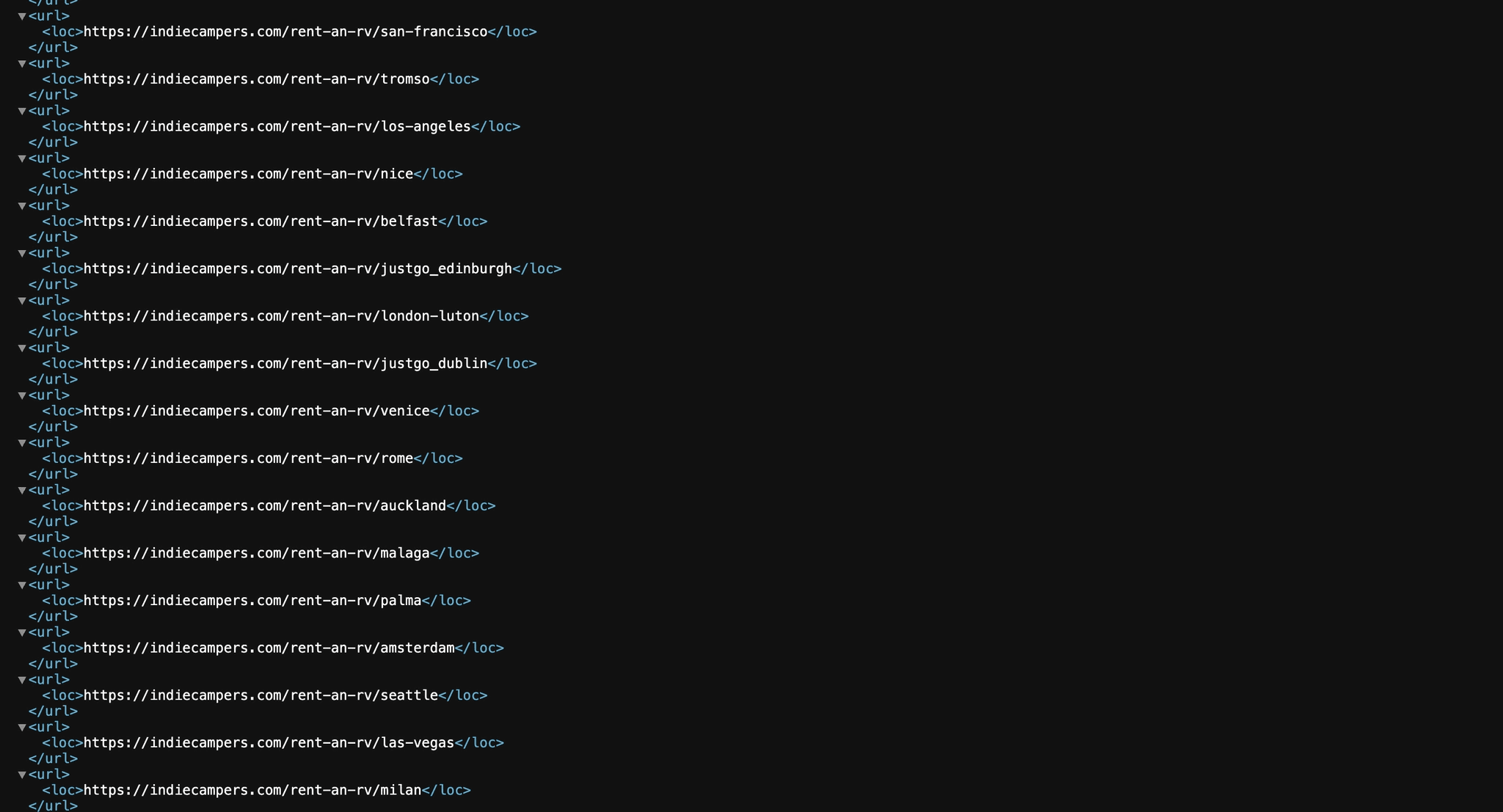
When the migration changed most of the site's URL structure (e.g. /rent-an-rv/usa → /discover/en-us/rent-an-rv/usa), the XML sitemap was never regenerated. It kept listing the old, pre-migration URLs. 301 redirects were correctly in place at the URL level, but the sitemap itself had effectively become a list of redirect sources rather than live canonical destinations.
This violates Google's own sitemap guidelines, which state that sitemaps should only contain 200-status canonical URLs. The consequences compound fast on a site of Indie Campers' size: every crawl of the sitemap pushes Googlebot through an unnecessary redirect hop for every URL listed, new locale variants take longer to get discovered, and the sitemap ends up sending a weakened canonical signal that actively conflicts with the 301s being served.
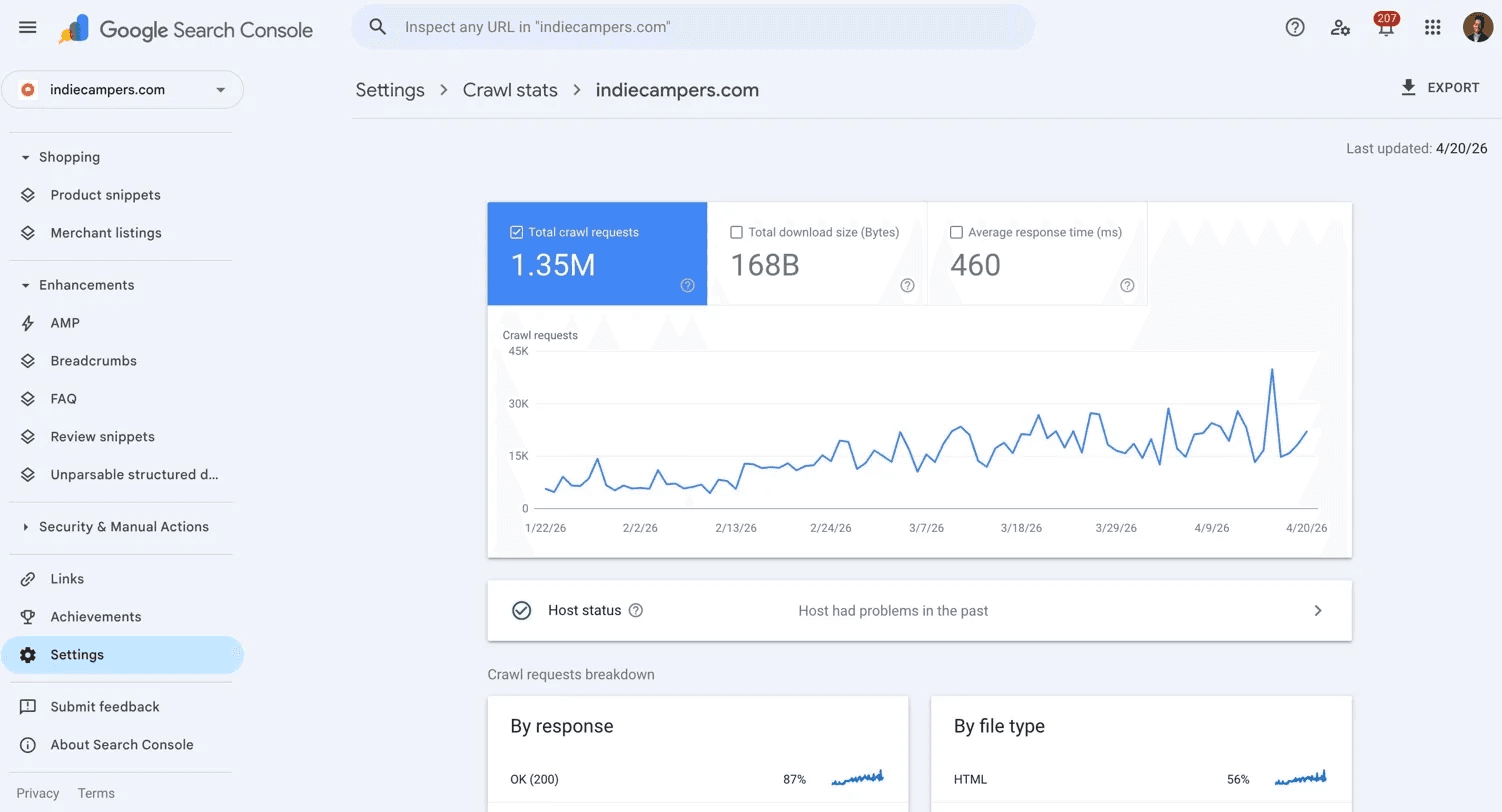
The Crawl Stats report in GSC confirmed the cost: daily crawl requests had climbed roughly 4 to 5x over 90 days, peaking at 100K to 140K requests per day, the opposite of the pattern a healthy post-migration site should show.
Our fix was to regenerate the sitemap so every entry points directly to its final, post-migration URL with zero redirect hops, and to drop deprecated URLs entirely rather than keep them alive through redirects. Once resubmitted to Google Search Console and Bing Webmaster Tools, this immediately reclaims the crawl capacity that was being burned on redundant hops and accelerates discovery of new locale variants across every market.
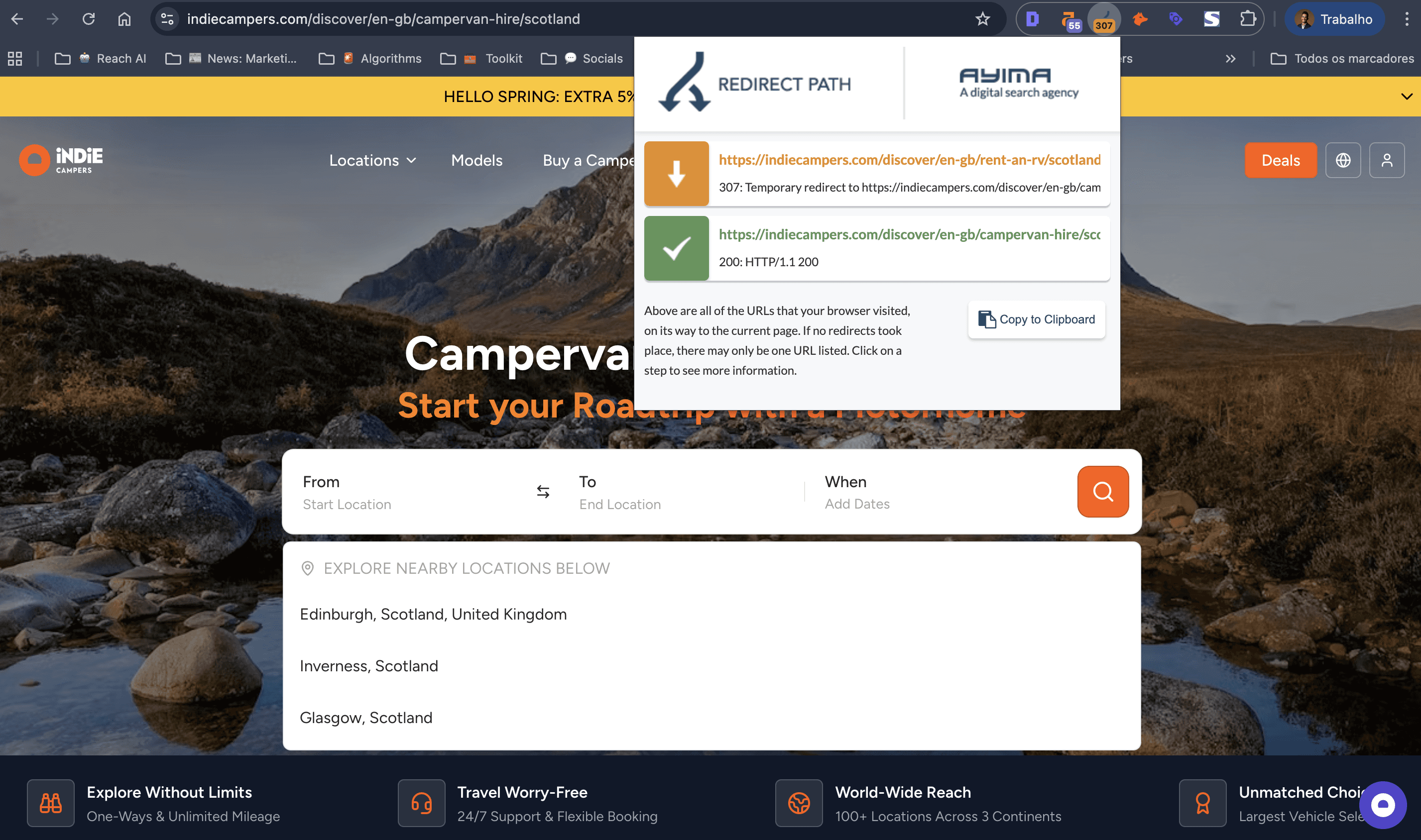
5) 307 temporary redirects
When users or crawlers hit certain location URLs, they were being forwarded to the correct destination, but through a 307 (Temporary) redirect rather than a 301 (Permanent) one. The difference seems small from a user's perspective (the page loads either way), but for search engines it changes the meaning of the redirect entirely. A 307 tells search engines "this move is temporary, keep checking the original URL."
That has three big consequences:
PageRank never consolidates. Any authority built up from internal or external links gets diluted rather than passed through to the destination.
Crawl budget is wasted. Googlebot keeps revisiting the original URL on every crawl cycle instead of treating the destination as final.
Indexing becomes uncertain. Google may surface the redirect origin, the destination, or neither with any real confidence.
On Indie Campers, the pattern was locale-wide, affecting URLs like /discover/en-gb/rent-an-rv/scotland → /discover/en-gb/campervan-hire/scotland and equivalents across every market and language.
Our fix was to replace all 307 redirects in this pattern with proper 301 (Permanent) redirects, so search engines correctly consolidate signals to the live destination URLs and stop wasting crawl cycles on the old ones. Combined with the sitemap regeneration, this meaningfully cleaned up the redirect chain inefficiencies that were driving crawl activity up post-migration.
A note on attribution
We are transparent about what Reach drove versus what Indie Campers' broader business is doing. Indie Campers runs a sophisticated paid acquisition program, a strong brand, and a large product team shipping improvements to the booking experience. SEO and AI search results sit on top of that foundation.
What we can attribute directly: the 187 location-page rebuilds delivered to the team, the 25 published blog posts (7 of the top 10 impression drivers on the blog are ours), the 16+ backlinks and 4+ earned mentions secured, the AI visibility gains on the 77 tracked prompts, and the technical fixes shipped during migration. The YoY growth numbers reflect the combined engine, with Reach as the primary organic and AI search driver.
Ready to turn search into your best performing growth channel?
Schedule a 30-minute call with Reach to walk you through the tactics we used to turn SEO and AI search into a compounding channel for ColdIQ, Indie Campers, Fidelidade, and more, and map out what it would look like for your company.
Ready to turn search into your best performing growth channel?
Schedule a 30-minute call with Reach to walk you through the tactics we used to turn SEO and AI search into a compounding channel for ColdIQ, Indie Campers, Fidelidade, and more, and map out what it would look like for your company.
Ready to turn search into your best performing growth channel?
Schedule a 30-minute call with Reach to walk you through the tactics we used to turn SEO and AI search into a compounding channel for ColdIQ, Indie Campers, Fidelidade, and more, and map out what it would look like for your company.