Webinar Recap: How to Turn AI Visibility Into Traffic & Pipeline with José Velez
The full end-to-end system, built live. From finding the prompts your buyers actually search, to reverse-engineering what gets recommended, to de-anonymizing the traffic AI sends you and converting it into pipeline.

In this live workshop, José Velez (Co-Founder & CEO, Reach) walked through the complete system that takes a company from AI-search visibility all the way to qualified pipeline, end to end. From positioning and prompt research, to reverse-engineering what actually gets recommended, to de-anonymizing the traffic AI sends you and turning it into meetings.
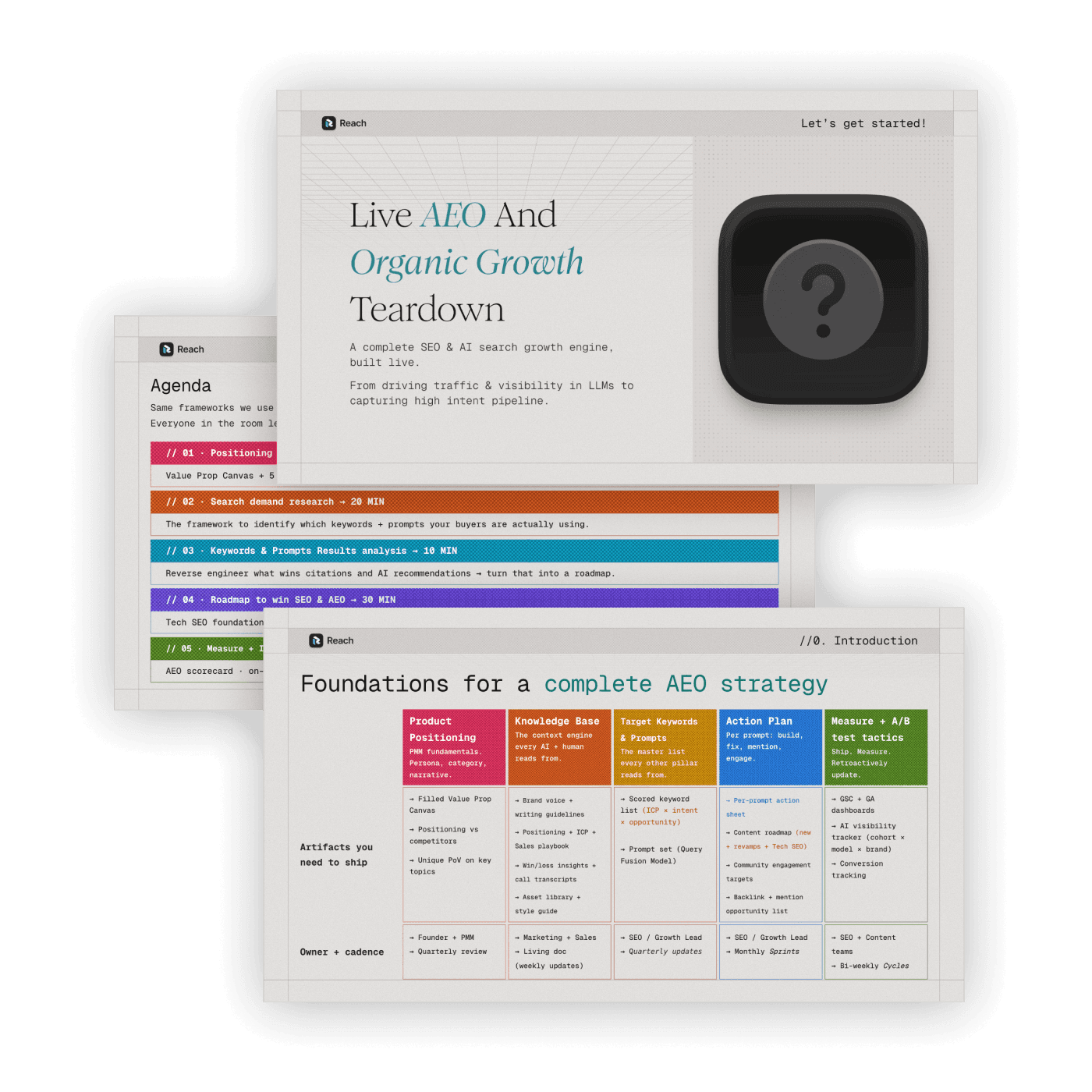
Top Takeaways
AEO is two optimizations stacked, not one. An answer engine fans a single prompt out into many searches under the hood, pulls a large set of pages, then decides which few to cite and recommend. So you do classic SEO to get into the candidate set, then a second layer of optimization to win the citation and the recommendation. For "best email finder for LinkedIn outreach," 71 of the 119 cited pages were listicles. Wrong format, zero citation, no matter how good the page is.
Positioning is the input to everything, and the grounding layer for AI content. If you can't cleanly state who you're for and what job you do for them, you don't know which prompts to chase, and neither does the LLM recommending you. Codify positioning, competitive angles, and proof into a knowledge base of artifacts so every AI-assisted asset is grounded and on-narrative, instead of the slop everyone complains about.
Find the prompts your buyers actually search: ignore platform "prompt volume." Suggested-prompt lists and volume estimates from AEO tools are mostly noise. Even Google's keyword volumes were often inaccurate (hence zero-volume keyword strategies); with prompts, the long-tail problem is that times 100. Mine intent, not volume. "Who cares if it's not 1,000 people? You're going to have 20 high-intent customers." That's how Reach sourced 7-figure deals for Carro straight out of ChatGPT, by targeting the prompts that mattered.
Optimize to be recommended, not just cited. Match content format to the prompt cohort: listicles for "best X," comparison pages for "X vs Y," alternative pages for "X alternatives." Then check sentiment and positioning. A huge share of voice is worthless if the model recommends you badly. "You don't want AI to just cite you. You want AI to recommend you, with the right positioning."
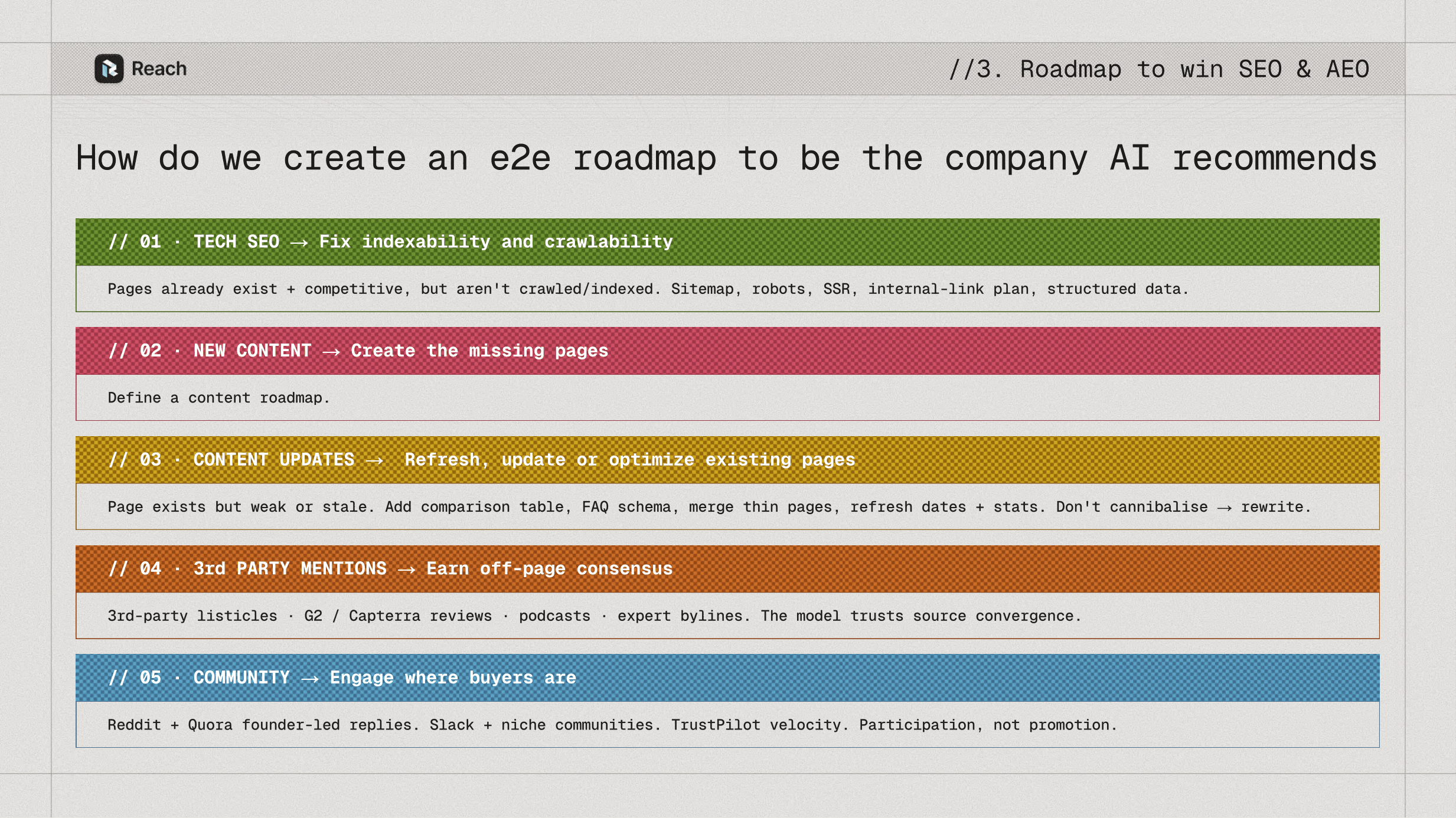
The roadmap is tech SEO → content → off-page, and you can win with your own content. Around 85% of cited sources are third-party (Snov.io appears in ~22% of its own citations), but that does not mean you should only chase PR and Reddit. Reach has made customers a top-cited source with owned content, where you control the narrative. Start with the 5% of technical SEO that drives 95% of the impact, keep pages fresh (models are heavily biased toward recently updated content), and A/B test everything.
Visibility is only half the loop: close it to pipeline. Once AI sends you high-intent visitors, de-anonymize up to 45% of the companies hitting your site, route the hottest straight to sales, and retarget the rest. Re-engaged accounts are ~14x more likely to convert because AI already pre-warmed them. And the entire system (research, content, outreach) runs faster with Claude Code.
Best Practices and Key Learnings
Pillar 1 · Positioning is the input to everything
Before keywords, before prompts, before any content: a tight, stable answer to "what does this company do, and for whom?", repeated everywhere LLMs read from. It's an overlooked step, but without clear positioning per persona, use case, and segment, you don't even know what to optimize for. And it's not just about earning the link or the blue-link ranking anymore, you want the recommendation, with the right narrative attached. If your own team can't articulate that per segment, neither the people doing your AEO nor the LLMs will get it right.
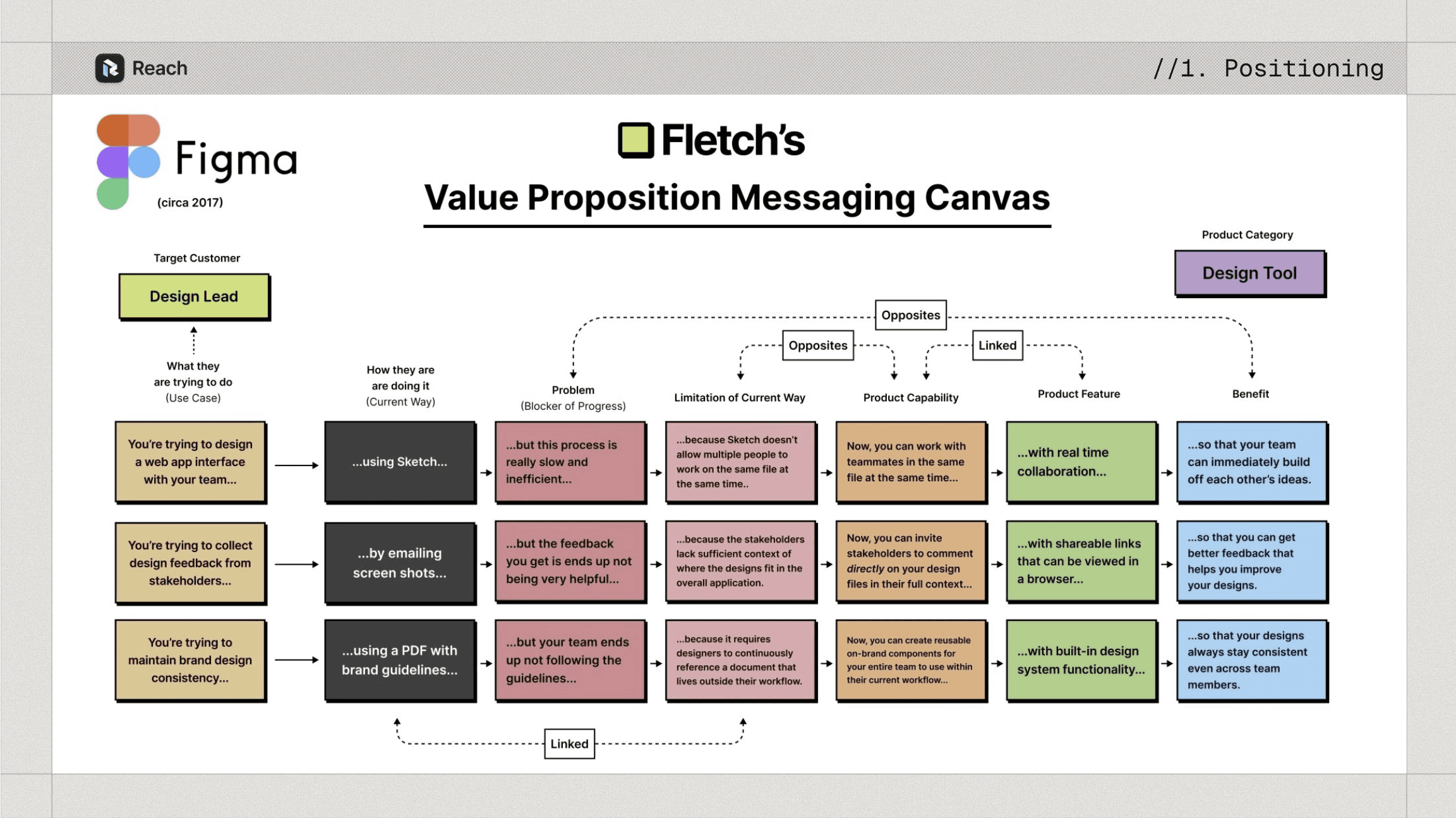
José's mental model of choice is a value proposition framework: a specific persona, trying to do a specific job, currently doing it some way, blocked by a limitation, and now they can do something new, with a specific feature, for a specific benefit. The Figma example he walked through: a design lead trying to design a web-app interface with their team, stuck on Sketch because it doesn't let multiple people work in the same file at once, and now they can collaborate in real time, so the team builds off each other's ideas instead of working in silos. If it doesn't read as one clean sentence, the positioning is broken.
Then comes the part most teams skip: consistency across every surface LLMs read, your own content (the website) and earned content (G2, Capterra, Trustpilot, directories, and communities like Reddit, Quora, and Facebook groups). Codify it all into a knowledge base: a dedicated artifact for each piece (core positioning, customer results, how you compete with each competitor, even past webinars and your point of view on key topics). That becomes the grounding layer Claude pulls from for both content and analysis. Without it, AI hallucinates and drifts.
Pillar 2 · Find the prompts your buyers actually search
The hardest part of an AI-search strategy isn't the platform you use to track prompts: it's choosing the right prompts in the first place.
Here's the spicy take, José said, "but based on data": the suggested prompts and volume estimates AEO platforms hand you are the wrong lens. Even on Google, a lot of keyword volumes were inaccurate, which is exactly why the best SEOs moved to zero-volume keyword strategies, optimizing for intent over volume. With prompts, that problem is multiplied by 100, because there are endless long-tail variations. The job is to understand search intent and cluster it. You don't need the volume. You need to know whether someone searching this is actually on the journey to buy what you sell.
The signal hierarchy (highest signal → broadest coverage):
Proprietary first-party data. Google Search Console: the searches already driving traffic to your site where you're not ranking at the top, and not being recommended in AI platforms.
Sales transcripts (B2B) / support tickets (B2C). The most common questions real buyers are blocked on, mostly bottom-of-funnel, the shortest distance to a deal.
Paid-search winners. If a keyword combination already converts on paid, borrow it. Paid has conversion data organic doesn't.
Competitor keyword gaps + live related questions. What drives the most traffic and conversions to competitors, plus Google's People Also Ask and Perplexity autocomplete, real questions, straight from how people search in Google and in AI.
Review platforms. G2, Trustpilot, Capterra in buyer language. (Competitor sales pages too, though Reach rarely uses them, since doing their own research usually beats copying the competition.)
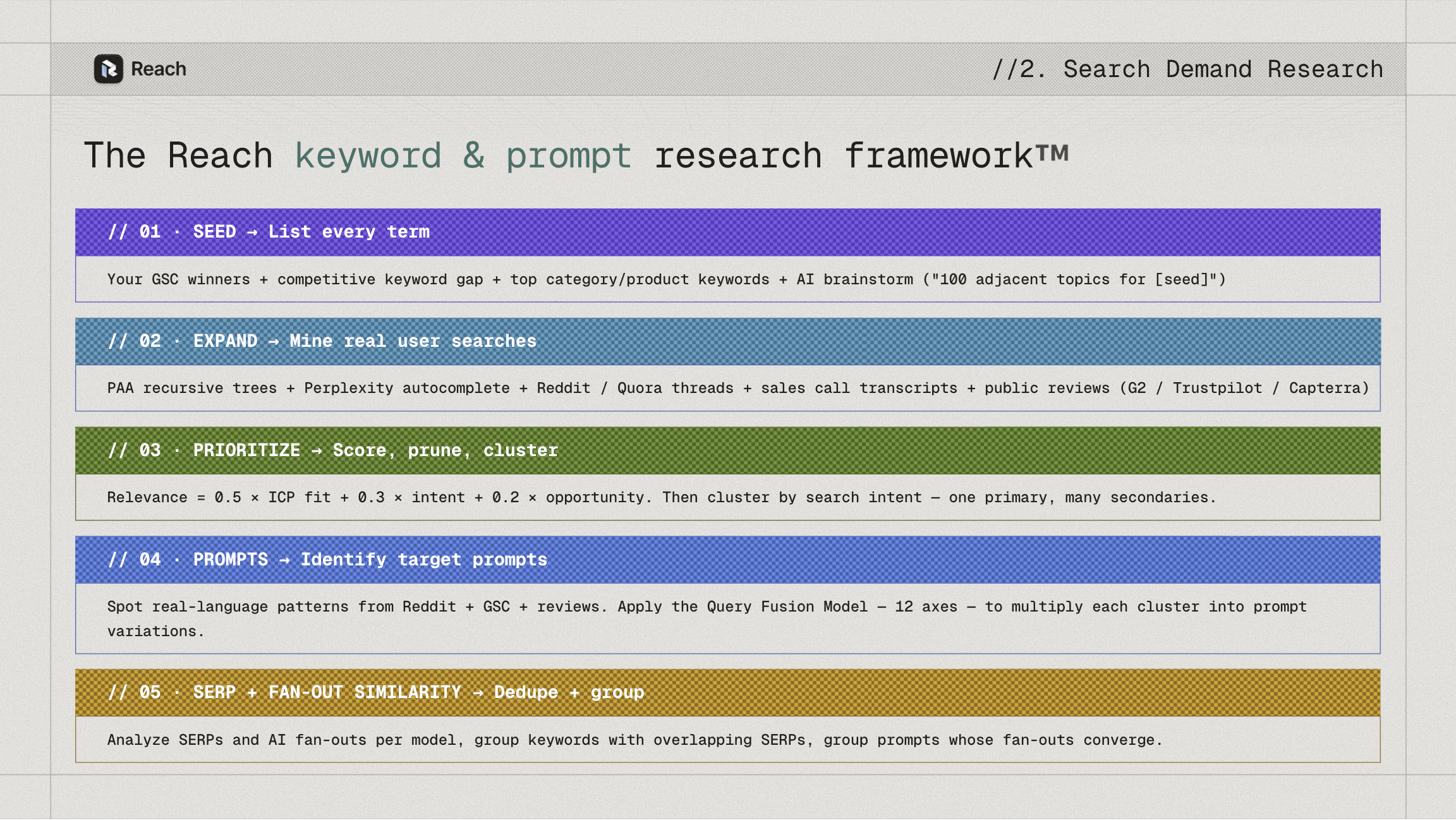
The Reach process: pull GSC, then score every search with a custom Relevance Score, an algorithm that combines whether it's the right keyword for your buyer journey, ICP, and positioning, and whether people are actually searching for it, and whether you can realistically rank. Mine real user questions from Reddit, reviews, and sales calls, plus People Also Ask and autocomplete, then expand each seed into its variations.
The framework, end to end: list seed keywords (GSC, competitor gap analysis, your top category and product terms, and an AI brainstorm, for seeds only; the AI's actual prompt suggestions are mostly inaccurate, which is exactly what the AEO platforms are serving you). Expand them with People Also Ask, Perplexity autocomplete, and real questions, which gives you ~100,000 searches. Then prioritize and cluster by SERP similarity and query-fan-out similarity, so you never track the same prompt twice.
Why the heavy machinery? Because ChatGPT and Claude hallucinate on this out of the box. They're probabilistic. Reach built a large set of deterministic scripts, APIs, and internal tools so the analysis is reproducible, every time, without the hallucinations.
FREE AUDIT
Want this analysis run on your site?
We'll pull your existing prompts, score them against your top competitors, and show you where you're missing the citation, the same process from the workshop, applied to your domain.
Pillar 3 · Reverse-engineer recommendations, not just citations
The biggest misconception out there: that you do the same thing for every prompt. "I've seen all sorts of rubbish online, add statistics and citations go up by X, add FAQs and…" That's solving the wrong problem. What wins a citation is completely different per prompt type.
So Reach built the Prompt Reverse Engineering Framework, the repeatable process for figuring out how companies are being recommended for a given prompt, and what you'd need to do to be the one that's recommended:
Pick a prompt cohort (group prompts by use case) and read the query fan-outs the models run under the hood. The same searches appear far more often than others. In one example, a single search showed up 60 times across the last 240 responses. Stable = real pattern.
See who ranks for those searches. ChatGPT leans on Bing, often pulls from Google, and increasingly uses generative search engines like exa.ai. Reach aggregates the SERP, the search features (AI Overview, ads, People Also Ask), and the cited sources.
Analyze the patterns with Claude: format mix, winning title formats, the questions used in FAQ sections, source categories. For "best email finder for LinkedIn outreach," listicles were dominant: 71 of 119 cited pages. Shift to a different cohort and comparison or alternative pages win instead. Wrong format gets zero citations, regardless of how good the writing is.
Map the pattern to an action using a simple decision matrix:
Citations are competitor/vendor pages and you can out-build them → create or revamp your own page.
Citations are mostly third-party → mention-building (get into the listicles that already recommend other companies).
Citations are mostly community → show up on Reddit and the relevant communities.
Then the step most teams skip entirely: sentiment and positioning. Being mentioned isn't enough. Is the model actually recommending you (not just naming you), for the right use case, with positive sentiment? José sees companies brag about share of voice "but it's always saying bad things about your brand, so you're not going to get customers that way." (Snov.io, for what it's worth, is already cited every single day across the models Reach tracks, so the live question becomes whether it's framed right.)

Pillar 4 · Build the roadmap: technical SEO → content → off-page
Start with technical SEO, whether it's a search engine, a generative engine, or an LLM, the agents have to crawl, render, and index your content or none of it counts. But don't drown in audits. Most SEO agencies build endless technical to-do lists; the highest-impact fixes are the ones hitting your whole domain and the pages that drive the most revenue. Fix those first.
The 5% of technical SEO that delivers 95% of the impact:
Let search and AI crawlers in. Robots.txt and sitemap clean, current, and well-formatted. (Plenty of sites still block the very bots they now want to be featured by.) Table stakes.
Crawlable, well-rendered pages. Heavy JavaScript that won't render, or pages that load too slowly, get skipped. Even a #1 ranking is useless if the crawler can't read the content. Table stakes.
Canonicals pointing at the right page. A canonical aimed at the wrong URL tells the engine this isn't the main version of the page. Small thing, big impact.
Internal links. Pages with 8+ contextual internal links pointing at them pull roughly 300% more traffic, and it lifts crawlability, rankings, and citations.
Content is two sub-pillars: new pages (the gaps your prompt research surfaces) and revamps (existing pages that need the work). Critically, don't spin up a second page targeting the same intent; it splits authority across both and they cannibalize each other. Revamp instead, and decide new-vs-revamp at scale, programmatically. Keep everything fresh: models "are craving for fresh information, that's why they have a huge bias toward revamped and up-to-date content," since their training data is already stale. Make content agent-ready: original, with information gain (unique data and insights), and authoritative (real sources, citations, point of view). And don't mass-produce a single format just because listicles are winning a cohort, mix it up, or it reads as a spam signal.
The 85% myth. It's true that in most categories ~85% of cited sources are third-party. For Snov.io, the company shows up in only ~22% of its own citations. But concluding "so just optimize for third-party mentions, PR, and community" is, in José's words, bullshit. Reach has made several customers one of the most-cited sources in AI with owned content, the content where you control the narrative. Third-party mentions and community engagement are how you reinforce the specific prompts you can't move with your site alone.
Off-page (earned mentions + community). Prioritize by the pages with the highest citation impact on your highest-intent, bottom-of-funnel prompts. Listicles already list ~10 companies, so they're easy to be added to, and mention swaps work, even with non-direct competitors (give them a mention in a use case you don't care about; get one in a use case you own). Community is the same idea with a caveat: you have to build real authority first, Reddit karma, genuinely helpful answers, per subreddit. Reach generates first-draft outreach and replies from its own templates, then exports them into tools like Instantly or Amplemarket to run at scale.
Pillar 5 · Measure what matters and A/B test everything
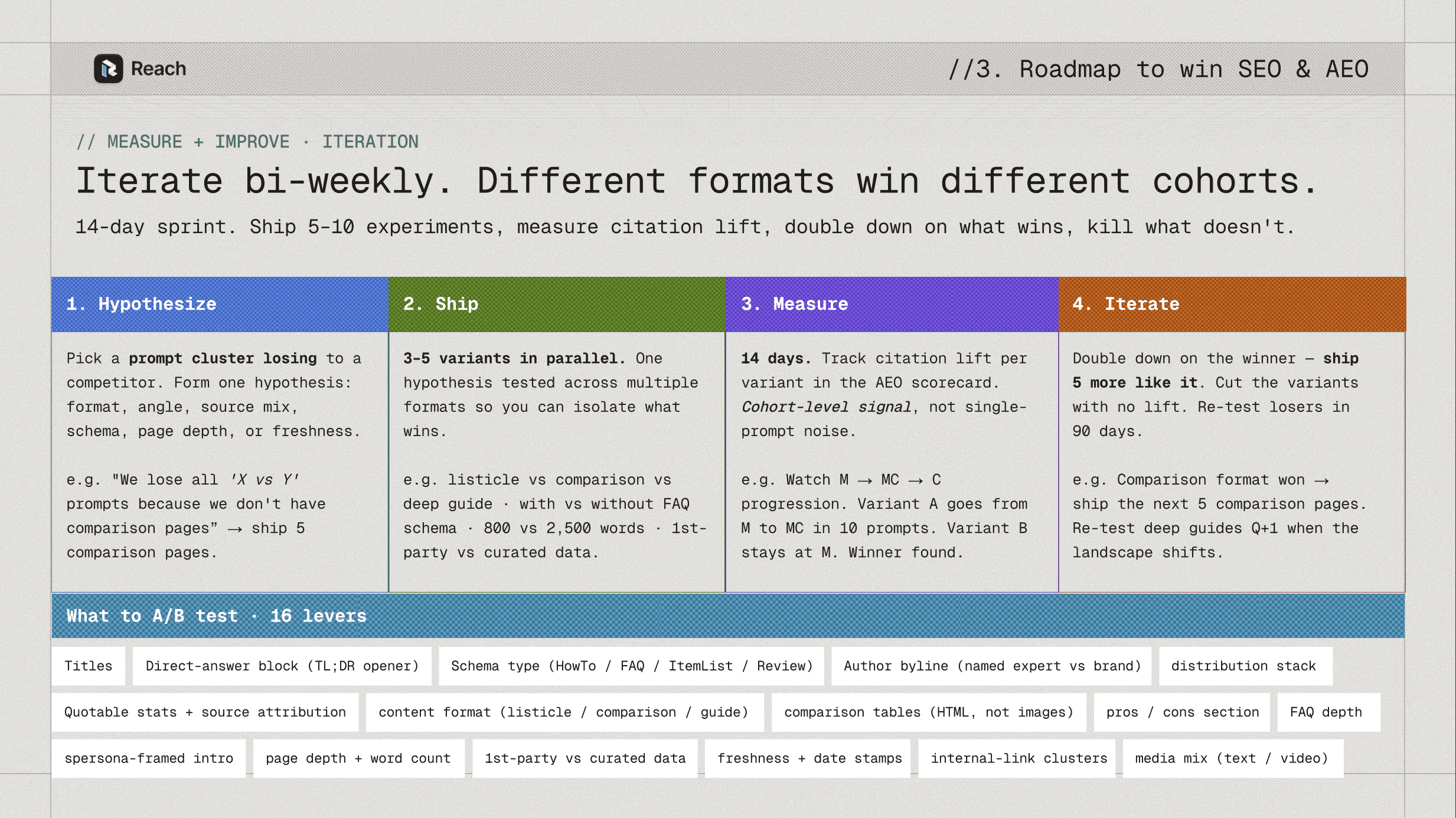
"It's super important to measure the things that are actually working." And then to keep going, patterns shift, so treat the whole program like a product: "You need to update it. You shouldn't set it and forget it."
Reach built Page Insights for exactly this: it pulls Google Search Console data, Reach's own AI-search citation data, Google Analytics engagement and conversion data, and the technical SEO issues hitting each page, so you can see which pages genuinely perform and why.
Then A/B test for real impact. Ship 10 pages with one approach and 10 with another, compare them on citation lift and conversions, and retroactively rebuild the losers with the winning approach. The point isn't just keyword rankings and prompt citations: it's leads and conversions on the pages that matter, because that's what counts at the end of the day.
Pillar 6 · Close the loop: turn AI visibility into pipeline
This was Inês's half, covered at a high level. The core point: visibility and traffic don't become pipeline on their own. Once AI sends high-intent visitors to your site, there's a whole motion to capture them.
De-anonymize the traffic. You can identify up to 45% of the companies visiting your website (who they are, and who the people are) and use it for both sales and marketing. (This is Dealfront's core.) Not all traffic is qualified, so filter by ICP first.
Route by heat. If it's super hot (pricing pages, case-study pages), pass it straight to sales and reach out while it's warm. If it's ICP traffic on other high-intent (not generic top-of-funnel) pages, start nurturing with retargeting, both outbound and paid.
Why it works: accounts you re-engage are about 14x more likely to convert, they already know you, they're actively in market, and they were "pre-warmed up and pre-sold by AI."
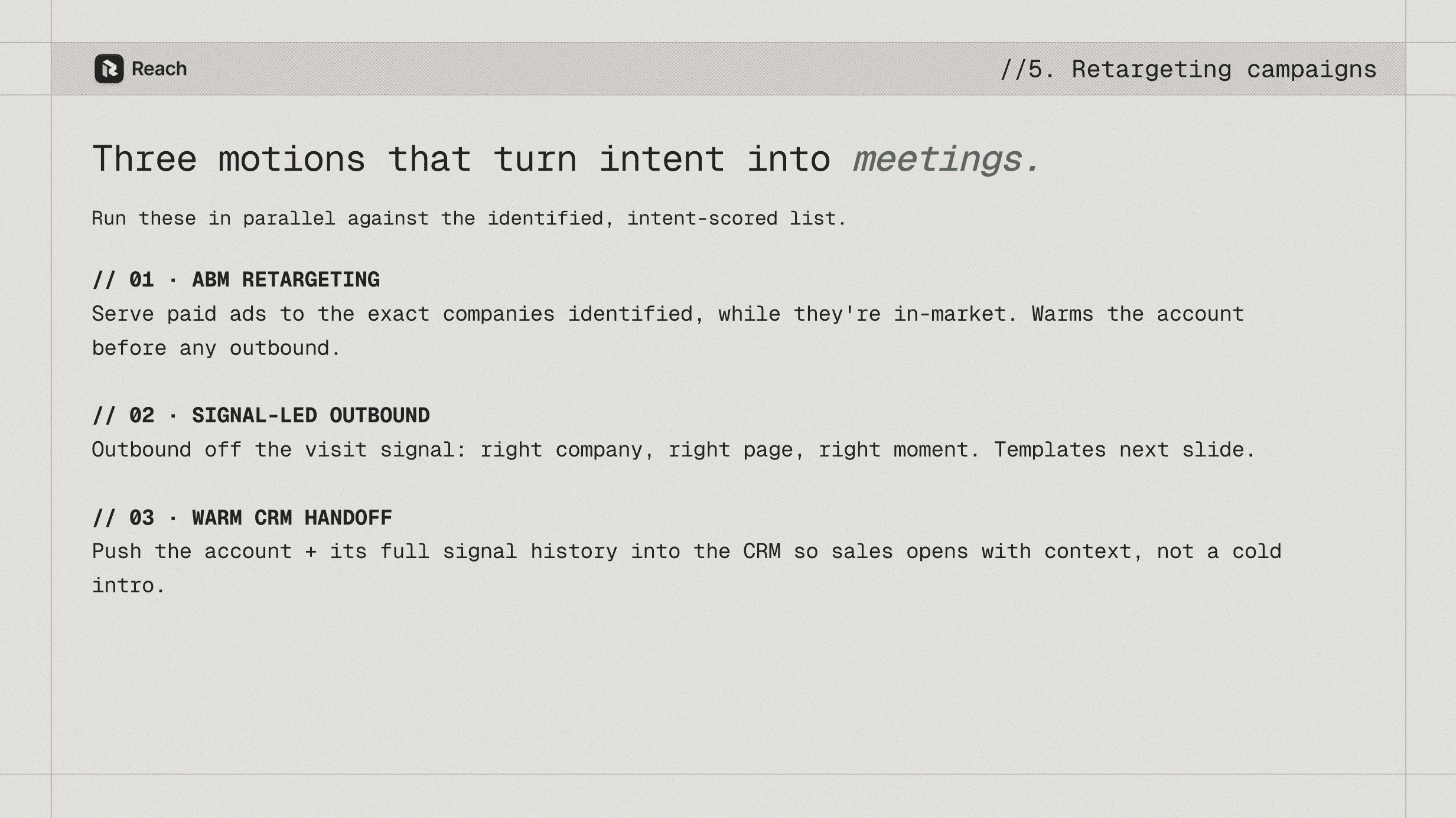
The three retargeting motions:
Paid ads served to specific lists of companies and/or people.
Signal-led outbound, personalized cold outreach built on exactly what they read (which pages, which topics, which case studies), so it lands as genuinely relevant.
Auto-populate the CRM, so account executives walk into every conversation already knowing each account's hottest pain points.
Related articles