Webinar Recap: Live AEO & Organic Growth Strategy Teardown with Abby Gleason & José Velez
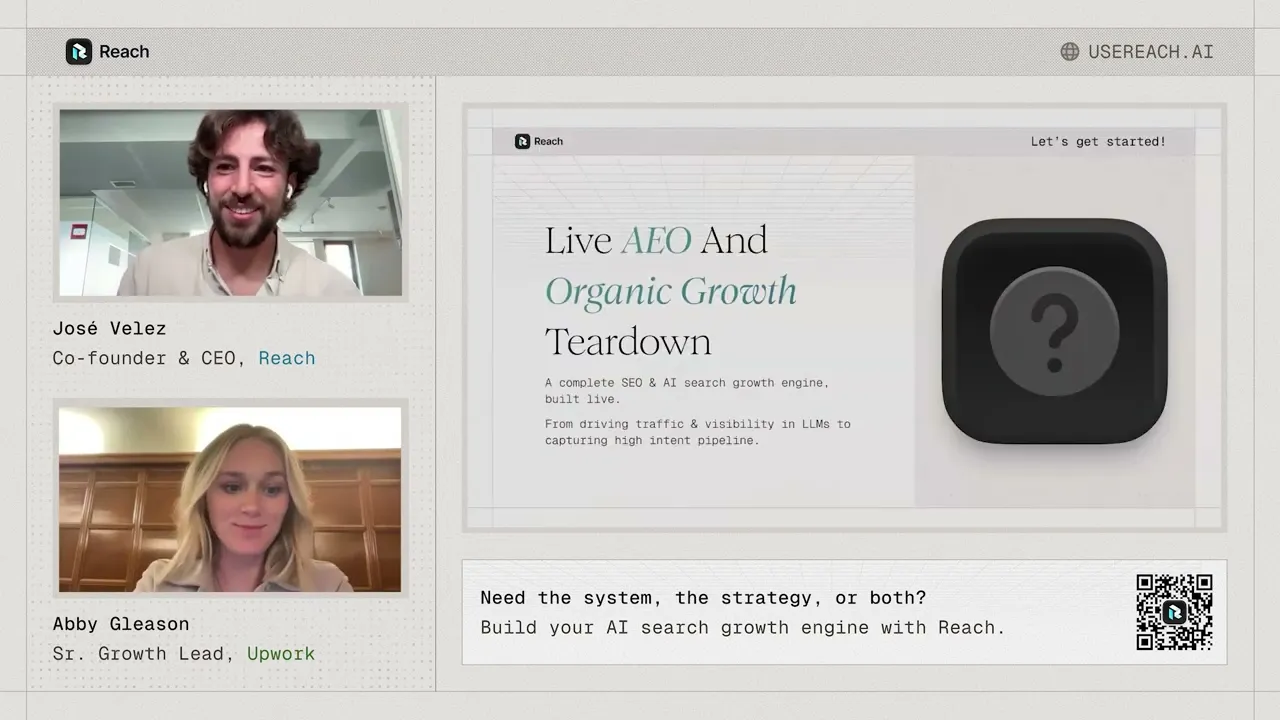
A complete SEO & AI search growth engine, built live. From driving traffic & visibility in LLMs to capturing high intent pipeline.

In this live session, Abby Gleason (Organic Growth at Upwork) and José Velez (Co-Founder & CEO, Reach) designed a complete SEO + AI search growth engine for one company live. End to end. From positioning, to prompt and keyword research, to ranking and citation analysis, to the conversion engine that turns visibility into pipeline.
The main theme stayed clear throughout: marketing teams need to help Large Language Models (LLMs) understand, retrieve, and accurately recommend their brand. Everything below is structured around that.
Webinar Transcript
Top Takeaways
Positioning is infrastructure, not messaging.
LLMs pattern-match on repetition across surfaces. If the homepage, About, third-party directories, PR, and partner sites all describe you differently, none of it compounds. Define a stable answer to "what does this company do, and for whom?" and codify it everywhere.
Start search demand research with first-party conversions, not keyword tools.
Abby's signal hierarchy: top-converting pages in GSC, sales transcripts + support tickets, paid-search winners. Translate the keywords that already convert into the prompts buyers are actually using on AI. "Let the money and the conversions start, then follow from there."
Reverse-engineer what wins the citation, then match the format.
Run every prompt 3–5× across ChatGPT, Perplexity, Gemini, AI Overviews. Pattern-map the citations. If 7 of 10 are listicles → earn mentions. If 7 of 10 are vendor pages and you don't have one → build the page. If 7 of 10 are Reddit threads → engage. Different prompts demand structurally different content.
3 buckets, not 5 pillars: foundational, content, off-page.
Abby's framing: tech SEO is the foundation (don't block AI bots in robots.txt). On-page is two sub-pillars (new content + content updates). Off-page is earned mentions + community. Most teams over-invest in one bucket and skip the other two.
Measure recognition, not ranking.
AI is a mention engine, not a referral engine. Track share-of-voice vs competitors by prompt cohort, brand search volume, direct + branded traffic, and "how did you hear about us" attribution. Stop chasing raw AI referral traffic, it will always look small, and your leadership won't be impressed.
Best Practices and Key Learnings
Pillar 1 · Positioning is infrastructure, not messaging
Before keywords, before prompts, before any content: a tight, stable answer to "what does this company do, and for whom?" Repeated everywhere LLMs read from.
José's framework of choice is the Value Proposition Messaging Canvas by Anthony Pierri and Robert Kaminski. Pick a persona. Fill the row as a single readable sentence: "Persona is trying to [use case], by [current way], but [problem], because [limitation]. Now, you can [capability], with [feature], so that [benefit]." If it doesn't flow as a sentence, the positioning is broken.
For Snov.io we filled three rows live, based on what's publicly on their site: prospecting (build a verified-email list from a LinkedIn search), deliverability (send 1,000+ cold emails a week without burning the domain), and stack consolidation (run the whole motion from sourcing to closed pipeline at SMB pricing). Row 3 is the moat.
Then comes the part most teams skip: codify the positioning, competitive positioning, and objection handling into a knowledge base. That knowledge base becomes the grounding layer for every piece of AI-assisted content you produce. Without it, AI hallucinates, drifts, and produces the slop everyone complains about.
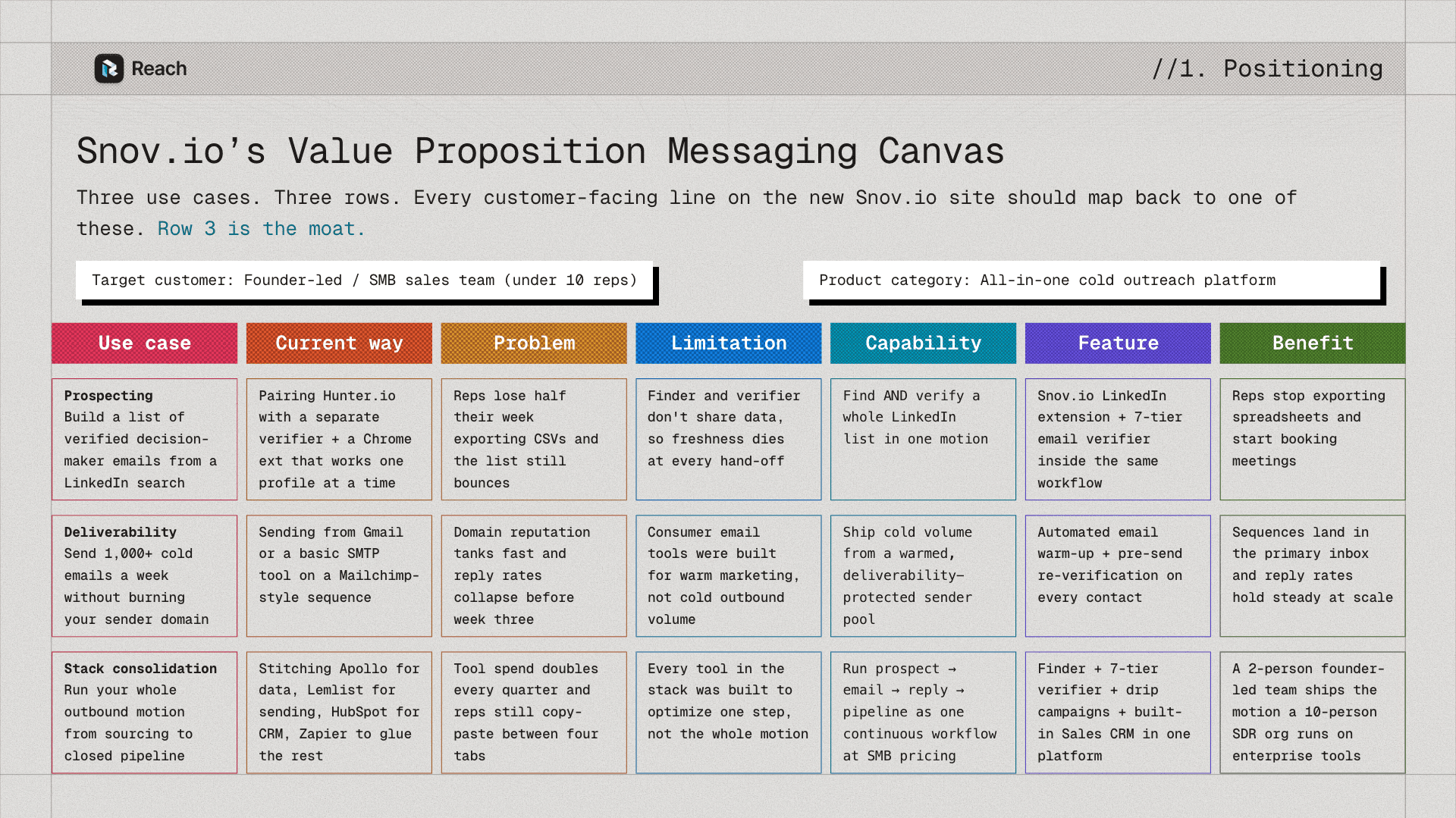
Snov.io's canvas filled in live. Three rows: prospecting, deliverability, stack consolidation. Row 3 is the moat.
Pillar 2 · Find your buyers' real prompts
The hardest part of an AI-search strategy isn't the platform you use to track prompts. It's picking the right prompts to track in the first place.
Abby's signal hierarchy (from the talk):
Highest signal: first-party conversions. Take your top-converting pages in GSC, look at the top queries driving traffic to them, and translate those into prompts. "Best white dress pants" becomes "what are the best white dress pants for [persona]." Different vocabulary, same intent.
Sales transcripts + customer support tickets. Real-time signal of what high-value buyers are blocked on. These are mostly BOFU queries, the ones with the shortest distance to a deal.
Paid search winners. Paid teams have keyword-level conversion data that organic doesn't. Borrow it.
Validated demand in the wild. Competitor keyword inventory, People Also Ask trees, AI fan-out queries across ChatGPT / Perplexity / Gemini, G2 + Capterra + Trustpilot reviews in buyer language.
Supplemental discovery. Reddit, Quora, Slack hot threads, autocomplete, niche newsletters and podcasts. Lower signal, higher coverage of emerging vocabulary.
Abby's tip for the SEO-vs-GEO question one attendee asked: "What keywords are already working on SEO will be reflected in your prompts." You don't need to optimize twice. Start with the queries that already convert.
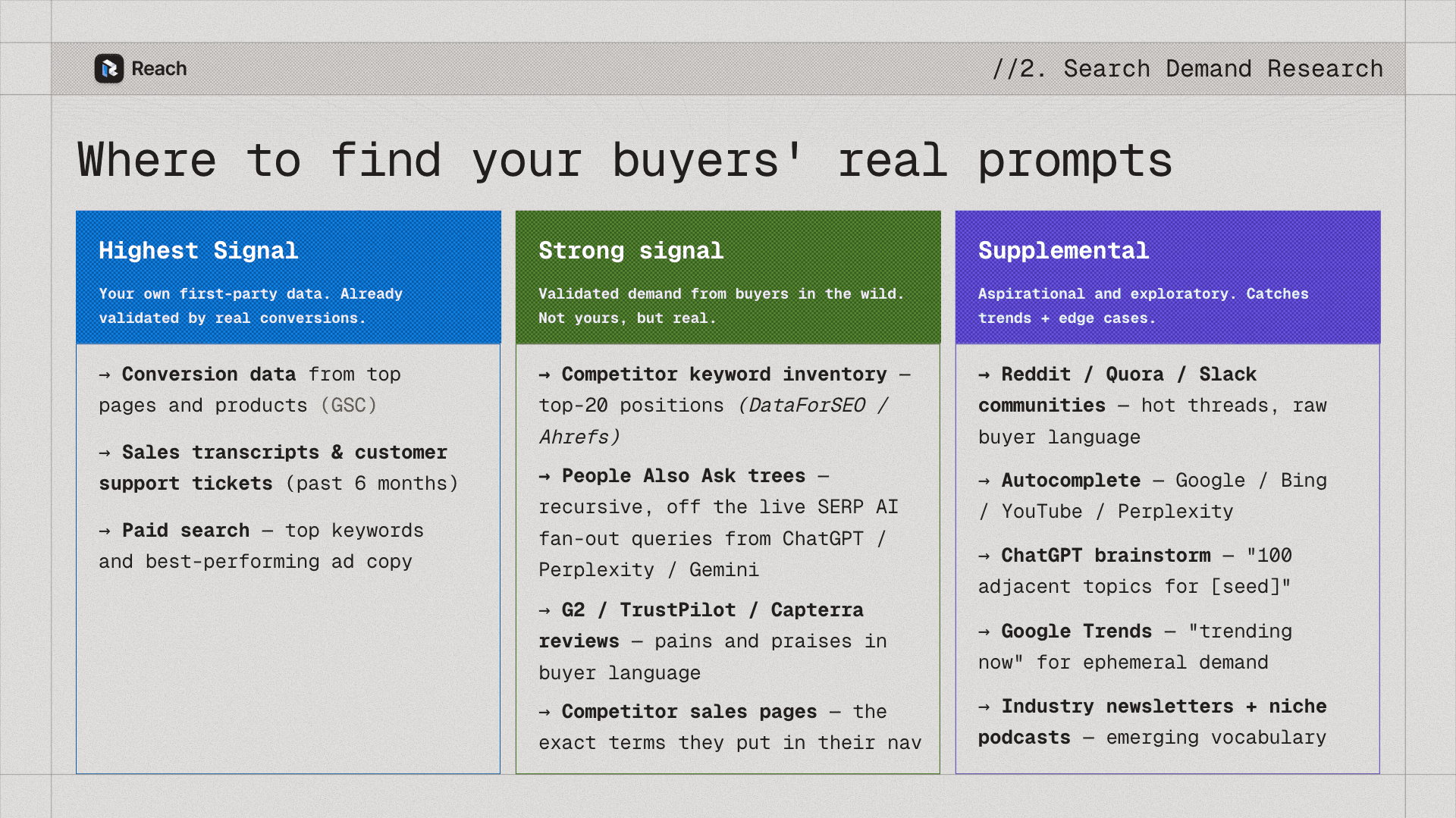
The three signal tiers we mine for real buyer prompts. Let the money and the conversions start, then follow from there.
FREE AUDIT
Want this analysis run on your site?
We'll pull your existing prompts, score them against your top competitors, and show you where you're missing the citation, the same process from the workshop, applied to your domain.
Pillar 3 · Reverse-engineer what wins the citation
Most teams stop at "we're tracking 100 prompts." That's the input, not the insight. The insight comes from analyzing where the citations are coming from, prompt by prompt, and using that to decide what to build next.
The 4-step Reach loop:
Run each prompt 3–5× across ChatGPT, Perplexity, Gemini, AI Overviews. Look for stable fan-outs (e.g., "this listicle showed up 14 of the 56 times we ran the prompt"). Stable = real pattern. Single appearance = noise.
Analyze citation patterns. Are the cited sources vendor pages? Third-party listicles? Reddit? Each implies a different action.
Map pattern to action. Listicles dominant → earn mentions. Vendor pages dominant + you don't have one → create the page. Reddit dominant → engage in communities. Wrong action = wasted effort.
Check sentiment + positioning alignment. Being mentioned isn't enough. Is the mention positive? Does it reflect your positioning? Abby: "You can't just say it about yourself. It's because other people have validated that approach, that's why people inherently trust LLMs."
Same prompt cohort, different content format. "Best X" wins with listicles. "X vs Y" wins with comparison pages. "X alternatives" wins with G2-style pages. "How does X work" wins with deep guides. Wrong format gets zero citation regardless of how good the writing is.
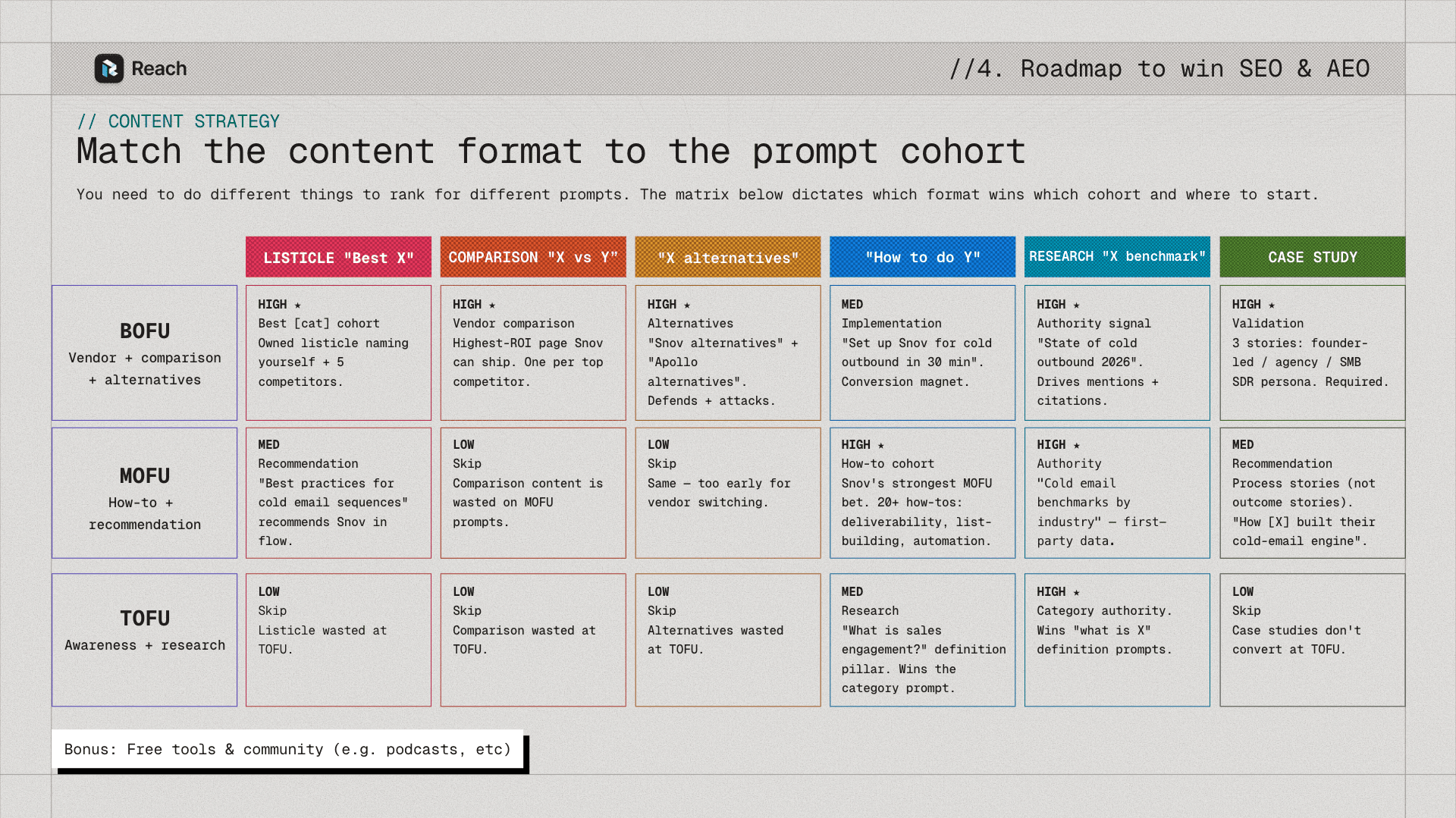
Match the content format to the prompt cohort. Wrong format = no rank, no citation, regardless of how good the page is.
Pillar 4 · The 3-bucket roadmap to win AI search
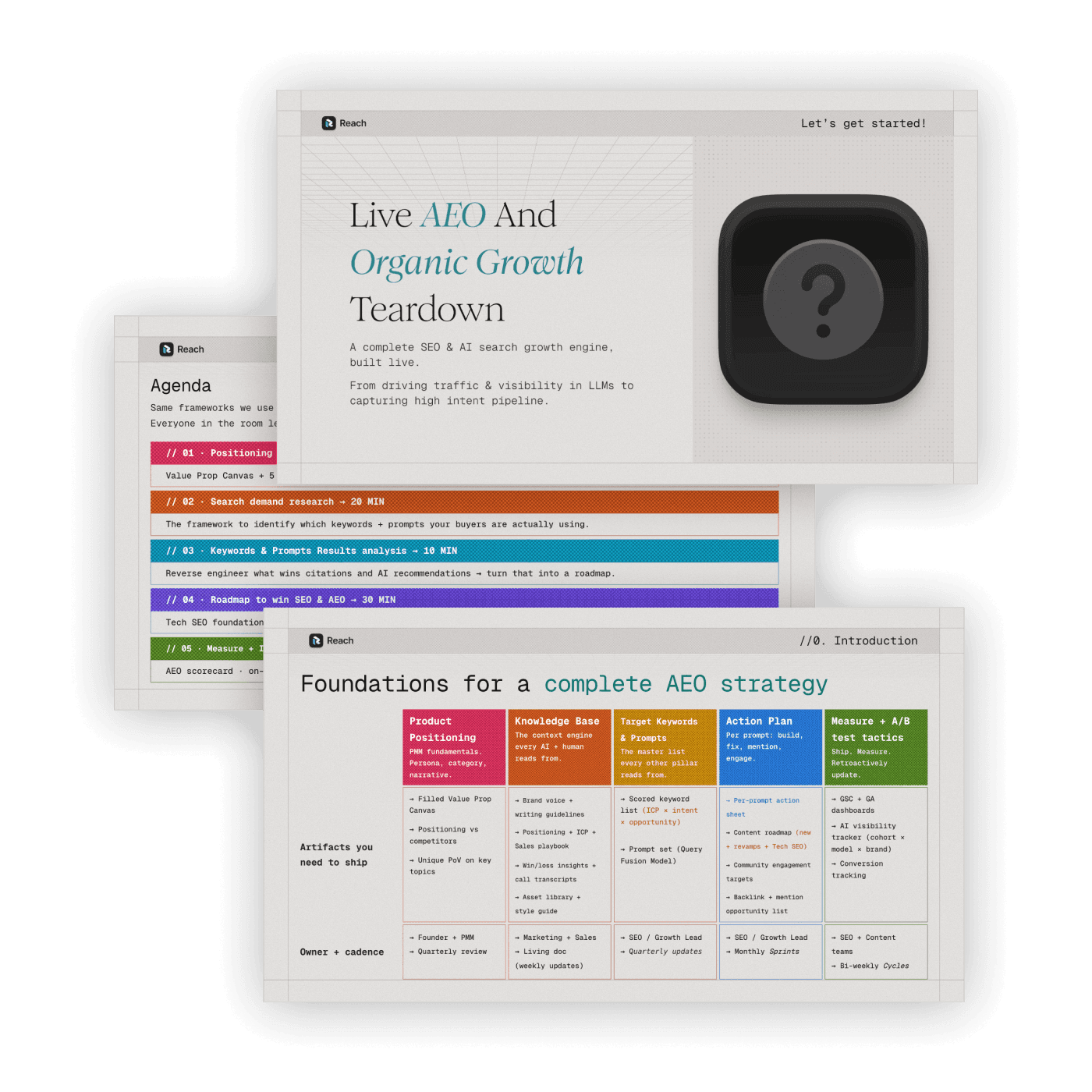
Abby's framing: 5 steps, 3 buckets. Foundational, content, off-page. Most teams over-invest in one and skip the other two.
Bucket 1 · Foundational (Tech SEO). The 5% of work that has 95% of impact:
Allow AI crawlers. Check your robots.txt for GPTBot, ClaudeBot, PerplexityBot, Google-Extended, OAI-SearchBot. Plenty of sites that historically blocked scrapers are still blocking the bots they now want to be featured by.
Crawlable + well-rendered pages. Logical heading hierarchy, no critical content behind JavaScript rendering, server-side render in under ~2.5 seconds (crawlers abort past that).
Internal links to adjacent topics. Pages with 8+ contextual internal links pull ~300% more traffic.
Schema + clean URLs. FAQPage + HowTo schema on highest-intent pages, hreflang done right, no dates in URLs, no query-string sprawl.
Bucket 2 · On-page content. Two sub-pillars: new content (the missing pages your keyword + prompt research surfaces) and content updates (the existing pages that need FAQ schema, comparison tables, refreshed dates + stats, merged thin pages). Abby's biggest winner at Upwork: "Answering non-brand queries on our product and category pages, that has been huge, especially in growing AI Overviews and clicks."
Bucket 3 · Off-page (earned mentions + community). Where most non-community AI citations come from is a surprise to most teams: niche tool blogs and competitor-adjacent sites out-cite traditional publishers. For Snov.io, the top non-own sources were prospeo.io, lagrowthmachine.com, salesforge.ai, saleshandy.com, not Sales Hacker or HubSpot. Abby: "You can never show up in too many listicles."
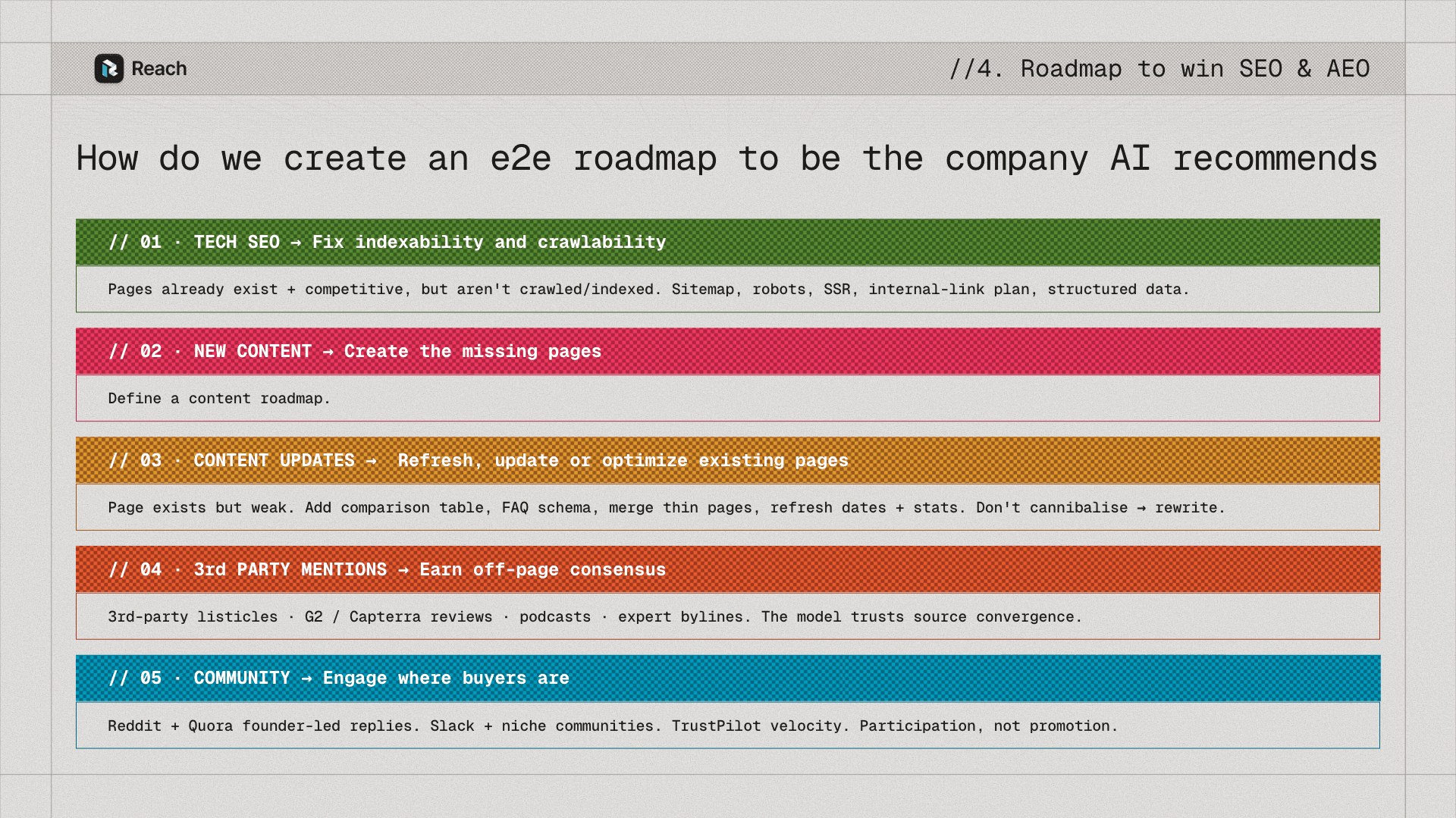
The 5 steps grouped into 3 buckets: foundational, content, off-page. Skip any one and the system breaks.
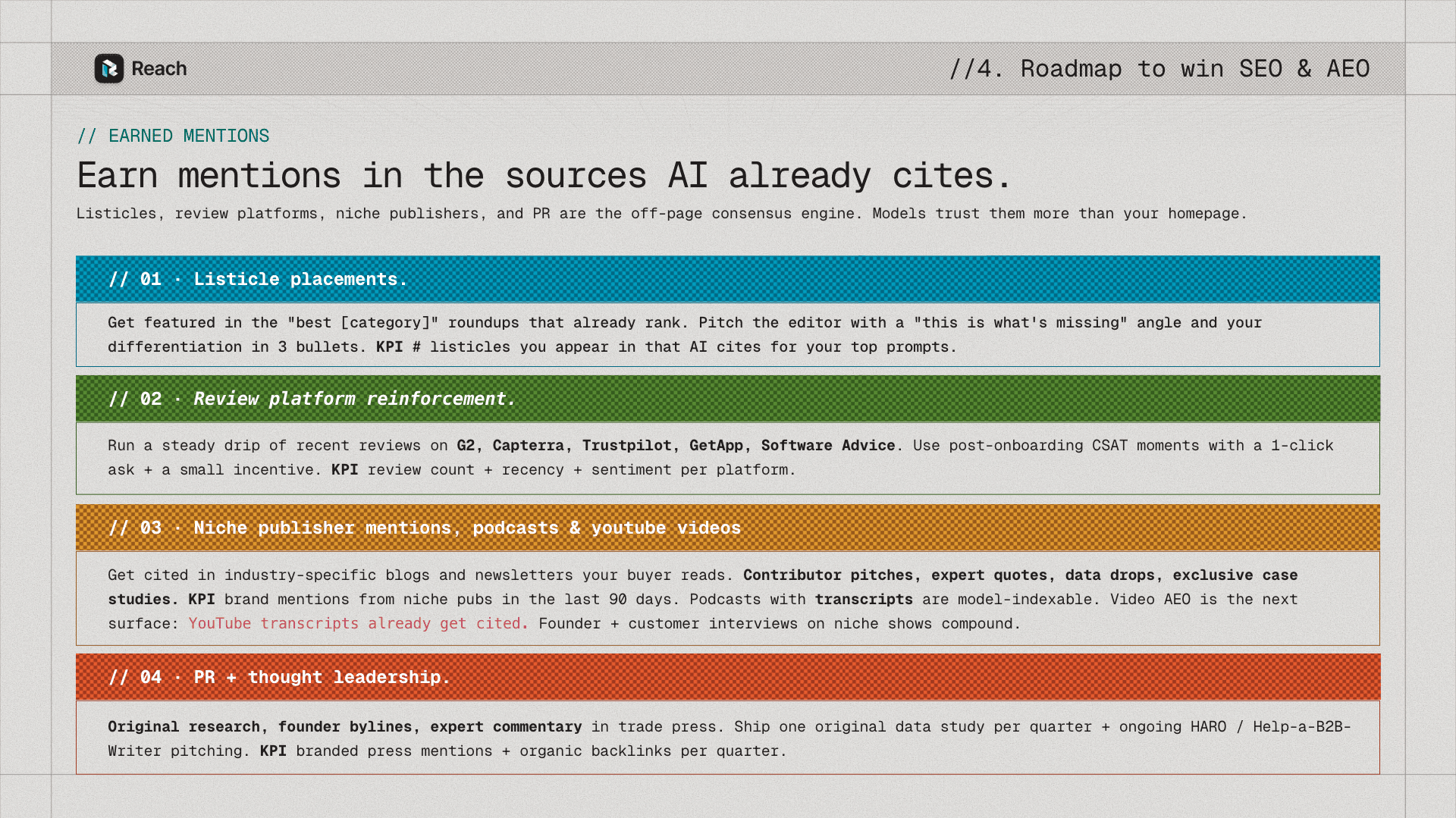
The surprise finding from the live teardown: competitor + niche-tool blogs out-cite traditional publishers.
Free Audit
Skip the months of guesswork, we'll build your 3-bucket roadmap for you.
Same system Reach runs with paying customers in 5-6 figure engagements. We'll identify the prompts that matter, audit the gaps, and ship a prioritized roadmap. No commitment.
Pillar 5 · Measure recognition, not ranking
Abby's opener on this section: "Y'all, people forget about measurement way too much. We get so caught up in execution that actually proving the value gets left behind. But that's what gets you more budget, more visibility, and ideally a promotion."
Track these:
AI share of voice by prompt cohort. Not "we appear in 120 prompts", that's context-free. "Of the top queries our customers ask, we rank in X% compared to competitors." That gives leadership a benchmark.
Citation share by source type. Vendor / 3rd-party / community split per cluster. Tells you which bucket to invest in next.
Brand search volume (Google Trends, Ahrefs). Rising line = AI awareness converting to active intent. Abby's data point at Upwork: "As organic traffic has gone down, direct and branded traffic have gone up."
"How did you hear about us" survey on the site. Add ChatGPT, Perplexity, AI Mode, AI Overviews as named options. Before LLMs were on the list at Upwork, the #1 most-written-in "other" answer was always ChatGPT, Perplexity, or "an LLM."
Stop chasing: raw AI referral traffic (will always look small in referral reports), absolute citation counts (track share), position-only metrics (you can rank #1 in Google and still not be recommended), single-prompt wins (one prompt is noise, optimize for cluster patterns).
José's add: A/B test everything. Ship 3 different approaches across 30 pages (10 per variant), measure citation lift + conversion data per page, then retroactively rebuild the losing pages with the winning approach. Conversion-rate optimization layers on top: fixed CTAs in blog pages, content upgrades (templates, lead magnets, calculators) tied to the topic of the page. ColdIQ's blog playbook works because every page has the same conversion mechanic, A/B tested into shape.
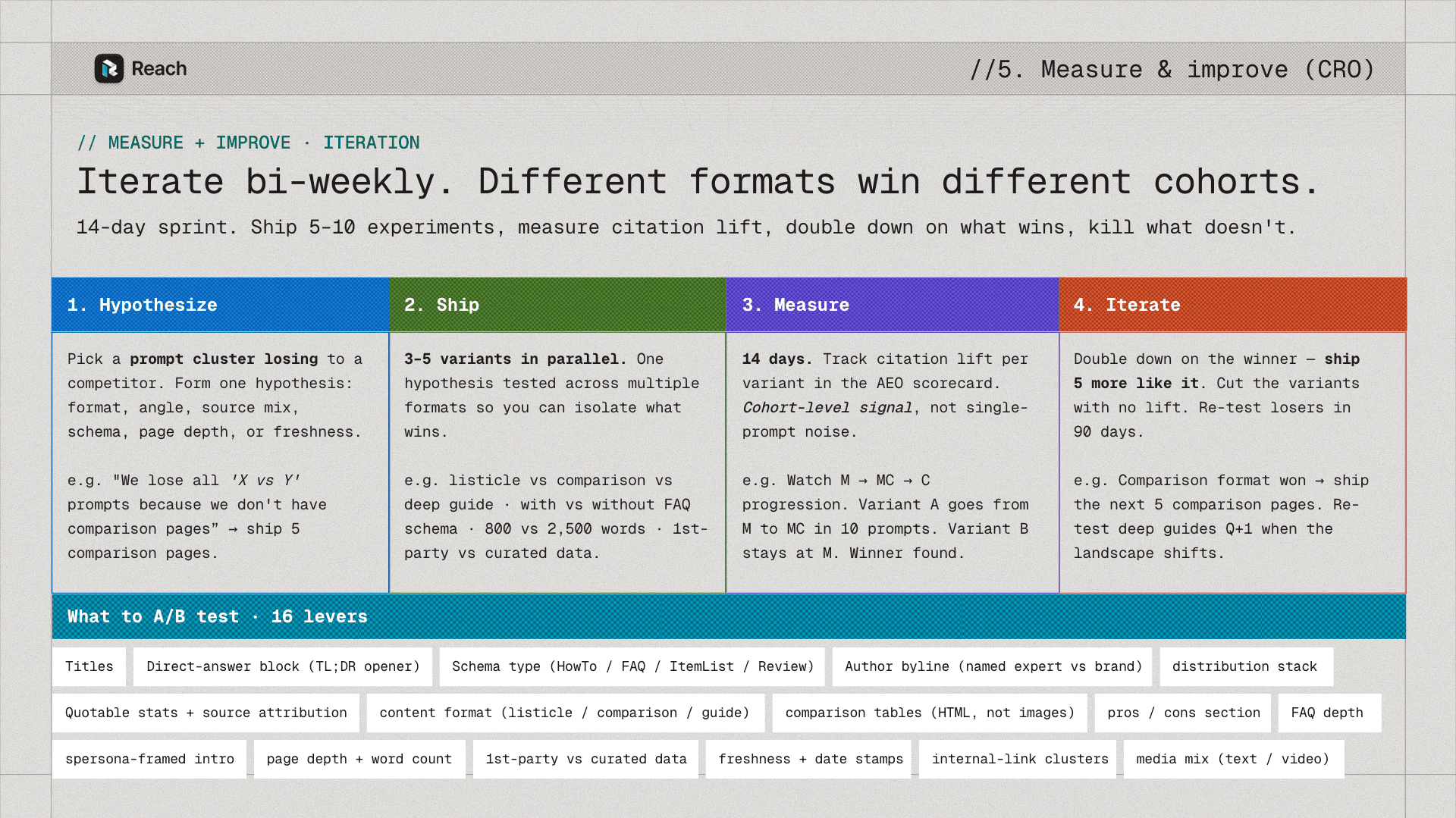
The 14-day iteration loop. Hypothesize → ship variants → measure cohort-level citation lift → double down on the winner.
Related articles