Reach
Prompt Research for AI SEO in 2026: Find the Questions AI Is Answering
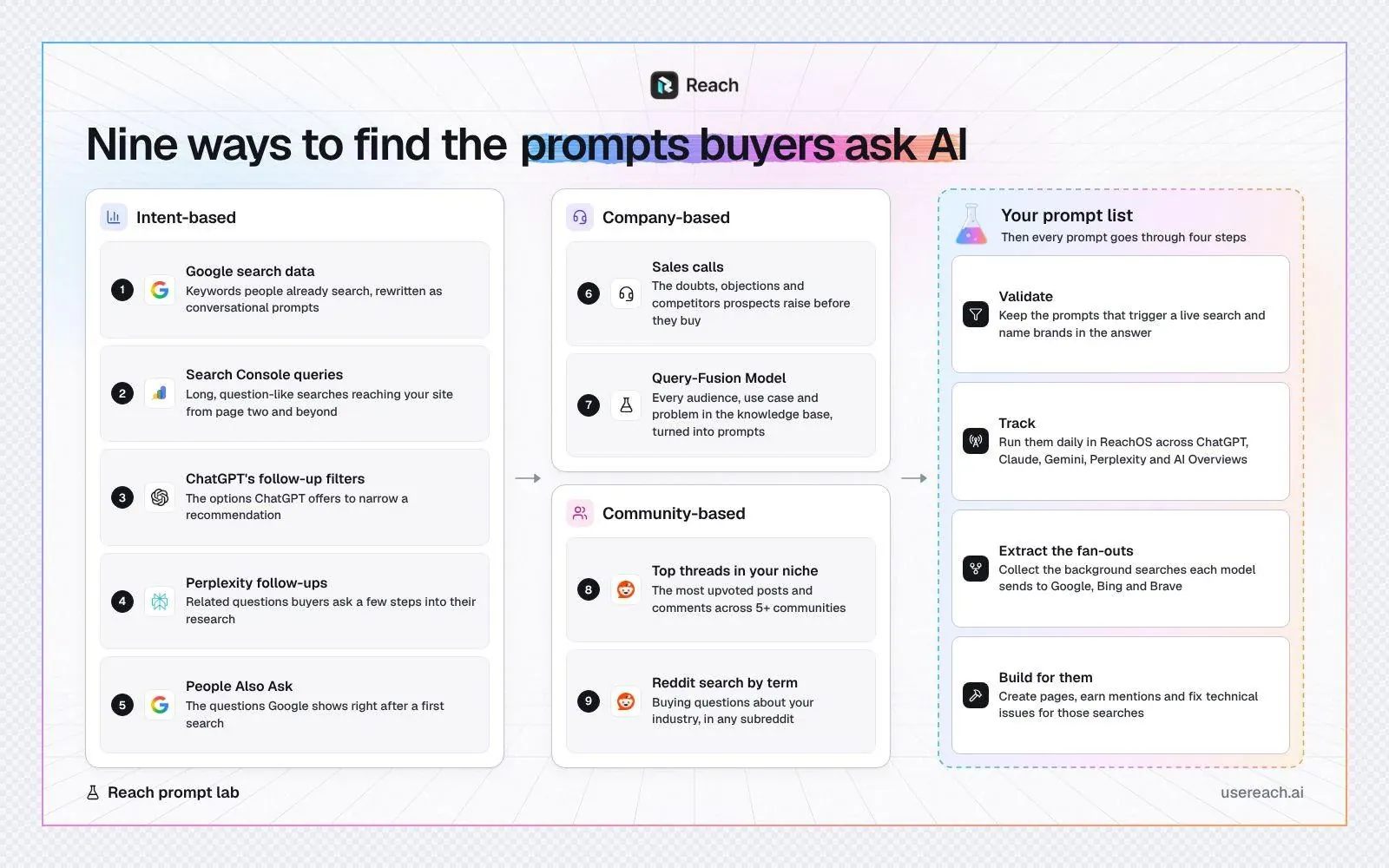
Prompt research is the work of finding the questions your buyers ask ChatGPT, Claude, Gemini, Microsoft Copilot and Perplexity, so you can get your brand into the answers. There's no keyword planner for it, so Reach AI rebuilds the demand with three prompt mining methods: intent-based, company-based and community-based prompts.

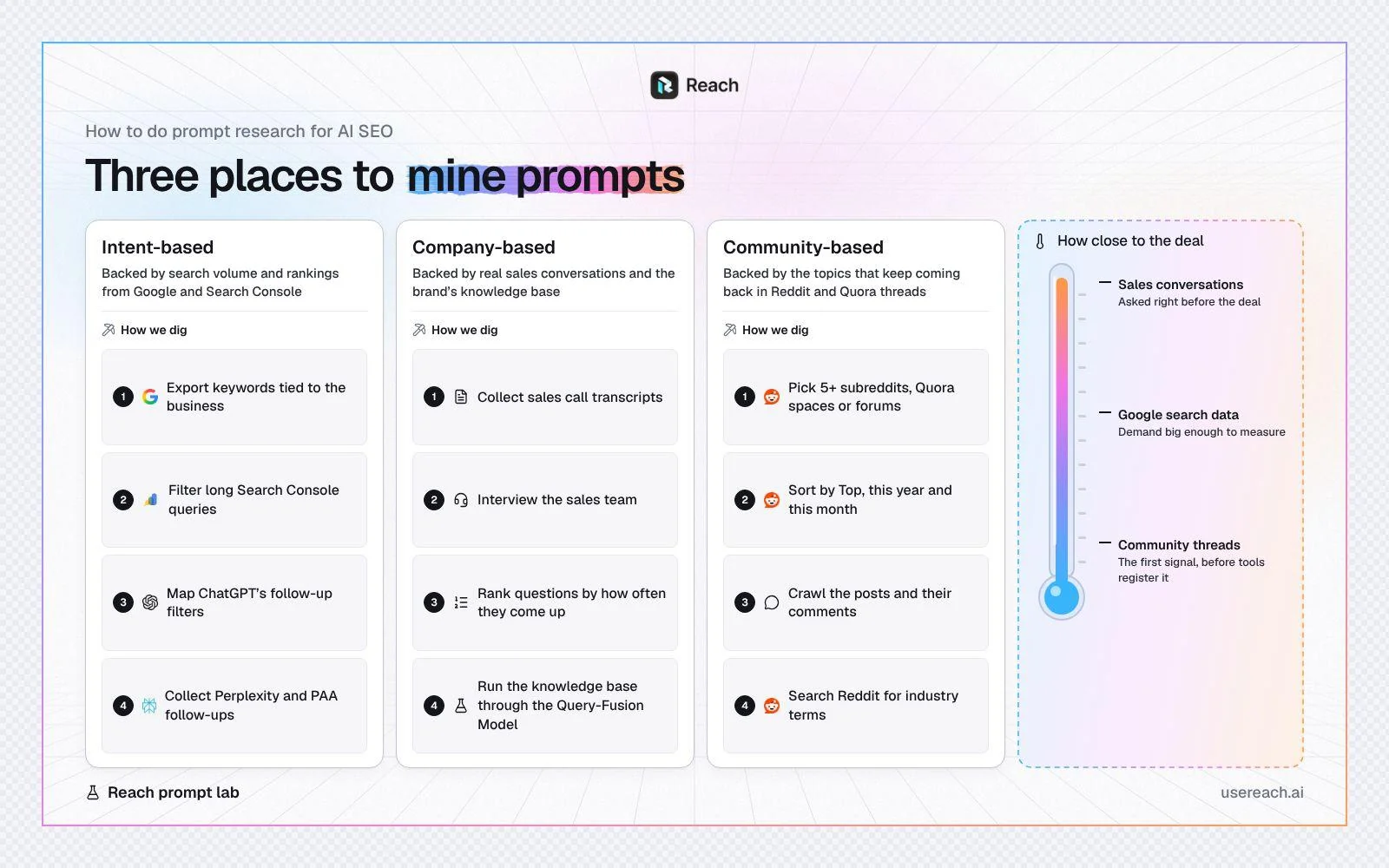
- Intent-based prompts: Google search data, hidden opportunities in Google Search Console, the filters ChatGPT suggests in its follow-up questions, Perplexity's follow-up questions and People Also Ask.
- Company-based prompts: what buyers tell your sales team, and your knowledge base turned into potential searches with our Query-Fusion Model.
- Community-based prompts: the topics people keep raising in Reddit, Quora and niche forum threads.
Most people who start with an AI search tool get stuck on the first step: defining the prompts. They don't know which prompts to monitor, and the prompts the tool suggests are written by an AI that has never seen their brand context or their search data.
The data that would settle it isn't public. OpenAI doesn't share what people type into ChatGPT, and Anthropic doesn't share what they type into Claude, while some of these AI search engines are still building their consoles for businesses.
The closest so far is OpenAI's Businesses in ChatGPT, launched in November 2026. It shows how often your business is mentioned and the conversation topics where it appears, which still leaves you without the prompts themselves.
And to be honest, I don't expect a prompt planner sorted by search volume, like the Google Keyword Planner, to ever exist. On Google, people type "tv for gaming". On ChatGPT, they describe their setup, their budget and their constraints, so a hundred people with the same intent write a hundred different prompts.
Finding each prompt word for word is also the least important part of the work, because prompts with the same intent trigger similar background searches. To get into those answers, you need the intent behind the prompt (the problem or need that made someone ask), and the searches the model runs in the background to answer it.
This guide is the prompt research process we follow at Reach AI for every customer, from the first prompt we find to the pipeline it brings in.
Key Takeaways
- What prompt research is: finding the conversational questions your buyers ask AI engines, grouped by intent, so you know which answers your brand needs to appear in.
- Why there's no prompt volume data: neither OpenAI nor Anthropic publishes a keyword planner for their models, and prompts are so long and personal that two people rarely type the same one. If an AI search tool tells you it has exact search volumes for prompts, it's lying to you.
- Why that's fine: LLMs turn each prompt into short background searches (query fan-outs). Prompts with the same intent trigger similar fan-outs, so you win the intent instead of chasing the wording.
- The three groups of prompt research methods we use: intent-based methods (Google search data, hidden Google Search Console opportunities, ChatGPT's follow-up filters, Perplexity's follow-up questions, People Also Ask), company-based methods (what buyers tell your sales team, your knowledge base run through the Query-Fusion Model) and community-based methods (recurring topics in community threads).
- Which prompts to keep: middle and bottom-of-funnel prompts that trigger a real-time search and return brand recommendations. Start with the ones that are specific, whose fan-outs aren't branded and where the cited pages don't cover the intent well.
- The top 3 mistakes when choosing prompts: letting ChatGPT or Claude write the list with no search data behind it, tracking prompts that describe your own company and inflate your share of voice, and tracking informational prompts whose answers rarely name vendors.
- What happens after prompt research: we track the prompts in ReachOS, extract the query fan-outs each model runs, then build content and earn mentions for those searches.
- Why tool-suggested prompts mislead: most AI search tools generate prompts from your domain alone, with no positioning, customer or search data behind them, so teams end up tracking prompts that never reach their pipeline. Our AI SEO services are run by a team of senior SEO and GEO experts who build your prompt list with the workflows in this guide, from Google demand and sales conversations to community threads and the Query-Fusion Model. They know which prompts you have a real chance to influence, and what it takes to win them.
Prompt Research at a Glance
| Method | Group | Where the prompts come from | What it proves |
|---|---|---|---|
| Google search data | Intent-based | Google Keyword Planner or any keyword research tool, filtered by the knowledge base | The demand exists, with search volume behind it |
| Hidden Google Search Console opportunities | Intent-based | Long and question-based queries ranking below position 10 | People already reach your site with conversational searches |
| ChatGPT's follow-up filters | Intent-based | The questions ChatGPT asks to narrow down a recommendation | The criteria ChatGPT uses to pick which brands to recommend |
| Perplexity's follow-up questions | Intent-based | The related questions Perplexity suggests after each answer | Where the research goes next, often right before a shortlist |
| People Also Ask | Intent-based | The related questions Google shows for your main keywords | What searchers want to know after their first search |
| What buyers tell your sales team | Company-based | Sales call transcripts and sales team interviews | Buyers ask it before they purchase, even without volume data |
| Knowledge base with the Query-Fusion Model | Company-based | Audiences, use cases, problems, integrations and competitors from the knowledge base | Every persona and use case the brand serves has a prompt |
| Community threads | Community-based | Subreddits, Quora spaces and niche forums | The topic is growing before keyword tools register it |
What Is Prompt Research?
Prompt research is the process of finding, choosing and tracking the prompts where your brand should be recommended. It maps the conversations buyers have with AI engines before they pick a vendor, in ChatGPT, Claude, Gemini, Microsoft Copilot, Perplexity, Google AI Overviews and AI Mode, and shows whether your brand gets mentioned and recommended in the answers.
The output is a list of prompts grouped by intent: the audience asking, the problem they want solved, the use case and the buying stage. Every prompt on that list should be one where a recommendation would bring you a lead, a sale or a signed contract.
That list then goes into an AI search monitoring tool. At Reach AI, our professional services team of senior SEO and GEO experts loads it into ReachOS, our own AI search monitoring software. ReachOS runs every prompt across the main AI engines and shows whether our customers' brands appear, how often they're cited and which sources the models use.
Why Prompt Research Has No Keyword Planner
Why You Won't Find Search Volumes for Prompts
In traditional SEO, Google gave us the data. Search volumes, keyword patterns and historical trends came from the Google Keyword Planner inside Google Ads, and tools like Semrush and Ahrefs collected that data and organized it with better filters and years of history.
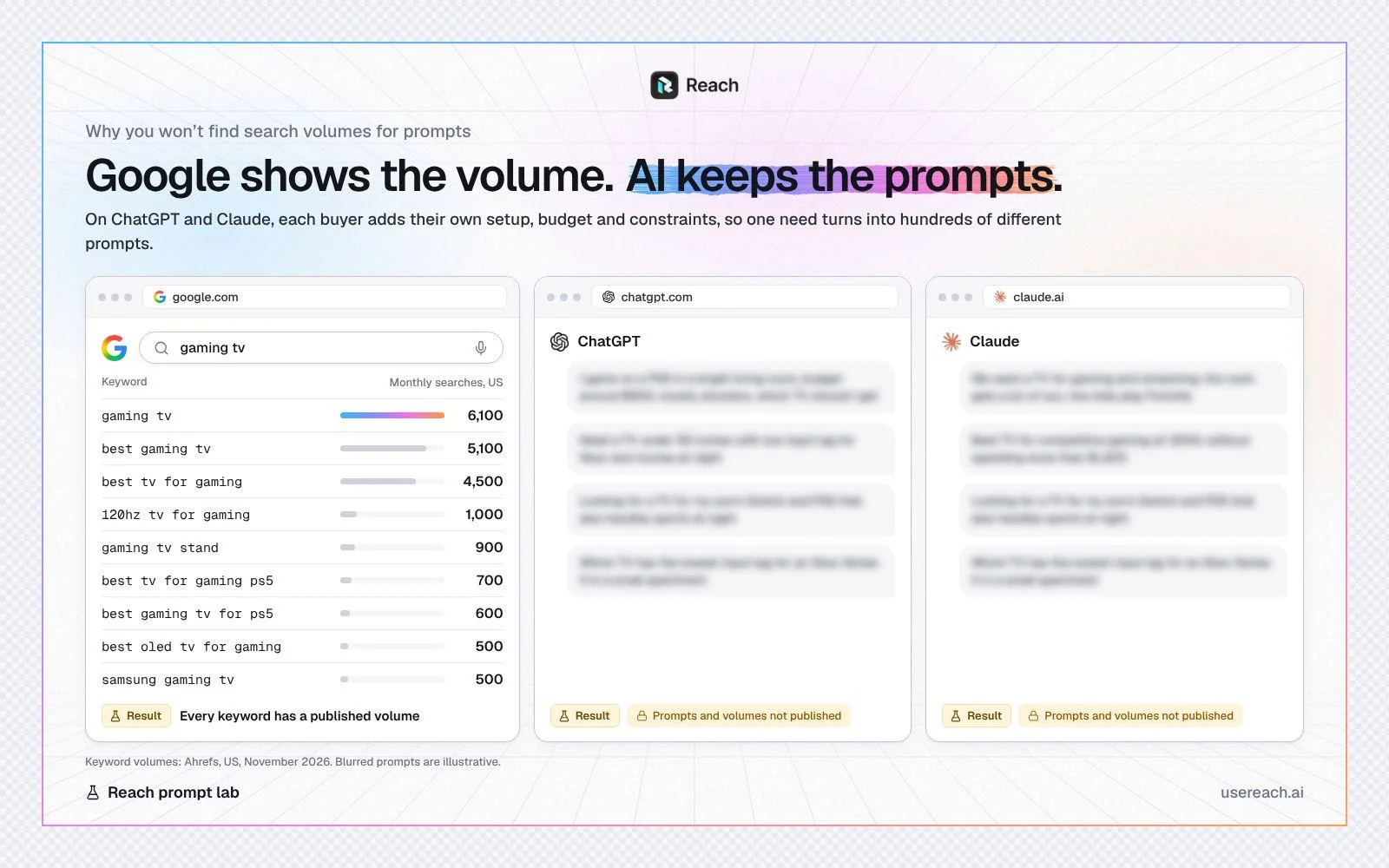
AI search has nothing like it (for now...). OpenAI's business tools for ChatGPT stop at mentions and conversation topics, and Anthropic offers no equivalent for Claude, so anyone doing AI SEO prompt research starts without official search volumes.
I don't personally think that will change. On Google, people type short, keyword-style searches like "tv for gaming". On ChatGPT, they write full sentences with their context, their budget and the specific games they want to play.
So even if a hundred people need the exact same thing, the chance of two of them typing the same prompt is close to zero. A volume figure for one exact prompt would be meaningless.
OpenAI already shares conversation topics, and I expect model providers to go further with the most common search intents. They won't share full prompts with volumes, the way Ahrefs shows "this keyword gets X searches a month".
Why You Shouldn't Rely on the Prompts AI Search Tools Suggest
Most AI search monitoring tools try to fill that gap with AI-generated prompts. You enter your domain or your category, and the tool asks an LLM to write the 20 or 50 prompts it thinks your buyers ask.
That LLM reads your homepage and little else. It has no access to your positioning, your ICPs, the products that bring in revenue, what people search on Google or the objections your sales team hears every week.
The prompts that come out look reasonable and miss in predictable ways:
- Generic top-of-funnel questions like "what is email marketing?", which the model answers from its training data without searching
- Prompts about products, audiences or markets you don't sell to
- Prompts with no demand behind them, since nothing checked them against search data or sales calls
Tracking prompts like these gives you visibility charts that move with no effect on pipeline. Each method below adds the context those tools are missing.
Why You Don't Need the Exact Prompt to Win the Answer
Take two buyers looking for the same tool. One writes "I'm looking for an email marketing tool for my business, an SMB in the SaaS space." The other writes "What tool do you recommend for SaaS email marketing?"
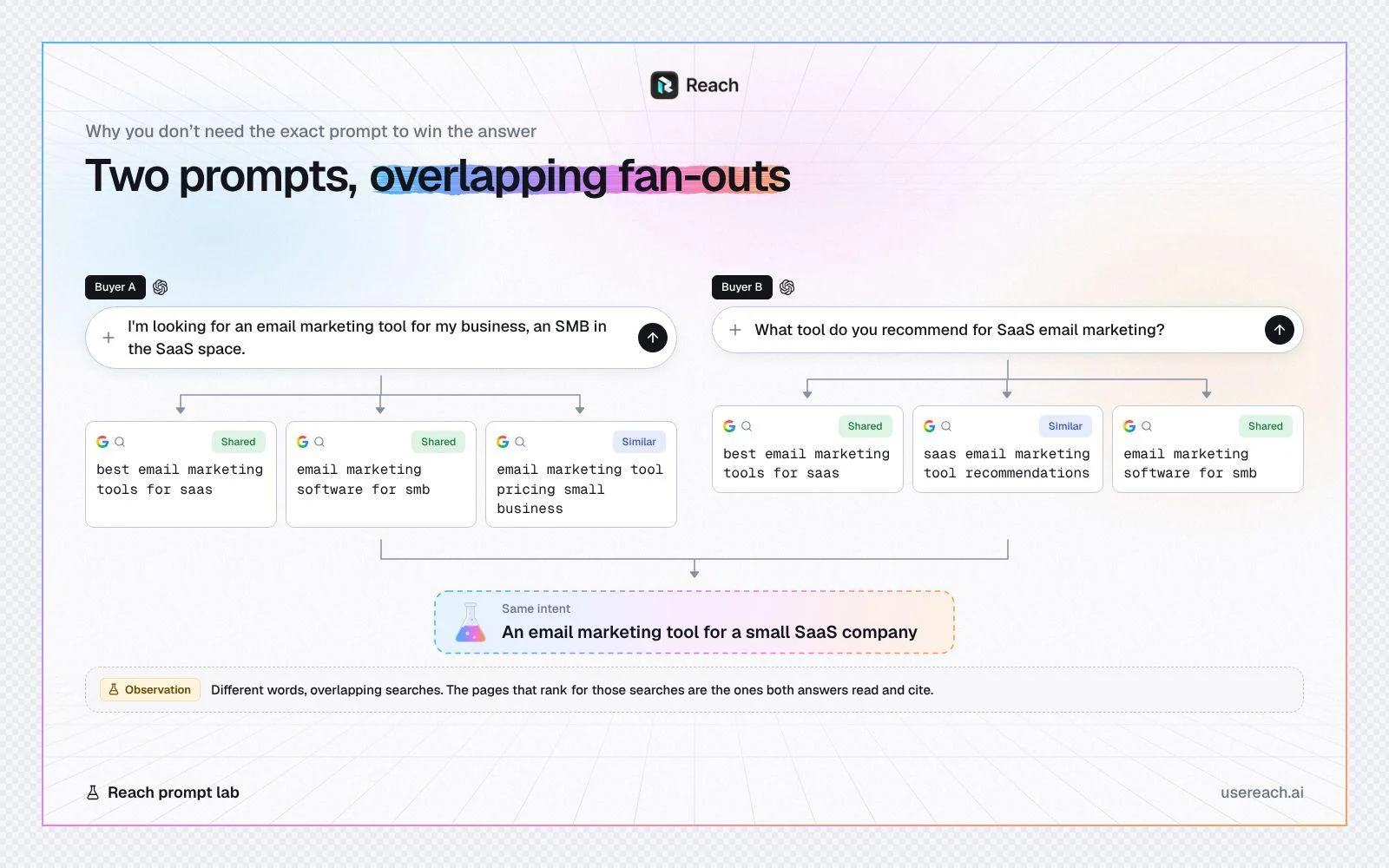
The wording differs, and the need is identical: an email marketing tool for a small SaaS company. Whether the prompt starts with "I'm looking for" or "What do you recommend" changes nothing about which brand should be recommended.
Your brand gets recommended for the intent behind the prompt, and you can see that intent in the searches the model runs next.
How Query Fan-Outs Work
When an LLM needs current information to answer, it doesn't search for the whole prompt. It breaks the prompt into shorter background searches, called query fan-outs, and sends them to search engines like Google, Bing and Brave.
- The prompt: the user writes a long, specific question with their own context.
- The breakdown: the model reads the intent and writes several short, search-friendly queries.
- The searches: those queries run on search engines, and the pages they return become the sources the model reads, cites and summarizes.
Two or three prompts with slightly different words, and the same problem, tend to produce near-identical fan-outs. That's why we optimize for the intent and the fan-outs it triggers, and why prompt research only has to get close to the real wording.
Free organic growth review
See your own AI search visibility, free
Where your buyers search, who's winning today, where you're missing out and what we'd do first, from our SEO and AEO experts.
Prefer to talk first? Book a call with Alex
Free · We tell you if search isn't a real channel for you
How to Do Prompt Research for AI SEO: Our 3 Prompt Mining Methods
So how do you decide which prompts to track? We group every prompt by where it comes from, since no single source shows the full picture of what buyers ask.
Intent-based prompts prove that the demand exists. Company-based prompts predict what buyers ask right before they buy, and community-based prompts catch topics before keyword tools register them.
1. Intent-Based Prompts: Start From Proven Search Demand
Intent-based prompts are the ones we can back with search data. The problems people bring to Google are the same problems they bring to ChatGPT, described in more detail. The back pain behind a search for a better mattress, or the need for an AI meeting note-taker that works with Microsoft Teams, stays the same whether someone asks Google or ChatGPT.
So we start from what people already search on Google, and rewrite it the way someone would ask an AI engine. We use five methods for this, and two of them start from the AI engines' own answers.
Turn Google Search Data Into Conversational Prompts
The first method is traditional keyword research. We export the keywords related to the customer's business from traditional keyword research tools, and look for the patterns: the problems people mention, the needs they describe, the categories they compare, the most common qualifiers ("best", "most reliable", "cheapest"), and the attributes, audiences and price ranges that come up again and again.
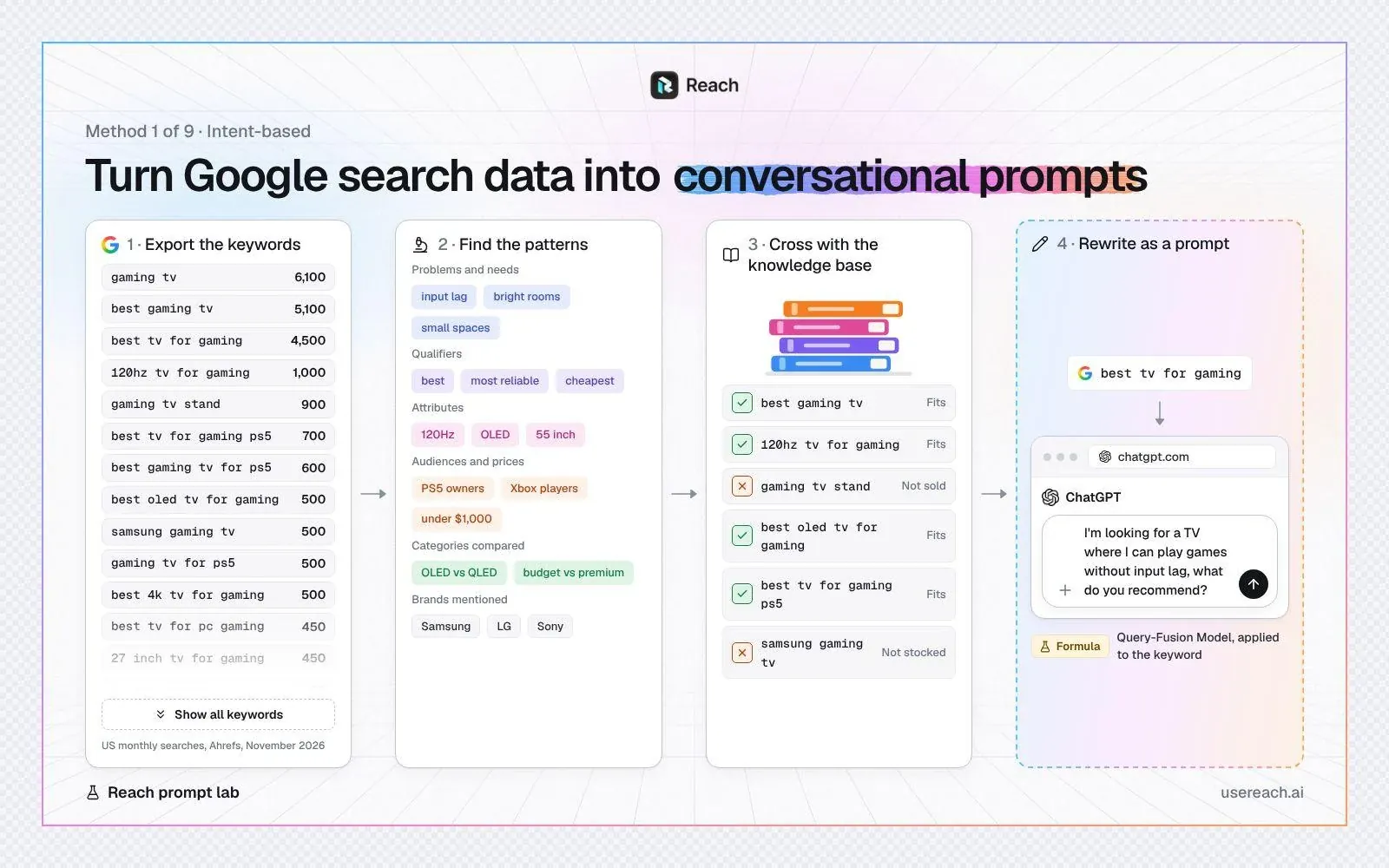
Then we cross that list with the customer's knowledge base. Every keyword that doesn't fit the audience, the product or the growth goals gets cut, because a prompt with demand and no fit brings visibility that never turns into pipeline.
The keywords that survive get rewritten as conversational prompts, with the same Query-Fusion Model formulas we apply to the knowledge base (more on those below). Someone searching "tv for gaming" on Google becomes "I'm looking for a TV where I can play games without input lag, what do you recommend?"
Find Hidden Opportunities in Google Search Console
The second method works for brands that have done SEO for a while and have history in Google Search Console. Long, question-like searches already reach your website, and many of them rank on page two or lower, because no page on the site was written for them.
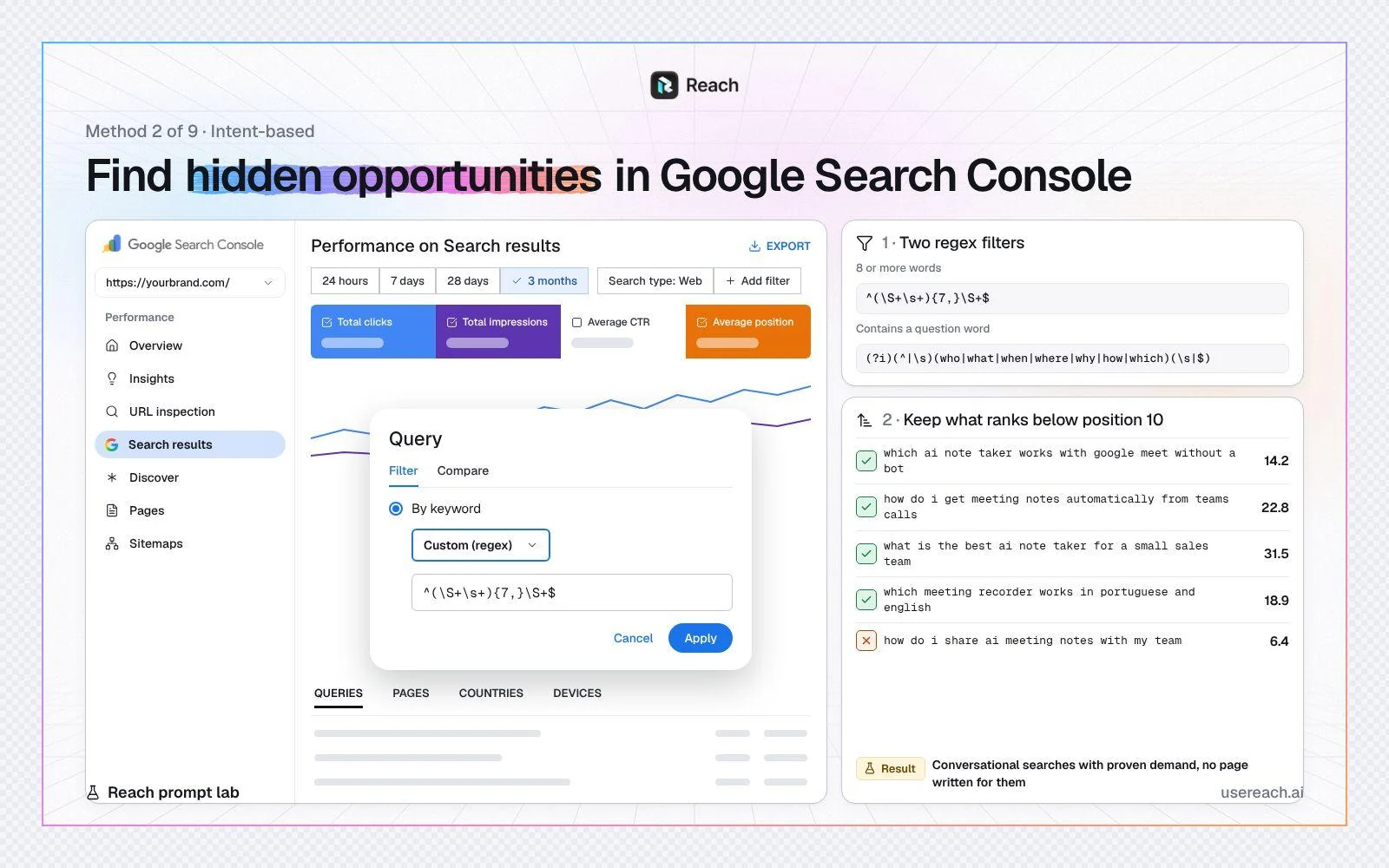
In the Performance report, click + Add filter, choose Query, switch the dropdown to Custom (regex) and paste one of these. The first one shows only queries with 8 or more words:
^(\S+\s+){7,}\S+$
The second shows only queries that contain a question word:
(?i)(^|\s)(who|what|when|where|why|how|which)(\s|$)
Turn on Average position, export the results and keep the queries ranking below position 10. Those are the hidden opportunities: conversational searches that already reach your site with search data proving the demand, and many of them trigger AI Overviews too.
Map the Filters ChatGPT Suggests in Its Follow-Up Questions
The third method turns the broad prompts already on your list into more specific ones. For broad recommendation prompts, ChatGPT can reply with a short set of follow-up questions that help the user narrow the options, and every option it offers is a more specific prompt you can add to your list.
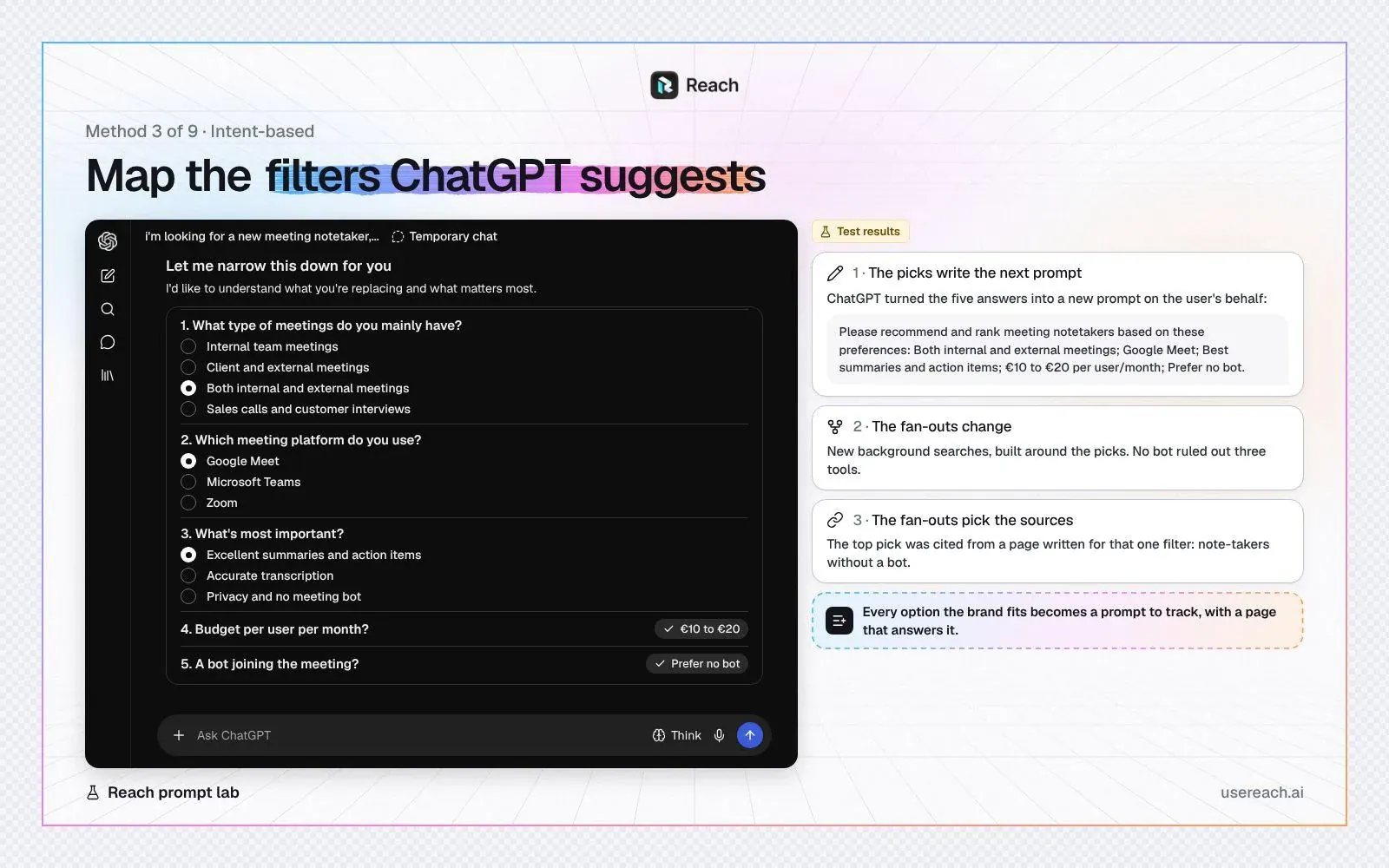
Ask it "I'm looking for a new meeting note-taker" and it comes back with five filters, each with its own options: the type of meetings, the meeting software, what matters most, the budget per user per month and whether a bot can join the meeting.
Each filter is a criterion ChatGPT uses to decide which brands to recommend. We tested it by picking both internal and external meetings, Google Meet, summaries and action items, €10 to €20 per user per month and "prefer no bot", and the selections changed everything that came after:
- The filters wrote the next prompt. ChatGPT turned the selections into a new prompt on the user's behalf: "Please recommend and rank meeting notetakers based on these preferences: Both internal and external meetings; Google Meet; Best summaries and action items; €10–20 per user/month; Prefer no bot. Include pricing, pros and cons, and your top recommendation."
- The new prompt changed the fan-outs. ChatGPT ran a new set of background searches built around those preferences, and named the "no bot" preference as the deciding factor, which ruled out Fireflies, Fathom and tl;dv.
- The fan-outs decided the citations. Granola ranked first, and one of the two sources cited for it was Notibo's article "AI note takers without a bot (2026): 8 tools compared", a page written for that exact filter.
One filter option sent ChatGPT to a page built for that option alone. So we run the broad prompts on our list, map every filter and option ChatGPT suggests, and turn each option the brand fits into a new, more specific prompt to track, with a page that answers it.
The options also line up with the Query-Fusion axes (audience, use case, attributes, price range), so they show which combinations the knowledge base already covers.
Add Perplexity's Follow-Up Questions
The fourth method starts from the prompts you already have as well. Perplexity suggests related follow-up questions under every answer, so run the main prompts on your list in Perplexity and collect the follow-ups it shows.
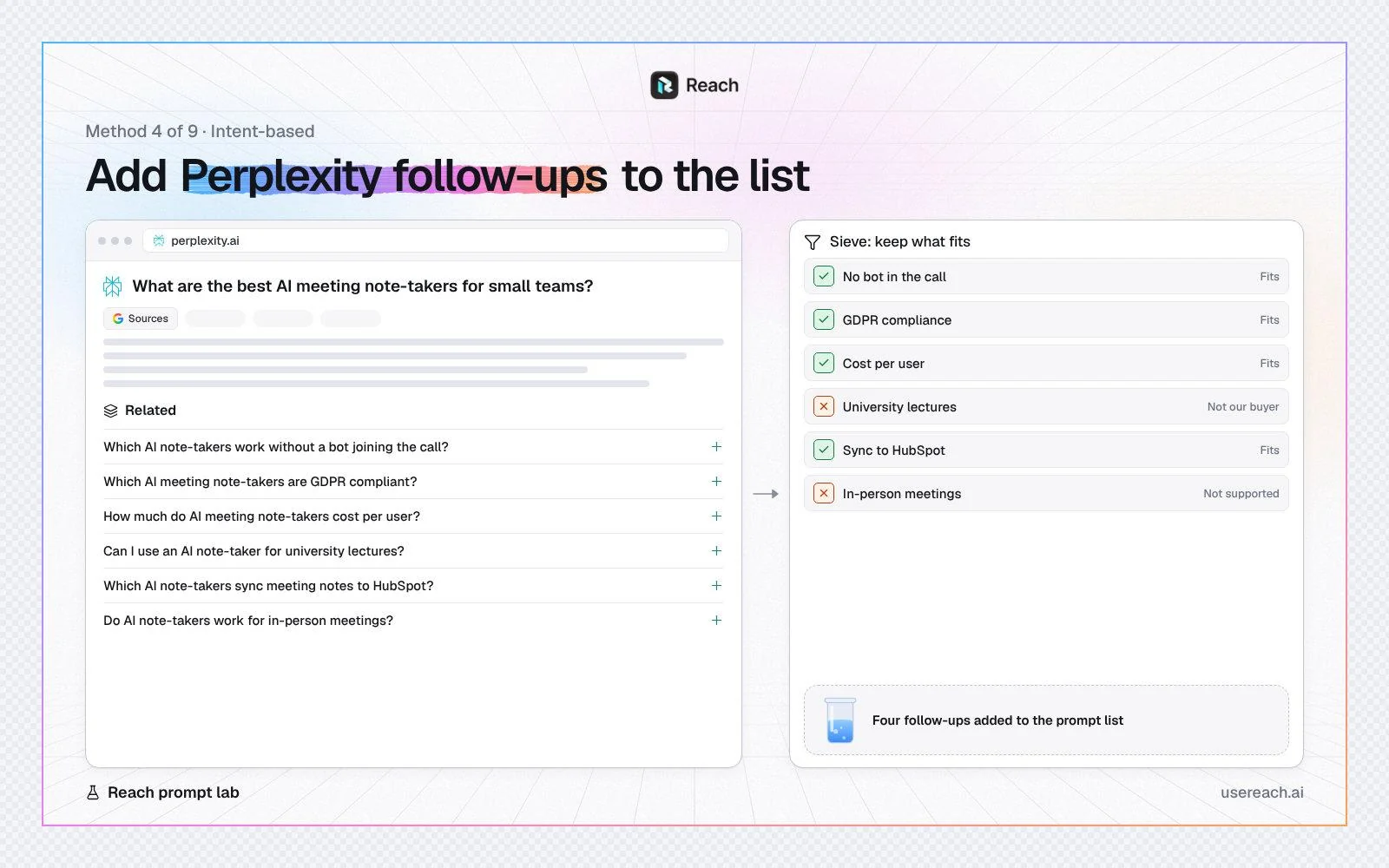
They're the questions a buyer asks two or three steps into their research, often right before comparing vendors. We add the ones that fit the business to the list.
Collect People Also Ask Questions
The fifth method is Google's People Also Ask box. For the main keywords on your list, collect the related questions Google shows underneath.
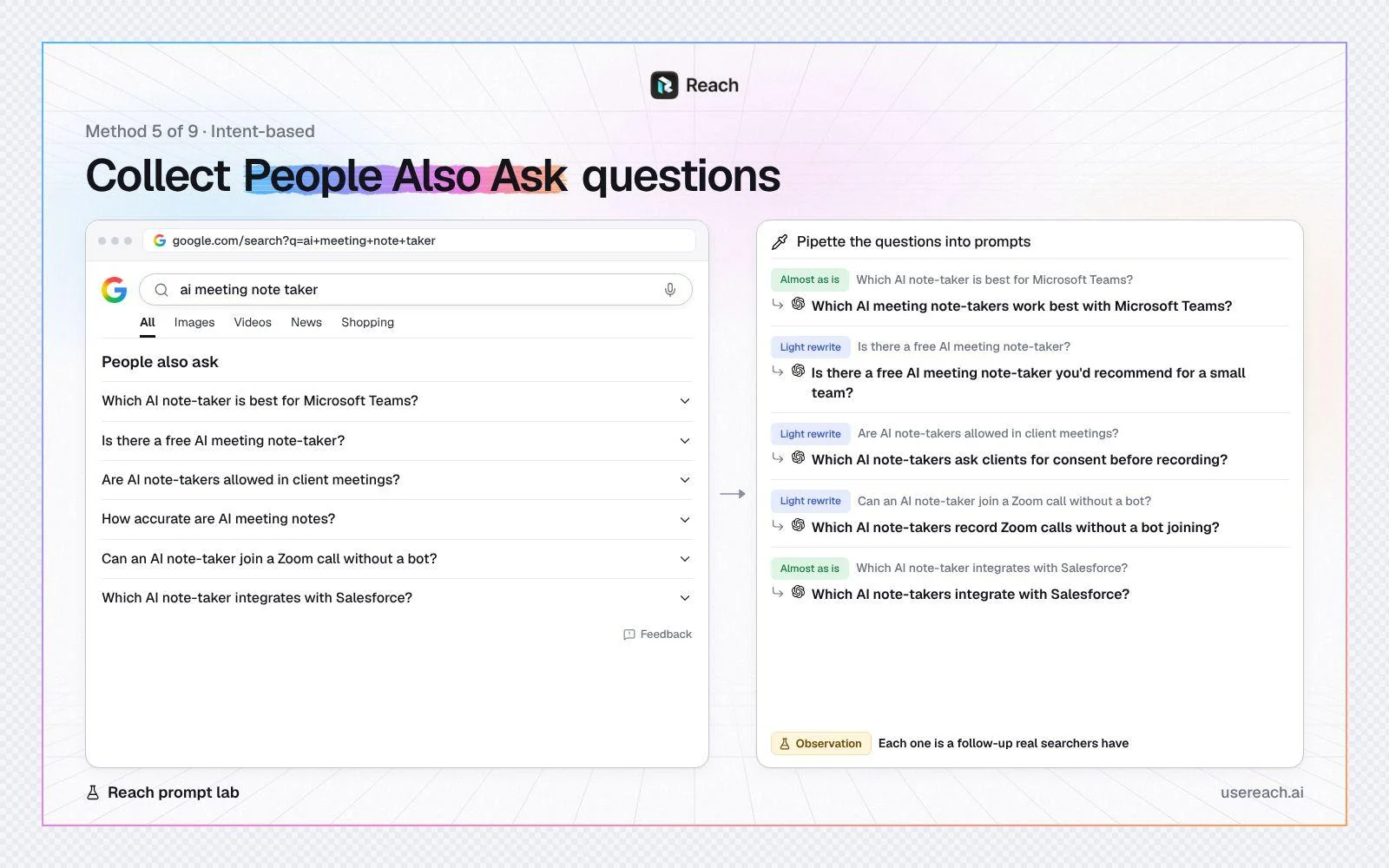
Each one is a follow-up real searchers have. Many of them work as prompts with little rewriting, and they show what someone wants to know after their first search.
2. Company-Based Prompts: Use What Your Buyers Ask Your Sales Team
Company-based prompts come from the brand itself: what buyers tell its sales team and what its knowledge base says about the business. We can't attach a search volume to them, but the chance that buyers ask these questions is high, since they come from conversations with real prospects.
This is where you find the questions that sit closest to a purchase. We use two methods.
Turn What Buyers Tell Your Sales Team Into Prompts
We ask customers to share transcripts of their sales calls, and we talk to their sales team. We look for three things:
- the doubts prospects raise before buying
- the objections that slow deals down
- the competitors prospects compare against
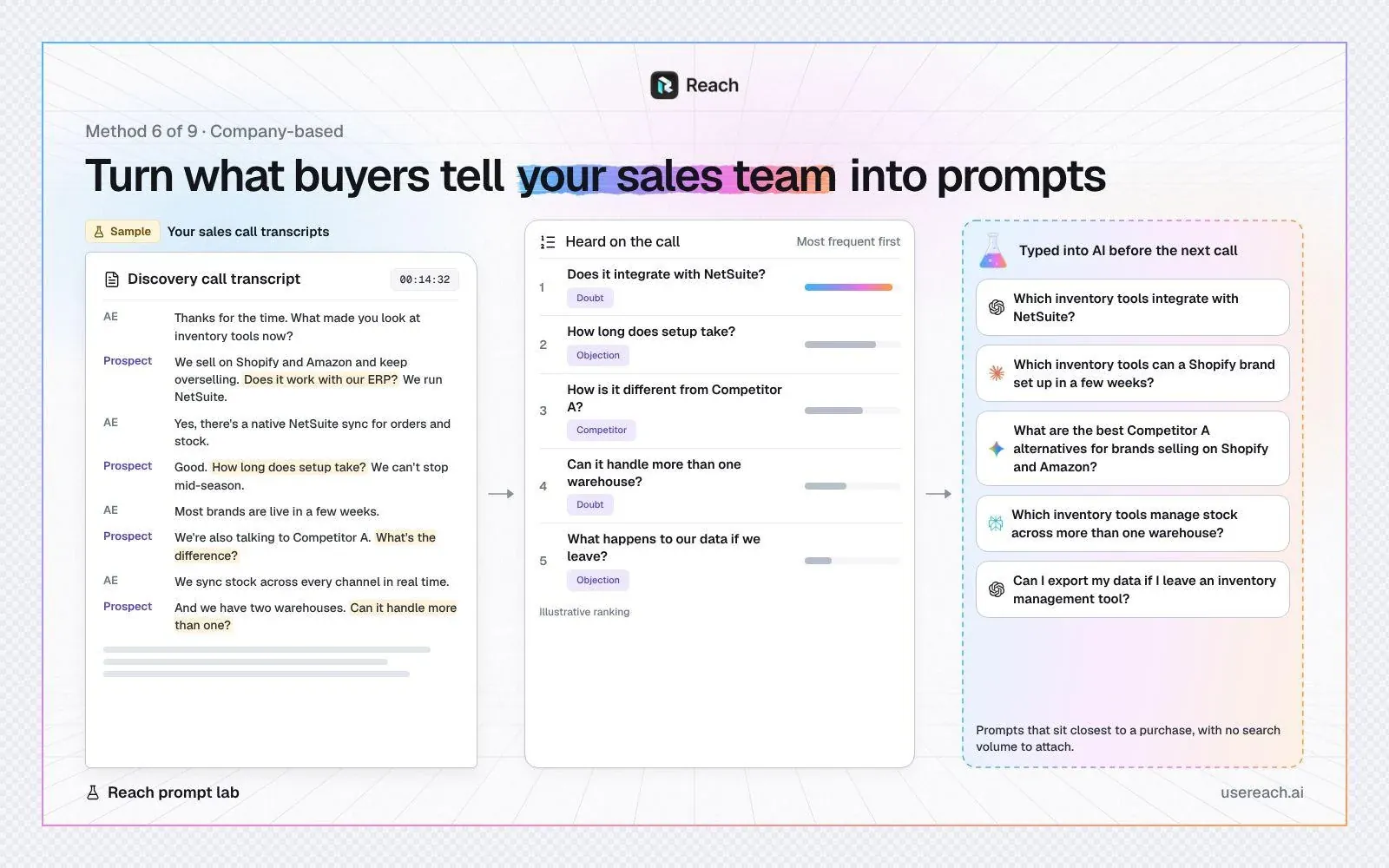
Each of these becomes a prompt. A prospect who asks on a call "does it work with our ERP?" is likely to ask ChatGPT "Which inventory tools integrate with NetSuite?" before that call ever happens.
Turn the Knowledge Base Into Prompts With the Query-Fusion Model
We built the Query-Fusion Model from scratch at Reach AI, as our own method for turning everything the knowledge base says about a business into potential searches. Every prompt it writes combines a qualifier, the category and one axis from the knowledge base.
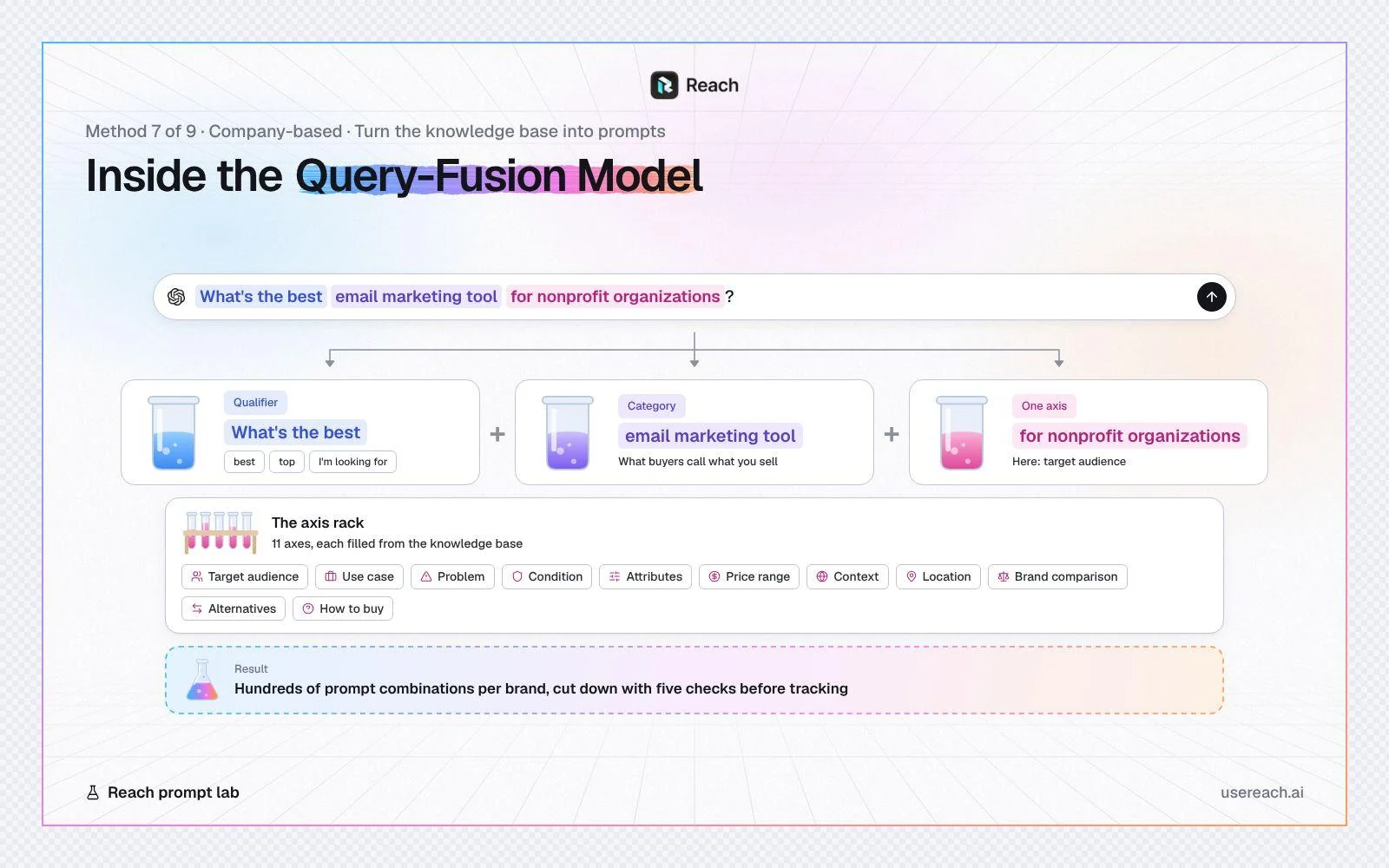
The qualifier is how buyers open the question: "best", "top", "what is the best" or "I'm looking for the best". Next comes the category, the name buyers use for what you sell, such as "PR agency", "AI meeting note-taker" or "running shoes", and then an axis, the detail that makes the prompt specific to one audience, use case or situation.
Let's use a customer selling an AI meeting note-taker as an example. From the knowledge base we know it transcribes calls and writes meeting notes, it targets small and mid-sized businesses, and it integrates with Microsoft Teams and Google Meet. That already gives us prompts like these:
- "What are the best AI meeting note-takers that integrate with Microsoft Teams?"
- "What are the top AI meeting note-takers with Google Meet integration for small businesses?"
We work through 11 axes for every customer, pulling the values for each one from the knowledge base. A mid-sized knowledge base produces hundreds of combinations, so the list gets cut down with the validation criteria in the next section.
These are the 11 axes, with the formula and an example for a services company, a software company and an ecommerce brand.
Target Audience
List every audience and ICP the brand sells to: company sizes, industries, roles and types of buyer. Each one gets its own prompt, since an AI engine recommends different vendors to a startup than to an enterprise.
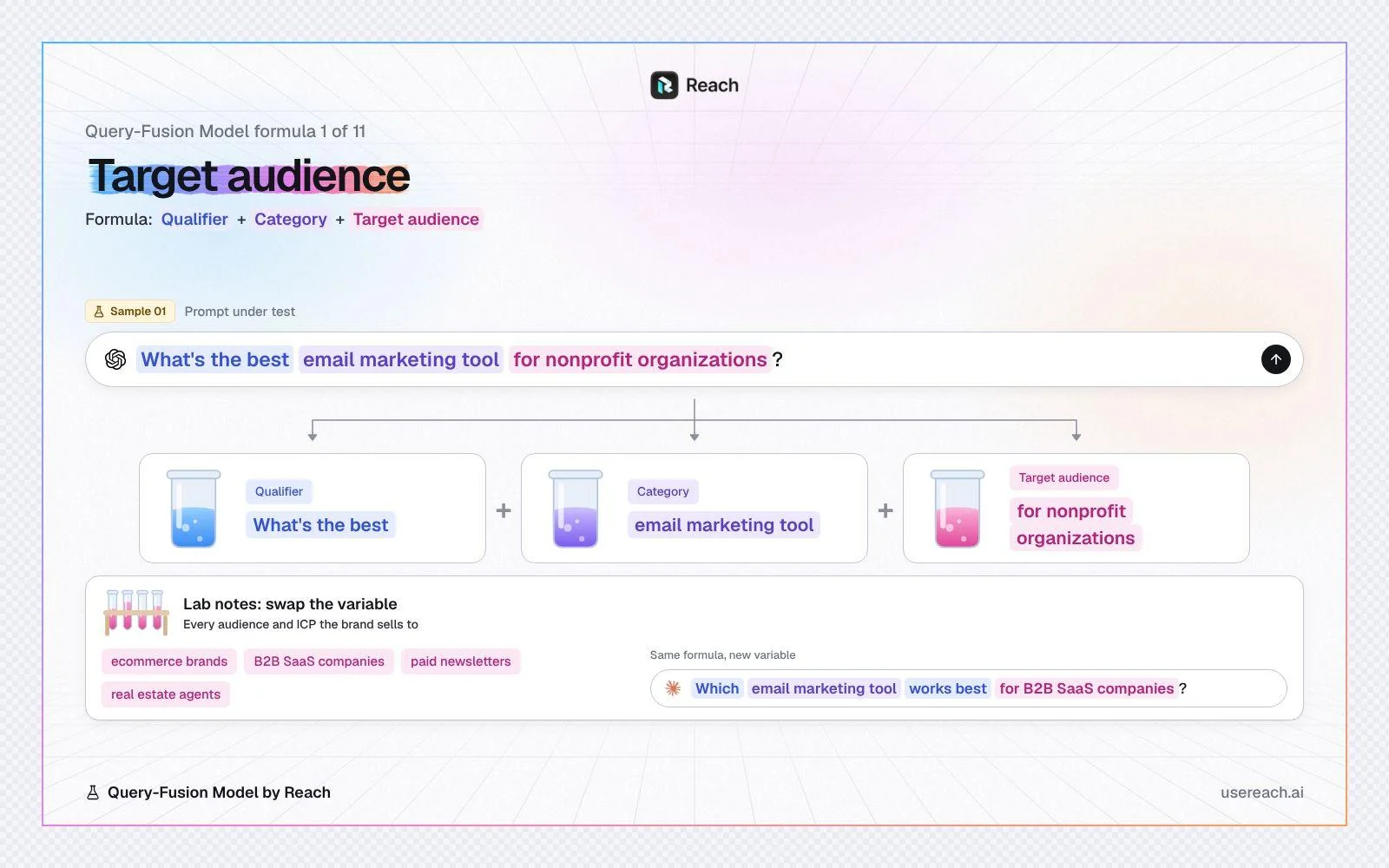
Formula: Qualifier + Category + Target Audience
- Services: "We're an early-stage startup. What's the best PR agency for a company like ours?"
- SaaS: "Which AI meeting note-takers work best for sales teams?"
- Ecommerce: "What are the best running shoes for someone who runs casually a few times a week?"
Use Case or Intent
List the jobs buyers hire the product or service for. The same category gets a different shortlist for each job, so a PR agency for rebranding and a PR agency for press release distribution are two separate prompts.
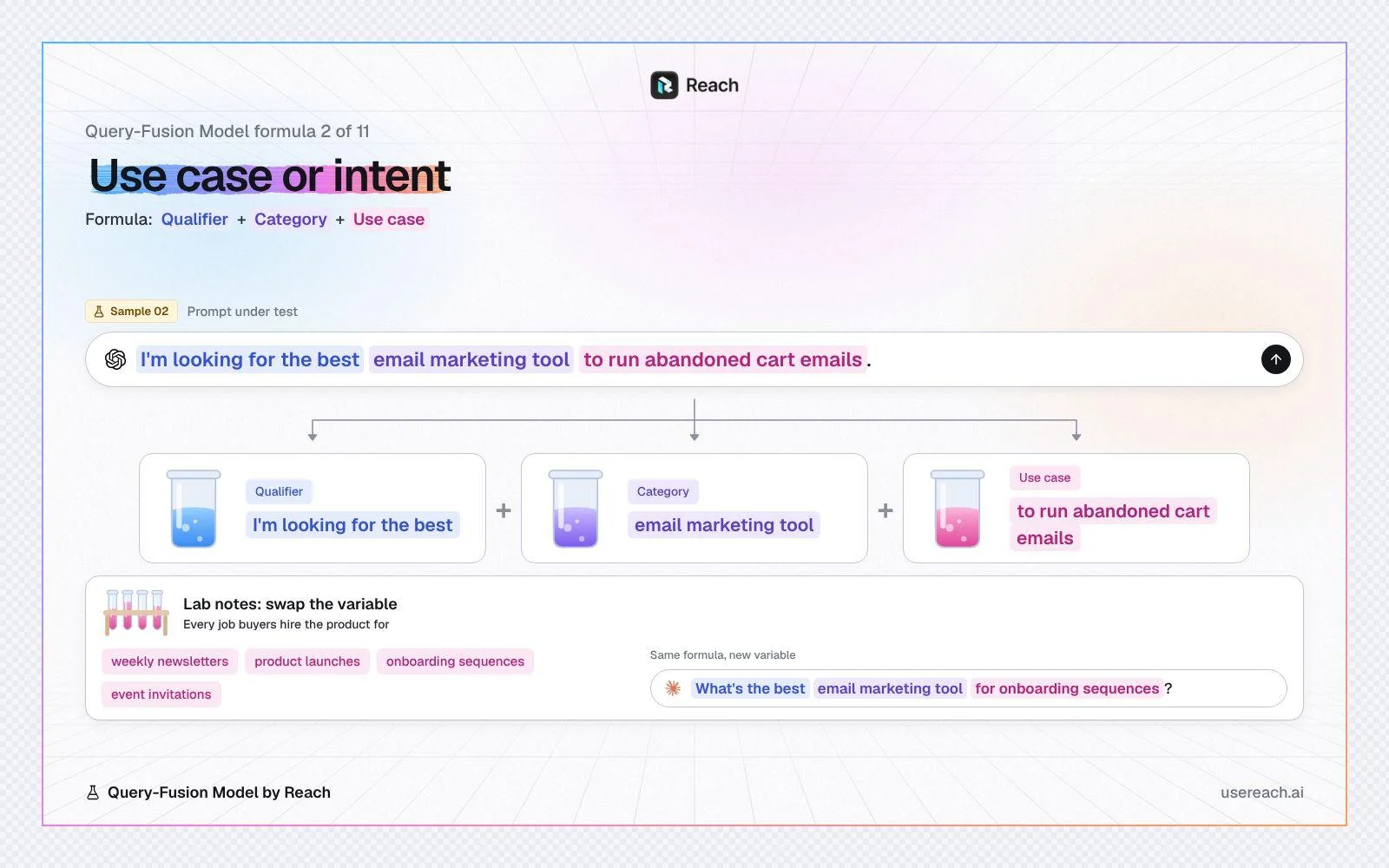
Formula: Qualifier + Category + Use Case
- Services: "We're planning a rebrand. Which communication agency would you recommend?"
- SaaS: "What's the best AI meeting note-taker for running customer interviews?"
- Ecommerce: "I want to get into trail running. Which running shoes should I look at?"
Problem
List the problems that push someone to look for the category in the first place. These prompts often name the symptom before the product, and sales calls and support tickets are full of them.
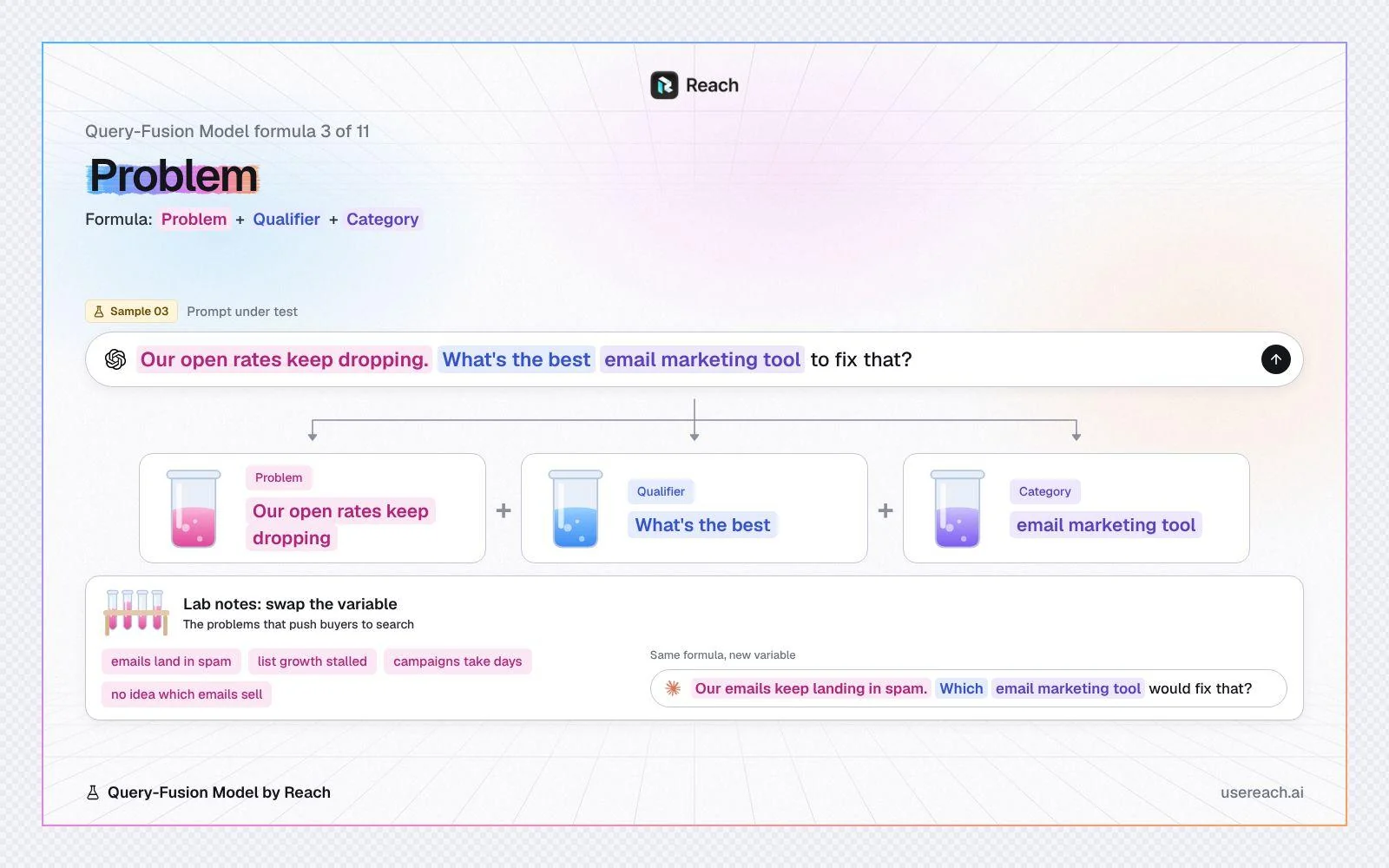
Formula: Qualifier + Category + Problem
- Services: "Nobody knows our brand yet. Which PR agency can help us build awareness?"
- SaaS: "Our team keeps losing action items after calls. Which AI meeting note-taker would fix that?"
- Ecommerce: "What are the best running shoes if I have knee pain?"
Condition
List the situations buyers are in when they search, such as recovering from a crisis, entering a new market or operating under a specific regulation. The condition is a fact about the buyer, and AI engines use it to decide which vendors qualify.
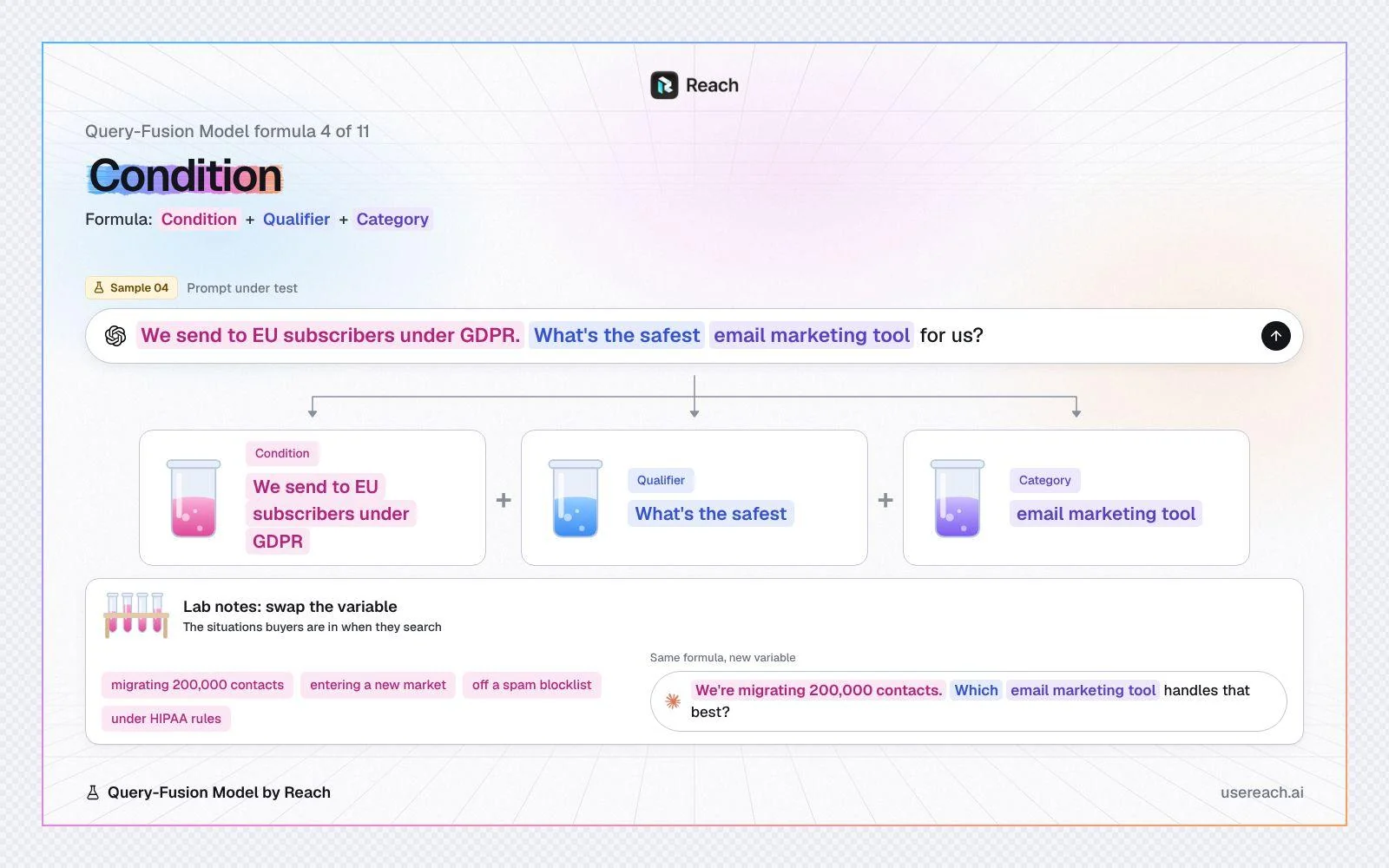
Formula: Qualifier + Category + Condition
- Services: "We're expanding into new markets. Which PR agencies are best for that?"
- SaaS: "Which AI meeting note-taker is the safest choice for a company with strict GDPR requirements?"
- Ecommerce: "I have flat feet. What running shoes would you recommend?"
Attributes
List the features and characteristics buyers ask for by name: API-based, AI-powered, bilingual, a size or a color. In this axis the attribute goes before the category, the way people describe what they want.
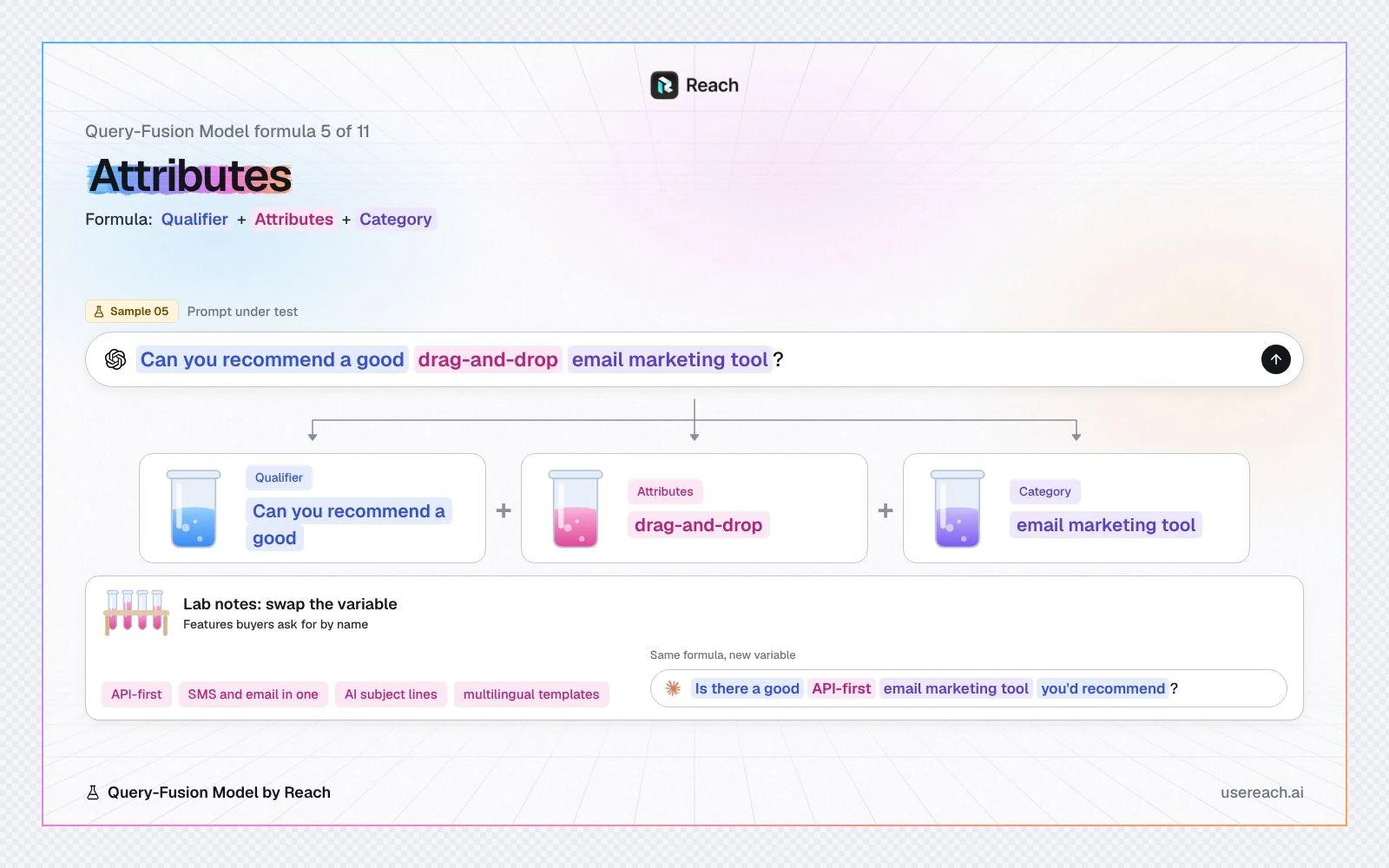
Formula: Qualifier + Attributes + Category
- Services: "Can you recommend a digital-first public relations agency?"
- SaaS: "Is there a good bot-free AI meeting note-taker you'd recommend?"
- Ecommerce: "Where can I find good black running shoes in size 43?"
Price Range
List the price points and pricing models the brand competes on: budget, premium, pay-per-use or a monthly cap. Add only the ranges the brand fits, since a recommendation in the wrong price bracket brings unqualified leads.
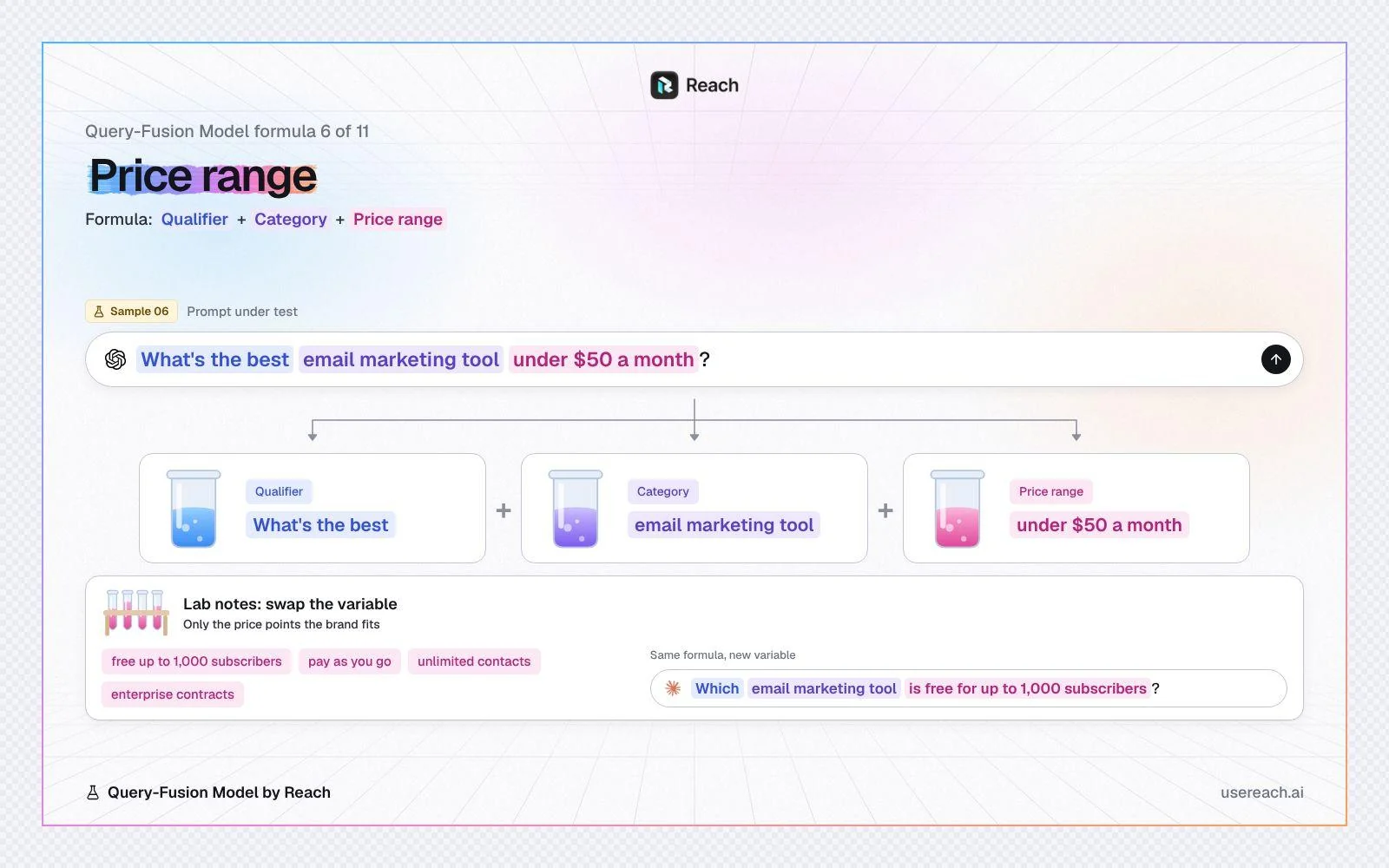
Formula: Qualifier + Category + Price Range
- Services: "Which PR agencies work with budgets under €5,000 a month?"
- SaaS: "What's the best AI meeting note-taker for under €15 per user per month?"
- Ecommerce: "What are the best running shoes under $100?"
Context or Environment
List the settings where the product or service gets used: a market, a type of company, a technical environment or the weather. Context prompts are where niche brands get recommended ahead of category leaders.
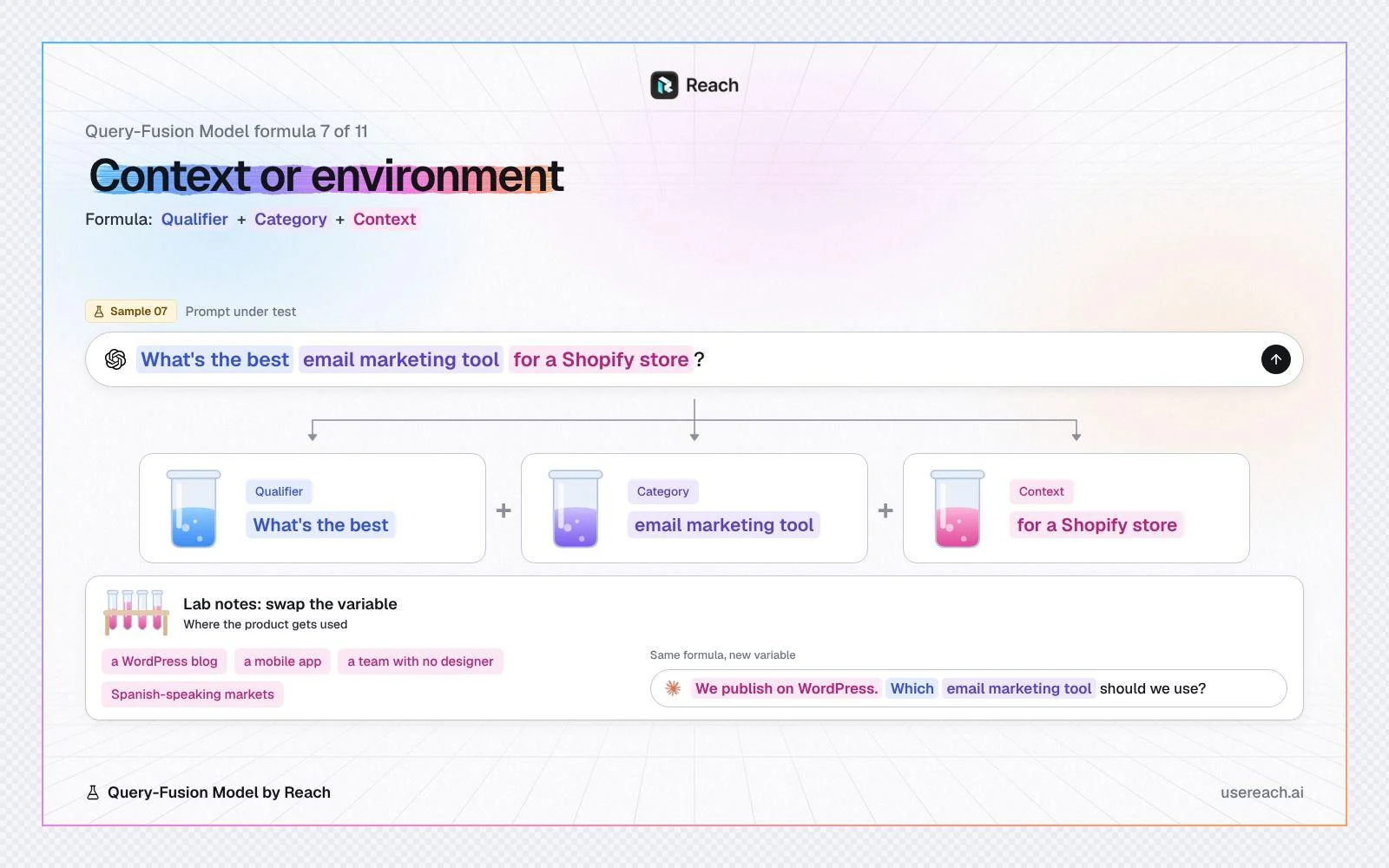
Formula: Qualifier + Category + Context
- Services: "Which communication agency is best for Portuguese-speaking markets?"
- SaaS: "We're a fully remote team. Which AI meeting note-taker should we use?"
- Ecommerce: "What running shoes work best in the rain?"
Location
List every country, region and city where the brand operates or has physical stores. For retail and ecommerce, add a physical intent such as "stores" or "places to buy", since the buyer wants somewhere to go.
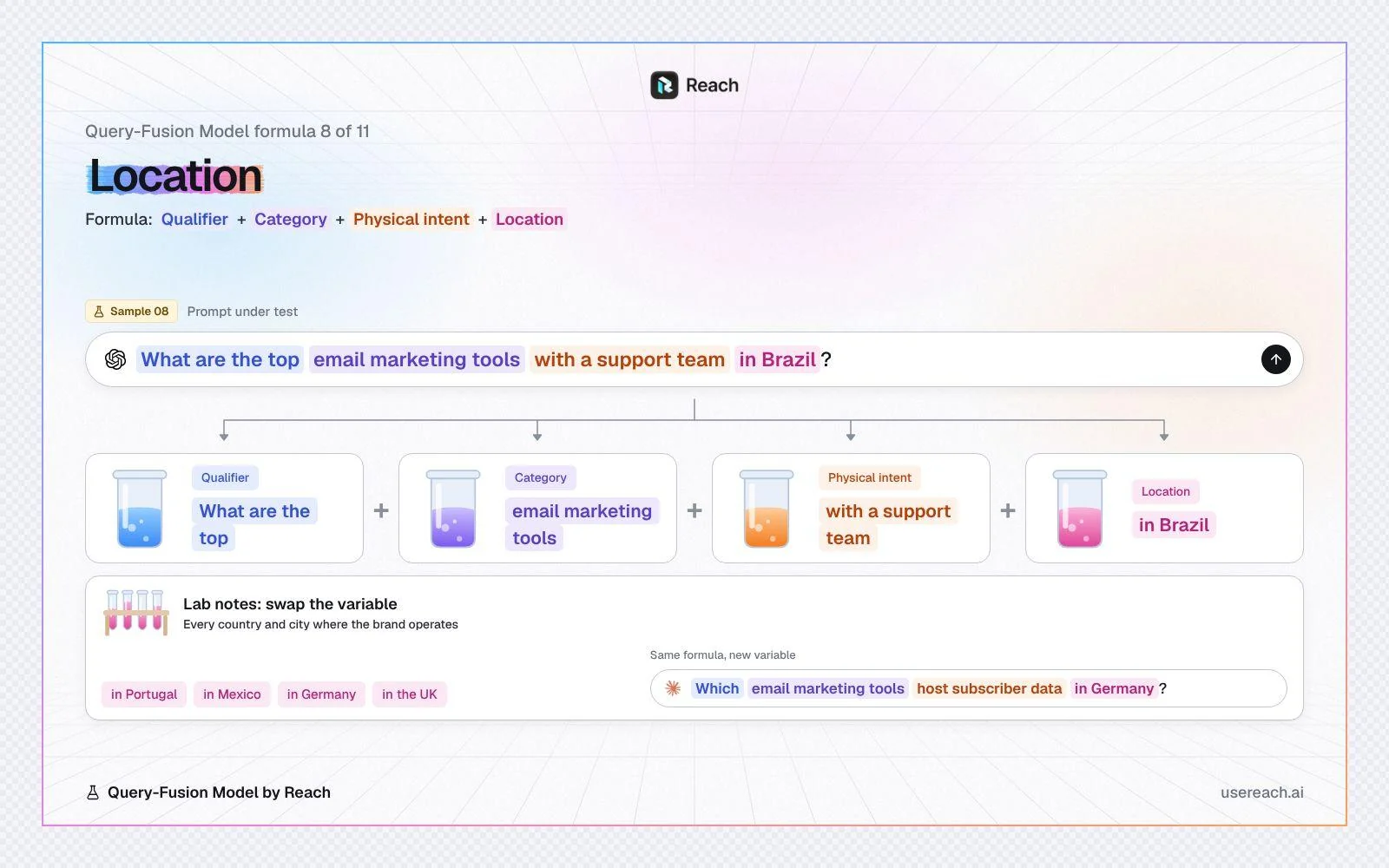
Formula: Qualifier + Category + Physical Intent + Location
- Services: "What are the top public relations agencies in Portugal?"
- SaaS: "Which AI meeting note-takers store their data in Europe?"
- Ecommerce: "Where's the best place to buy running shoes in Porto?"
Brand Comparison
List the competitors buyers compare the brand against, starting with the names prospects bring up on sales calls. Each competitor gets a head-to-head prompt with the brand on the other side.
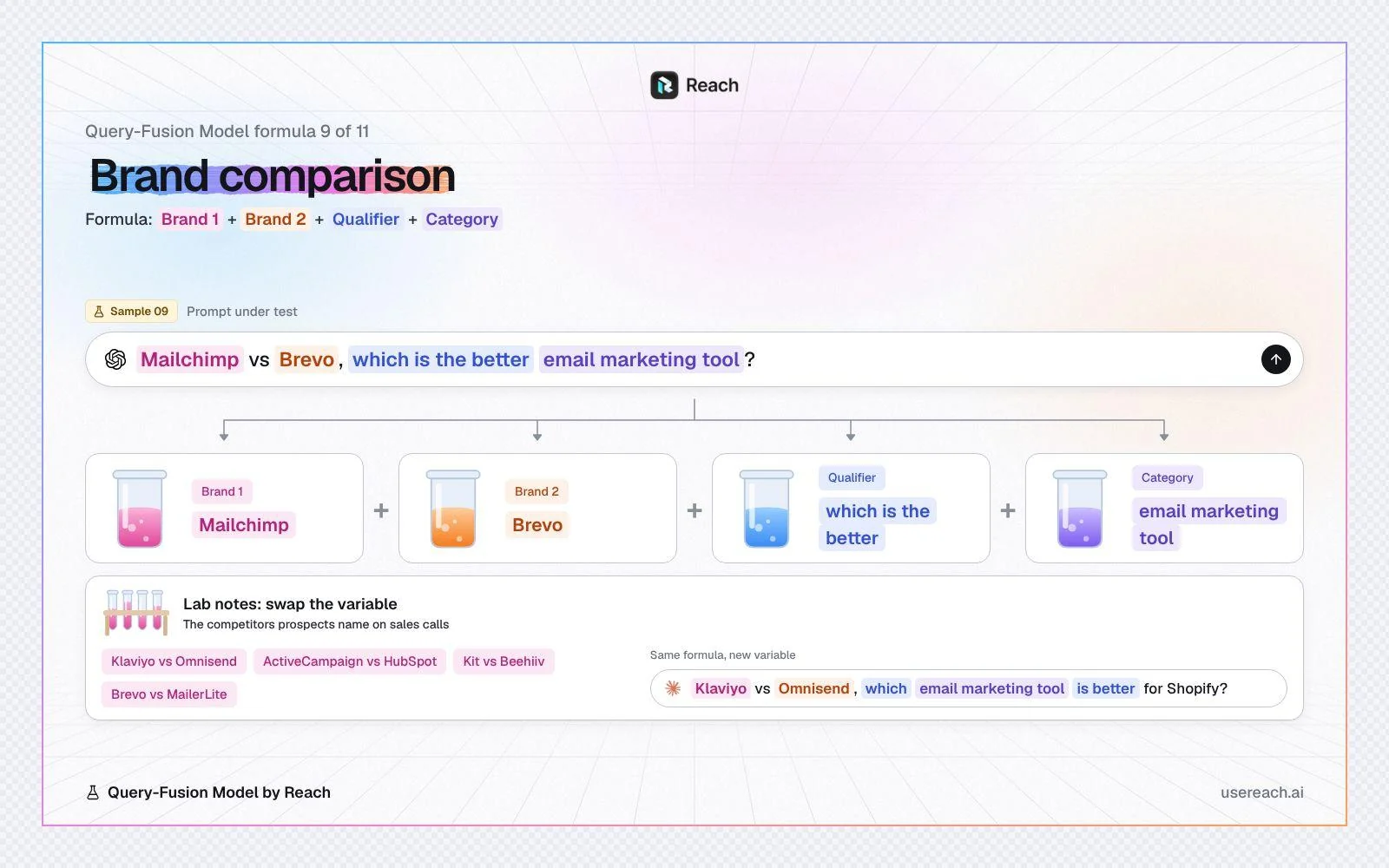
Formula: Brand 1 vs Brand 2 + Qualifier + Category
- Services: "Ogilvy PR or Weber Shandwick, which one is better for communication services?"
- SaaS: "Otter vs Fireflies, which AI meeting note-taker is better for sales calls?"
- Ecommerce: "Nike or Adidas, which brand makes better running shoes?"
Brand Alternatives
Use the same competitor list, one name at a time. Buyers who already know the category leader and want something different ask for alternatives, and those prompts sit close to a purchase.
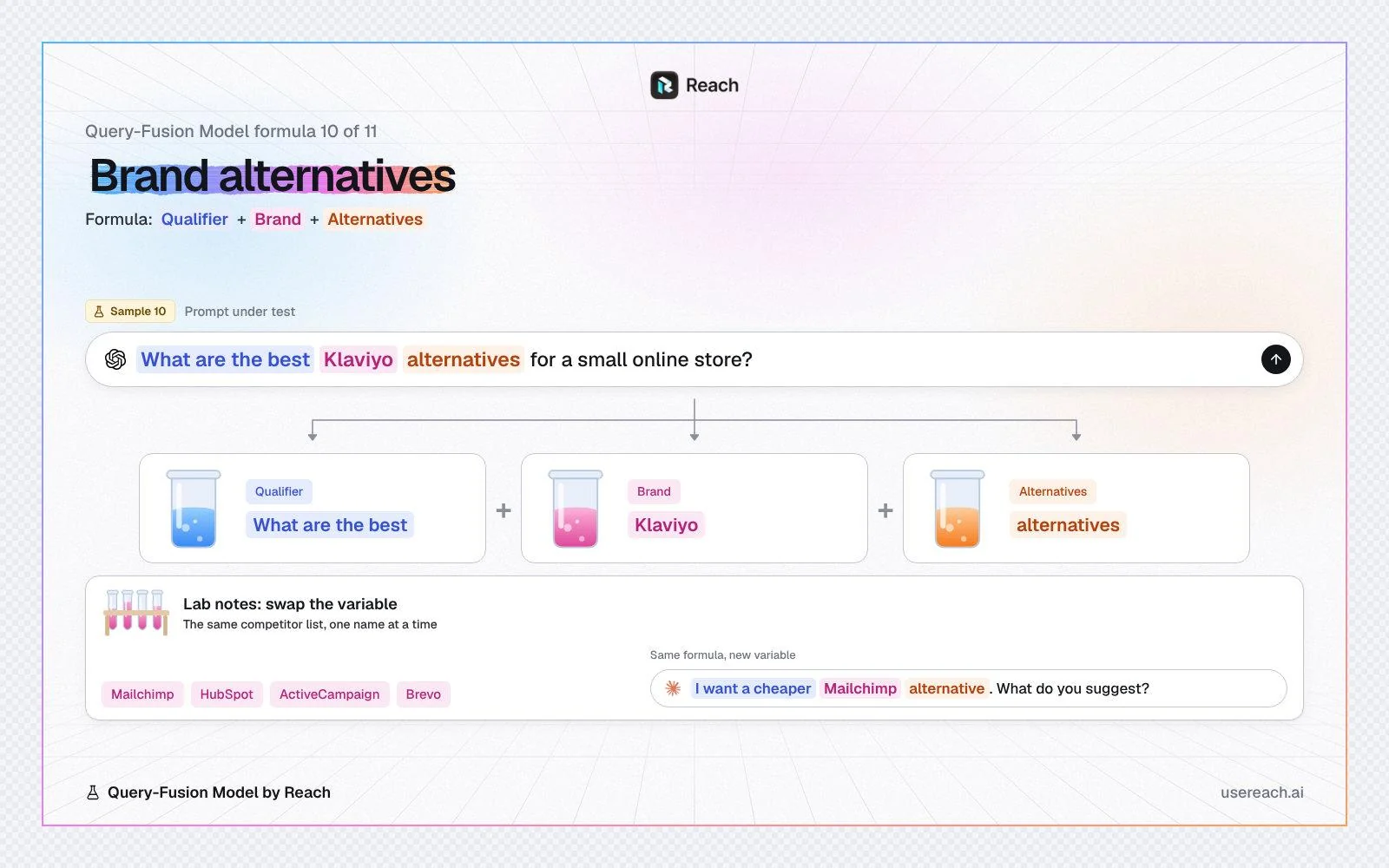
Formula: Qualifier + Brand + Alternatives
- Services: "What are some good Burson alternatives in Portugal?"
- SaaS: "I'm looking for an Otter alternative that works well with Google Meet. What do you suggest?"
- Ecommerce: "What are the best alternatives to Puma running shoes?"
How to Buy
List the ways buyers ask for help choosing before they have a shortlist: how to choose, what to look for and how to evaluate. Answers to these prompts often list evaluation criteria next to the brands that meet them.
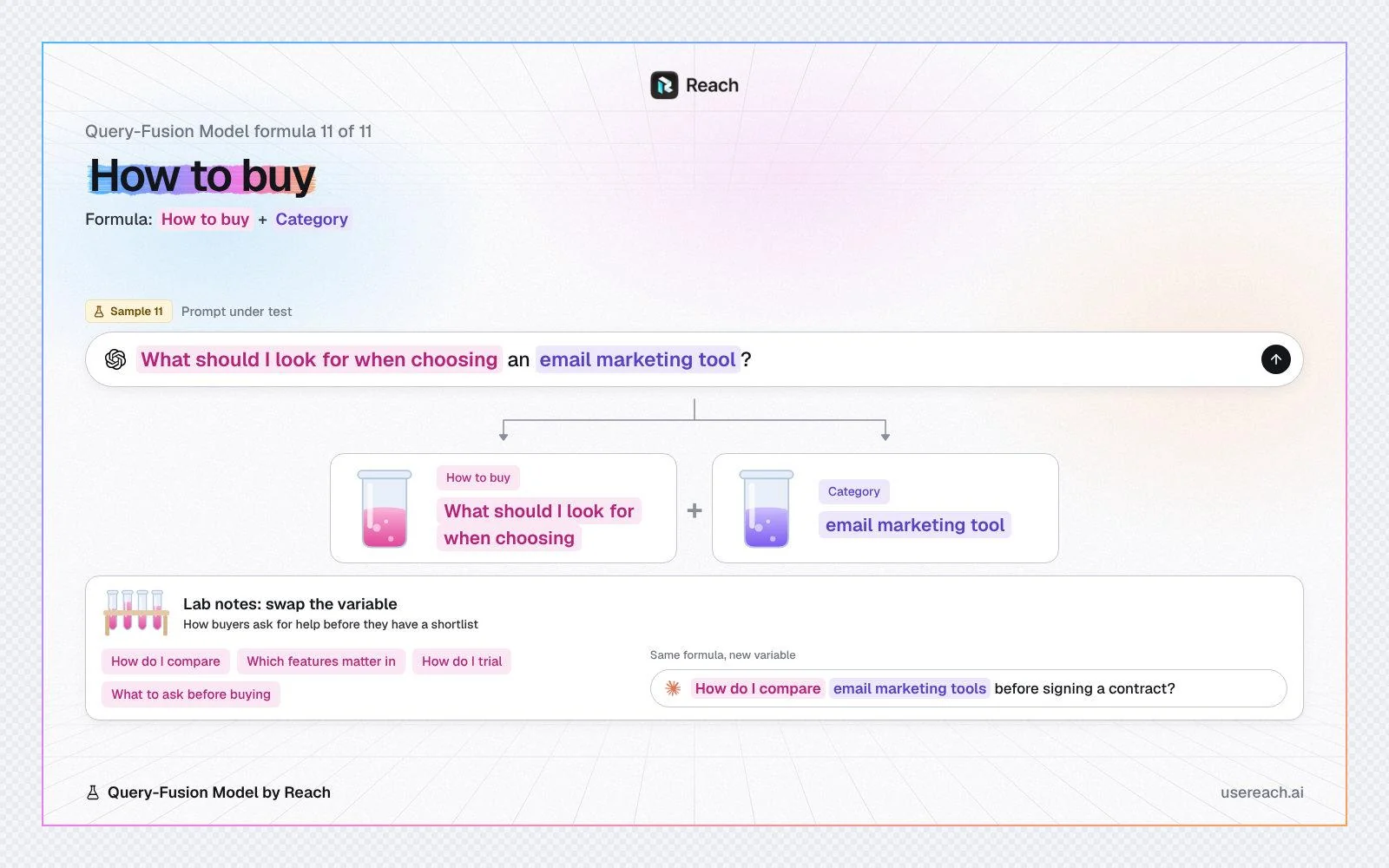
Formula: How to Buy + Category
- Services: "How should I evaluate PR agencies before hiring one?"
- SaaS: "How do I choose the right AI meeting note-taker for my team?"
- Ecommerce: "How do I pick the right running shoes for me?"
3. Community-Based Prompts: Catch New Topics Before Keyword Tools Do
Ahrefs, Semrush and Google Keyword Planner show averages from past months. When a topic is new, it takes a while before these tools show any volume for it.
Community threads show it first. We use an automation that crawls hundreds or thousands of Reddit and Quora threads for each customer, and finds the topics people discuss most and the words they use to describe them.
When a topic keeps coming up, it becomes a prompt on the list, and often a new page on the roadmap. We collect the threads in two ways.
Crawl the Top Threads in Your Niche's Communities
Start by identifying at least 5 communities where people discuss your niche: subreddits, Quora spaces or niche forums. For an AI meeting note-taker, that could be communities about productivity, remote work and sales.
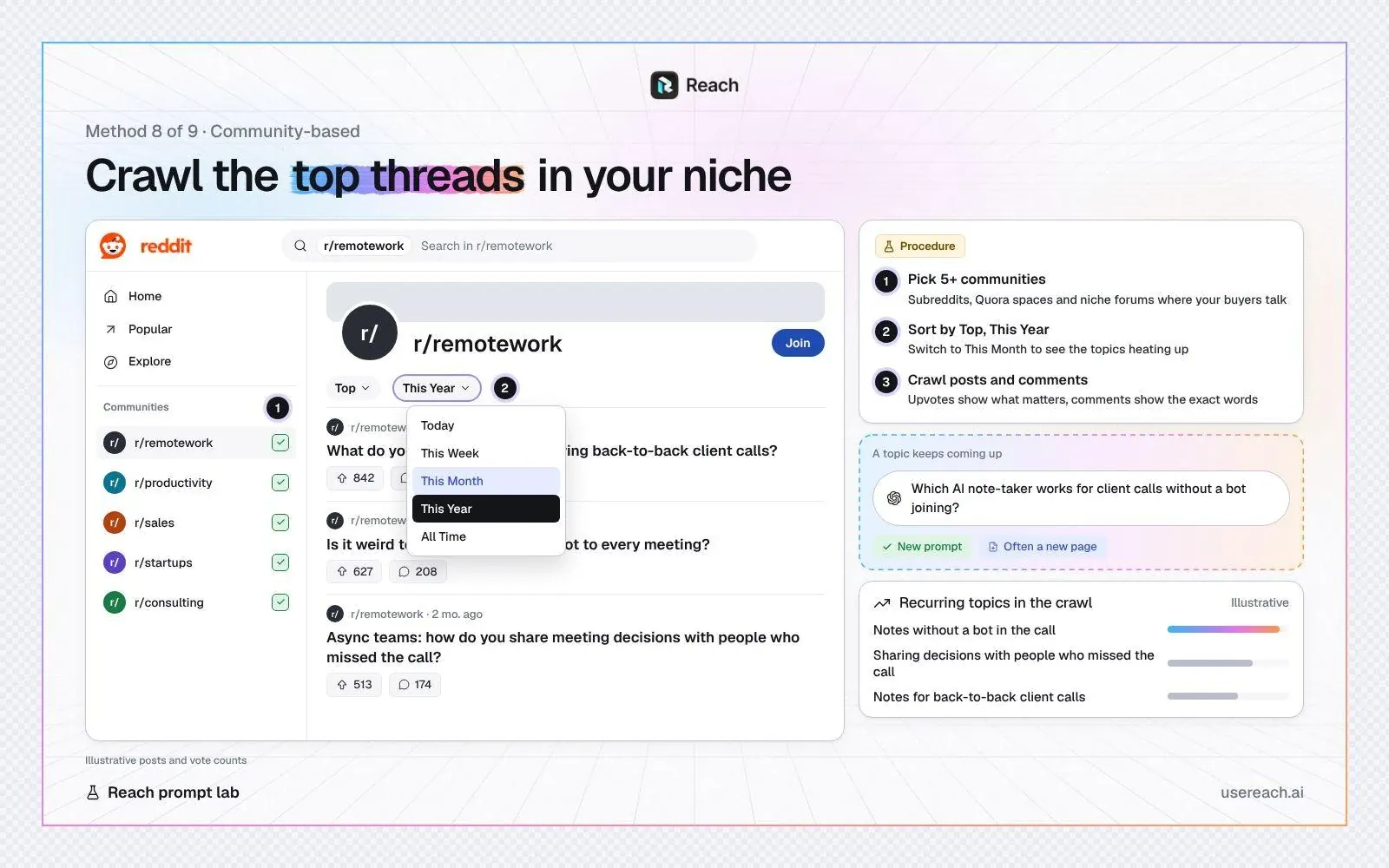
In each subreddit, sort the posts by Top and set the time range to This year. Switch it to This month to find the topics heating up right now.
Then crawl those posts and their comment threads. The most upvoted posts show what the community cares about, and the comments show the exact words people use when they ask for recommendations.
Search Reddit for Your Industry's Terms
The second method goes beyond the communities you picked. Type the terms associated with your industry into Reddit's search bar, such as "meeting notes", "AI note-taker" or "call transcription", and scrape every relevant conversation that comes back, whatever subreddit it sits in.
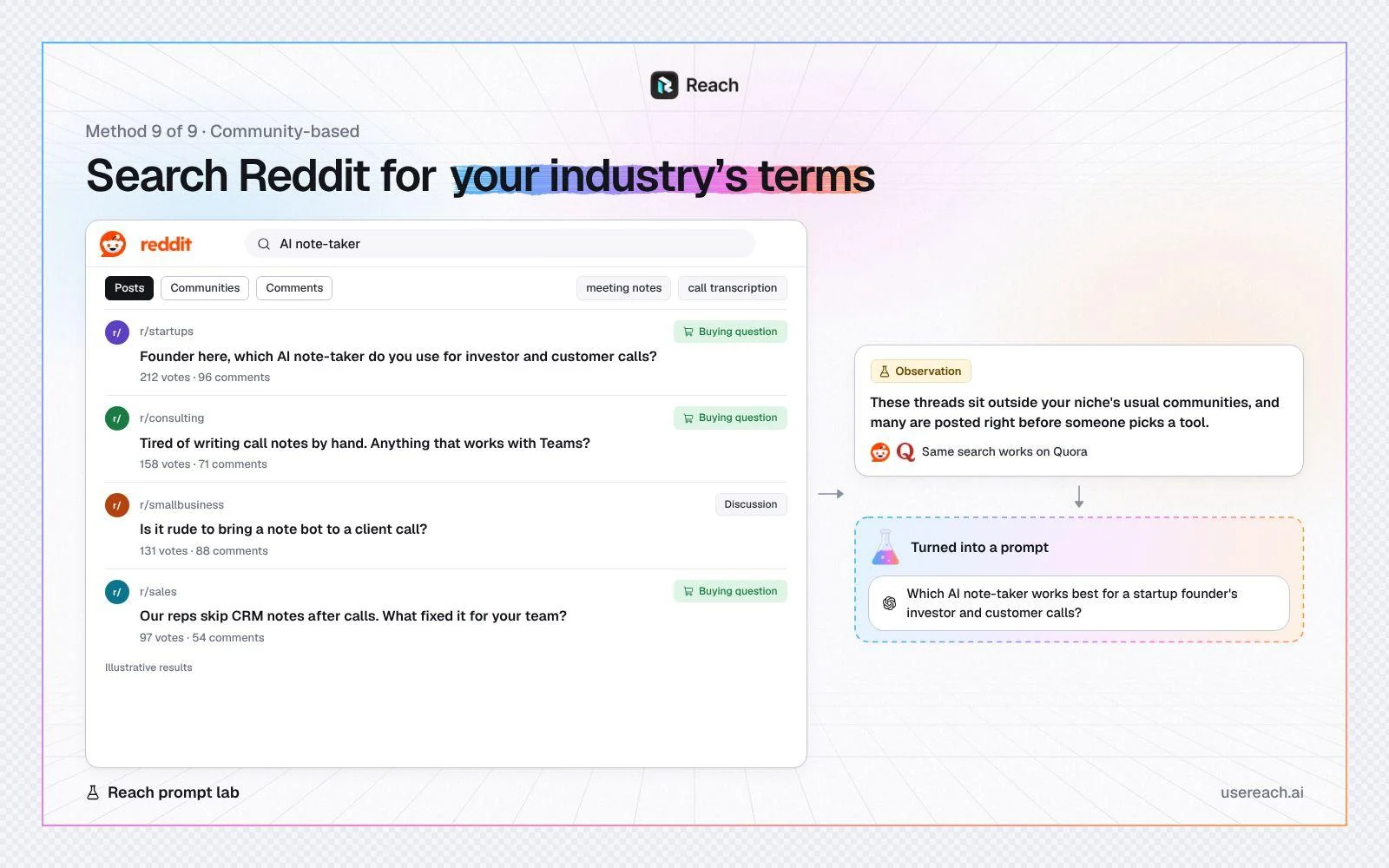
This catches the discussions that happen outside your niche's usual communities, like a founder asking for note-taker recommendations in a startup subreddit. Many of those threads are buying questions, posted when someone is about to choose a tool.
Which Prompts to Track: MOFU and BOFU Prompts That Trigger RAG
The three groups give you a long list, and every prompt on it may make business sense. Before a prompt earns a place on the roadmap, we check whether it can be won.
AI engines answer in two ways. Some prompts get answered from the model's pre-trained data, with no live search, and the only way into that answer is the next training run. Others trigger retrieval-augmented generation (RAG): the model searches the web in real time, reads the pages it finds and cites them.
Only RAG answers respond to the work you do this quarter. Middle and bottom-of-funnel prompts, where buyers compare options, ask for recommendations or look for a vendor, are the ones that tend to trigger a search, while definitional prompts like "what is email marketing?" are often answered from memory.
We validate every prompt against five criteria. The first two are requirements, and the last three decide where to start.
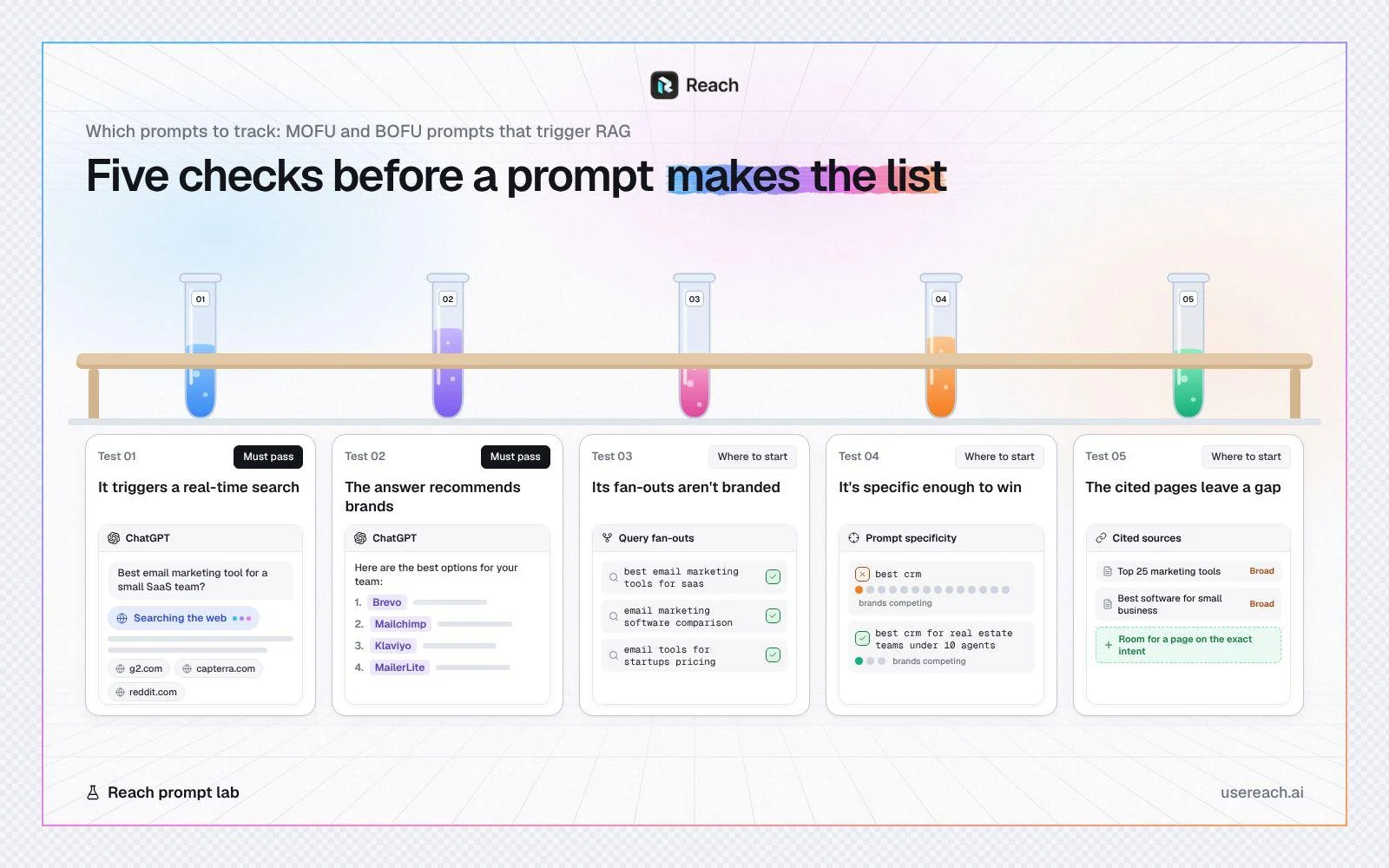
1. It Triggers a Real-Time Search
Run the prompt and check whether the answer shows sources. In ChatGPT, a search shows up as cited links and a sources panel, and in ReachOS, a prompt that triggers RAG shows the fan-outs the model ran and the pages it cited.
If the answer has no sources, the model answered from its training data. Drop the prompt or keep it on a watchlist, since models change when they decide to search.
2. The Answer Recommends Brands
Some prompts trigger a search and still return general advice with no vendors named. A citation in that answer may bring awareness, and it rarely brings a lead.
Keep the prompts where the answer names brands, products or providers, and where your brand belongs on that list. Those are the answers that shape a buyer's shortlist.
3. Its Fan-Outs Aren't Branded
This criterion is optional, and it changes where you start. Look at the fan-outs each prompt triggers: for "best email marketing tools", one of the most common is "ActiveCampaign email marketing tool", a search about one brand.
Branded fan-outs return the brand's own pages and reviews about it, which leaves little room for anyone else. Start with prompts whose fan-outs are unbranded, like "best email marketing tools for SaaS", where a new page can rank and get read by the model.
4. It's Specific Enough to Win
The same rule as traditional SEO applies here. Broad prompts like "best CRM" are the most contested, with category leaders and large publishers in every answer.
Specific prompts like "best CRM for real estate teams with under 10 agents" have fewer brands competing for them, and the buyers asking them are closer to a decision. Start there, and work toward the broad prompts as your authority grows.
5. The Cited Pages Leave a Gap
Look at the pages each prompt cites. When the cited domains only have general pages, such as a broad "best CRMs" listicle answering a question about real estate teams, nobody has written for that intent yet.
Those are the prompts where a page built for the exact intent has the best chance of getting cited. ReachOS shows the cited pages for every prompt, so the gaps show up prompt by prompt.
From Prompts to Query Fan-Outs: What You Actually Optimize For
Prompt research is the starting point. It shows which conversations to watch, while the searches that decide each answer sit in the fan-outs the prompts trigger.
This is the cycle we follow for every customer:
- Find the prompts: build the list from intent-based, company-based and community-based prompts.
- Track them: run the prompts in ChatGPT, Claude, Gemini, Perplexity and Google's AI features with a monitoring tool like ReachOS.
- Validate them: keep the middle and bottom-of-funnel prompts that trigger RAG and recommend brands, starting with the specific ones that have unbranded fan-outs and citation gaps.
- Extract the fan-outs: collect the background searches each model runs on Google, Bing and Brave for those prompts.
- Build for the fan-outs: create the pages, earn the mentions on third-party sites and fix the technical issues that put your brand in the sources the models read.
To find the gaps, we run a query fan-out gap analysis. It compares the pages and target keywords on a customer's content roadmap with the fan-outs the models run, and shows the searches no page covers yet.
Fan-outs also change from one model to another, so we plan the roadmap per search engine and per prompt. We call this method Prompt Constellations.
Prompt Research Mistakes to Avoid
The process only works when every step stays tied to buyers and revenue. These are the mistakes I see most often when teams start AI search prompt research.
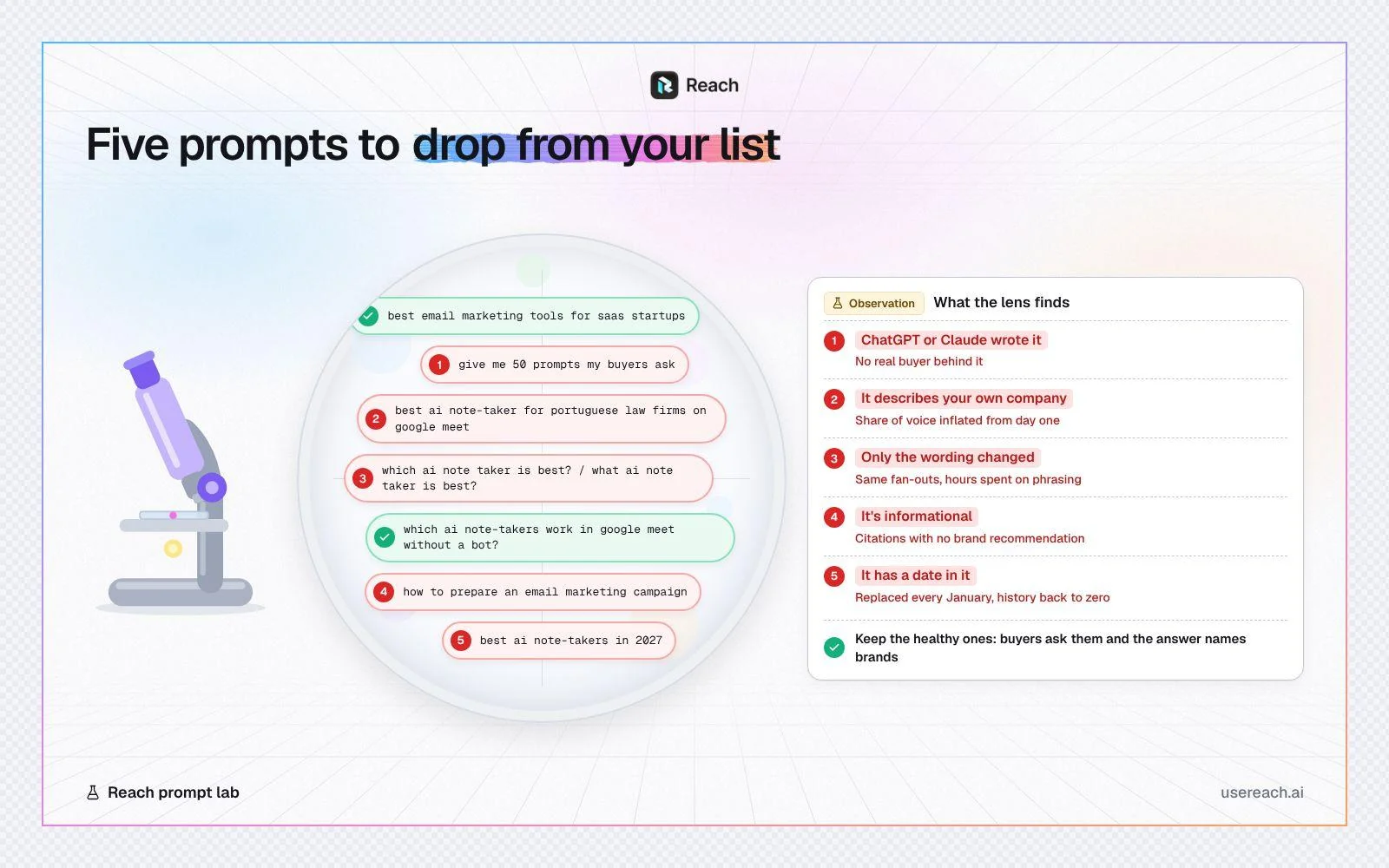
Asking ChatGPT or Claude to Write Your Prompts
It's the fastest way to fill a tracking list: paste your website into ChatGPT or Claude and ask for 50 prompts your buyers might ask. The list looks plausible, and nothing in it comes from a real buyer.
The model has no access to your search data or your sales calls, so it guesses from your homepage and its training data. Use the output as a brainstorm at most, and keep only the prompts you can back with one of the three groups of methods above.
Tracking Prompts That Describe Your Company
Some teams track prompts so close to their own offer that the AI can barely answer without recommending them, and their share of voice looks great from day one. Picture an AI note-taker for law firms tracking "best AI meeting note-taker for Portuguese law firms with 10 to 50 lawyers that works in Google Meet without a bot, transcribes in European Portuguese and sends the notes straight to Clio", when that sentence is its positioning.
That share of voice is inflated, since few buyers ask the question in that shape. Specific prompts are worth tracking when search data, sales calls or community threads show buyers asking them, and the test is whether someone outside your company would type them.
Writing Prompts Word for Word and Stopping There
Teams spend hours debating the exact phrasing of each prompt. The wording matters far less than the intent, since prompts with the same need trigger similar fan-outs.
Spend that time on the fan-outs instead. They're the searches your pages need to win.
Tracking Informational Prompts
Prompts like "best strategy to generate more leads" or "how to prepare an email marketing campaign" have plenty of demand and rarely lead to a purchase. The answers are advice, often written from the model's training data, and they seldom name vendors.
You can still win citations for these prompts in Google AI Overviews, AI Mode and Perplexity, which search the web even for informational questions like these. Your page gets cited as a source with no brand recommendation attached, so that citation is worth much less than a recommendation in a middle or bottom-of-funnel answer.
Keep the tracking list focused on middle and bottom-of-funnel prompts where the answer recommends brands, and cover informational topics with content for traditional SEO.
Tracking Prompts With Dates
Prompts like "best AI meeting note-takers in 2026" look reasonable, since people often add the year when they search. The problem comes in January: the prompt is out of date, and you have to delete it and replace it with a new one.
Every replaced prompt starts its history from zero, so you lose the trend that shows whether your visibility improved. Keep dates out of the prompts you track in AI visibility trackers, since the fan-outs for "best AI meeting note-takers" often add the current year by themselves.
Prompt Research That Turned Into Pipeline
We refined the methods in this guide over time, through experiments we've been running with brands across B2B software, services, ecommerce and travel. Each round of tests showed us which prompts moved visibility and which ones moved revenue, and the process kept getting sharper.
That's why we judge a prompt list by what it brings in: leads, deals and revenue, more than citation counts. These are some of the customers where the prompts we picked turned into business results.
ColdIQ: $506K in Signed Contract Value in 4 Months
ColdIQ is a B2B outbound and lead generation company. Its buyers compare providers before they book a call, so the prompts we prioritized were the ones where they ask AI engines which agencies and services to shortlist.
The work included roundups of B2B lead generation services built around those prompts and their fan-outs. In four months, SEO and AI search brought ColdIQ $506K in signed contract value. The full story is in the ColdIQ case study.
Carro: 7-figure Deals From AI Search
Carro sells inventory management and EDI software to ecommerce brands. Its buyers ask specific questions, often naming the store software they sell on, which is exactly the kind of prompt the Query-Fusion Model maps by integration.
We built an EDI article cluster, inventory management listicles for 5 ecommerce store systems and three-way comparison pages for the prompts where buyers weigh Carro against competitors. AI search became responsible for 7-figure deals. The full story is in the Carro case study.
Indie Campers: AI Search Revenue Growth
Indie Campers rents RVs and campervans across several countries. Travelers ask AI engines where to go, which routes to take and where to rent, often naming a specific country or city.
Those location prompts shaped the location pages we built and optimized across languages. AI search revenue grew 14x, and the details are in the Indie Campers case study.
Everything You Need to Know About Prompt Research
| Topic | What to know |
|---|---|
| What it is | Finding the conversational questions buyers ask AI engines, grouped by intent, so you know which answers your brand needs to appear in |
| Why there's no volume data | No AI company publishes prompt volumes, and prompts are too long and personal to repeat word for word |
| Tool-suggested prompts | Generated from your domain alone, without brand context or search data, so check them against real demand before tracking |
| What you optimize for | The intent behind the prompt and the query fan-outs the model runs on Google, Bing and Brave |
| Intent-based prompts | Google search data, hidden Google Search Console opportunities, ChatGPT's follow-up filters, Perplexity's follow-up questions and People Also Ask |
| Company-based prompts | What buyers tell your sales team, and the knowledge base turned into prompts with the Query-Fusion Model |
| Community-based prompts | Recurring topics and wording from Reddit, Quora and niche forum threads |
| Which prompts to keep | Middle and bottom-of-funnel prompts that trigger RAG and recommend brands, starting with specific prompts that have unbranded fan-outs and citation gaps |
| How to measure success | Leads, pipeline and revenue from AI search, with citations and mentions as leading indicators |
Find the Prompts That Bring You Pipeline
At Reach AI, prompt research is where every customer program starts. We build the prompt list from Google demand, your sales conversations and your communities, track it in ReachOS across ChatGPT, Claude, Gemini, Perplexity and Google's AI features, and turn the fan-outs into the pages and mentions that get your brand recommended.
It works for companies that already have demand in their category, whether they sell software, services or products, including teams with an in-house SEO or content team that hasn't worked on AI search yet. We cover the full process, from the first prompt list to the revenue it brings in.
Free 30-minute call
Book a call with Reach AI
In 30 minutes Alex looks up you and your closest competitors on Google and in ChatGPT, Claude and Gemini, live, and shows you what we'd do first.
Not ready for a call? Get a free organic growth review
Free 30-minute call · You keep the notes
 Google
 ChatGPT
 Claude
 Gemini
Prompt Research FAQs
What is prompt research?
Prompt research is the process of finding the conversational questions people ask AI engines like ChatGPT, Claude, Gemini and Perplexity, and grouping them by the problem they want to solve. It's the AI search equivalent of keyword research. The prompts you find go into a monitoring tool, which tracks whether your brand gets mentioned and recommended in the answers. The goal is a list of prompts where a recommendation brings leads or sales.
How to do AI prompt research for SEO?
To do AI prompt research for SEO, build the list from three groups of prompts. Intent-based prompts come from Google keyword data, long and question-based Search Console queries, the follow-up questions ChatGPT and Perplexity suggest, and People Also Ask. Company-based prompts come from sales call objections and your knowledge base, and community-based prompts come from Reddit and Quora threads. Keep the middle and bottom-of-funnel prompts that trigger a real-time search, track them in a monitoring tool and optimize for the query fan-outs each one triggers.
Which prompts should I track for AI search?
The prompts to track for AI search are middle and bottom-of-funnel prompts that trigger a real-time search and return brand recommendations. Prompts answered from the model's pre-trained data can't be influenced until the next training run, so they're a poor place to start. Prioritize prompts that are specific to one audience or use case, whose fan-outs aren't branded and where the cited pages don't cover the intent well. Those are the answers a new page has the best chance of entering.
Should I use the prompts my AI search tool suggests?
You can use the prompts your AI search tool suggests as ideas, and check each one before tracking it. Most tools generate prompts with an LLM that reads your domain, with no access to your positioning, your ICPs, your search data or your sales conversations. The result is often generic top-of-funnel prompts the model answers from training data, or prompts nobody asks. Keep only the ones backed by search data, sales calls or community discussions.
Is there search volume data for AI prompts?
There is no search volume data for AI prompts, because neither OpenAI nor Anthropic publishes prompt data the way Google does through its Keyword Planner. Prompts are also long and personal, so two people rarely type the same one. The workaround is to prove demand with Google data for the same intent, and to use sales conversations for the questions buyers ask before they purchase. OpenAI now shows businesses the conversation topics where they appear in ChatGPT, though full prompts with volumes are unlikely.
What is the difference between keyword research and prompt research?
The difference between keyword research and prompt research is that the whole process changes, because Google is far more transparent with its data than any AI search engine. Google shares search volumes through its Keyword Planner, and keyword research tools build on that data, while OpenAI, Anthropic and the other AI companies don't publish what people type. Prompt volumes are also much harder to gather, since people write long, personal prompts and two buyers with the same need rarely use the same words. That's why prompt research rebuilds demand from Google data, sales conversations and community threads, focused on the intent behind each prompt.
What are query fan-outs?
Query fan-outs are the short background searches an LLM runs on search engines like Google, Bing and Brave while it builds an answer. The model breaks a long prompt into several search-friendly queries, reads the pages that come back and cites some of them. Prompts with the same intent tend to trigger similar fan-outs. That's why AI search work targets the fan-outs, with prompt research as the way to find them.
Can I use Google Search Console for prompt research?
Yes, you can use Google Search Console for prompt research by filtering your queries with a custom regex. One filter shows queries with 8 or more words, and another shows queries containing question words like who, what, how and why. Export the results and keep the ones ranking below position 10, since those are conversational searches with no page written for them. This method only works for sites that already have some search history.
Do prompts differ between ChatGPT, Claude and Gemini?
Prompts with the same intent look alike across ChatGPT, Claude and Gemini, but the fan-outs and sources behind each answer differ. Each engine is built by a different company and searches in its own way, so a brand cited by one can be missing from another. That's why the roadmap should be planned per engine and per prompt. At Reach AI, we call this method Prompt Constellations.
Who are the best companies to help with GEO prompt research?
The best companies to help with GEO prompt research combine their own AI search monitoring software with a senior team that turns the data into pages and mentions. Reach AI builds prompt lists from Google demand, sales conversations and communities, tracks them in ReachOS and optimizes for the fan-outs behind each answer. We judge the work by leads and revenue, and our customers include ColdIQ, Carro, Indie Campers and LEGALFLY. For a wider comparison, see our list of the best AI search optimization agencies.
Read next

Research
How to rank in AI search: what I wish I knew earlier
What 551,849 AI answers about 1,037 companies show: Google rankings were the strongest signal, the engines disagree, answers change daily, and pipeline is the number to judge.
Opinions
Why AI Search Uses Your Content but Never Names Your Brand
Ghost citations happen when an AI answer links to your website but never says your brand name. We measured 71,275 of them, and one change stood out.
Events
How to Turn AI Visibility Into Traffic & Pipeline
The full end-to-end system, built live: from finding the prompts your buyers search to turning the traffic AI sends you into pipeline.
Agencies charge $3k+ for this
Apply for an in-depth audit of your organic growth potential
Our proprietary platform makes it possible for us to do this audit quickly.
Prefer to talk first? Book a call with Alex
All audit numbers are estimated