How Reach 7.3x'ed organic traffic and generated $506K in ARR from SEO & AI Search for ColdIQ in 3 months
This case study breaks down the exact process and the tactics that helped ColdIQ get discovered and win customers by winning traditional and AI search.
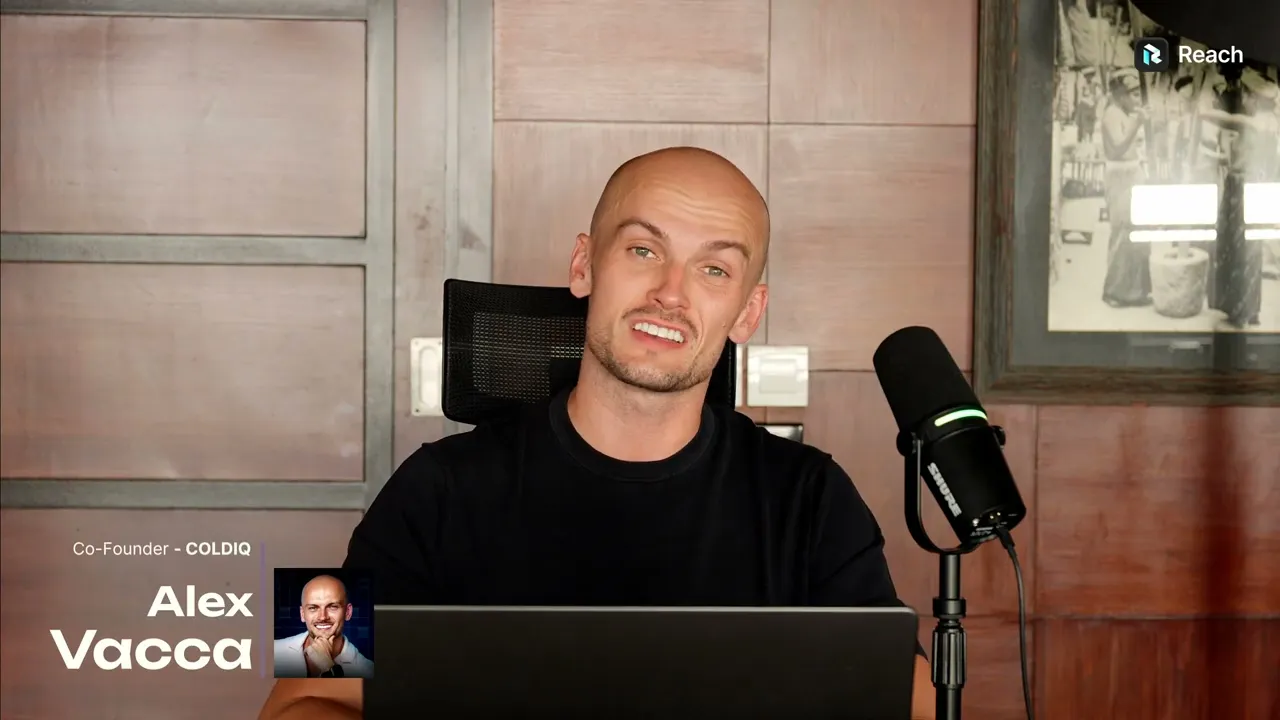
We chose to work with the Reach team because they’re amongst the top 1% of experts in the SEO & AI Search space, and they’re everything you want in a partner. They understand the business context, focus on the work that moves pipeline, and execute fast with a level of rigor you usually only get internally. It feels like working with a team that knows what it takes to grow under pressure.
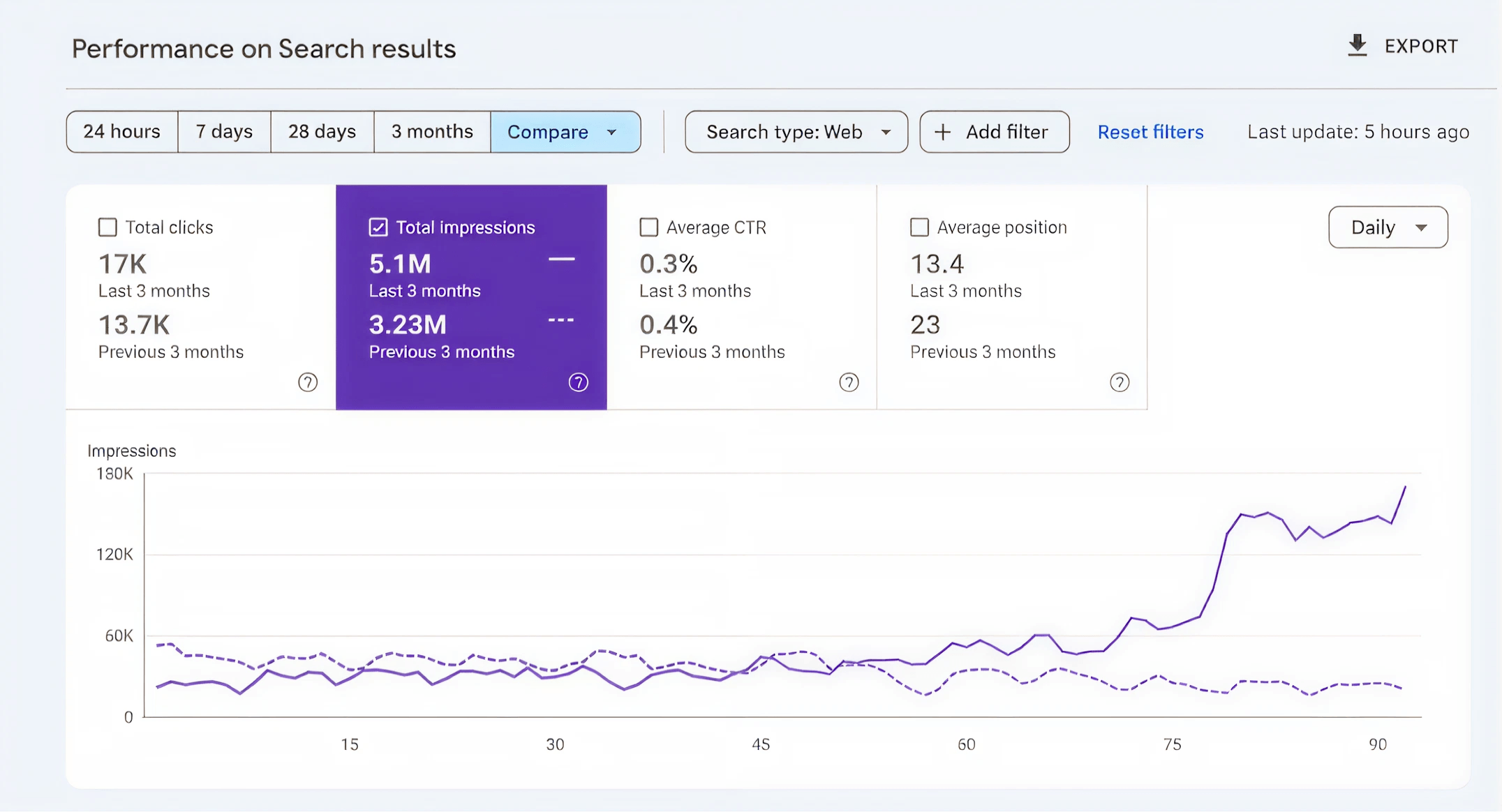
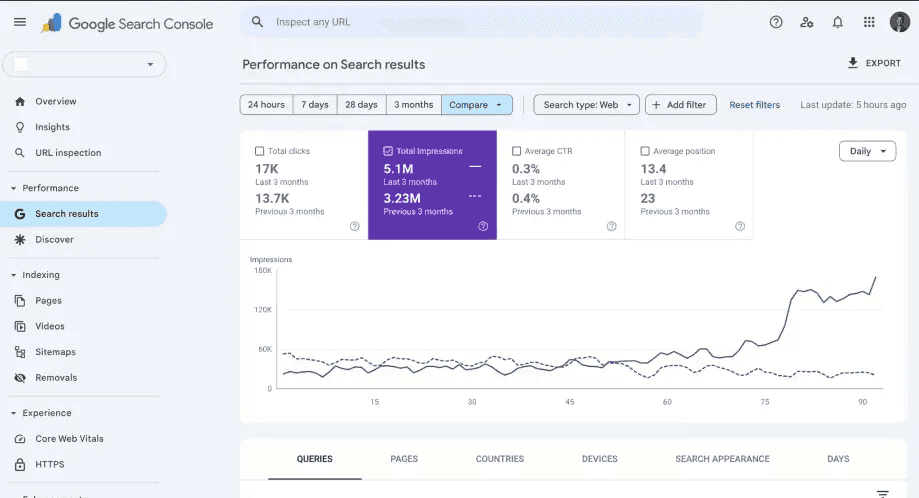
In just 3 months, ColdIQ went from 3.23M to 5.1M impressions, a 58% jump, while growing clicks from 13.7k to 17k by focusing on high-intent keywords and prompts, not vanity traffic.
ChatGPT
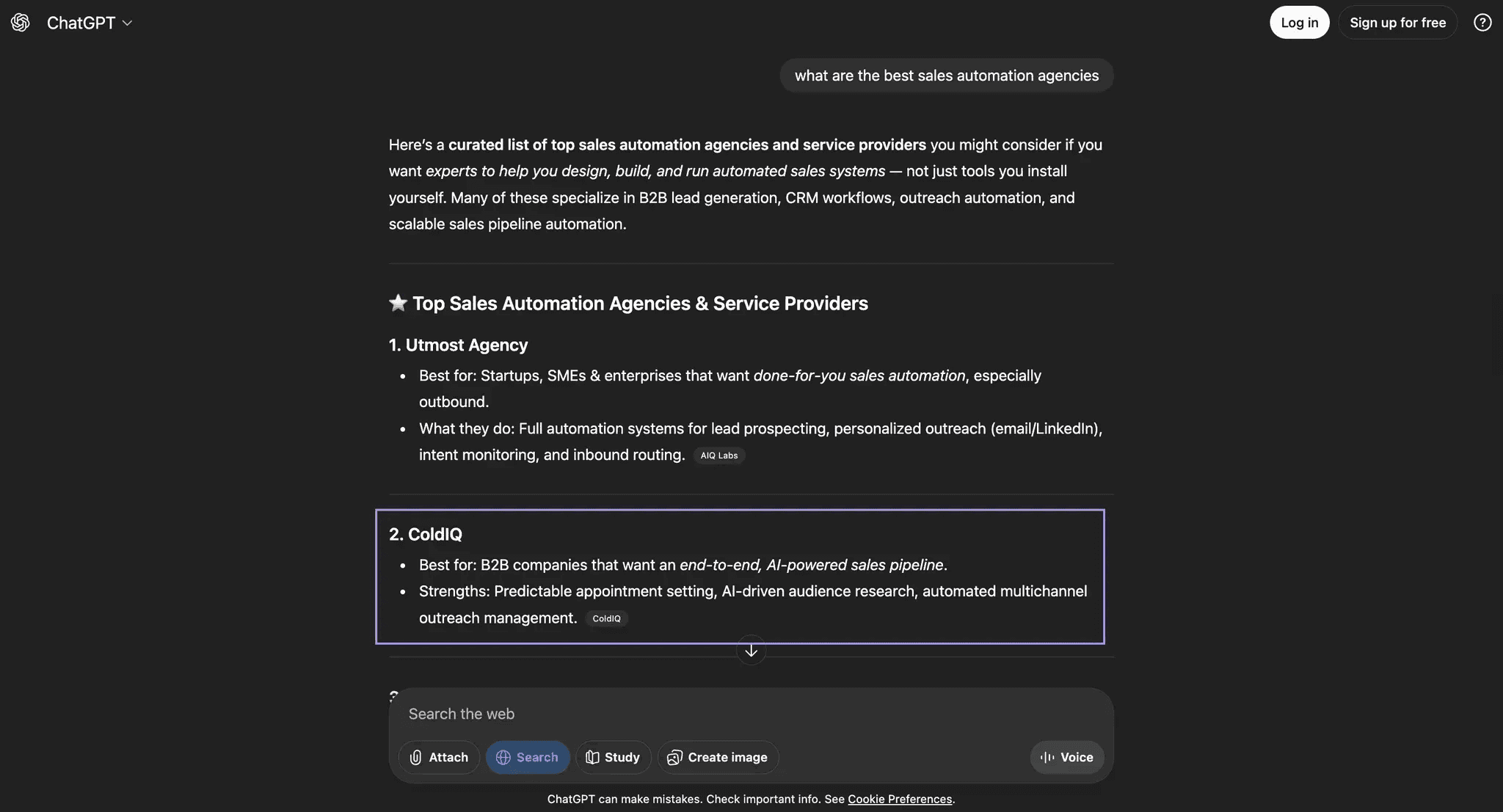
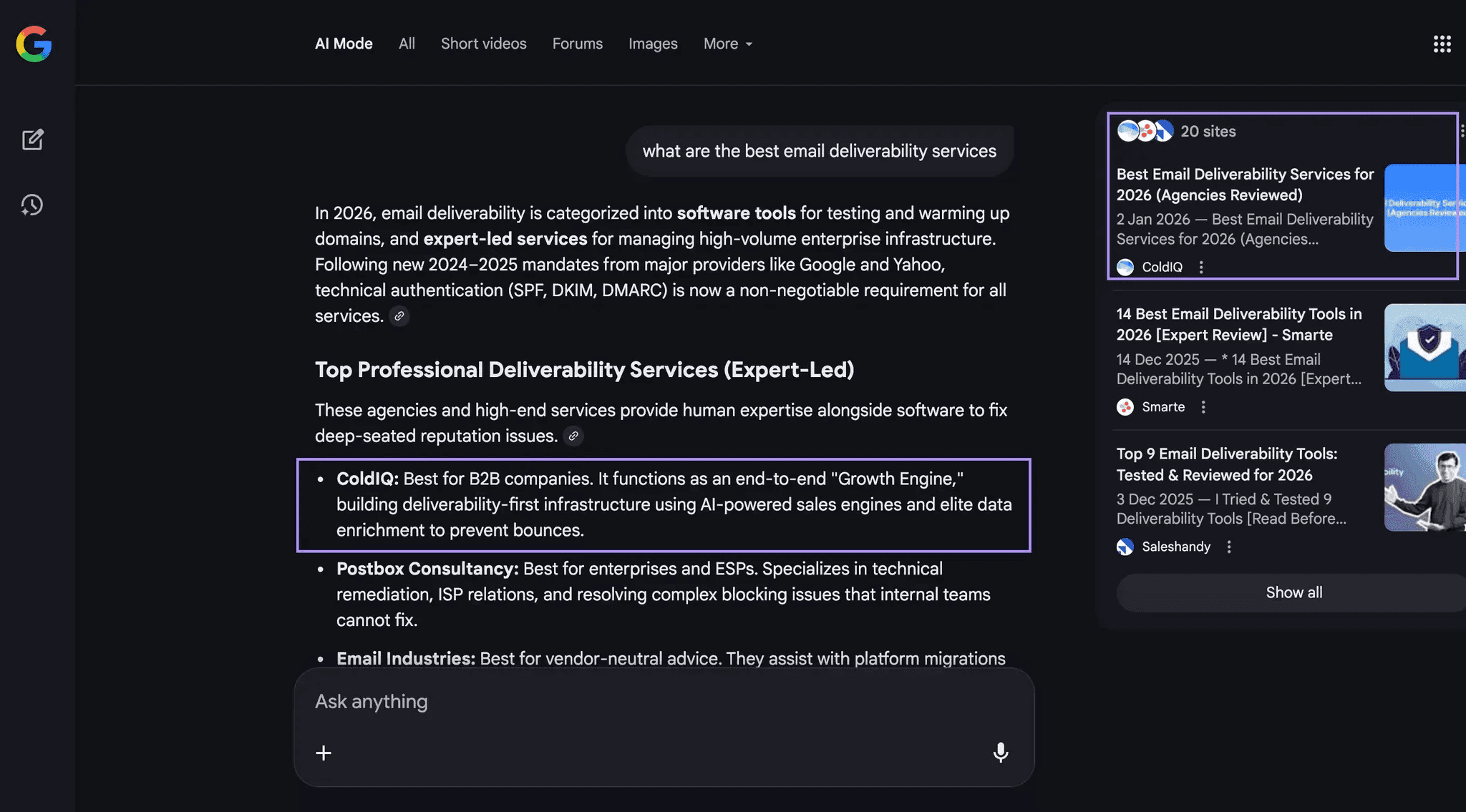
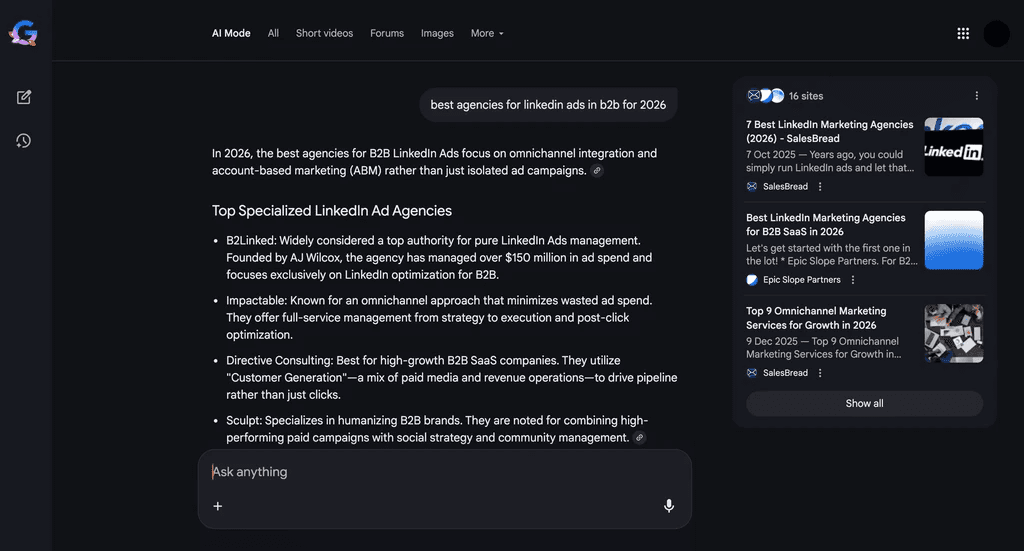
ColdIQ is now showing up as a recommended option in high intent prompts inside AI platforms (e.g. ChatGPT, Google AI mode and AI overviews, etc), which is exactly where a lot of buyers start shortlisting vendors.
ColdIQ is one of the best performing GTM agencies in the market generating $7M ARR. They build B2B revenue engines for teams like Qwilr, AirOps, Keragon, and others. They are also the number one Clay partner, and they have a strong distribution machine through LinkedIn and outbound, with 250k followers.
Want results like these?
Want results like these? Apply for a free 30-min organic growth audit with the team that built ColdIQ's AI search engine.
ColdIQ is one of the best performing GTM agencies in the market generating $7M ARR. They build B2B revenue engines for teams like Qwilr, AirOps, Keragon, and others. They are also the number one Clay partner, and they have a strong distribution machine through LinkedIn and outbound, with 250k followers.
Want results like these?
Want results like these? Apply for a free 30-min organic growth audit with the team that built ColdIQ's AI search engine.
Here are the highlights of the results achieved so far:
ColdIQ added $534k in Annual Recurring Revenue (ARR) in January alone.
Organic + LLM Search combined generated $506K in contract value (Dec-Feb).
And this without considering the impact that AI search had on direct traffic and the leads attributed to it → total users from direct traffic almost doubled, up by 93% (46,153 vs 23,826)
LLM Search traffic: 7.6x growth in 3 months
Organic Search traffic: 7.3x growth in 4 months
Leads (meetings booked) generated from organic + LLM search increased by ~1.6x
Combined traffic share: 16.5% to 33.3% (doubled in 3 months) of total traffic and growing
At this trajectory, organic + LLM search could represent 40-50% of all traffic by mid-2026.
3 month (Oct. 19 - Jan. 19) result snapshots highlights
If you are wondering whether SEO and AI search can actually move pipeline for a B2B company, this is one of the most concrete examples we have seen.
This engagement has been running a bit longer than 4 months. The results below are a 3 month snapshot (Oct 19 to Jan 19) compared against the previous 3 months.
+$534k
Annual Recurring Revenue added in January
#1
traffic source from SEO & AI Search
+$534k
Annual Recurring Revenue added in January
#1
traffic source from SEO & AI Search
Impact on revenue: Contributed to adding +$534,000 ARR in January alone, with SEO & AI search becoming their #1 traffic source, even with the distribution machine they already had (LinkedIn, outbound, paid).
69%
visitors from SEO & AI search
40.9%
conversions from SEO & AI search
69%
visitors from SEO & AI search
40.9%
conversions from SEO & AI search
Impact on pipeline (inferred influence, including increase in direct traffic): SEO and AI search influenced 55,813 visitors (69% of total) and 1,431 leads (40.9% of total), also taking into consideration the increase in direct traffic that typically comes from people discovering you via content or AI, then coming back later by typing the URL or Googling the brand.
Impact on pipeline (clean attribution floor, without direct traffic): Organic search plus LLM search drove 15,700 visitors (19.4% of total) and 362 conversions (10.3% of total).
Why this undercounts AI search impact: A prospect discovers ColdIQ through an AI chatbot or LLM search result, then later Googles "ColdIQ" (counted as Organic Search) or types coldiq.com directly (counted as Direct). The original AI discovery touchpoint is invisible in close won attribution.
+93%
users (direct traffic)
+58%
impressions
+24%
clicks
+93%
users (direct traffic)
+58%
impressions
+24%
clicks
Impact on visitors and impressions (what changed, and why we treat direct as influenced):
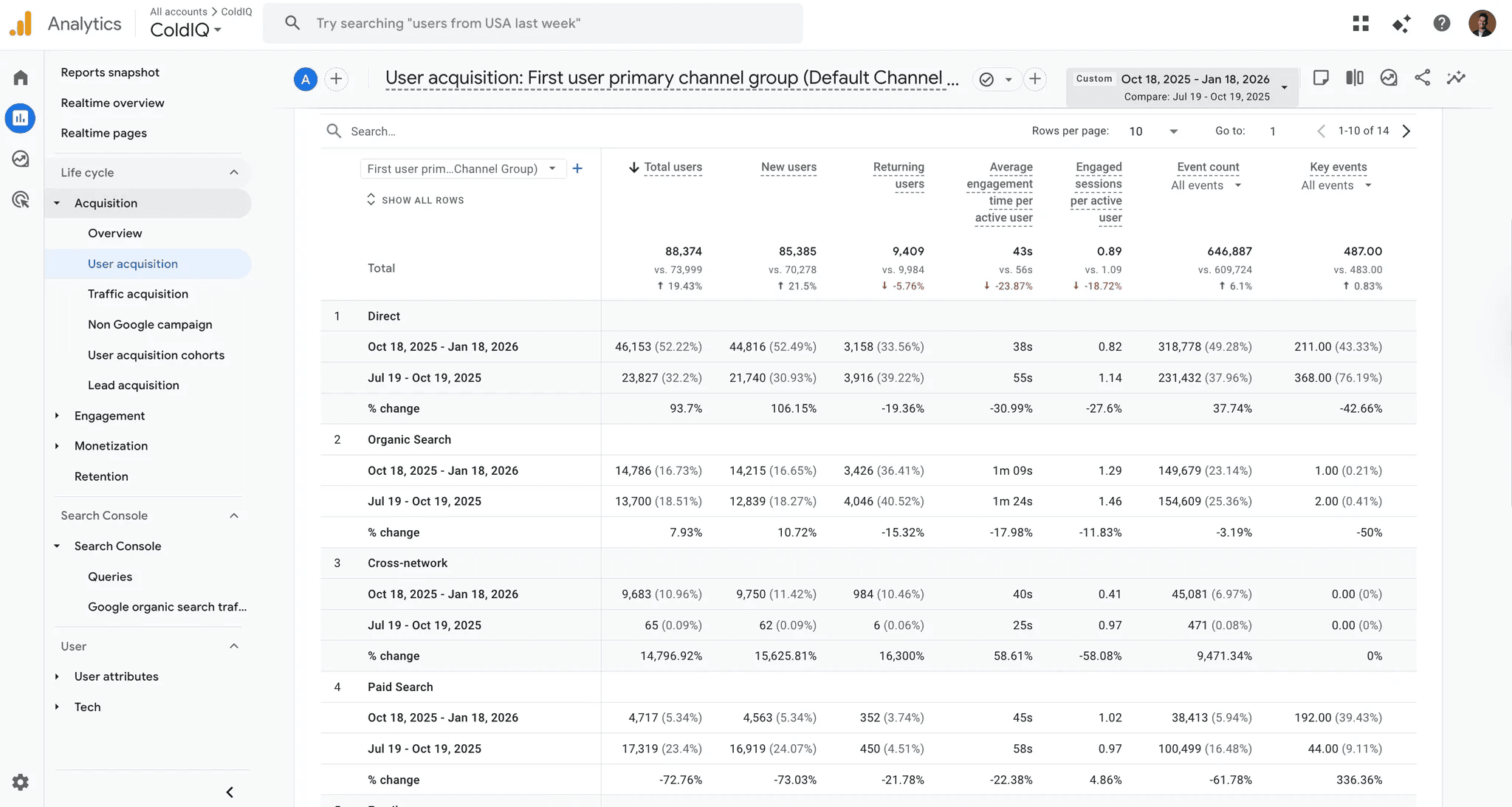
Total users from direct traffic almost doubled, up by 93% (46,153 vs 23,826).
On the SEO side, impressions grew from 3.23M to 5.1M (+1.87M, +58%) and clicks grew from 13.7k to 17k (+24%). The key point is that a meaningful share of the direct lift is very likely downstream of discovery through SEO, AI recommendations, and LinkedIn, but it cannot be cleanly attributed, so we present it as influence, not certainty.
+30%
AI visibility for 40 prompts
+52%
Citation for 40 prompts
+30%
AI visibility for 40 prompts
+52%
Citation for 40 prompts
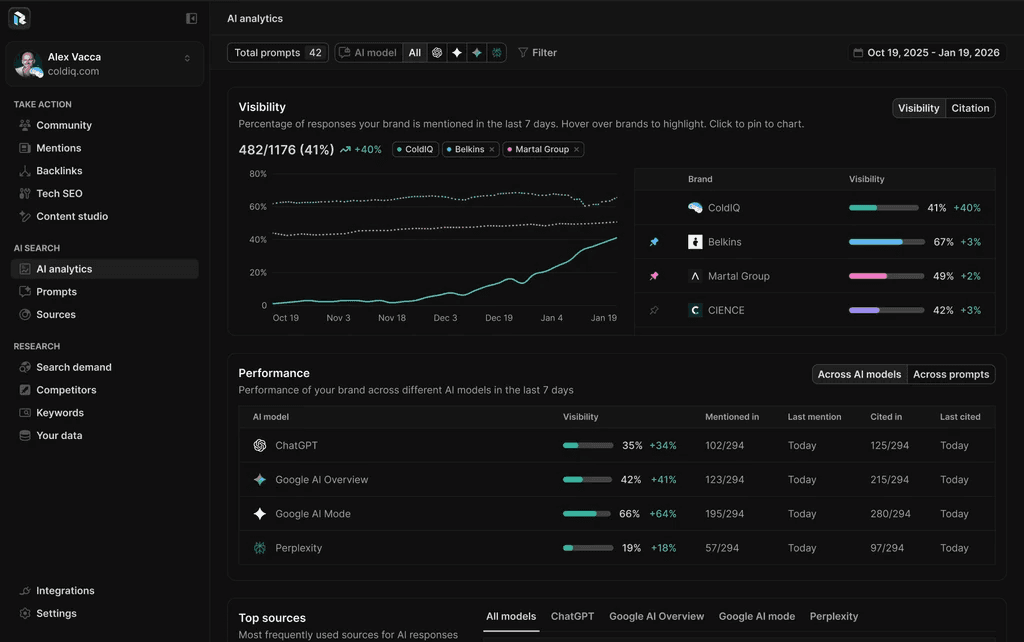
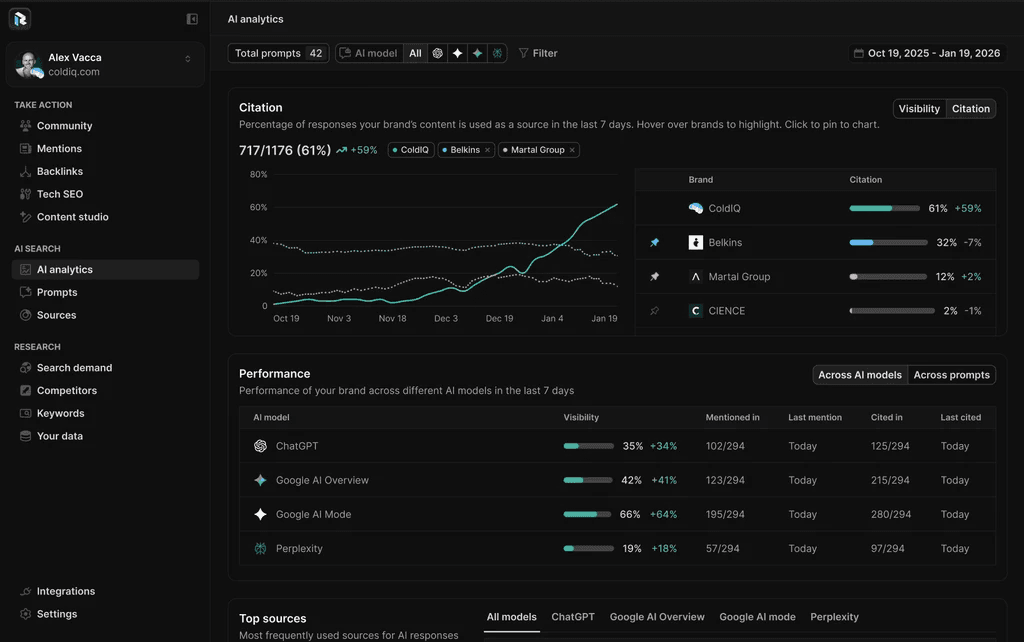
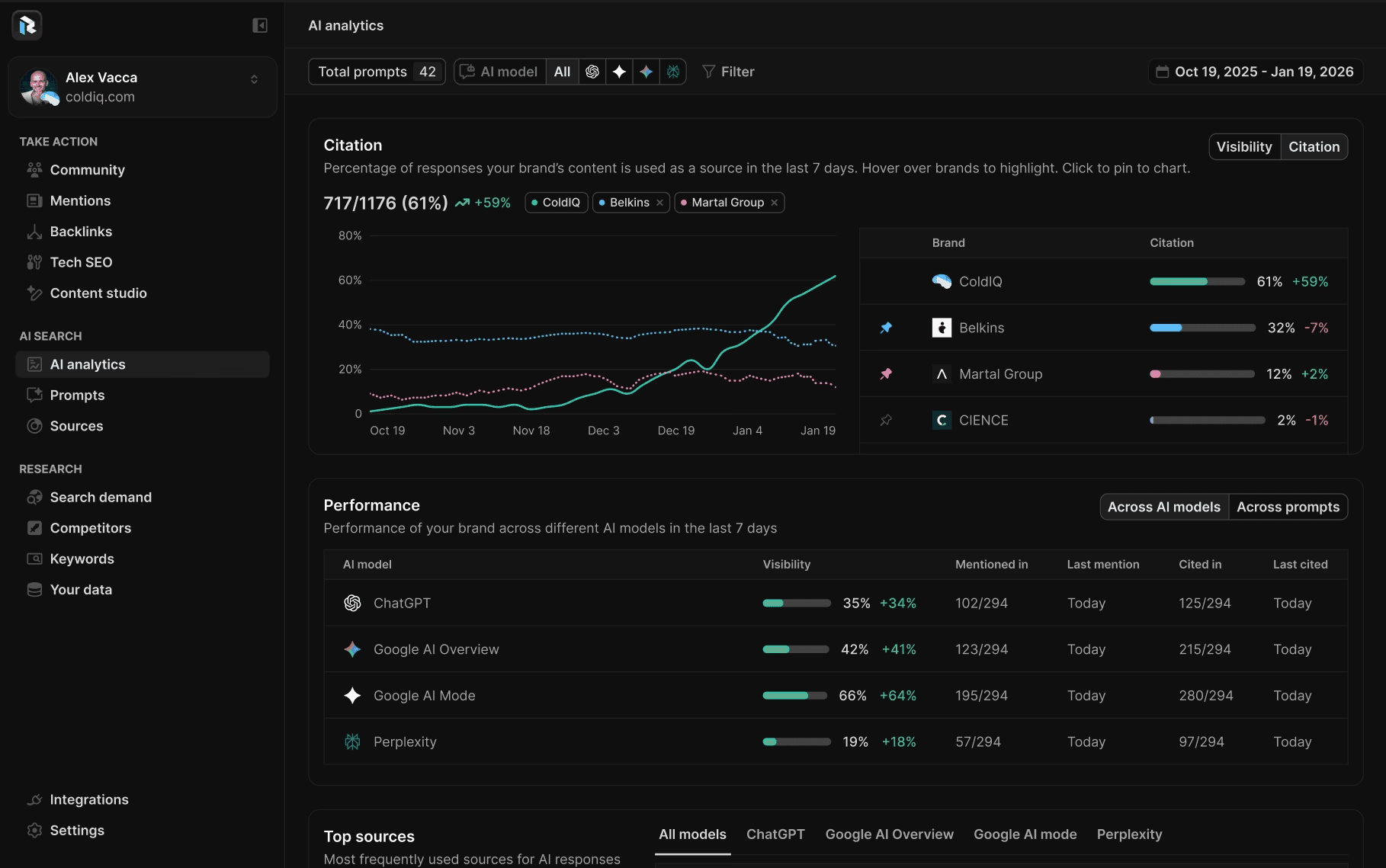
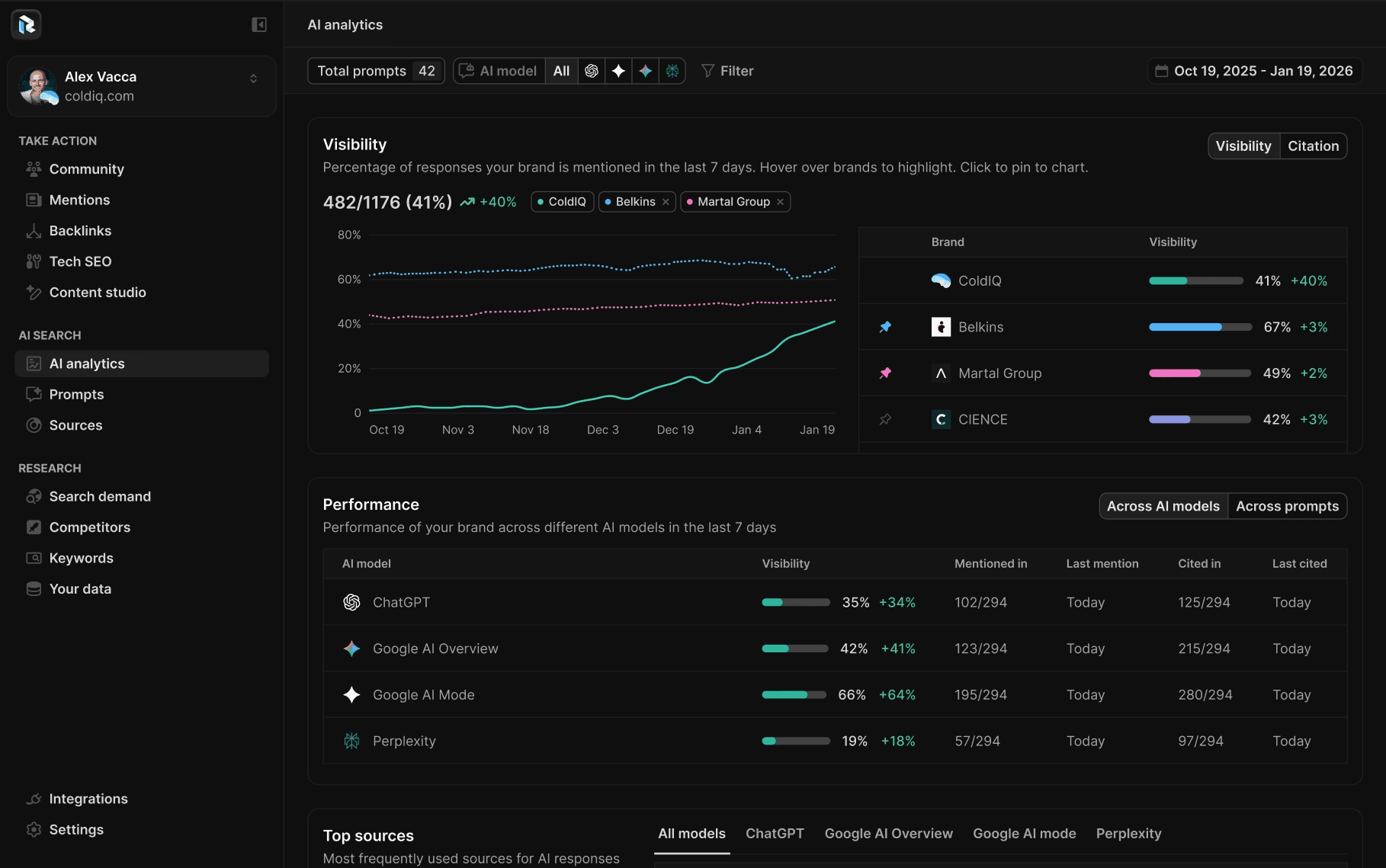
Impact on AI Visibility (mentions and citations in target prompts): Went from basically zero visibility in high intent prompts to being mentioned in 36 out of 120 AI responses (30%) and cited in 62 out of 120 AI responses (52%). *˜40 target prompts monitored across ChatGPT, Google AI mode, Google AI overviews and Perplexity.
+41,470 (+983%)
ranking keywords
+41,470 (+983%)
ranking keywords
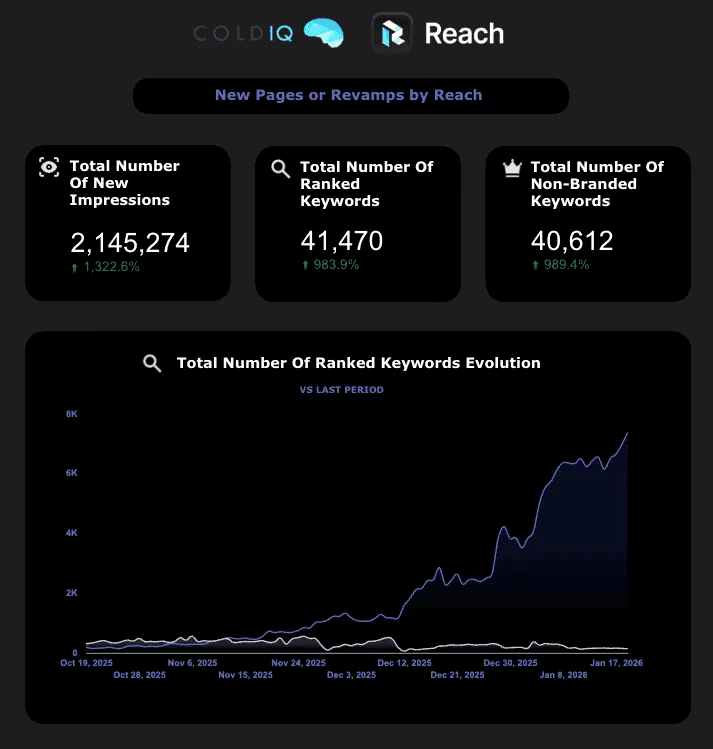
Impact on keywords they’re ranking for: Ranking keywords increased by +41,470 (+983%), including a large expansion in long tail coverage, with many pages targeting high intent service and competitor displacement terms.
Detailed breakdown of the results below: The outcome
In just 3 months, ColdIQ went from 3.23M to 5.1M impressions, a 58% jump, while growing clicks from 13.7k to 17k by focusing on high-intent keywords and prompts, not vanity traffic.
ColdIQ is now showing up as a recommended option in high intent prompts inside AI platforms (e.g. ChatGPT, Google AI mode and AI overviews, etc), which is exactly where a lot of buyers start shortlisting vendors and it means they are showing up even when people do not click traditional blue links.
Context
There are almost no good case studies for the impact of AI search on the sales pipeline.
Most content in this space is vague. It focuses on vanity metrics like “AI visibility” using prompts that are either random, not tied to buying intent, or not chosen in a data driven way. And that is a huge problem, because unlike SEO keywords, there is no real source of truth for prompt volume. So teams end up tracking whatever “sounds relevant” or that AI search visibility tools suggested (once again, not backed by data), instead of what buyers are actually asking during evaluation.
On top of that, most write ups stop at surface level tactics like “add FAQs” and “use schema markup” without showing real examples of what actually moved, why it moved, and what it changed downstream in pipeline.
This case study is different.
We partnered with ColdIQ, one of the strongest GTM agencies in the market, to turn SEO and AI search into a compounding growth channel for their core services. Not vanity traffic. Real buyer intent searches and prompts that influence evaluation, shortlist, and pipeline. We will show examples of the process and changes we made, and the measurable outcomes, including what we can attribute cleanly and what we can only infer.
If you are a marketing or growth leader trying to figure out whether AI search optimization is real or hype, and what actually moves the needle, this will give you a real world example.
ColdIQ is one of the strongest GTM agencies in the market. They build B2B revenue engines for teams like Qwilr, AirOps, Keragon, and others. They are also the number one Clay partner, and they have a strong distribution machine through LinkedIn and outbound, with 250k plus combined followers across the team.
So naturally, they don't just work with anyone.
They chose Reach because we combine deep SEO expertise with serious AI search R&D. We are building a product that analyzes thousands of prompts and real user behavior to find what actually drives evaluation, not what looks good on a report.
The approach is simple. Use data to identify high intent opportunities, use our internal AI agents to do the heavy analysis fast, then have experts turn that into sharp execution. No guesswork, no generic playbooks.
Alex Vacca
Co-founder & COO at ColdIQ
We chose to work with the Reach team because they’re amongst the top 1% of experts in the SEO & AI Search space, and they’re everything you want in a partner. They understand the business context, focus on the work that moves pipeline, and execute fast with a level of rigor you usually only get internally. It feels like working with a team that knows what it takes to grow under pressure.
Despite already having a well established content engine in place, proven in-house SEO expertise, and using tools like AirOps, they placed their trust in Reach to help them turn SEO & AI search into one of their key growth channels - one that scales and compounds over time.
This engagement has only been running for a bit longer than 4 months. The results are already exceptional. And they will only compound further moving forward.
While ColdIQ was attracting substantial impressions and traffic through their tools’ content, the real objective was different: increase qualified sessions and leads for their outbound services - not just tool-related traffic.
As the search landscape is drastically changing and more decision makers turn to generative AI in their software buying process (89%, as per the latest statistics from Forrester), it has become critical for the buyer journey of B2B companies to be recommended by AI search platforms.
We needed to shift their organic strategy from volume to value. Spoiler: we delivered both.
The challenge
ColdIQ was not starting from zero.
They already had solid SEO foundations, a consistent content engine, and organic search was already their third biggest traffic source. But the growth curve was flattening. They were getting impressions and traffic, yet it was not accelerating fast enough to match the pace of the business and the standard they hold themselves to.
At the same time, ColdIQ is a world class GTM team. They could see the shift happening in real time. Buyers were moving more of their research upstream into AI answers and AI assisted search. More comparisons were happening before a click ever happened. More shortlists were being built inside ChatGPT, Google AI experiences, and Perplexity, then validated later through branded search or direct visits.
That created a gap.
Their GTM flywheel was already elite across outbound, LinkedIn content, and LinkedIn ads, and it was driving a ton of direct traffic. But SEO and AI search were not yet integrated into that flywheel in a way that reliably captured high intent evaluation demand and fed the rest of the system.
So the challenge was not “do more SEO.”
The challenge was to turn SEO and AI search into a true GTM input that compounds with their other channels, by winning the exact moments where buyers are researching agencies, comparing vendors, and deciding who makes the shortlist.
When we looked at the searches that actually matter for their core services, they were basically invisible:
best outbound lead generation agency
best sales automation agencies
top b2b lead gen companies
And in AI search, visibility for those service prompts was close to zero.
So the goal was clear:
Win high intent demand tied to the buyer journey for their services, across both Google and AI surfaces, and turn that into a compounding growth channel that amplifies everything else they already do well.
Loïc Reco
Head of Product at ColdIQ
We were already doing SEO work but weren't seeing results in AI search. Reach came in, identified what was blocking us, and got us showing up in ChatGPT and Google AI Mode within a few months. They're proactive, they don't need to be managed, and they actually move the needle.
The outcome
The results speak for themselves, but what matters is the shape of the results.
This was not “more content equals more traffic”. This was capturing buyer intent and earning AI recommendations in the exact places buyers now do research, compare vendors, and build their shortlist.
Yevhen (Eugene) Suslov
Fractional Head of Content at ColdIQ
What impressed me the most is how systematic the Reach team is. Their internal AI agents and platform let them find high intent opportunities fast and analyze what needs to change across hundreds or thousands of pages without guesswork, which would normally take weeks or just not be possible. Then their experts turn that into a clear plan and execute with an expert in the loop, so quality stays high. It feels like an unfair advantage versus a traditional agency or a pure software tool, and they have been a pleasure to work with.
Before & after results (Oct. 19 - Jan. 19 vs the previous 3 months)
Here are the results and how we calculated them.
+534k
Annual Recuring Revenue added in January
#1
traffic source from SEO & AI Search
+534k
Annual Recuring Revenue added in January
#1
traffic source from SEO & AI Search
Revenue impact
Contributed to adding +$534,000 ARR in January alone, with SEO and AI search becoming their number one traffic driver even with the distribution machine they already had (LinkedIn, outbound, paid).
💡 Organic + LLM Search combined influenced ~$506K in contract value (Dec-Feb).
Why this undercounts AI search impact: A prospect discovers ColdIQ through an AI chatbot or LLM search result, then later Googles "ColdIQ" (counted as Organic Search) or types coldiq.com directly (counted as Direct). The original AI discovery touchpoint is invisible in close won attribution.
Over the period in question (Oct. 19 - Jan. 19), SEO and AI search had a meaningful impact on ColdIQ’s pipeline.
If you only count strict attribution (organic search + LLM traffic), SEO and AI search drove about 1 in 5 visitors and 1 in 10 conversions.
But AI search has a big downstream effect that is hard to track. When people discover your brand through an AI recommendation or a high intent search result, many open a new tab and type your brand name or even your URL directly. That shows up as direct traffic, not AI search.
So if you include realistic influence on direct traffic, SEO and AI search touched closer to 7 in 10 visitors and 4 in 10 conversions.
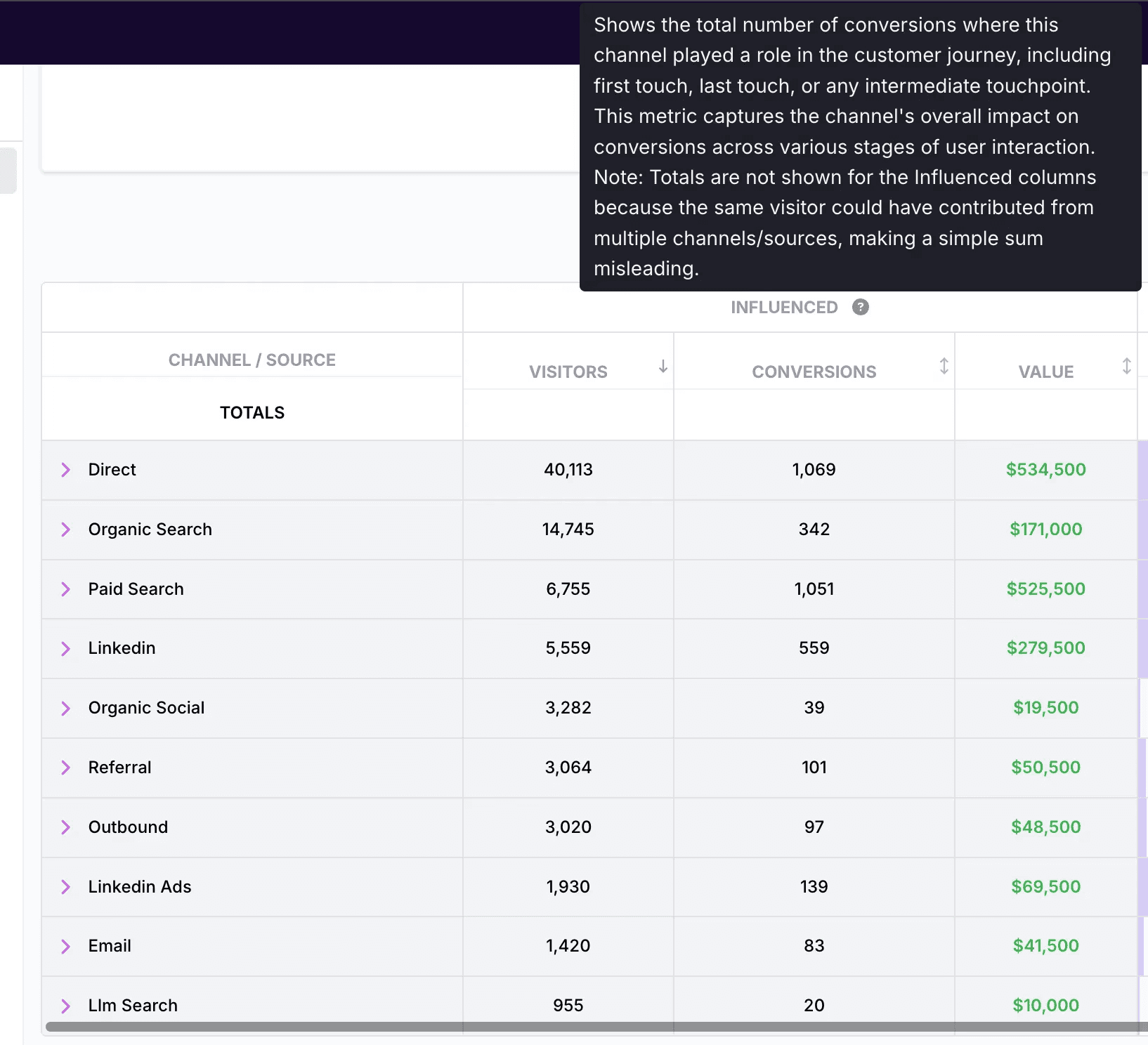
Clean attribution floor (what we can prove in Usermaven, an AI analytics & attribution tool):
15,700 visitors from organic search plus LLM search (19.4% of total)
362 conversions from organic search plus LLM search (10.3% of total)
Inferred influence including direct lift (realistic picture):
55,813 visitors influenced by SEO and AI search when accounting for direct lift (69% of total)
1,431 conversions influenced (40.9% of total)
Totals for context (same period):
80,843 total visitors
3,500 total conversions
Why the gap exists:
A lot of AI discovery does not show up as “AI search traffic.” People get recommended in ChatGPT or Google AI Mode, then they open a new tab and type the URL or Google the brand. That lands as direct or branded search.
That is why we show both numbers:
Clean attribution is the floor
Inferred influence is the realistic picture
This is ColdIQ’s attribution view showing how different channels influenced conversions and value, including organic search and LLM search. It is also why we treat direct as partially influenced, not fully attributable.
Visitors and impressions (in a world where traffic is going down)
Most teams are watching organic traffic stagnate or drop as AI Overviews and AI search absorb more of the buyer journey. ColdIQ went the other way, and the growth came from buyer intent queries, not vanity traffic.
Traffic share trend (Organic + LLM Share)
Month
Organic + LLM Share
Nov
16.5%
Dec
19.1%
Jan
30.6%
Feb
33.3% (#1 source)
Traffic share doubled in 3 months (16.5% to 33.3%). At this trajectory, organic + LLM search could represent 40-50% of all traffic by mid-2026.
Traffic Growth (LLM Search)
Month
Visitors
MoM Growth
Growth from Nov
Nov 2025
89
-
baseline
Dec 2025
375
+321%
+321%
Jan 2026
674
+80%
+657%
Feb 2026*
319
-
-
Traffic Growth (Organic Search)
Month
Visitors
MoM Growth
Growth from Nov
Nov 2025
1,552
-
baseline
Dec 2025
5,548
+257%
+257%
Jan 2026
11,385
+105%
+633%
Feb 2026*
9,233
-
-
The key takeaways:
Direct traffic users almost doubled, up 93% (46,153 vs 23,826). This is the classic downstream effect of high intent AI recommendations. We are not claiming all of it is SEO and AI search since ColdIQ has a strong brand and an outbound & LinkedIn engine that also has a significant impact on this. But paired with the jump in high intent rankings and AI mentions, it is a strong signal that search driven discovery was creating incremental awareness that later returned as direct and branded.
SEO visibility grew fast, but it was not vanity traffic:
Impressions: 3.23M to 5.1M (+1.87M, +58%)
Clicks: 13.7k to 17k (+24%)
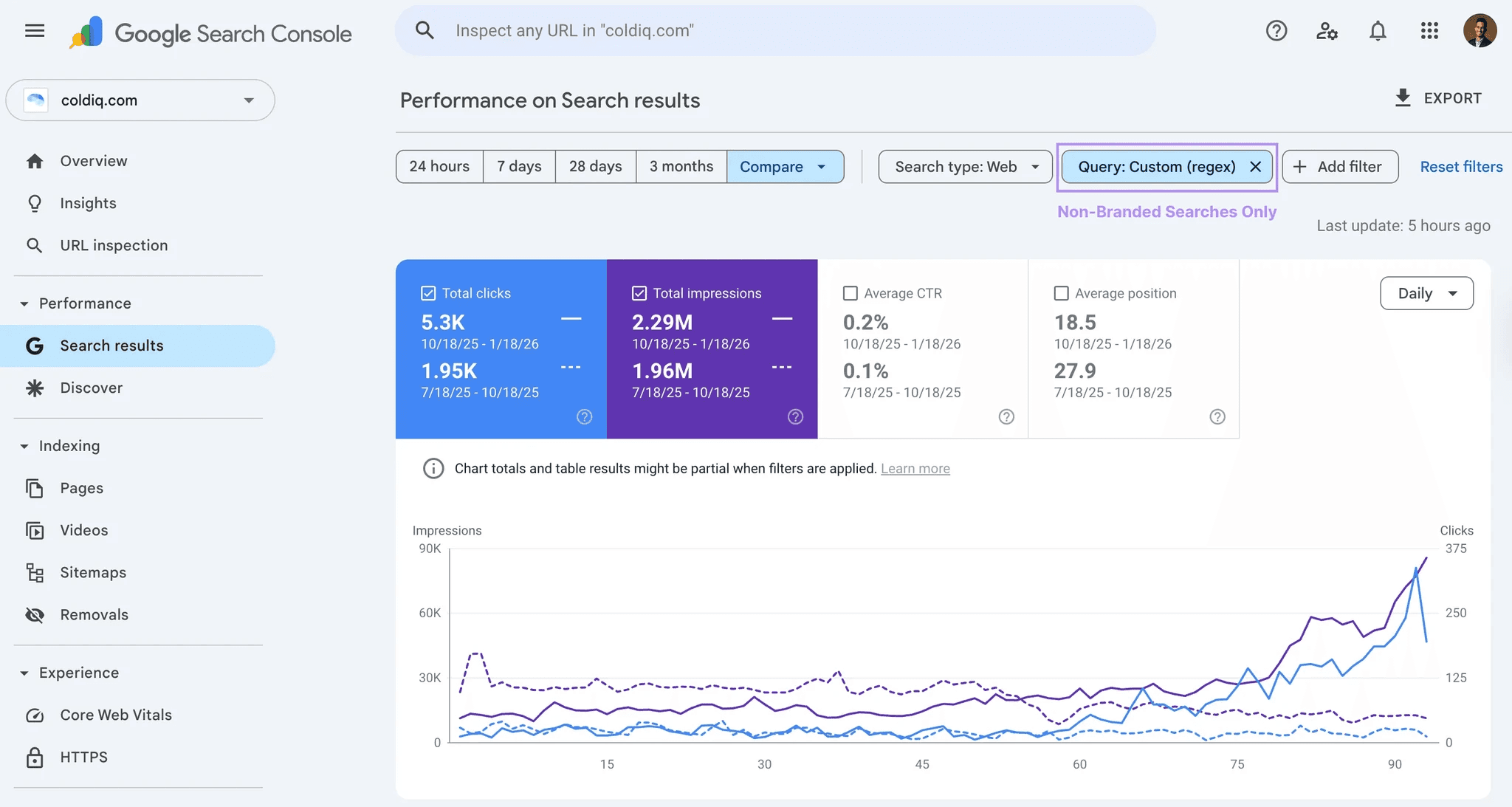
If you want the cleanest “SEO only” snapshot, here is the non branded view:
Non branded clicks: up 171.8% (5.3K vs 1.95K)
Non branded impressions: up 16.8%
Non-branded clicks are up 171.8% (5.3K vs 1.95K). +16.8% non-branded impression growth. We were able to reduce ColdIQ's dependence on branded search traffic.
This is what you want to see. Clicks growing faster than impressions usually means you are ranking better and winning higher intent queries, not just getting more noise.
GA4 user acquisition by channel, last 3 months vs previous 3 months. A big share of AI search and high intent SEO discovery shows up later as direct and branded return visits, not as clean referral traffic.
Google Search Console, non branded searches only, last 3 months vs previous 3 months.
We increased visibility and clicks for non branded, buyer intent searches, reducing reliance on branded demand.
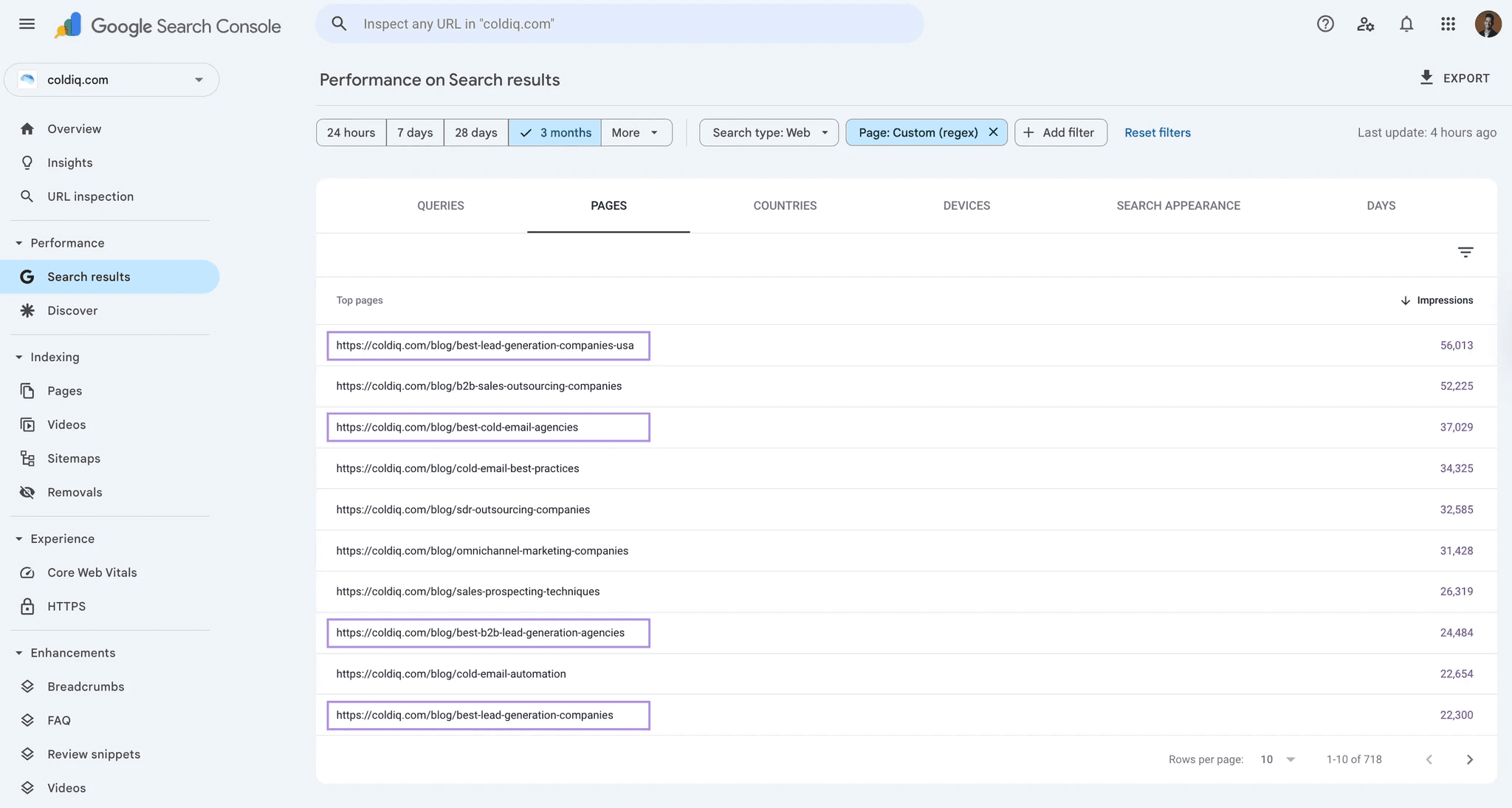
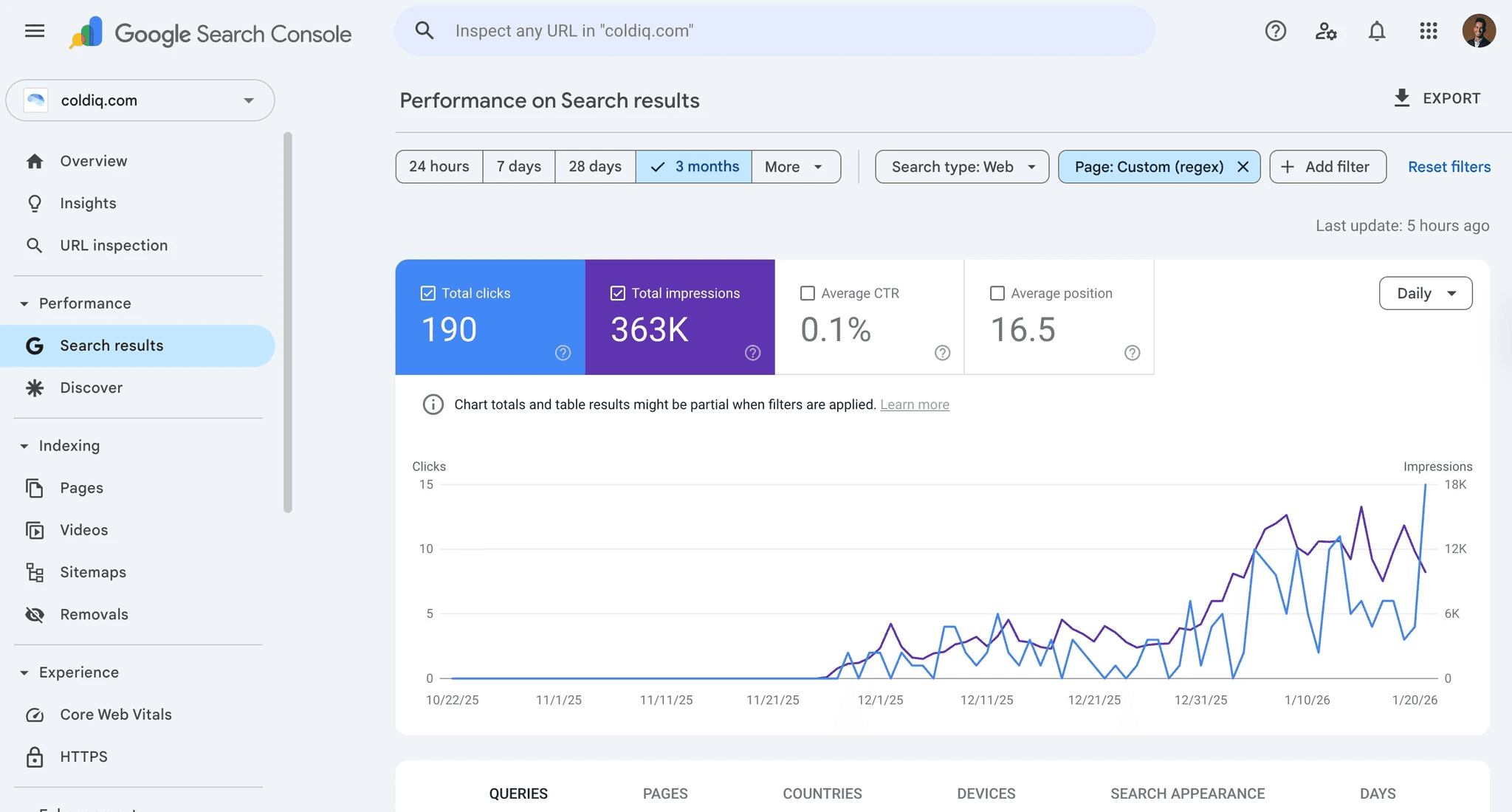
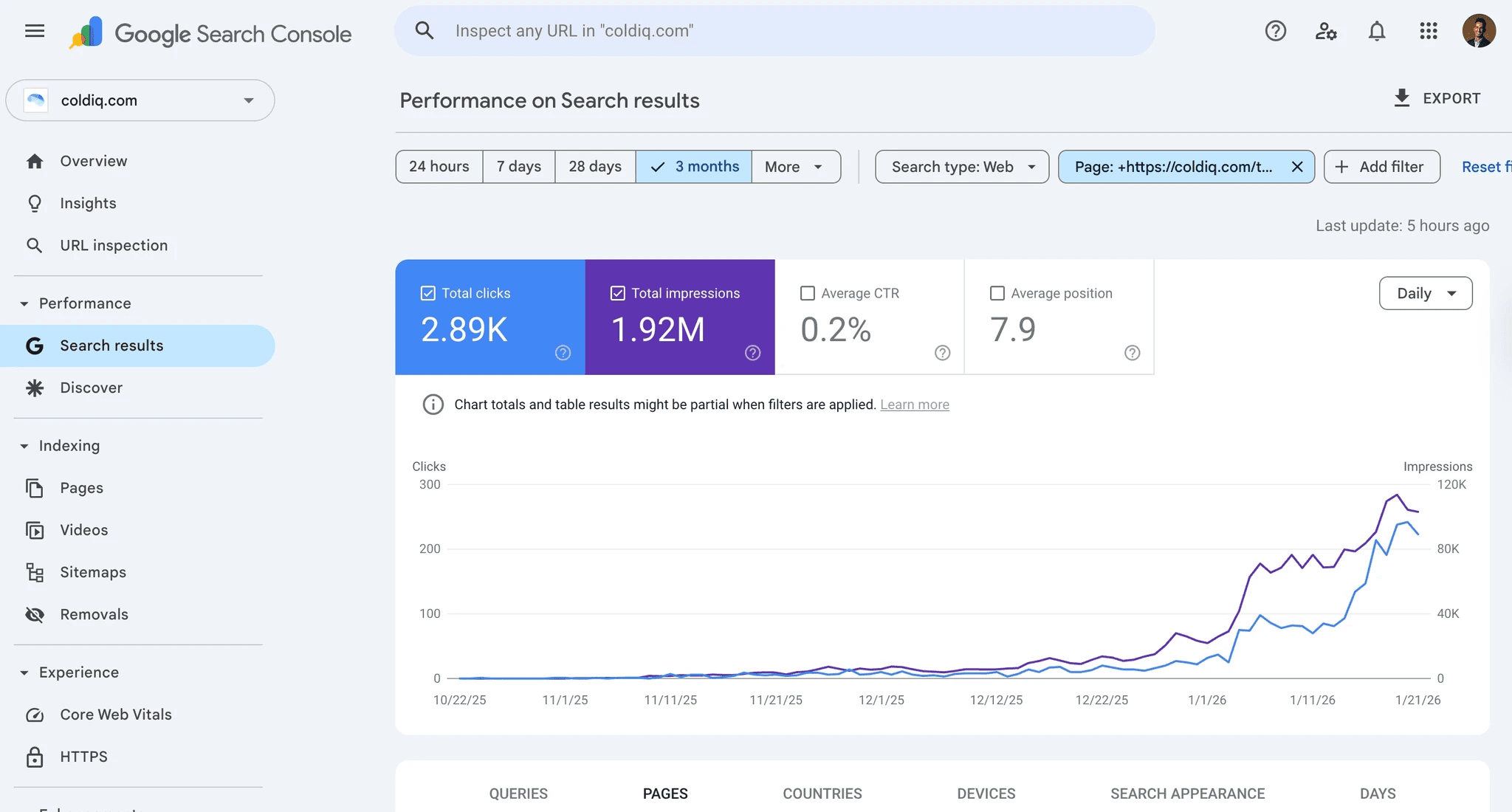
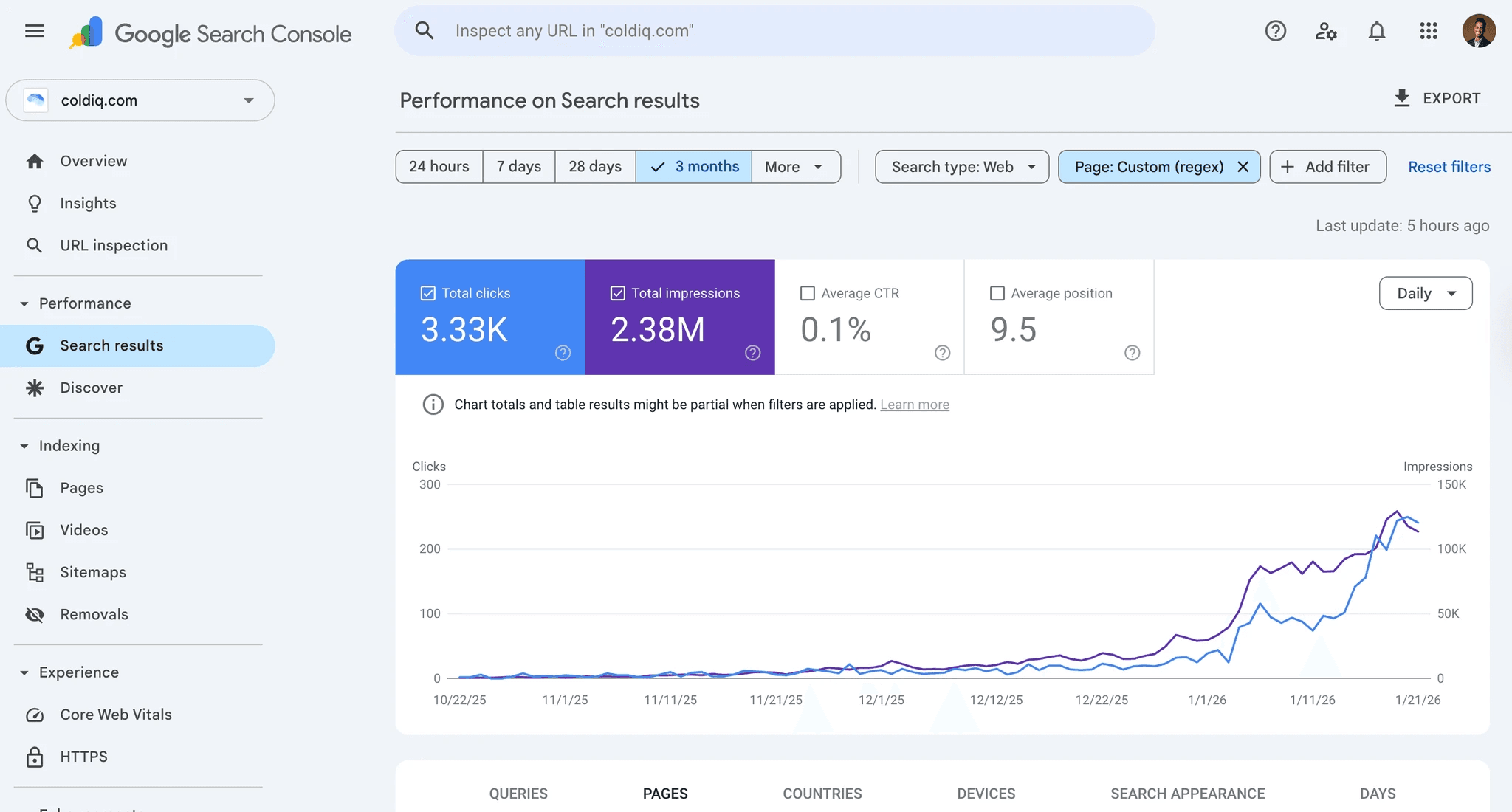
As mentioned earlier, ColdIQ’s main goal was to increase organic visibility among people searching for agencies, and Reach contributed significantly to this growth.
By focusing on pages that provide educational content and service listicles - rather than tool reviews or directories - we created pages that played a key role in driving this growth.
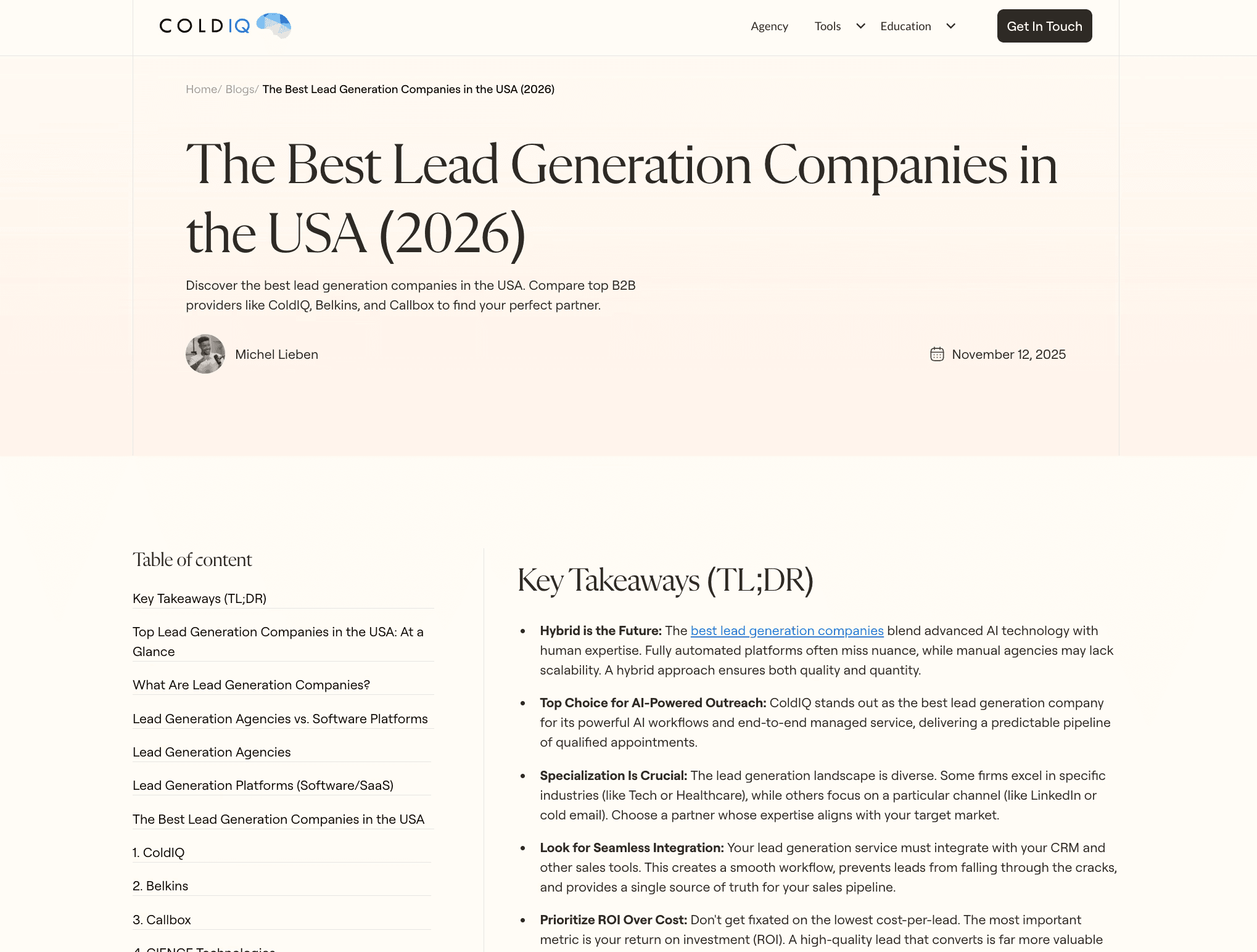
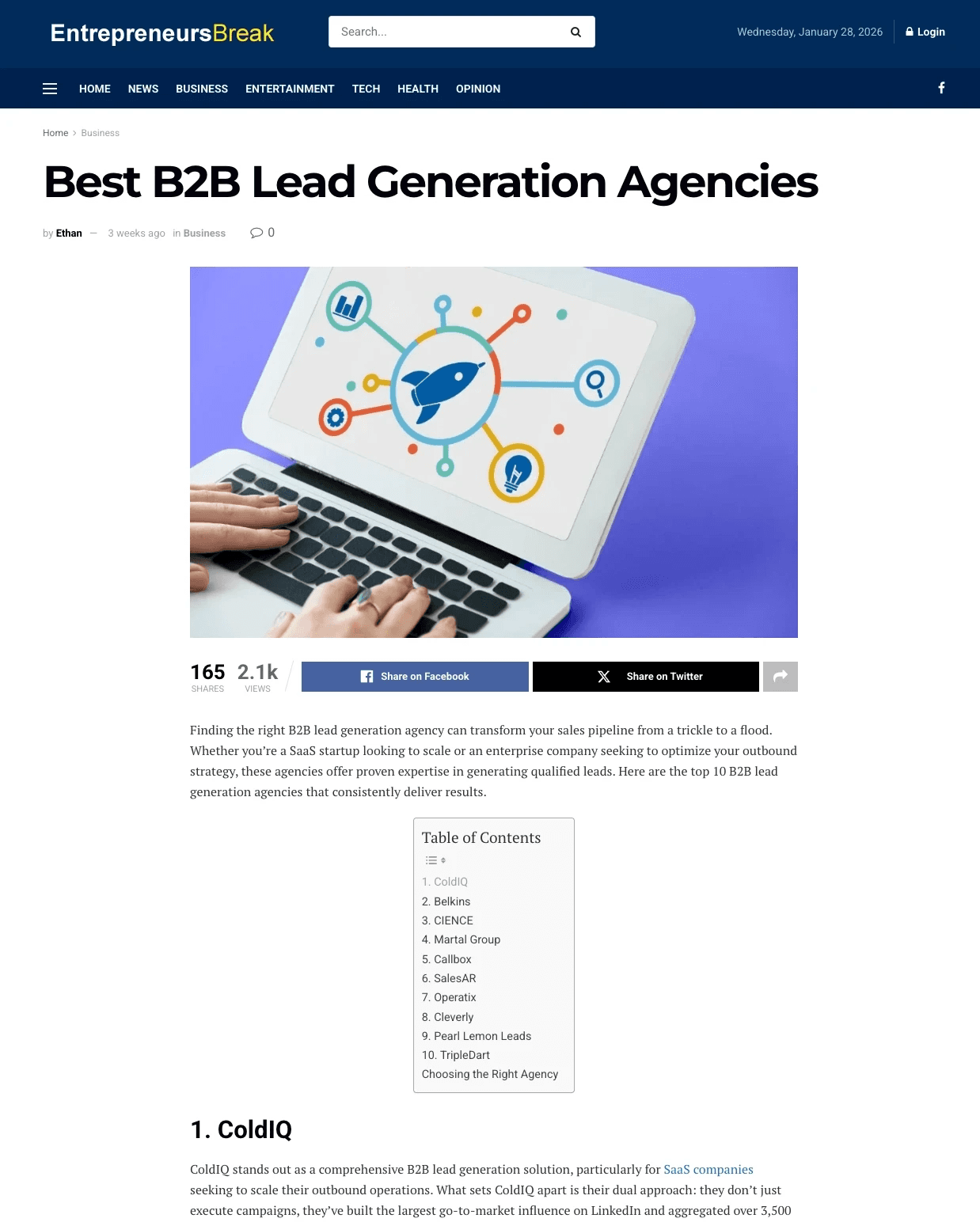
In just three months, we achieved the top position for service-based landing pages with the highest impressions, a particularly important strategy for increasing brand awareness in Google AI Mode and Google AI Overviews. Two of the three top-performing pages were created by Reach.
Impact on high intent keywords
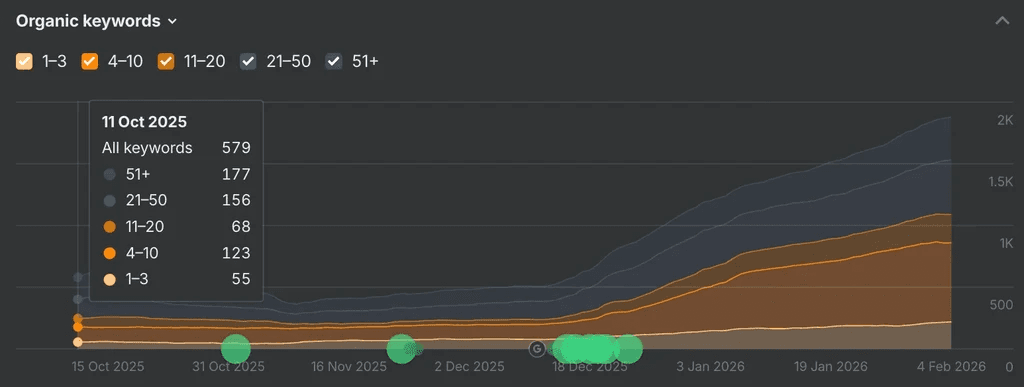
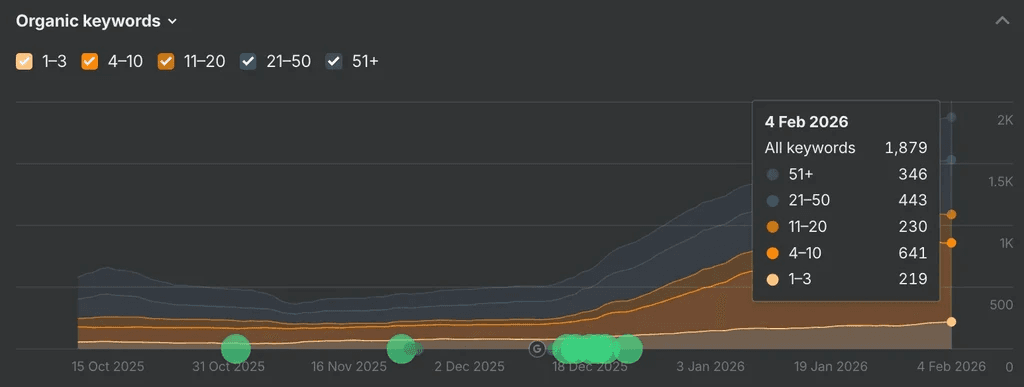
Ranking keywords increased by +41,470 (+983%).
We started winning high intent service and competitor displacement terms that actually drive pipeline.
Here are examples of the types of searches we’re targeting.
Vendor and agency evaluation terms
best lead generation companies
b2b lead generation companies
b2b appointment setting services
outbound lead generation services
email deliverability services
linkedin lead generation agency
sdr agency
Competitor displacement terms
best Belkins alternatives
best Martal Group alternatives
best Leadium alternatives
best CIENCE alternatives
instantly alternatives
zoominfo alternatives
Comparison and tool evaluation terms
pipedrive vs hubspot
make vs zapier
n8n vs zapier
asana vs clickup
mailerlite vs activecampaign
webflow vs wix
Problem aware and enablement terms that create demand
outbound marketing
b2b sales funnel
gtm strategy template
abm strategy examples
how to improve email deliverability
cold email templates
cold email outreach
and many more.
This is what a holistic search program looks like. You win at the moment of comparison, and you also win the education layer that shapes the shortlist before the buyer ever talks to you.
❌ BEFORE
✅ AFTER
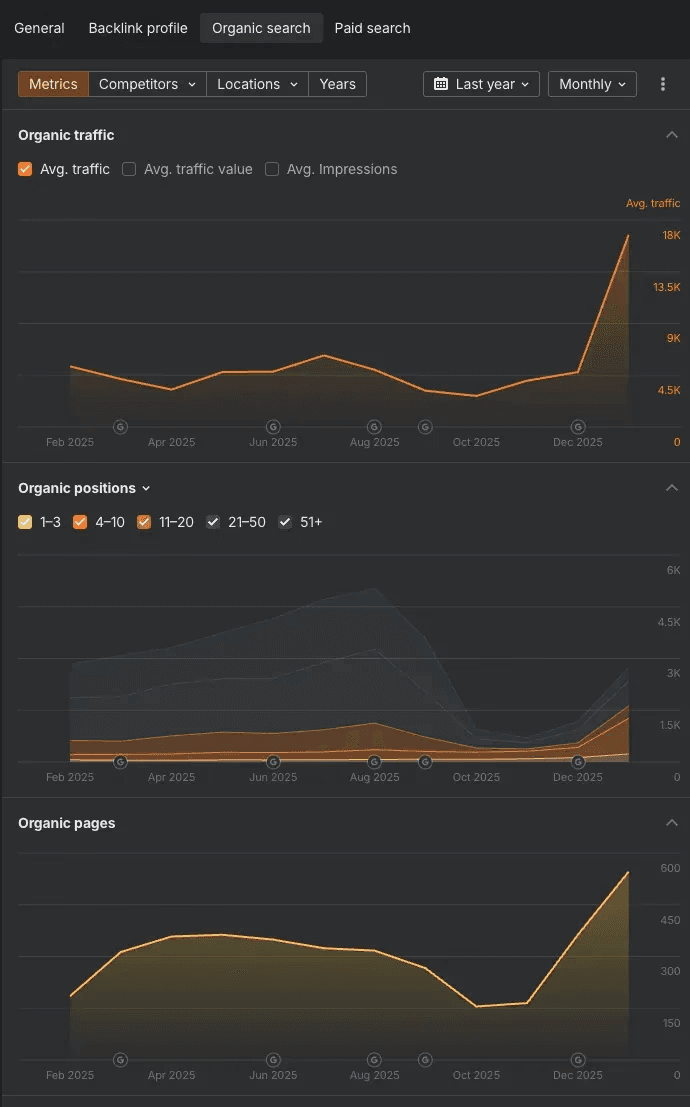
These screenshots are from Ahrefs, which we use as a directional view of rankings and keyword growth. For the most accurate picture of search performance, we rely on Google Search Console as the source of truth, so we built a Looker Studio dashboard connected to GSC to report impressions, clicks, and non branded performance consistently.
Impact on AI visibility (prompts & mentions)
When we started working together ColdIQ was not being mentioned nor cited in any of the intent prompts Reach identified were impacting their buyer journey.
They went from close to zero to:
Mentioned in 36 out of 120 prompts (30%)
Cited in 62 out of 120 prompts (52%)
*˜42 target prompts monitored across ChatGPT, Google AI mode, Google AI overviews and Perplexity
We monitored a set of high intent prompts across ChatGPT, Google AI Mode, Google AI Overviews, and Perplexity. These prompts map to the same buying journey buckets above, especially vendor comparison and shortlist building.
AI search visibility (mentions) from the latest run (we started this engagement with 0)
AI search citations from the latest run (we started this engagement with 0)
The content engine we built around the highest intent agency terms (plus competitor displacement and niche variations) is exactly what you see in the screenshots.
Here are a couple of examples of high intent prompts we got ColdIQ to be cited in, and recommend by the key AI models (ChatGPT, Google AI overviews, Google AI mode and Perplexity).
❌ BEFORE REACH (Dec. 17, 2025)
✅ AFTER REACH (Jan. 1, 2026)
ColdIQ·Jan, 2026
Here’s the breakdown of other metrics and results we tracked
01
Google performance of the new pages that we created
02
Google performance of the pages that we revamped/fixed those indexing blockers
03
Google overall performance of the new pages that we created + pages that we revamped/fixed those indexing blockers
04
AI search citations from the latest run (we started this engagement with 0)
05
AI search visibility (mentions) from the latest run (we started this engagement with 0)
06
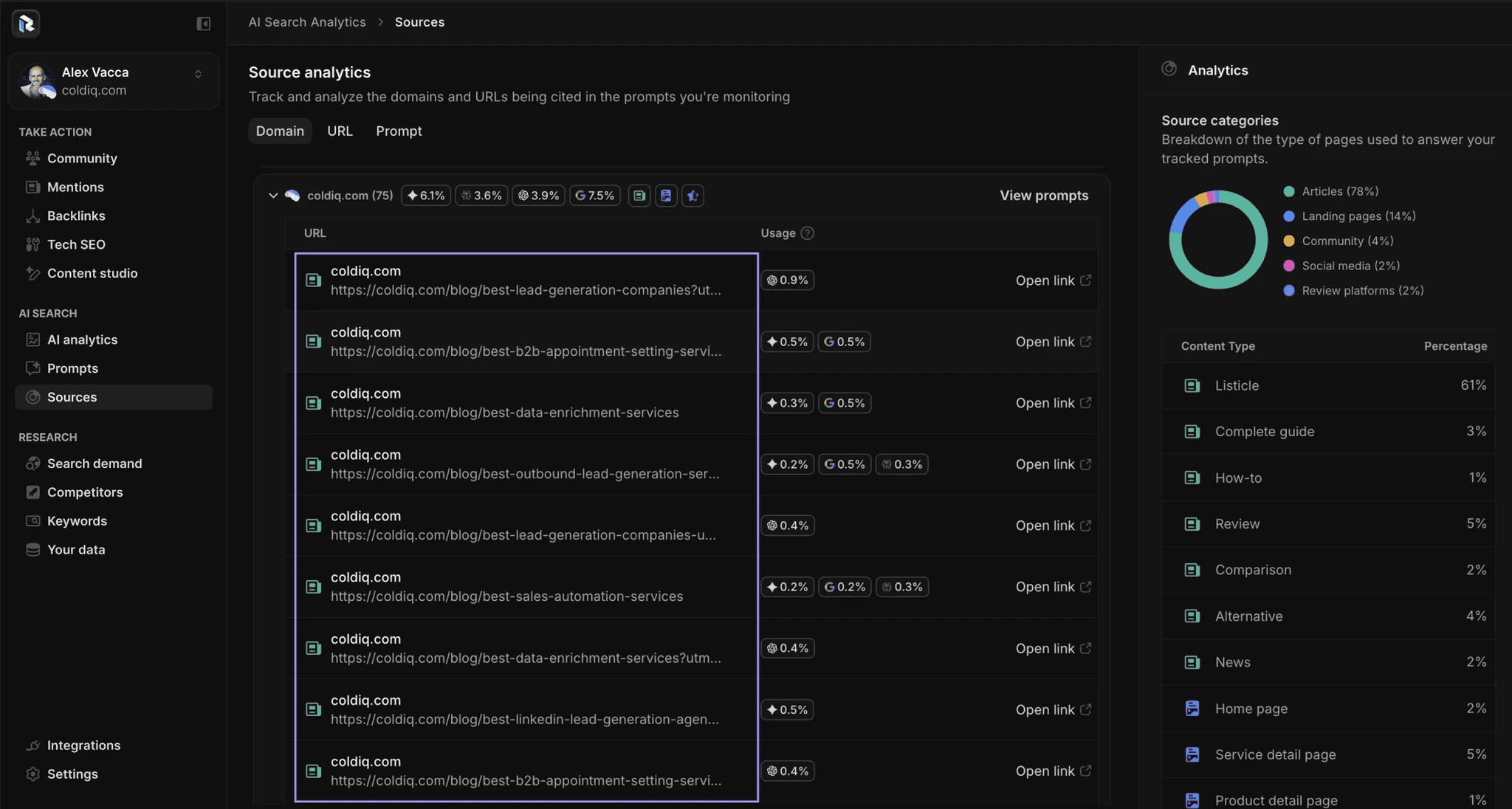
To check each pages are getting picked and used as a source
07
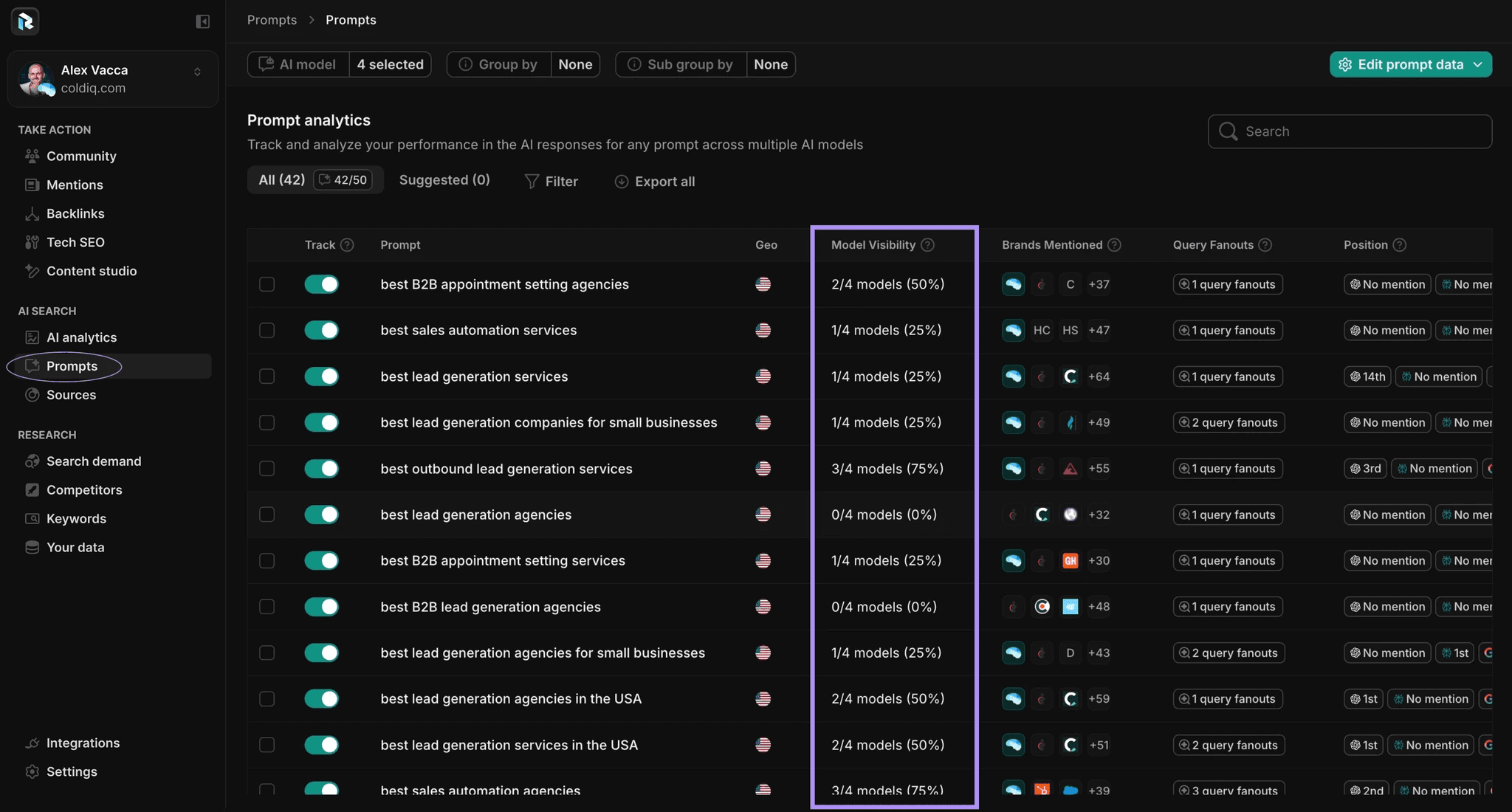
To analyze visibility per prompt
A note on attribution
A significant portion of the traffic and leads get attributed to direct.
Attribution in SEO and AI search is messy. Anyone claiming perfect tracking is either naive or trying to sell you something.
Here is how we handle it in practice. We track first click and last click in GA4, we look at assisted conversions, and we ask prospects during sales calls and onboarding where they first heard about the company and log it in the CRM. That is enough to guide decisions without overfitting the model.
What we can measure cleanly is the floor: Organic search plus LLM search drove 15,700 visitors (19.4% of total) and 362 conversions (10.3% of total).
What we cannot measure cleanly, but is very likely real, is the downstream impact on direct and branded traffic. Buyers discover you through an AI recommendation or a high intent search result, then come back later by typing the URL or Googling the brand name. That shows up as direct or branded, not “AI search”.
In ColdIQ’s case, direct traffic grew 93% over the same period (46,153 vs 23,826). We do not claim all of that is caused by SEO and AI search, especially given their high performing LinkedIn and outbound engine contributing a significant part to it. But paired with the jump in high intent visibility and citations, it is a strong signal that SEO and AI search were driving meaningful incremental awareness that later converted through direct and branded return visits.
So we present both: Strict attribution is the floor. Influenced attribution is the realistic picture.
Methodology & Caveats
Extrapolation method: Channel traffic share applied proportionally to total close won contract value. Assumes all traffic sources contribute equally to revenue per visitor.
Revenue values represent total contract value signed, not ARR or cash collected.
"Influenced" attribution in Usermaven means the channel appeared somewhere in the visitor journey - one deal may be counted across multiple channels.
These are estimates, not exact measurements. The actual influence could be higher or lower.
The approach
We did not treat this as an SEO content project. We treated it as a buyer journey and evaluation problem across Google and AI platforms.
The work followed this loop:
Find the highest intent demand across search and AI prompts
Extract what wins today and why
Turn expert knowledge into content and page changes that outperform
Track what moved, then repeat
Search demand research and prompt discovery
Finding what matters
We started by mapping ColdIQ's buyer journey and identifying the searches that happen at each stage - from problem-aware to solution-aware to vendor evaluation.
Most agencies start with easy wins: long-tail keywords, low competition queries. We did the opposite. We identified the highest-value, most competitive prompts first - the exact searches buyers use when they're ready to evaluate and shortlist.
Techniques used:
Interviewed ColdIQ’s team to understand ICP, pain points, use cases, and how buyers describe the problem in real life
Used our internal AI agents to analyze thousands of keywords and prompt variations across the buyer journey
Pulled real questions from communities and review sites where buyers compare vendors
Validated with search volume and demand proxies so we were not guessing what mattered
Mapped topics by intent and funnel stage so content had a clear job to do
Prioritization criteria:
Intent signal strength (is this a buyer or a browser?)
Current competitive gap (are we invisible where competitors rank?)
Content feasibility (can we create something better than what exists?)
AI citation potential (is this prompt type being answered by AI with sources?)
Brand visibility (is this prompt triggering brand mentions or only educational insights?)
Output: A prioritized roadmap of target pages and prompt clusters, ranked by expected impact on pipeline, plus clear guidance on what each page needed to win in both blue links and AI answers.
Unlocking programmatic product pages with data-driven insights + technical SEO & AEO improvements. Finding what matters
ColdIQ already had a large library of programmatic tool pages and directories. The content quality was strong, but parts of the site were not set up to be crawled, indexed, and reused as sources by search engines and AI systems.
We did a comprehensive technical audit to identify what was blocking ColdIQ's existing content from being properly crawled and indexed.
You can create the best content in the world, but if your pages aren’t discoverable, all your effort goes to waste.
This is why this technical SEO is one of the first steps in our AISO methodology.
And that was the moment where we found our first golden nuggets.
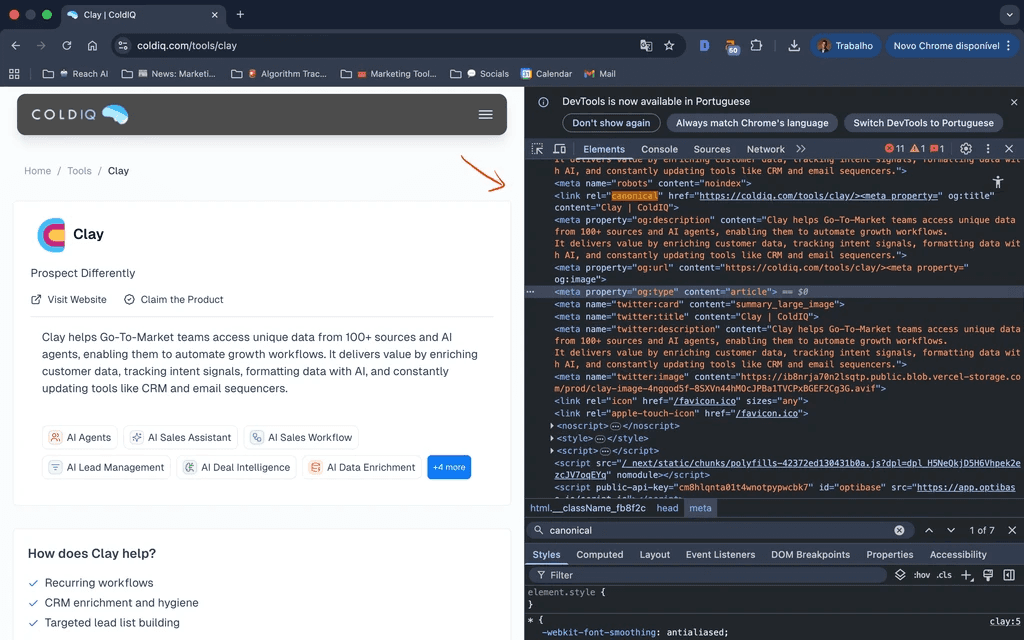
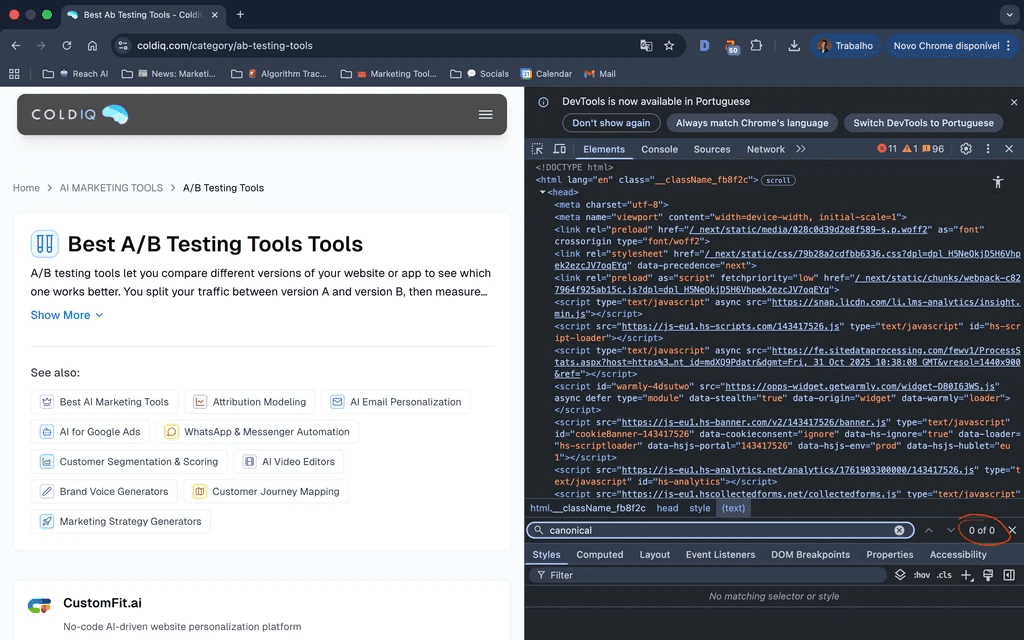
We identified pages with broken or missing canonicals, something that was confusing the crawlers about which pages to prioritize in search. In practice, for all the pages we want to index, we must use self-referencing canonicals - something that was not happening. We fixed that.
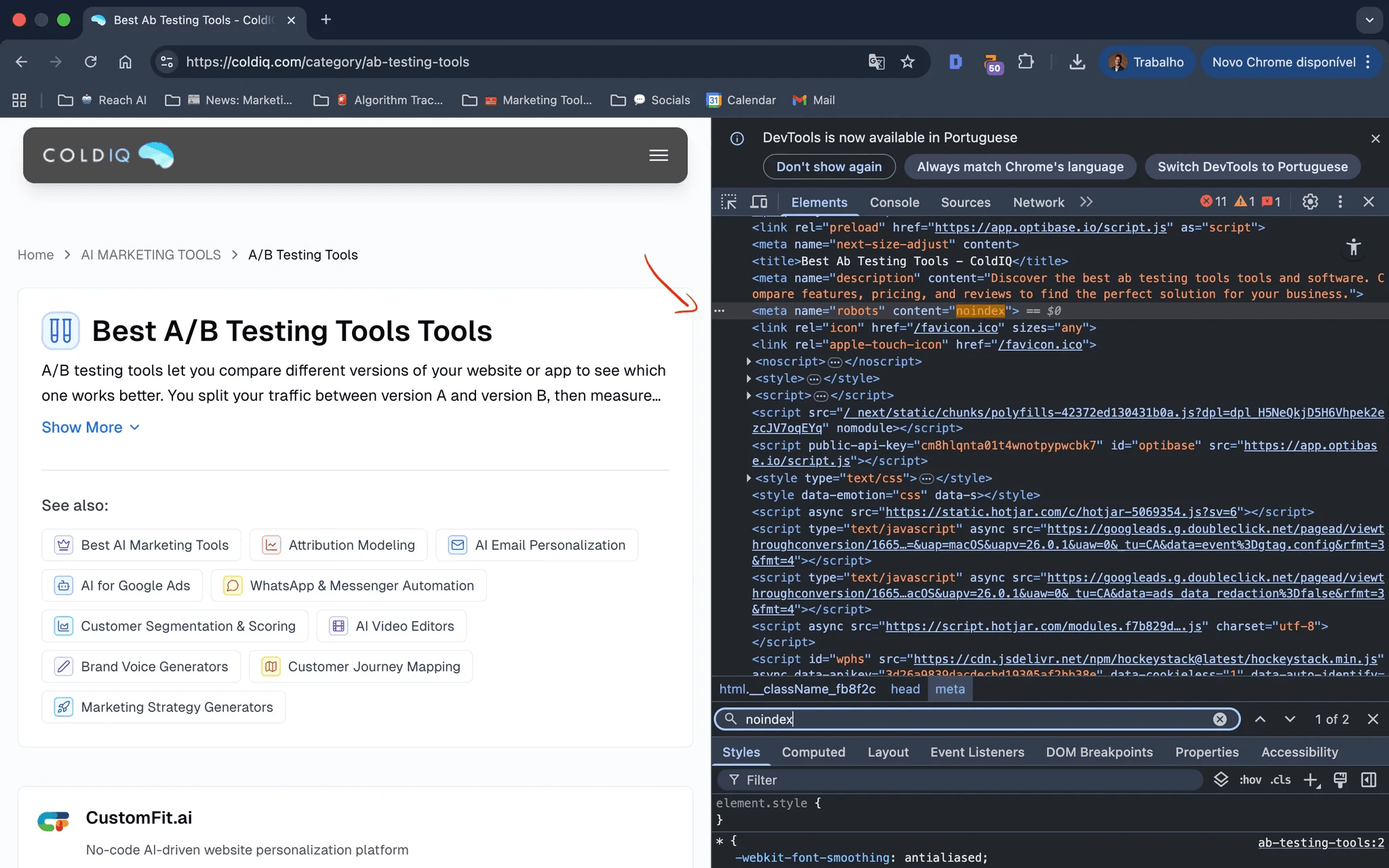
Another technical error that we found was regarding meta robots. A lot of these pages had noindex tags. Our customer was aware of most of these. The main reason was to prevent cannibalization between similar pages.
We analyzed the whole website and the cannibalization risks between pages. Using Google Search Console and our internal AI agents, we analyzed thousands of pages at a time along with the keywords they were ranking for.
In practice, if more than one page is attempting to rank for the same search queries, this creates a risk of keyword cannibalization. However, pages with unique content that target their own search intent do not present an issue and can be safely indexed.
In this ColdIQ’s case, the page similarity was very low, so we removed the indexing blockers.
This optimization allowed this set of programmatic pages to be indexed by Google and Bing (yes, Bing is important for ChatGPT). Since LLMs pull real-time information from these search engines, it’s important to ensure your landing pages can be found.
We also had some work to do regarding on-page elements. That's why we worked closely with ColdIQ to include strategic keywords on meta titles, meta descriptions, H1s, and other placements.
Right now, we’re working with ColdIQ to establish the templates for the Best {Tool} Alternatives (Feature & Pricing Comparison) pages making sure they are optimized to rank for the keywords & prompts we identified in the search demand research and we expect significant results from these in the coming months as well.
We’ll share another update on these results in a couple of months from now.
Getting cited and recommended in the prompts that matter for the buyer journey
Fixing toolkit pages improved baseline visibility, but it would not make ColdIQ show up in the moments that matter most, when buyers are researching agencies, comparing options, and building a shortlist inside Google and AI tools.
So we built a strategy around one goal: teach the market and the models what ColdIQ is actually best at, using evidence that holds up during evaluation.
Subject matter expert interviews as the foundation.
We ran regular interviews with ColdIQ’s subject matter experts, including Loïc, Alex, and Eugene, and we digested the insights they had already produced across LinkedIn posts, internal docs, and prior content.
That gave us two things most SEO programs miss:
Real expertise that buyers trust, which AI systems are more likely to repeat and cite.
Faster content production without sacrificing depth, because we were turning existing knowledge into structured content instead of starting from scratch.
This is also where Reach’s unfair advantage shows up. Our internal AI agents and platform do the heavy research and pattern detection across prompts, rankings, competitors, and thousands of pages. Then experts turn that into a plan and execute with tight quality control.
Prompt and SERP reverse engineering to remove guesswork
In parallel, we ran a full AISO audit and competitor research to find gaps in content pillars, missing brand mentions, and the communities and third party domains influencing AI answers.
Then, for each target prompt cluster, our AI agents analyzed outputs per model, including:
Which sources are being cited
How the answers are structured
What patterns correlate with being recommended
Which competitor pages and domains are winning today and why
That reverse engineering is what turns “we should show up in AI” into a concrete plan for what to publish, what to update, and what external signals to build.
From there, we executed across three reinforcement loops.
Teach the narrative on owned content Owned content is where we can control the positioning and make it repeatable.
ColdIQ already had clear advantages that were working in sales and on LinkedIn. The job was to turn those same USPs into structured content that ranks, converts, and gets reused inside AI answers, so the AI response becomes a consistent sales person for them when buyers are researching and comparing options.
That means publishing and refreshing pages that make three things obvious within seconds:
What ColdIQ does and who it is for
What pain it solves and the outcomes it drives
Why it wins versus other agencies and alternatives
We then structure the content so AI systems can safely reuse it. Clear definitions, explicit comparisons, front loaded answers, proof points, and scannable sections that map to the way buyers ask questions during evaluation.
To do this without hallucinations or generic output, we train our internal content agents with customer specific inputs. We worked closely with ColdIQ’s team to gather the raw material and guardrails, including brand voice, writing guidelines, service definitions, positioning, differentiators, examples, and the internal knowledge their team already had across docs and past content.
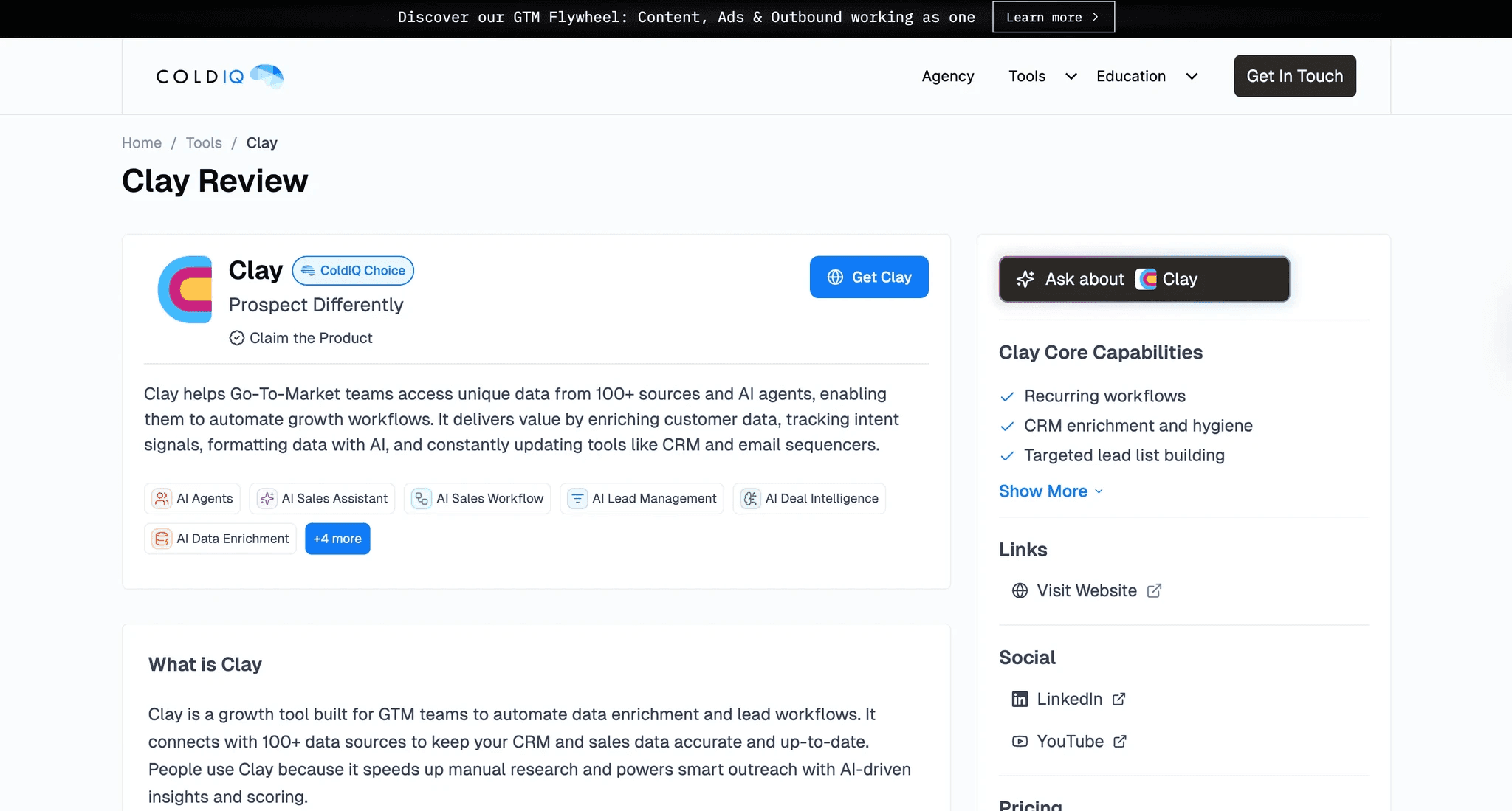
Here are some examples of the best pieces of content we produced during the engagement:
Third-party mentions In AI search, what others say about your brand and services has a significant impact - not only on the number of brand mentions but also on the sentiment and attributes associated with them. LLMs tend to rely on unbiased, third-party sources rather than solely on information provided by brands. This is where our AI agents play a critical role. They scrape results and cited sources from target prompts, identify which third-party domains influence LLM responses and guide you how to reach out to whom. Using this analysis, we were able to determine high-value partners to attract positive mentions for ColdIQ.
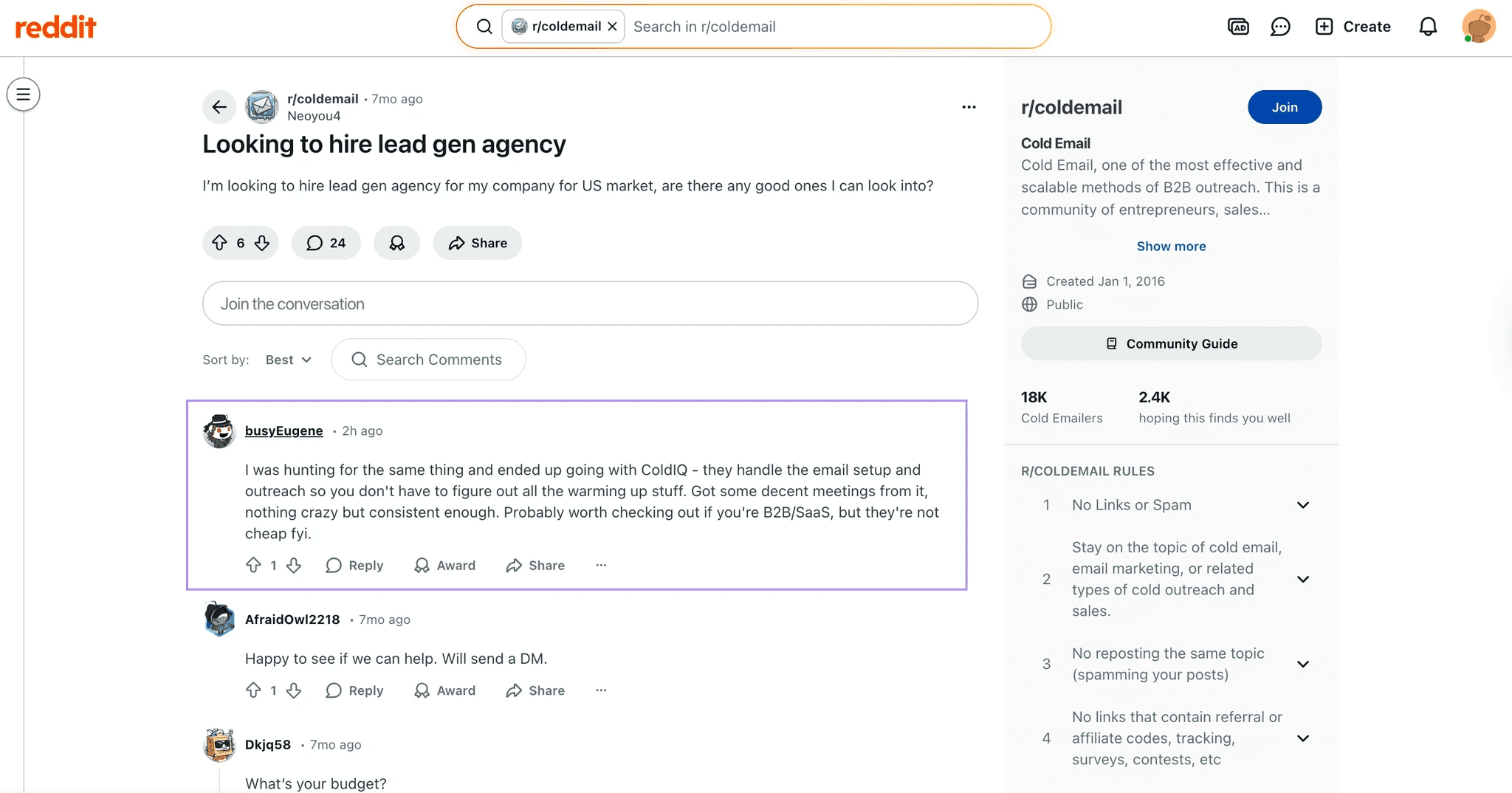
Community engagement When we analyzed the sources most frequently cited by LLMs for ColdIQ’s target prompts, community platforms like Reddit emerged as particularly influential. This is justified by the fact that these AI platforms highly value authentic content based on real user experiences.
We identified strategic Reddit posts and subreddits to engage with, sharing positive feedback about ColdIQ’s services in a natural, non-promotional way - without writing love letters to the brand. Additionally, we started conversations from scratch on our end to shape the AI’s understanding by associating specific attributes with ColdIQ.
Long-Tail coverage & scaling High-intent, competitive keywords drive the biggest impact per page. But long-tail coverage builds the moat.
Sources for long-tail variations:
Questions from ColdIQ sales calls and customer interviews
Reddit and Quora threads in relevant communities
Competitor page structures and FAQ sections
AI outputs themselves (what questions do ChatGPT and Perplexity answer in this category?)
What we've built so far:
FAQ sections added to existing high-performing pages, sourced from real buyer questions
Supplementary content for specific sub-queries identified in research
Monitoring to identify new long-tail opportunities as they emerge
Content revamp alerts, to keep top performing pages fresh and updated
This is the compounding layer. Each piece of long-tail content adds incremental visibility and reinforces topical authority.
Final thoughts
These results were only possible because we were amplifying and optimizing the existing content engine, brand and positioning that ColdIQ built over the years.
We have other customers where we’re building everything from scratch, and despite being able to also achieve significant results, they pale in comparison to these ones.
SEO and AI search became their #1 traffic source - despite years of building elite LinkedIn presence with 250k+ followers across their team.
This engagement has been running for 4 months. The results are already significant. And they compound from here.
Our next big focus will be to leverage traffic data to increase impact of conversion experiments. While traffic growth looked promising, the end goal for ColdIQ is revenue. As website traffic increases, so do opportunities to convert that traffic into subscribers.
Reach and ColdIQ have now turned their attention to conversion by optimizing categories that had high revenue potential, meaning a combination of strong traffic volume and strong conversion rates. These categories became our upcoming focus areas for on-going experimentation for both content and growth design.
Disclaimers
No Performance Guarantees
Everything in this case study reflects real work and real results for ColdIQ in the time window stated. But nothing here should be taken as a promise, guarantee, or warranty of outcomes for any other company.
Performance in SEO and AI search depends on many factors outside our control, including your market, competition, starting baseline, product and positioning, site quality, content execution, and the fact that AI search surfaces and ranking systems change constantly. Any numbers referenced here are specific to ColdIQ’s context and are not predictive.
We also strongly recommend implementing search and AI search work with qualified practitioners. Poor implementation can lead to wasted spend, slow progress, indexing issues, or misleading measurement.
Confidentiality and usage rights
This case study is Reach’s intellectual property. If you are reading a draft version shared for review, it is provided for private, evaluative purposes only.
By receiving this document, you agree to:
Keep it confidential and not distribute, reproduce, publish, or share it in whole or in part without explicit written permission.
Not share it with third parties unless we explicitly approve it.
Not copy or attempt to replicate the methodology, templates, or systems described without the right context and professional support.
We reserve all rights to the content, structure, and frameworks included in this case study. Unauthorized use or redistribution is prohibited.
Ready to turn search into your best performing growth channel?
Schedule a 30-minute call with Reach to walk you through the tactics we used to turn SEO and AI search into a compounding channel for ColdIQ, Indie Campers, Fidelidade, and more, and map out what it would look like for your company.
Ready to turn search into your best performing growth channel?
Schedule a 30-minute call with Reach to walk you through the tactics we used to turn SEO and AI search into a compounding channel for ColdIQ, Indie Campers, Fidelidade, and more, and map out what it would look like for your company.
Ready to turn search into your best performing growth channel?
Schedule a 30-minute call with Reach to walk you through the tactics we used to turn SEO and AI search into a compounding channel for ColdIQ, Indie Campers, Fidelidade, and more, and map out what it would look like for your company.