
How to build a top-tier website that stands out and actually converts in 2026
I just spent weeks obsessing over a website most founders would have shipped in 2 days. Here's why, and exactly how we built it.

I just spent weeks obsessing over a website most founders would have shipped in 2 days.
Here's why, and exactly how we built it. (Quick credit where it's due: every visual decision on the new usereach.ai came out of working closely with Alex, our product designer, who actually built it.)
In a world where everyone can vibe-code a website, generate a product, and pump out content with AI in a few hours, volume is no longer how you win. When everything becomes noise, attention becomes the scarcest resource. And the only way to capture attention is with quality, craft, and intention.
This is one of my strongest convictions: in 2026 and beyond, quality is going to be one of the most powerful competitive advantages you have left.
When we sat down to relaunch usereach.ai, we made a decision: we were not going to ship anything that looked like every other AI company out there. Every section, every line, every pixel had to earn its place.
What follows is the breakdown of every key decision we made, why we made it, and the principle behind it. If you're a founder, marketer, or operator thinking about how to build a website that earns trust and converts in the AI era, this is for you.
1. Why volume is dead in 2026
Anyone can spin up a website with Lovable or v0 in 10 minutes. Anyone can generate 50 blog posts with Claude in an afternoon. Anyone can ship a "product" that's really just three API calls stitched together.
So if everyone can produce volume, volume is no longer a competitive moat.
What is a moat? Quality. Craft. Care. Things that are slow, hard, and expensive to fake.
Your website and the content you produce represent your brand. They're what you'll be remembered for. So the bar can't be "good enough to ship." The bar has to be "memorable enough to be talked about."
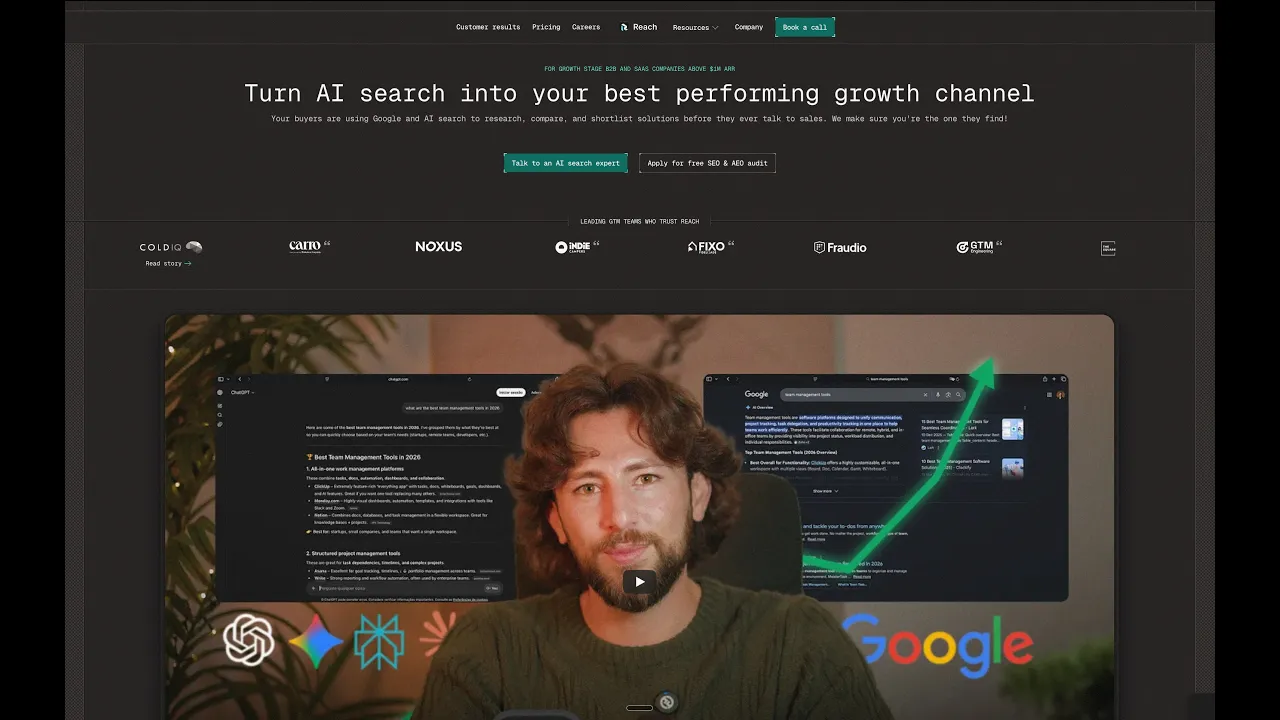
The first thing you'll notice on usereach.ai is the look and feel. Every color, every pattern, every visual element is unique to our brand. No template under the hood. Nothing borrowed from the same five SaaS UI kits everyone else is using.
This matters because your brand needs to be memorable. When someone sees a Reach asset out in the wild, they should recognize it instantly, even before they see the logo.
Your brand is what people remember. If your website looks like everyone else's, you're invisible.
2. Lead with who you're for, not what makes you different
In our hero section, we clearly explain three things: who we're for, the outcome we deliver, and what we do. We do not lead with our differentiation.
This is intentional.
The first thing a visitor needs to figure out is whether they're in the right place. If you immediately start explaining what makes you different from your competitors, you're skipping a step. You're assuming they already know they need a solution like yours.
Lead with who and what. Save the why for later, once they're already invested.
The order of operations on a homepage matters more than the copy itself.
3. Real testimonials, immediately
Inspired by Clay's website, we put real customer stories and testimonials immediately after the hero. We're very specific about the results.
You can drill down and read the full case studies. For example, our ColdIQ case study shows exactly how much signed contract value (real revenue) was driven and attributed to SEO and AI search. We have:
A video of Eugene, the fractional Head of Content at ColdIQ, walking through the results
Screenshots from Search Console and Google Analytics
A written testimonial from Alex Vacca, the co-founder of ColdIQ
Multiple layers of proof. Not one testimonial, not five quotes. Layered evidence from different angles.
And the reason this matters so much is that these are the things you cannot vibe-code. Real customer proof requires real customer results. That requires real delivery. That requires real work over a long period of time.
Most companies skip this step because it's hard. That's exactly why it's a moat.
Real customer proof is the one thing your competitors can't fake. Invest in it earlier than feels comfortable.
4. Put your face on the homepage
Right after the testimonials, there's a 3-minute video of me explaining what makes us different. This was non-negotiable for two reasons.
First, the face itself.
I'm putting my stamp of approval on this. I'm putting my reputation on the line. The people who know me know I've been in the game for a while (Techstars NYC '21, raised $3.6M for my last company). They know that if my face is on this, it's not just another AI-coded tool or another venture-backed startup riding a wave. It's something I'm willing to vouch for personally.
In a world where every website is starting to look AI-generated, putting your actual face on the homepage is one of the strongest credibility signals you can give.
Personal brand isn't a vanity play anymore. It's the new trust layer.
Second, the video itself is engaging.
As we walk through what makes us different and how we work, there are animations, fast-paced transitions, and visual hooks designed to keep attention. Three minutes of dense, high-energy storytelling beats ten minutes of static text every single time.
5. Pain points written from real sales calls
Immediately after the video, we go into the pain points we solve. Using the exact language we hear on sales calls every week.
Not generic copy. Not AI slop. The actual things people say to us when they pick up the phone:
"My competitors are showing up in AI search and I'm not."
"My agency is producing content but nothing is happening."
"My CAC is going up and I don't know why."
We also added a small interactive element to make this section more engaging. The combination of recognition ("that's literally me") and interactivity drives way more engagement than a static bullet list.
If your ICP doesn't see themselves immediately on your page, they're gone. Use their words, not yours.
6. Skip the methodology, go straight to results
After the pain points, we go straight to the results. We don't explain how we work. We don't show the product or the services. We just show real screenshots of real outcomes and let people click through to the full customer results page.
This sequencing matters.
Most companies make the mistake of explaining themselves before they've earned the right to. Buyers don't care about your methodology until they believe you can deliver. Show them you can deliver first. Then they'll be curious about how.
The customer results page itself is loaded with real testimonials, real evidence, and real screenshots. Again, hard to fake, hard to copy. That's the entire point.
7. Layered social proof, not stacked
After the results, we finally explain our approach: human SEO and AI search experts combined with the software and AI agents we've built. This combination is our unique angle and what gives us and our customers the differentiation we need to actually win in AI search, which is fundamentally a zero-sum game.
We then go back to more real testimonials.
Most websites stack all their testimonials in one big "social proof" section near the top. We do the opposite. We layer them throughout the page so that every time the reader is about to ask "but is this real?" the answer is right there.
One testimonial near the top is good. Multiple testimonials, spread strategically across the page, is how you actually build trust.
People need repetition to believe.
8. CTAs that give value, not ask for time
Even our final call to action is unique. Instead of "book a demo with us," our primary CTA is to apply for an in-depth audit for free.
We're giving value, not asking for it.
This is an important concept we apply across the entire company. We're now starting to invest more in our own SEO and AI search content (now that we have product-market fit and plenty of social proof). And as we ramp that up, we're building conversion funnels around permissionless value props: real things we give away for free that companies would normally pay for.
For example, we built a free AI SEO dashboard that companies would easily pay €1,000+ for us to implement. We give it away.
Why?
Because the free thing becomes a proxy for the quality and value you'd get from working with us. If we're giving this away for free, what do you think we deliver inside our paid services?
Everything we put out into the world, even the free stuff, has the same level of craft. It represents who we are.
9. Make your pricing public
Most companies in our space hide pricing behind a "contact sales" form. We share the actual pricing, exactly what we charge, what's included, what the engagement looks like step by step, and who we built it for.
This is not just about transparency. This is about AI search readiness.
Here's the thing most people are missing: when potential buyers do research today, they're not just going through your website. They're asking ChatGPT, Perplexity, and Google AI questions like:
"How much does Reach cost?"
"What's included in their packages?"
"Who do they work with?"
"How does Reach compare to [competitor]?"
If that information isn't publicly available and well-structured on your website, you're going to lose those buyers before they ever land on your homepage. The AI won't know how to answer the question, or worse, it'll guess wrong and recommend a competitor.
The new SEO is making sure your website is structured so AI can answer questions about you accurately. Pricing, deliverables, ICP, comparisons, FAQs. All of this needs to be public, structured, and detailed.
This is one of the biggest shifts happening right now and most companies are completely asleep at the wheel.
10. Every CTA is contextual
A few more details that often get overlooked:
The announcement bar. Wherever you are on the site, you can get to the case study with one click. The journey is always clear.
Contextual CTAs in the blog and resources. The CTAs across our blog pages and white papers are relevant to the content the reader is consuming. Generic "book a demo" CTAs underperform contextual ones every time. We're rolling this approach out across everything we publish (including this very post you're reading).
The book-a-call page. Even this page is unique. It has social proof, testimonials from real customers, but it doesn't take them away from the form. The goal of someone who already booked a call is to get them to actually fill out the form and book, not to send them off exploring more pages. Social proof here is there to increase conversion, not navigation.
Every CTA on your website should be contextual to the content around it. Generic CTAs are leaks in your funnel.
11. The principle behind every decision
If there's one principle that drove every single decision on this website, it's this:
You can't fake quality anymore.
Buyers can smell AI slop from a mile away. Templates feel like templates. Generic copy reads like generic copy. Stock photos look like stock photos. Hidden pricing feels like hidden pricing.
The only way to stand out in 2026 is to actually care about every detail, every word, every page, every pixel. Care about your customers enough to deliver real results so they'll vouch for you on camera. Care about your buyers enough to write copy in their own words. Care about your craft enough to design something memorable instead of borrowing from a template. Care about your brand enough to put your face on it.
This applies to your website. It applies to your content. It applies to your product. It applies to everything.
That's what we tried to do with usereach.ai. And it's exactly what we do for our customers every single day.